PUBLISHER: Mordor Intelligence | PRODUCT CODE: 2122412

PUBLISHER: Mordor Intelligence | PRODUCT CODE: 2122412
Rapeseed - Market Share Analysis, Industry Trends & Statistics, Growth Forecasts (2026 - 2031)
According to Mordor Intelligence, the rapeseed market size is expected to grow from USD 44.7 billion in 2025 to USD 46.61 billion in 2026 and is forecast to reach USD 57.53 billion by 2031 at 4.28% CAGR over 2026-2031.
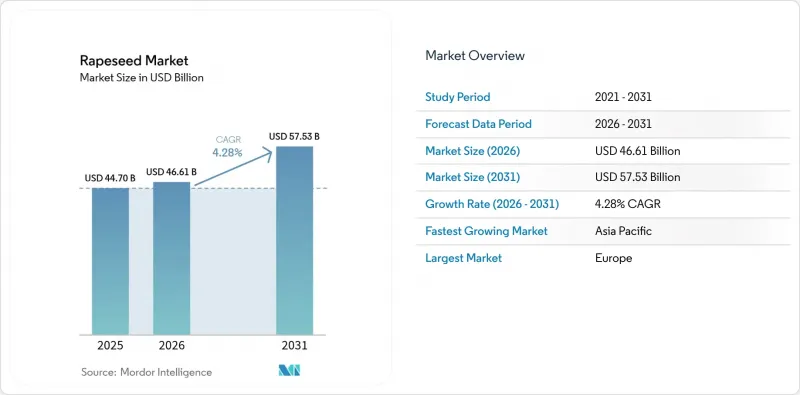
This report is Segmented by Geography (North America, Europe, Asia-Pacific, South America, Middle East, and Africa). The Study Includes Production Analysis (Volume), Consumption Analysis (Value and Volume), Export Analysis (Value and Volume), Import Analysis (Value and Volume), and Price Trend Analysis. The Market Forecasts are Provided in Terms of Value (USD) and Volume (Metric Tons).
Global Rapeseed Market Trends and Insights
Expansion of Bio-fuel Mandates
Bio-fuel policy acceleration is driving significant demand in the rapeseed market. Europe's Renewable Energy Directive III mandates a 14.5% greenhouse-gas intensity reduction in transport fuels by 2030, compelling refiners to increase their low-carbon feedstock procurement. In the United States, renewable diesel projects are expanding capacity to 1.3 million barrels of oil-equivalent per day by 2035, resulting in record rapeseed oil imports. The implementation of Indonesia's B35 mandate and Brazil's B15 target further increases the global vegetable-oil deficit, supporting rapeseed prices. European hydrotreated vegetable-oil demand is projected to increase by more than 400,000 metric tons in 2025, with rapeseed oil accounting for nearly half of this volume. The imposition of anti-dumping duties on Chinese biodiesel reinforces rapeseed's importance in meeting renewable-fuel requirements.
Rising Demand for Plant-Based Protein Meal
Rapeseed meal consumption is increasing across livestock, aquaculture, and human-nutrition sectors as an alternative protein source to soybean. The EU-27 consumed 13.75 million metric tons and China 12.54 million metric tons in 2024, demonstrating the growing global adoption of rapeseed. Danish research developments in glucosinolate removal have created a human-grade protein concentrate suitable for food ingredients. Research indicates that rapeseed protein's amino-acid profiles match soybean quality and provide superior benefits for non-ruminant animals. Through fermentation processes, antinutritional factors have been reduced, enabling 25% fishmeal replacement in salmon feed and reducing aquaculture production costs. The pharmaceutical industry's extraction of bioactive peptides from rapeseed meal has created additional revenue opportunities and strengthened market growth.
Climate-Driven Pest and Disease Volatility
An increase of one degree Celsius in winter temperatures reduces UK rapeseed yields by 113 kg per hectare, resulting in USD 21.61 million (GBP 16 million) in annual losses for producers. Higher winter temperatures enable multiple generations of aphids, increasing virus transmission risk and pesticide expenditure, thereby reducing profit margins. Research demonstrates that the combination of elevated CO2, heat, and ozone reduces omega-3 content by 45% and decreases oil yields by 58% in controlled trials, indicating potential quality deterioration under future climate conditions. The northward migration of pathogens, evidenced by clubroot detection beyond traditional boundaries in Scandinavia, necessitates enhanced biosecurity measures. While producers implement biological controls, resistant varieties, and precision monitoring to maintain yields, these measures increase operational complexity and costs, limiting rapeseed market expansion.
Other drivers and restraints analyzed in the detailed report include:
- Favorable Price Spread Versus Other Oilseed Crops
- Rapeseed Oil as Feedstock for Sustainable Aviation Fuel
- Acreage Competition from Other Oilseed Crops
For complete list of drivers and restraints, kindly check the Table Of Contents.
Complete Report Scope:
- By Geography (Production Analysis (Volume), Consumption Analysis (Volume and Value), Import Analysis (Volume and Value), Export Analysis (Volume and Value), and Price Trend Analysis)
- North America
- United States
- Canada
- Mexico
- Europe
- Russia
- Germany
- United Kingdom
- Italy
- Spain
- France
- Poland
- Ukraine
- Asia-Pacific
- China
- India
- Japan
- Australia
- South America
- Brazil
- Argentina
- Middle East
- United Arab Emirates
- Turkey
- Iran
- Africa
- South Africa
- Egypt
- North America
Geography Analysis
Europe maintains a 34.85% share of the global rapeseed market in 2025 despite increasing import requirements due to weather-affected yields. France demonstrates acreage recovery, and Germany reports incremental area expansion, while reduced seed counts persist due to insufficient vernalization periods. The United Kingdom recorded a 12% decrease in output year-on-year due to flea beetle infestations, while demand remains consistent for biodiesel and culinary oil production. Ukraine increased export volumes to Europe despite logistical constraints, with Australia providing a supplementary supply, demonstrating Europe's strategic diversification of import sources. The region's hydrotreated vegetable oil production requirements will increase by 400,000 metric tons in 2025, sustaining crusher utilization and market stability.
Asia-Pacific holds the fastest growth rate at 4.68% CAGR through 2031 due to policy support and agronomic improvements. China's implementation of high-yield hybrids across 7 million hectares could increase domestic self-sufficiency by 14.5 percentage points, reducing edible oil import expenses. India's expanding poultry sector, growing at 9% annually, drives increased meal consumption. Australia strengthens its position through record rapeseed plantings and new crushing facilities near Perth, serving both domestic bio-fuel needs and export markets. Japan focuses on specialty oil production, including non-GMO food-service varieties, while South Korea imports rapeseed meal for aquaculture feed, creating diverse regional market opportunities.
North America benefits from supportive policies and agricultural advantages. The United States reached 1 million hectares of rapeseed cultivation in 2024, with North Dakota contributing 830,000 hectares, supported by improved crop insurance and favorable pricing. Canadian processors crushed 5.93 million metric tons in 2024, producing 2.49 million metric tons of oil and 3.47 million metric tons of meal for export to Mexico, Japan, and the United States. New processing facilities in Kansas and Saskatchewan will add 1.5 million metric tons of crushing capacity, strengthening regional supply. South America maintains a limited market presence, with Argentina's production restricted by soybean prevalence, though Brazil's southern regions show potential through winter-rapeseed trials.
- The market estimate (ME) sheet in Excel format
- 3 months of analyst support
TABLE OF CONTENTS
1 Introduction
- 1.1 Study Assumptions and Market Definition
- 1.2 Scope of the Study
2 Research Methodology
3 Executive Summary
4 Market Landscape
- 4.1 Market Overview
- 4.2 Market Drivers
- 4.2.1 Expansion of Bio-Fuel Mandates
- 4.2.2 Rising Demand for Plant-Based Protein Meal
- 4.2.3 Favorable Price Spread Versus Other Oilseed Crops
- 4.2.4 High-Yield/Lower Erucic Cultivar Innovations
- 4.2.5 Rapeseed Oil as Feedstock for Sustainable Aviation Fuel
- 4.2.6 Carbon-Credit Revenue from Regenerative Rotations
- 4.3 Market Restraints
- 4.3.1 Climate-Driven Pest and Disease Volatility
- 4.3.2 Acreage Competition from Other Oilseed Crops
- 4.3.3 Sustainability Caps on Biodiesel
- 4.3.4 GMO-Threshold Trade-Policy Uncertainty
- 4.4 Value/Supply-Chain Analysis
- 4.5 Regulatory Landscape
- 4.6 Technological Outlook
- 4.7 PESTLE Analysis
5 Market Size and Growth Forecasts (Value and Volume)
- 5.1 By Geography (Production Analysis (Volume), Consumption Analysis (Volume and Value), Import Analysis (Volume and Value), Export Analysis (Volume and Value), and Price Trend Analysis)
- 5.1.1 North America
- 5.1.1.1 United States
- 5.1.1.2 Canada
- 5.1.1.3 Mexico
- 5.1.2 Europe
- 5.1.2.1 Russia
- 5.1.2.2 Germany
- 5.1.2.3 United Kingdom
- 5.1.2.4 Italy
- 5.1.2.5 Spain
- 5.1.2.6 France
- 5.1.2.7 Poland
- 5.1.2.8 Ukraine
- 5.1.3 Asia-Pacific
- 5.1.3.1 China
- 5.1.3.2 India
- 5.1.3.3 Japan
- 5.1.3.4 Australia
- 5.1.4 South America
- 5.1.4.1 Brazil
- 5.1.4.2 Argentina
- 5.1.5 Middle East
- 5.1.5.1 United Arab Emirates
- 5.1.5.2 Turkey
- 5.1.5.3 Iran
- 5.1.6 Africa
- 5.1.6.1 South Africa
- 5.1.6.2 Egypt
- 5.1.1 North America
6 Competitive Landscape
- 6.1 List of Stakeholders
7 Market Opportunities and Future Outlook

