PUBLISHER: Mordor Intelligence | PRODUCT CODE: 2122422

PUBLISHER: Mordor Intelligence | PRODUCT CODE: 2122422
High Speed Steel - Market Share Analysis, Industry Trends & Statistics, Growth Forecasts (2026 - 2031)
According to Mordor Intelligence, the high speed steel market size is estimated at USD 5.72 billion in 2026, and is expected to reach USD 8.74 billion by 2031, at a CAGR of 8.84% during the forecast period (2026-2031).
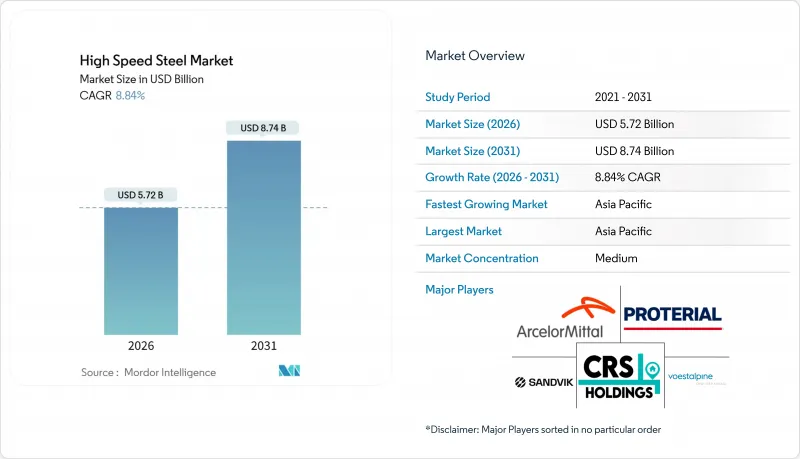
This report is Segmented by Type (Tungsten High Speed Steel, Molybdenum High Speed Steel, and Other Types), Product Type (Metal Cutting Tools, Cold Working Tools, and Other Product Types), End-User Industry (Automotive, Aerospace, Plastics, and Other End-User Industries), and Geography (Asia-Pacific, North America, Europe, and More). The Market Forecasts are Provided in Terms of Value (USD).
Global High Speed Steel Market Trends and Insights
Expansion of EV Driven Automotive Machining Demand
As battery-electric vehicle production surges, tolerance bands are tightening below 50 µm. This shift leads to quicker tool wear and a significant uptick in drill and end-mill turnover. In tandem, Tesla ramped up its cutting tool procurement during its plant expansions in Texas and Berlin. Meanwhile, the Chinese Ministry of Industry and Information Technology reported an increase in new-energy vehicle production. Such production volumes favor molybdenum grades, which maintain hardness at 550-600 °C without incurring the cobalt premium. This preference bolsters the continuous growth of the high-speed steel market.
Rising Aerospace Engine and Air Frame Tooling Needs
Boeing reported a commercial backlog in its 2025 filing, while Airbus announced it has orders pending delivery. The high-speed steel market remains resilient against a complete shift to carbide, as secondary drilling and reaming on titanium shells still depend on the toughness of high-speed steel. Pratt & Whitney, citing the heightened risk of carbide fractures under vibratory loads, continues to use high-speed steel form tools for finishing fir-tree slots.
Rapid Shift Toward Carbide and Ceramic Substitutes
In 2024 trials, ceramic inserts outlasted coated high-speed steel when milling Inconel 718. GE Aerospace's 2025 supplier guide has eliminated high-speed steel from many aerospace operations, mandating carbide or CBN for all primary cuts. Sandvik revealed growth in carbide insert sales in 2024, underscoring a notable shift in market share.
Other drivers and restraints analyzed in the detailed report include:
- Automation and Industry 4.0 Boosting Tool Change Frequency
- Powder Metallurgy High Speed Steel Grades Extending Tool Life
- Volatile Tungsten and Molybdenum Input Prices
For complete list of drivers and restraints, kindly check the Table Of Contents.
Segment Analysis
Molybdenum compositions held 37.16% of 2025 revenue, and the cohort is set for a 9.43% CAGR through 2031. This positions molybdenum grades as the fastest-growing segment in the high-speed steel market, outpacing all rival alloys. Buyers remain loyal, drawn by cost advantages over tungsten blends and consistent performance up to 600 °C. The powder-metallurgy processing technique, which disperses fine carbides, enhances toughness and grindability. While tungsten grades maintain a niche for temperatures exceeding 650 °C, their rising prices limit broader adoption. Meanwhile, cobalt-enriched alloys find their place in high-speed gear hobbing and broaching, where they offer added red-hardness for intermittent loads.
In response to price fluctuations in tungsten during 2024-2025, OEMs shifted their focus to molybdenum variants. Proterial's M42 cobalt-molybdenum product achieved high Rockwell C hardness, boasting a significant cost advantage over the tungsten-rich T15. Meanwhile, Chinese producer Tiangong recorded notable sales growth in molybdenum high-speed steel in 2024, predominantly catering to automotive tiers in China and India, solidifying its leadership in the high-speed steel arena.
Complete Report Scope:
- By Type
- Tungsten High Speed Steel
- Molybdenum High Speed Steel
- Other Types (Cobalt High-Speed Steel, Chromium High-Speed Steel, and Vanadium High-Speed Steel)
- By Product Type
- Metal Cutting Tools
- Cold Working Tools
- Other Product Types (Milling Tools, Drilling Tools, etc.)
- By End-user Industry
- Automotive
- Aerospace
- Plastics
- Other End-user Industries (Mining, Manufacturing, Tool Making, etc)
- Geography
- Asia-Pacific
- China
- India
- Japan
- South Korea
- Malaysia
- Thailand
- Indonesia
- Vietnam
- Rest of Asia-Pacific
- North America
- United States
- Canada
- Mexico
- Europe
- Germany
- United Kingdom
- France
- Italy
- Spain
- NORDIC Countries
- Turkey
- Russia
- Rest of Europe
- South America
- Brazil
- Argentina
- Colombia
- Rest of South America
- Middle-East and Africa
- Saudi Arabia
- South Africa
- Nigeria
- Qatar
- Egypt
- United Arab Emirates
- Rest of Middle-East and Africa
- Asia-Pacific
Geography Analysis
Asia-Pacific generated 64.28% of global revenue in 2025 and is forecast to grow at a 9.34% CAGR to 2031. As a result, the high-speed steel market in Asia-Pacific is set to outpace all other regions in growth. In 2024, China, primarily from its Jiangsu and Zhejiang hubs, was responsible for a substantial portion of global cutting tool production. Meanwhile, India drew in considerable foreign manufacturing investments in 2025, directing a significant portion of these orders to local tool suppliers. Japan continues to lead in precision, and South Korea's machine-tool output surged in 2025, driven by investments in semiconductors and automotive sectors, further solidifying the region's dominance.
North America and Europe together accounted for a notable share of the 2025 market value. Boeing's substantial backlog, alongside Pratt & Whitney's turbine initiatives, underscores the stronghold of high-speed steel in secondary aerospace applications. In 2025, Germany boasted a robust machine-tool output, with a notable uptick in cutting-tool consumption. The EU's Critical Raw Materials Act, aimed at boosting tungsten recycling, saw voestalpine successfully recover a significant amount from scrap in 2024, bolstering the region's supply chains.
South America, along with the Middle East and Africa, accounted for the remaining share of the market. In 2025, Vale invested heavily in upgrading mine equipment, which prominently featured machining centers utilizing high-speed steel tooling. Saudi Arabia's Public Investment Fund, in 2025, allocated substantial resources towards advanced manufacturing projects, including a joint venture eyeing domestic high-speed steel production. Despite facing import competition, South Africa's vehicle production in 2025 bolstered the demand for local cutting tools.
- ArcelorMittal
- CRS Holdings, LLC
- ERASTEEL
- Friedr. Lohmann GmbH
- Graphite India Limited
- Hudson Tool Steel
- Jiangsu Tiangong Tools Co., Ltd.
- NIPPON KOSHUHA STEEL CO,. LTD.
- Proterial, Ltd.
- Sandvik AB
- voestalpine BOHLER Edelstahl GmbH & Co KG
Additional Benefits:
- The market estimate (ME) sheet in Excel format
- 3 months of analyst support
TABLE OF CONTENTS
1 Introduction
- 1.1 Study Assumptions and Market Definition
- 1.2 Scope of the Study
2 Research Methodology
3 Executive Summary
4 Market Landscape
- 4.1 Market Overview
- 4.2 Market Drivers
- 4.2.1 Expansion of EV-driven automotive machining demand
- 4.2.2 Rising aerospace engine and air-frame tooling needs
- 4.2.3 Automation and Industry 4.0 boosting tool-change frequency
- 4.2.4 Powder-metallurgy HSS grades extending tool life
- 4.2.5 Circular-economy push for tungsten recycling
- 4.3 Market Restraints
- 4.3.1 Rapid shift toward carbide and ceramic substitutes
- 4.3.2 Volatile tungsten and molybdenum input prices
- 4.3.3 3-D-printed carbide tools shortening HSS life-cycle
- 4.4 Value Chain Analysis
- 4.5 Porter's Five Forces
- 4.5.1 Bargaining Power of Suppliers
- 4.5.2 Bargaining Power of Buyers
- 4.5.3 Threat of New Entrants
- 4.5.4 Threat of Substitutes
- 4.5.5 Degree of Competition
5 Market Size and Growth Forecasts (Value)
- 5.1 By Type
- 5.1.1 Tungsten High Speed Steel
- 5.1.2 Molybdenum High Speed Steel
- 5.1.3 Other Types (Cobalt High-Speed Steel, Chromium High-Speed Steel, and Vanadium High-Speed Steel)
- 5.2 By Product Type
- 5.2.1 Metal Cutting Tools
- 5.2.2 Cold Working Tools
- 5.2.3 Other Product Types (Milling Tools, Drilling Tools, etc.)
- 5.3 By End-user Industry
- 5.3.1 Automotive
- 5.3.2 Aerospace
- 5.3.3 Plastics
- 5.3.4 Other End-user Industries (Mining, Manufacturing, Tool Making, etc)
- 5.4 Geography
- 5.4.1 Asia-Pacific
- 5.4.1.1 China
- 5.4.1.2 India
- 5.4.1.3 Japan
- 5.4.1.4 South Korea
- 5.4.1.5 Malaysia
- 5.4.1.6 Thailand
- 5.4.1.7 Indonesia
- 5.4.1.8 Vietnam
- 5.4.1.9 Rest of Asia-Pacific
- 5.4.2 North America
- 5.4.2.1 United States
- 5.4.2.2 Canada
- 5.4.2.3 Mexico
- 5.4.3 Europe
- 5.4.3.1 Germany
- 5.4.3.2 United Kingdom
- 5.4.3.3 France
- 5.4.3.4 Italy
- 5.4.3.5 Spain
- 5.4.3.6 NORDIC Countries
- 5.4.3.7 Turkey
- 5.4.3.8 Russia
- 5.4.3.9 Rest of Europe
- 5.4.4 South America
- 5.4.4.1 Brazil
- 5.4.4.2 Argentina
- 5.4.4.3 Colombia
- 5.4.4.4 Rest of South America
- 5.4.5 Middle-East and Africa
- 5.4.5.1 Saudi Arabia
- 5.4.5.2 South Africa
- 5.4.5.3 Nigeria
- 5.4.5.4 Qatar
- 5.4.5.5 Egypt
- 5.4.5.6 United Arab Emirates
- 5.4.5.7 Rest of Middle-East and Africa
- 5.4.1 Asia-Pacific
6 Competitive Landscape
- 6.1 Market Concentration
- 6.2 Strategic Moves
- 6.3 Market Share/Ranking Analysis
- 6.4 Company Profiles (includes Global level Overview, Market level overview, Core Segments, Financials as available, Strategic Information, Products and Services, Recent Developments)
- 6.4.1 ArcelorMittal
- 6.4.2 CRS Holdings, LLC
- 6.4.3 ERASTEEL
- 6.4.4 Friedr. Lohmann GmbH
- 6.4.5 Graphite India Limited
- 6.4.6 Hudson Tool Steel
- 6.4.7 Jiangsu Tiangong Tools Co., Ltd.
- 6.4.8 NIPPON KOSHUHA STEEL CO,. LTD.
- 6.4.9 Proterial, Ltd.
- 6.4.10 Sandvik AB
- 6.4.11 voestalpine BOHLER Edelstahl GmbH & Co KG
7 Market Opportunities and Future Outlook
- 7.1 White-space and Unmet-Need Assessment

