PUBLISHER: Mordor Intelligence | PRODUCT CODE: 2122424

PUBLISHER: Mordor Intelligence | PRODUCT CODE: 2122424
Metal Matrix Composites - Market Share Analysis, Industry Trends & Statistics, Growth Forecasts (2026 - 2031)
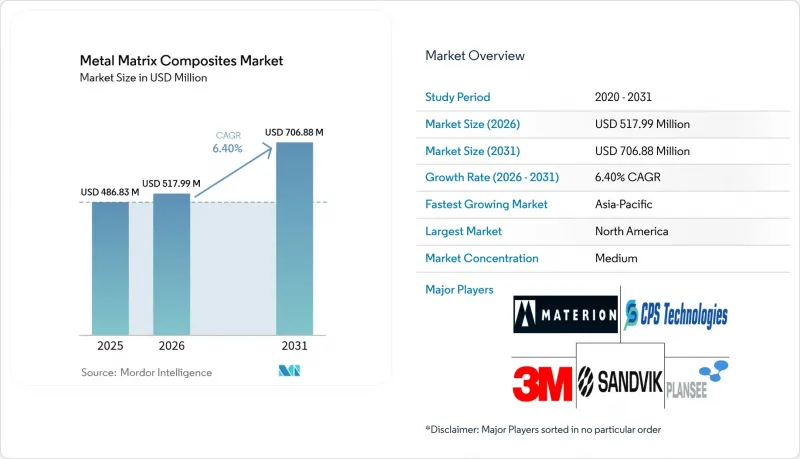
According to Mordor Intelligence, the metal matrix composites market size is expected to grow from USD 486.83 million in 2025 to USD 517.99 million in 2026 and is forecast to reach USD 706.88 million by 2031 at 6.40% CAGR over 2026-2031.
This report is Segmented by Type (Aluminium, Refractory, and Other Types), Fillers (Silicon Carbide, Aluminium Oxide, and Other Fillers), End-User Industry (Automotive and Locomotive, Aerospace and Defence, and Other End-User Industries), and Geography (Asia-Pacific, North America, Europe, South America, and Middle East and Africa). The Market Forecasts are Provided in Terms of Value (USD).
Global Metal Matrix Composites Market Trends and Insights
Increasing Demand for Lightweight Materials in Aerospace and Defense
Aerospace primes reduce structural weight to extend range and payload, prompting aluminum- and titanium-matrix composites in fuselage skins, missile bodies, and satellite panels. Hypersonic programs require skins that survive extreme thermal gradients, pushing refractory matrices into qualification pipelines. Defense contractors now specify metal matrix composites for electronic-warfare enclosures where mass savings deliver mission-relevant power density gains. ECSS and MIL-HDBK-17 standards govern test methods and facilitate certification, enabling faster insertion into flight hardware. Lockheed Martin's historical investment in SupremEX(TM) components underscores long-term commitment to composite metals.
Rapid EV-Led Need for Advanced Thermal-Management Materials
Fast-charging electric vehicles generate localized heat fluxes exceeding 100 W/cm2 around battery tabs and power modules. Silicon-carbide-reinforced aluminum spreads heat 40-60% better than conventional aluminum while maintaining battery-pack mass budgets. Diamond- and graphene-enhanced copper matrices emerge for inverter baseplates where coefficient-of-thermal-expansion matching mitigates solder fatigue. Automakers such as Tesla and BYD embed these composites into next-generation thermal interface architectures. Parallel roll-out of 5G macro cells intensifies cross-industry demand for identical heat-spreader solutions, multiplying order volumes for qualified suppliers.
Complex and Costly Fabrication Processes
Laser powder-bed fusion builds can cost 2-120 times more than comparable cast parts, restricting use to high-value applications. Stir-casting lines require precise temperature and atmosphere control, demanding capital-intensive furnaces and operator training. Non-destructive evaluation of porosity and reinforcement distribution adds inspection overhead, while ASTM D3552-24 compliance introduces incremental testing expenses. Smaller fabricators struggle to fund such infrastructure, limiting regional supply diversity and restraining the metal matrix composites market.
Other drivers and restraints analyzed in the detailed report include:
- Automotive Shift Toward SiC-Reinforced Al Brake and Power-Train Parts
- Superior Mechanical and Thermal Properties vs. Conventional Metals
- High Cost of Ceramic/Graphene Reinforcements
For complete list of drivers and restraints, kindly check the Table Of Contents.
Segment Analysis
Aluminum captured 45.55% of 2025 revenue, underscoring their synergy with existing aerospace and automotive qualification databases. The metal matrix composites market demonstrates sustained preference for aluminum because it combines lightweight attributes with thermal conductivity that exceeds steel by >=200%, enabling brake and heat-sink integration without severe tooling changes. Refractory, though smaller, are growing at a 7.36% CAGR; hypersonic vehicle skins must endure more than 1,000 °C boundary-layer temperatures that position molybdenum- or tungsten-based systems as frontrunners.
Additive-manufacturing toolpaths now embed graded reinforcements inside aluminum structures, allowing increased near-surface hardness while retaining ductile cores. ASTM certification protocols for aluminum composites further smooth aerospace approval pathways. Conversely, refractory systems face limited standardization, but novel laser-cladding approaches promise cost decline, hinting at eventual volume penetration that will diversify the metal matrix composites industry.
Complete Report Scope:
- By Type
- Aluminium
- Refractory
- Nickel
- Other Types
- By Fillers
- Silicon Carbide
- Aluminium Oxide
- Titanium Carbide
- Other Fillers
- By End-user Industry
- Automotive and Locomotive
- Aerospace and Defence
- Electrical and Electronics
- Industrial Machinery
- Other End-user Industries
- By Geography
- Asia-Pacific
- China
- India
- Japan
- South Korea
- ASEAN Countries
- Rest of Asia-Pacific
- North America
- United States
- Canada
- Mexico
- Europe
- Germany
- United Kingdom
- France
- Italy
- Russia
- NORDIC Countries
- Rest of Europe
- South America
- Brazil
- Argentina
- Rest of South America
- Middle East and Africa
- Saudi Arabia
- South Africa
- Rest of Middle East and Africa
- Asia-Pacific
Geography Analysis
North America controlled 32.40% of 2025 revenue because of its defense spending priorities and aerospace OEM clustering around the U.S. West Coast and Midwest. Domestic content rules in fighter and space programs secure local demand, while CHIPS Act incentives support composite heat-spreaders inside next-generation wafer fabs. Materion and Howmet run vertically integrated operations, mitigating reinforcement supply shocks and ensuring compliance with ITAR regulations.
Asia-Pacific leads growth with a 7.22% CAGR forecast to 2031 as China's aluminum value chain and cost-competitive silicon-carbide production shorten lead times for automotive brake suppliers. Japan's precision-machining sector scales composite housings for vehicle power modules, and South Korea integrates high-thermal-conductivity baseplates into its expanding battery plants. Regional free-trade agreements improve access to Australian bauxite and Vietnamese rare-earth projects, anchoring long-term feedstock security for the metal matrix composites market.
Europe situates between the two poles, leveraging strict emissions standards to drive composite part integration in premium cars and Airbus platforms. Germany's Tier-1 suppliers pioneer friction-stir-processed panels that satisfy REACH guidelines. Eastern-European machine shops explore composite metal foams for railcar crash-boxes, hinting at broader adoption. South American and Middle Eastern markets remain nascent yet possess bauxite and titanium reserves that could seed localized composite ecosystems post-2030.
- 3A Composites
- 3M
- ADMA Products, Inc.
- CPS Technologies
- Cymat Technologies Ltd.
- Denka Company Limited
- DWA Aluminum Composites USA, Inc.
- GKN Powder Metallurgy
- Materion Corporation
- Mitsubishi Materials Corporation
- MTC Powder Solutions AB
- Plansee SE
- Sandvik AB
- Sumitomo Electric Industries, Ltd.
- TISICS Ltd.
Additional Benefits:
- The market estimate (ME) sheet in Excel format
- 3 months of analyst support
TABLE OF CONTENTS
1 Introduction
- 1.1 Study Assumptions and Market Definition
- 1.2 Scope of the Study
2 Research Methodology
3 Executive Summary
4 Market Landscape
- 4.1 Market Overview
- 4.2 Market Drivers
- 4.2.1 Increasing Demand for Lightweight Materials in Aerospace and Defence
- 4.2.2 Rapid EV-Led Need for Advanced Thermal-Management Materials
- 4.2.3 Automotive Shift Toward Sic-Reinforced Al Brake and Power-Train Parts
- 4.2.4 Superior Mechanical and Thermal Properties Vs. Conventional Metals
- 4.2.5 Additive-Manufacturing Adoption for Complex MMC Heat Sinks
- 4.3 Market Restraints
- 4.3.1 Complex and Costly Fabrication Processes
- 4.3.2 High Cost of Ceramic/Graphene Reinforcements
- 4.3.3 Supply-Chain Scale and Standards Gaps
- 4.4 Value Chain Analysis
- 4.5 Technological Outlook
- 4.6 Porter's Five Forces
- 4.6.1 Bargaining Power of Suppliers
- 4.6.2 Bargaining Power of Buyers
- 4.6.3 Threat of New Entrants
- 4.6.4 Threat of Substitutes
- 4.6.5 Degree of Competition
5 Market Size and Growth Forecasts (Value)
- 5.1 By Type
- 5.1.1 Aluminium
- 5.1.2 Refractory
- 5.1.3 Nickel
- 5.1.4 Other Types
- 5.2 By Fillers
- 5.2.1 Silicon Carbide
- 5.2.2 Aluminium Oxide
- 5.2.3 Titanium Carbide
- 5.2.4 Other Fillers
- 5.3 By End-user Industry
- 5.3.1 Automotive and Locomotive
- 5.3.2 Aerospace and Defence
- 5.3.3 Electrical and Electronics
- 5.3.4 Industrial Machinery
- 5.3.5 Other End-user Industries
- 5.4 By Geography
- 5.4.1 Asia-Pacific
- 5.4.1.1 China
- 5.4.1.2 India
- 5.4.1.3 Japan
- 5.4.1.4 South Korea
- 5.4.1.5 ASEAN Countries
- 5.4.1.6 Rest of Asia-Pacific
- 5.4.2 North America
- 5.4.2.1 United States
- 5.4.2.2 Canada
- 5.4.2.3 Mexico
- 5.4.3 Europe
- 5.4.3.1 Germany
- 5.4.3.2 United Kingdom
- 5.4.3.3 France
- 5.4.3.4 Italy
- 5.4.3.5 Russia
- 5.4.3.6 NORDIC Countries
- 5.4.3.7 Rest of Europe
- 5.4.4 South America
- 5.4.4.1 Brazil
- 5.4.4.2 Argentina
- 5.4.4.3 Rest of South America
- 5.4.5 Middle East and Africa
- 5.4.5.1 Saudi Arabia
- 5.4.5.2 South Africa
- 5.4.5.3 Rest of Middle East and Africa
- 5.4.1 Asia-Pacific
6 Competitive Landscape
- 6.1 Market Concentration
- 6.2 Strategic Moves
- 6.3 Market Share/Ranking Analysis
- 6.4 Company Profiles (includes Global level Overview, Market level overview, Core Segments, Financials as available, Strategic Information, Market Rank/Share for key companies, Products and Services, and Recent Developments)
- 6.4.1 3A Composites
- 6.4.2 3M
- 6.4.3 ADMA Products, Inc.
- 6.4.4 CPS Technologies
- 6.4.5 Cymat Technologies Ltd.
- 6.4.6 Denka Company Limited
- 6.4.7 DWA Aluminum Composites USA, Inc.
- 6.4.8 GKN Powder Metallurgy
- 6.4.9 Materion Corporation
- 6.4.10 Mitsubishi Materials Corporation
- 6.4.11 MTC Powder Solutions AB
- 6.4.12 Plansee SE
- 6.4.13 Sandvik AB
- 6.4.14 Sumitomo Electric Industries, Ltd.
- 6.4.15 TISICS Ltd.
7 Market Opportunities and Future Outlook
- 7.1 White-space and Unmet-need Assessment

