PUBLISHER: Mordor Intelligence | PRODUCT CODE: 2122435

PUBLISHER: Mordor Intelligence | PRODUCT CODE: 2122435
Anti-Reflective Coatings - Market Share Analysis, Industry Trends & Statistics, Growth Forecasts (2026 - 2031)
According to Mordor Intelligence, the anti-reflective coatings market size was valued at USD 5.63 billion in 2025 and estimated to grow from USD 5.98 billion in 2026 to reach USD 8.09 billion by 2031, at a CAGR of 6.26% during the forecast period (2026-2031).
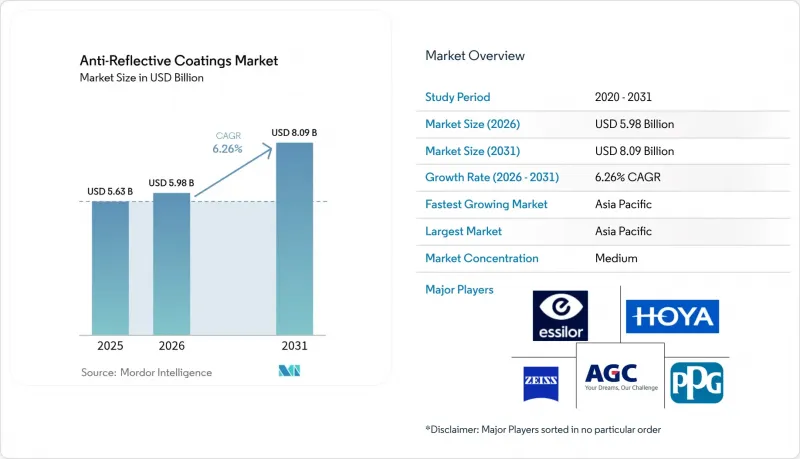
This report is Segmented by Deposition Method (Chemical Vapour Deposition, Electronic Beam Deposition, Sputtering, and Other Deposition Methods), Application (Semiconductors, Electronic Devices, Eyewear, Solar Panels, and More), and Geography (Asia-Pacific, North America, Europe, South America, and Middle East and Africa). The Market Forecasts are Provided in Terms of Value (USD).
Global Anti-Reflective Coatings Market Trends and Insights
AR/VR and Smart-Glass Adoption Driving Precision Optics Demand
Headset shipments reached 9.6 million units in 2024, and enterprise use cases, including training and remote collaboration, are broadening the addressable customer base. Optical stacks must now deliver average reflectance below 1% across the visible spectrum while maintaining color fidelity and scratch resistance. Zhejiang University researchers reported multilayer sol-gel stacks with a reflectance of less than 1% and a hardness exceeding 15 GPa, demonstrating durability suitable for consumer wearables. Coating houses capable of tuning layer thickness in sub-nanometer steps are winning premium contracts, because waveguide combiners and pancake lenses require angle-specific suppression of ghost images. As content providers optimize for spatial computing, headset OEMs specify broadband, low-scatter coatings that withstand perspiration, temperature cycling, and frequent cleaning, creating a sustained demand for high-performance anti-reflective formulations.
LiDAR Optics Enabling Autonomous-Vehicle Perception
Automotive LiDAR modules operating at 905 nm and 940 nm utilize low-reflectance transmit and receive optics to extend their detection ranges beyond 200 m. A Nature Communications study demonstrated that vertical-cavity lasers can reach a peak output of 400 W with six-junction anti-reflective stacks that have survived 6,000 hours of high-temperature testing. As system prices drop toward the USD 100 target, Tier 1 suppliers demand coatings that boost signal-to-noise while passing IATF 16949 audits. Qualification hinges on sustaining performance between -40 °C and +105 °C, as well as withstanding road-salt corrosion. Vendors that can document low lot-to-lot variation in refractive index and thickness uniformity gain preferred-supplier status during platform rollouts scheduled for 2026-2027.
High Production and Equipment Cost Constraining Entry
Electron-beam evaporators, magnetron sputtering chambers, and plasma reactors each cost upwards of USD 1 million and require Class 100 cleanroom facilities. Smaller coaters struggle to amortize capital outlays, driving consolidation around mega-fabs in China, South Korea, and the United States. Scheduled maintenance interrupts throughput, and skilled technicians command premium wages, further elevating fixed costs. The economics deter geographic diversification even when OEMs request local supply in Southeast Asia or Latin America, reinforcing the dominance of incumbent hubs.
Other drivers and restraints analyzed in the detailed report include:
- Solar PV Installations Amplifying Efficiency Gains
- Surge in High-Resolution Consumer Displays
- REACH and Fluorochemicals Regulation Forcing Reformulation
For complete list of drivers and restraints, kindly check the Table Of Contents.
Segment Analysis
Sputtering posted a 6.47% CAGR between 2026 and 2031, faster than the overall anti-reflective coatings market. Magnetron architectures deposit dense films at >10 nm per minute across Gen 8.7 glass, cutting takt time for display and photovoltaic fabs. The anti-reflective coatings market share for chemical vapor deposition remained 29.10% in 2025 because its superior conformality is indispensable for fiber-optic preforms and MEMS cavities. Hybrid production lines now combine plasma-enhanced chemical-vapor deposition for coverage on 3-D geometries with sputter sources for planar panels, maximizing equipment utilization. Ion-beam sputtering, though slower, enables atomic-scale smoothness essential for reticle blanks used in 193-nm lithography, where <0.2% residual reflectance prevents standing-wave defects. Process selection increasingly hinges on substrate thermal budget and whether plasma exposure is acceptable, prompting fabs to dual-source recipes to hedge risk.
Sputtering's expansion is also driven by flexible-display programs that specify 300 mm-wide rolls of polymer film rather than rigid glass. Rotatable targets in roll-to-roll sputtering lines enable the switch in composition mid-run, allowing for graded-index stacks that balance broadband performance with mechanical resilience. Conversely, chemical vapor deposition gains share in automotive lidar lenses molded from heat-sensitive polymers, where plasma bombardment would warp the optical figure. Capital-equipment vendors forecast sputter cathode upgrades that increase power density by 15%, resulting in thinner dead zones at target ends and improved material utilization, which further reduces per-square-meter coating cost.
Complete Report Scope:
- By Deposition Method
- Chemical Vapour Deposition
- Electronic Beam Deposition
- Sputtering
- Other Deposition Methods
- By Application
- Semiconductors
- Electronic Devices
- Eyewear
- Solar Panels
- Automotive Displays
- Other Applications
- By Geography
- Asia-Pacific
- China
- India
- Japan
- South Korea
- ASEAN Countries
- Rest of Asia-Pacific
- North America
- United States
- Canada
- Mexico
- Europe
- Germany
- United Kingdom
- France
- Italy
- Spain
- NORDIC Countries
- Rest of Europe
- South America
- Brazil
- Argentina
- Colombia
- Rest of South America
- Middle East and Africa
- Saudi Arabia
- South Africa
- Rest of Middle East and Africa
- Asia-Pacific
Geography Analysis
The Asia-Pacific region generated 34.10% of global revenue in 2025 and is projected to accelerate at a 7.62% CAGR through 2031, outpacing the average growth rate of the anti-reflective coatings market. China's Gen 10.5 LCD and OLED fabs in Guangdong and Jiangsu concentrate demand for large-area sputtering targets, while South Korea's premium smartphone-panel makers dictate ultralow-defect requirements. Japan's optical-glass heritage supports demand for camera-module and eyewear coatings, and India's solar assembly boom adds dual-sided coated glass volumes. Local content rules are nudging multinational vendors to site sputter lines near Vietnam and Malaysia, even though capital intensity remains a barrier.
North America captures a smaller volume but commands higher average selling prices because aerospace and defense programs specify low-scatter, broadband stacks and meticulous traceability. Silicon Valley's AR headset developers contract for brief production runs that require pattern-specific coatings applied with photomasks, an area where nimble U.S. coaters maintain an edge. Mexico benefits from its proximity to automotive assembly, but most large-area coatings still ship from Asia due to the established scale. Canada's demand centers on lidar sensors for mining and forestry automation, though absolute volumes remain modest.
Europe's market is shaped by REACH regulation, which is forcing coating formulators to qualify PFAS-free alternatives ahead of other regions. Germany's premium vehicle makers specify anti-reflective glass for head-up displays that integrate polarization control, raising the performance bar. Utility-scale solar in Spain and Greece is adopting bifacial modules, yet much of the coated glass still arrives from Asia, prompting EU initiatives to localize supply by 2027. Eastern Europe's optics clusters in Poland and the Czech Republic specialize in defense lenses, providing a small but stable demand base.
Middle East and Africa remain nascent: Saudi Arabia's gigawatt solar tenders and South Africa's mining-helmet visor upgrades are the primary drivers, usually served through imports given the limited cleanroom infrastructure. Latin America is gathering momentum-Brazil and Chile are expanding solar capacity and specifying anti-reflective glass to lift yield in high-irradiance zones-yet coating application still occurs offshore, leaving room for regional investments should consistent order pipelines materialize.
- AccuCoat Inc.
- AGC Inc.
- COCO LENI
- DuPont
- Edmund Optics Inc.
- EKSMA Optics USB
- EssilorLuxottica
- Evaporated Coatings Inc.
- Honeywell International Inc.
- HOYA VISION CARE COMPANY (HOYA Corporation)
- Majestic Optical Coatings
- Optical Coatings Japan
- Optics Balzers AG
- Optimum RX Group
- PPG Industries
- Quantum Coating
- Spectrum Direct Ltd
- Torr Scientific Ltd
- Viavi Solutions
- Zeiss International
Additional Benefits:
- The market estimate (ME) sheet in Excel format
- 3 months of analyst support
TABLE OF CONTENTS
1 Introduction
- 1.1 Study Assumptions and Market Definition
- 1.2 Scope of the Study
2 Research Methodology
3 Executive Summary
4 Market Landscape
- 4.1 Market Overview
- 4.2 Market Drivers
- 4.2.1 Augmented Reality(AR)/Virtual Rality(VR) and smart-glass adoption
- 4.2.2 LiDAR optics in autonomous vehicles
- 4.2.3 Rising demand from solar PV installations
- 4.2.4 Growth in ophthalmic eyewear prescriptions
- 4.2.5 Surge in high-resolution consumer displays
- 4.3 Market Restraints
- 4.3.1 High production and equipment cost
- 4.3.2 Stringent REACH and fluorochemicals regulation
- 4.3.3 Durability issues on flexible polymer substrates
- 4.4 Value Chain Analysis
- 4.5 Porter's Five Forces
- 4.5.1 Bargaining Power of Suppliers
- 4.5.2 Bargaining Power of Buyers
- 4.5.3 Threat of New Entrants
- 4.5.4 Threat of Substitutes
- 4.5.5 Degree of Competition
5 Market Size and Growth Forecasts (Value)
- 5.1 By Deposition Method
- 5.1.1 Chemical Vapour Deposition
- 5.1.2 Electronic Beam Deposition
- 5.1.3 Sputtering
- 5.1.4 Other Deposition Methods
- 5.2 By Application
- 5.2.1 Semiconductors
- 5.2.2 Electronic Devices
- 5.2.3 Eyewear
- 5.2.4 Solar Panels
- 5.2.5 Automotive Displays
- 5.2.6 Other Applications
- 5.3 By Geography
- 5.3.1 Asia-Pacific
- 5.3.1.1 China
- 5.3.1.2 India
- 5.3.1.3 Japan
- 5.3.1.4 South Korea
- 5.3.1.5 ASEAN Countries
- 5.3.1.6 Rest of Asia-Pacific
- 5.3.2 North America
- 5.3.2.1 United States
- 5.3.2.2 Canada
- 5.3.2.3 Mexico
- 5.3.3 Europe
- 5.3.3.1 Germany
- 5.3.3.2 United Kingdom
- 5.3.3.3 France
- 5.3.3.4 Italy
- 5.3.3.5 Spain
- 5.3.3.6 NORDIC Countries
- 5.3.3.7 Rest of Europe
- 5.3.4 South America
- 5.3.4.1 Brazil
- 5.3.4.2 Argentina
- 5.3.4.3 Colombia
- 5.3.4.4 Rest of South America
- 5.3.5 Middle East and Africa
- 5.3.5.1 Saudi Arabia
- 5.3.5.2 South Africa
- 5.3.5.3 Rest of Middle East and Africa
- 5.3.1 Asia-Pacific
6 Competitive Landscape
- 6.1 Market Concentration
- 6.2 Strategic Moves
- 6.3 Market Share/Ranking Analysis
- 6.4 Company Profiles (includes Global level Overview, Market level overview, Core Segments, Financials as available, Strategic Information, Market Rank/Share for key companies, Products and Services, and Recent Developments)
- 6.4.1 AccuCoat Inc.
- 6.4.2 AGC Inc.
- 6.4.3 COCO LENI
- 6.4.4 DuPont
- 6.4.5 Edmund Optics Inc.
- 6.4.6 EKSMA Optics USB
- 6.4.7 EssilorLuxottica
- 6.4.8 Evaporated Coatings Inc.
- 6.4.9 Honeywell International Inc.
- 6.4.10 HOYA VISION CARE COMPANY (HOYA Corporation)
- 6.4.11 Majestic Optical Coatings
- 6.4.12 Optical Coatings Japan
- 6.4.13 Optics Balzers AG
- 6.4.14 Optimum RX Group
- 6.4.15 PPG Industries
- 6.4.16 Quantum Coating
- 6.4.17 Spectrum Direct Ltd
- 6.4.18 Torr Scientific Ltd
- 6.4.19 Viavi Solutions
- 6.4.20 Zeiss International
7 Market Opportunities and Future Outlook
- 7.1 White-space and Unmet-Need Assessment

