PUBLISHER: Mordor Intelligence | PRODUCT CODE: 2122475

PUBLISHER: Mordor Intelligence | PRODUCT CODE: 2122475
Thermoplastic Composites - Market Share Analysis, Industry Trends & Statistics, Growth Forecasts (2026 - 2031)
According to Mordor Intelligence, the thermoplastic composites market size is expected to increase from 4.92 Million tons in 2025 to 5.17 Million tons in 2026 and reach 6.64 Million tons by 2031, growing at a CAGR of 5.14% over 2026-2031.
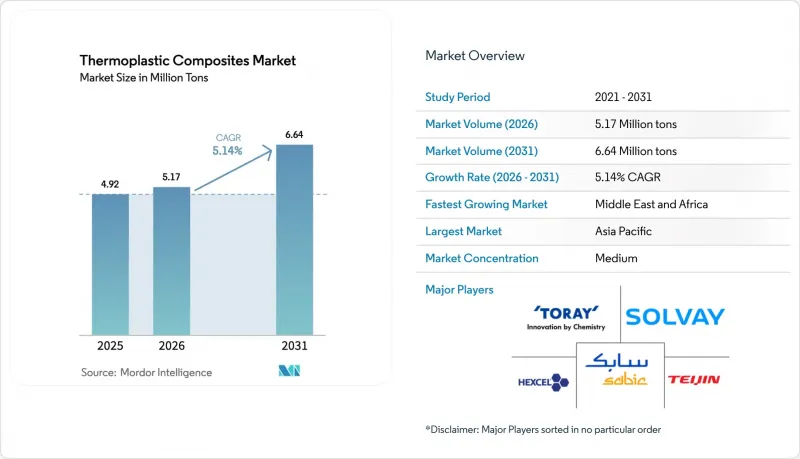
This report is Segmented by Resin Type (Polypropylene, Polyamide, and More), Fiber Type (Glass Fiber, Carbon Fiber, Other Fiber Types), Product Type (Short-Fiber, Long-Fiber, and More), End-User Industry (Automotive, Aerospace and Defense, and More), and Geography (Asia-Pacific, North America, Europe, South America, Middle East and Africa). Market Forecasts are Provided in Terms of Volume (Tons).
Global Thermoplastic Composites Market Trends and Insights
Rapid Vehicle Lightweighting Mandates in Europe and the United States
Euro 7 rules effective mid-2025 and the U.S. EPA's 2027-2032 greenhouse-gas standards oblige automakers to remove 8%-12% of curb weight to stay inside fleet-average limits. Thermoplastic composites deliver 30%-40% savings versus steel yet cycle in under 60 seconds, enabling line-side integration. BMW's iX roof panel shows structural feasibility while trimming 15 kg per vehicle. Penalties above EUR 95 per excess gram of CO2 make adoption financially unavoidable.
OEM Push for Recyclable Composite Solutions in E-Mobility
EU Battery Regulation thresholds on recycled content and digital passports promote closed-loop enclosures built from remeltable matrices. Mercedes-Benz recovers short-fiber polyamide housings for reuse, achieving 22% recycled content with no impact-strength loss. China's draft design-for-disassembly rules amplify the shift, and the American Chemistry Council targets 30% composite scrap circularity by 2030.
High Cost of Raw Materials and Forming Processes
Polyamide resins fluctuated between USD 2,800 and USD 3,400/ton in 2024-2025 as caprolactam supply tightened, and PEEK still commands USD 60-80/kg, curbing penetration outside aviation and implants. Carbon fiber at USD 15-25/kg remains a premium over glass. Automated tape-laying cells exceed USD 5 million, limiting SME entry, whereas epoxy systems price in at USD 4-6/kg and keep share in low-volume aerospace runs.
Other drivers and restraints analyzed in the detailed report include:
- Asia-Pacific LNG and Hydrogen Storage Megaproject Pipeline
- Thermoplastic Over-Molding Adoption in Smart-Electronics Housings
- Limited Awareness and Standardization
For complete list of drivers and restraints, kindly check the Table Of Contents.
Segment Analysis
The thermoplastic composites market size for polyamide reached 38.89% of total volume in 2025, owing to high-speed injection lines that meet automotive cycle-time targets. Moisture absorption cuts stiffness 15%-20% but boosts impact toughness, sustaining bumper-beam appeal. PEEK, although just a fraction of tonnage, is on a 6.08% CAGR path as aircraft brackets need 180 °C service and spine cages demand radiolucency. Polypropylene retains non-structural covers where cost and recycled-content mandates align, while PPS and PEI satisfy under-hood flame-retardant niches.
Heightened electrification keeps demand for chemical-resistant matrices; battery-tray suppliers are trialing recycled-content polyamide to meet 25% ELV thresholds. Meanwhile, the U.S. FDA's 510(k) clearance of PEEK spinal cages spurs hospital demand even as surgeons weigh titanium familiarity. Over the forecast horizon, polyimide blends and low-smoke zero-halogen PAEK grades could carve out cabin-interior volume once fire-smoke-toxicity testing matures.
Glass fiber supplied 87.27% of 2025 volume, offering 72 GPa modulus for USD 1.50-2.00/kg - adequate for battery trays and seat backs. Carbon fiber's 5.81% CAGR outlook is underpinned by programs like Mercedes-Benz EQS roof bows that trim 8 kg and lower center of gravity 12 mm. Basalt and aramid remain below 3% combined because supply chains lack scale.
Crash-standards tightening will gradually expand carbon into B-pillar reinforcements once cost drops below USD 12/kg, expected as two new 25 kt lines in China come online in 2027. Natural-fiber hybrids are testing well for door-trim acoustics in EU vans, though moisture uptake challenges persist.
Complete Report Scope:
- By Resin Type
- Polypropylene (PP)
- Polyamide (PA)
- Polyether-ether-ketone (PEEK)
- Other Resin Types
- By Fiber Type
- Glass Fiber
- Carbon Fiber
- Other Fiber Types
- By Product Type
- Short-Fiber Thermoplastic (SFT)
- Long-Fiber Thermoplastic (LFT)
- Continuous-Fiber Thermoplastic (CFT)
- Glass-Mat Thermoplastic (GMT)
- By End-User Industry
- Automotive
- Aerospace and Defense
- Electrical and Electronics
- Construction
- Medical
- Other End-Users
- By Geography
- Asia-Pacific
- China
- Japan
- India
- South Korea
- ASEAN
- Rest of Asia-Pacific
- North America
- United States
- Canada
- Mexico
- Europe
- Germany
- United Kingdom
- France
- Italy
- Spain
- Rest of Europe
- South America
- Brazil
- Argentina
- Rest of South America
- Middle East and Africa
- Saudi Arabia
- United Arab Emirates
- South Africa
- Nigeria
- Rest of Middle East and Africa
- Asia-Pacific
Geography Analysis
Asia-Pacific held 48.76% share in 2025, powered by China's 26.1 million vehicle output and electronics clusters along the Pearl River Delta. Beijing's NEV plan, extended to 2030, requires recyclable lightweight components, fueling short- and long-fiber feedstock imports. Japan's JPY 300 billion subsidy backs 1,000 hydrogen stations by 2030, pulling Type IV cylinder demand. South Korea's multi-material mid-frame adoption reduced smartphone assembly steps 40%. India's production-linked incentive cuts capital costs for composite cells, while Vietnam and Thailand expand over-molding capacity as supply chains diversify.
North America and Europe account for significant consumption volume. U.S. CAFE rules force Detroit to drop 100-150 kg per model using composite closures and seating. Boeing's 777X floor beams showcase cost and cycle reductions, and Euro ELV mandates place 25% recycled-plastic thresholds by 2030. The U.K.'s GBP 18 million wing-skin project targets 50% labor cuts at ATI facilities.
The Middle East and Africa lead by growth rate at 5.72% through 2031. Saudi Aramco's 200-km hydrogen pipeline at NEOM highlights 60% weight savings and embrittlement resistance. Masdar City specs thermoplastic facades that survive 50 °C swings. South Africa's Nampak compounding line readies for export vehicles bound for Europe, while Nigeria assesses sour-gas composite pipe to meet local content rules. South America trails, though Brazilian agri-equipment gains from lightweight harvesters that consume less diesel.
- Arkema
- Avient Corporation
- Alsiano A/S
- BASF
- Celanese Corporation
- Daicel Corporation
- dsm-firmenich
- DuPont
- Hexcel Corporation
- LANXESS
- LyondellBasell Industries Holdings B.V.
- Mitsubishi Chemical Group Corporation
- Owens Corning
- RTP Company
- SABIC
- SGL Carbon
- Solvay
- TechnoCompound GmbH
- TEIJIN LIMITED
- TORAY INDUSTRIES, INC.
- Victrex plc
Additional Benefits:
- The market estimate (ME) sheet in Excel format
- 3 months of analyst support
TABLE OF CONTENTS
1 Introduction
- 1.1 Study Assumptions and Market Definition
- 1.2 Scope of the Study
2 Research Methodology
3 Executive Summary
4 Market Landscape
- 4.1 Market Overview
- 4.2 Market Drivers
- 4.2.1 Rapid Vehicle-Light-Weighting Mandates in Europe and the United States
- 4.2.2 OEM Push for Recyclable Composite Solutions in E-Mobility
- 4.2.3 Asia-Pacific LNG and Hydrogen-Storage Megaproject Pipeline
- 4.2.4 Thermoplastic Over-Moulding Adoption in Smart-Electronics Housings
- 4.2.5 Military Demand for Damage-Tolerant, Radar-Transparent Structures
- 4.3 Market Restraints
- 4.3.1 High Cost of Raw Materials and Forming Processes
- 4.3.2 Limited Awareness and Standardization
- 4.3.3 Competitive Pressure from Thermoset Composites
- 4.4 Value Chain Analysis
- 4.5 Porter's Five Forces
- 4.5.1 Bargaining Power of Suppliers
- 4.5.2 Bargaining Power of Buyers
- 4.5.3 Threat of New Entrants
- 4.5.4 Threat of Substitutes
- 4.5.5 Competitive Rivalry
5 Market Size and Growth Forecasts (Volume)
- 5.1 By Resin Type
- 5.1.1 Polypropylene (PP)
- 5.1.2 Polyamide (PA)
- 5.1.3 Polyether-ether-ketone (PEEK)
- 5.1.4 Other Resin Types
- 5.2 By Fiber Type
- 5.2.1 Glass Fiber
- 5.2.2 Carbon Fiber
- 5.2.3 Other Fiber Types
- 5.3 By Product Type
- 5.3.1 Short-Fiber Thermoplastic (SFT)
- 5.3.2 Long-Fiber Thermoplastic (LFT)
- 5.3.3 Continuous-Fiber Thermoplastic (CFT)
- 5.3.4 Glass-Mat Thermoplastic (GMT)
- 5.4 By End-User Industry
- 5.4.1 Automotive
- 5.4.2 Aerospace and Defense
- 5.4.3 Electrical and Electronics
- 5.4.4 Construction
- 5.4.5 Medical
- 5.4.6 Other End-Users
- 5.5 By Geography
- 5.5.1 Asia-Pacific
- 5.5.1.1 China
- 5.5.1.2 Japan
- 5.5.1.3 India
- 5.5.1.4 South Korea
- 5.5.1.5 ASEAN
- 5.5.1.6 Rest of Asia-Pacific
- 5.5.2 North America
- 5.5.2.1 United States
- 5.5.2.2 Canada
- 5.5.2.3 Mexico
- 5.5.3 Europe
- 5.5.3.1 Germany
- 5.5.3.2 United Kingdom
- 5.5.3.3 France
- 5.5.3.4 Italy
- 5.5.3.5 Spain
- 5.5.3.6 Rest of Europe
- 5.5.4 South America
- 5.5.4.1 Brazil
- 5.5.4.2 Argentina
- 5.5.4.3 Rest of South America
- 5.5.5 Middle East and Africa
- 5.5.5.1 Saudi Arabia
- 5.5.5.2 United Arab Emirates
- 5.5.5.3 South Africa
- 5.5.5.4 Nigeria
- 5.5.5.5 Rest of Middle East and Africa
- 5.5.1 Asia-Pacific
6 Competitive Landscape
- 6.1 Market Concentration
- 6.2 Strategic Moves
- 6.3 Market Share(%)/Ranking Analysis
- 6.4 Company Profiles (includes Global level Overview, Market level overview, Core Segments, Financials as available, Strategic Information, Market Rank/Share for key companies, Products and Services, and Recent Developments)
- 6.4.1 Arkema
- 6.4.2 Avient Corporation
- 6.4.3 Alsiano A/S
- 6.4.4 BASF
- 6.4.5 Celanese Corporation
- 6.4.6 Daicel Corporation
- 6.4.7 dsm-firmenich
- 6.4.8 DuPont
- 6.4.9 Hexcel Corporation
- 6.4.10 LANXESS
- 6.4.11 LyondellBasell Industries Holdings B.V.
- 6.4.12 Mitsubishi Chemical Group Corporation
- 6.4.13 Owens Corning
- 6.4.14 RTP Company
- 6.4.15 SABIC
- 6.4.16 SGL Carbon
- 6.4.17 Solvay
- 6.4.18 TechnoCompound GmbH
- 6.4.19 TEIJIN LIMITED
- 6.4.20 TORAY INDUSTRIES, INC.
- 6.4.21 Victrex plc
7 Market Opportunities and Future Outlook
- 7.1 White-Space and Unmet-Need Assessment
- 7.2 Wide Application Scope in the Healthcare Sector

