PUBLISHER: Mordor Intelligence | PRODUCT CODE: 2122476

PUBLISHER: Mordor Intelligence | PRODUCT CODE: 2122476
Ultra High Performance Concrete (UHPC) - Market Share Analysis, Industry Trends & Statistics, Growth Forecasts (2026 - 2031)
According to Mordor Intelligence, the ultra high performance concrete market size is projected to be USD 575.42 million in 2025, USD 620.59 million in 2026, and reach USD 918.20 million by 2031, growing at a CAGR of 8.15% from 2026 to 2031.
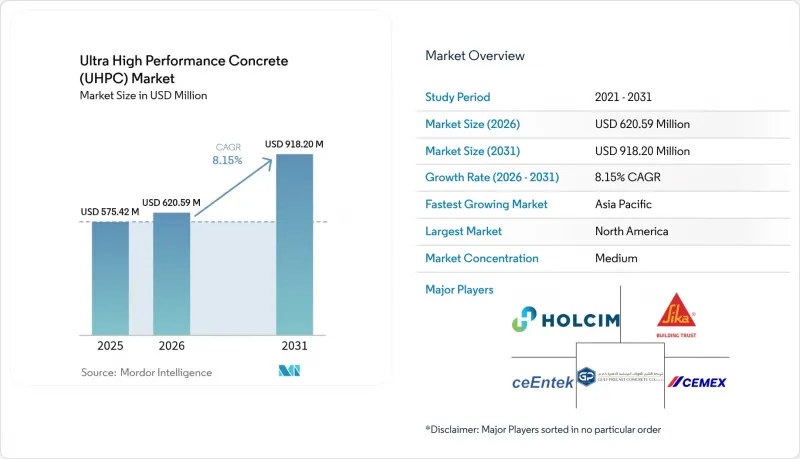
This report is Segmented by Product Type (Slurry-Infiltrated Fibrous Concrete, Reactive Powder Concrete, and Other Product Types), Application (Roads and Bridge Construction, Building Construction, and Other Applications), and Geography (Asia-Pacific, North America, Europe, South America, and the Middle East and Africa). The Market Forecasts are Provided in Terms of Value (USD).
Global Ultra High Performance Concrete (UHPC) Market Trends and Insights
Rising Demand for Durable Bridge and Transport Infrastructure
Structurally deficient bridges in the United States, elevated-expressway contracts in India, and Japan's coastal-highway repairs are moving UHPC from pilot status to programmatic adoption. The elimination of expansion joints, 60-year design lives, and slimmer cross-sections that reduce seismic mass underpin procurement decisions. China Railway Construction Corporation installed UHPC track slabs that promise ballast-free longevity. Despite jurisdiction-specific mix approvals slowing knowledge transfer, market momentum is now sustained by national funding rather than isolated demonstrations. The ultra-high-performance concrete (UHPC) market, therefore, aligns with long-duration infrastructure programs instead of discrete projects.
Growth of Prefabricated and Modular Construction
Off-site fabrication halves installation time for facade panels and bathroom pods, mitigating skilled-labor shortages in mature economies. New York State reopened Interstate 87 within 72 hours after installing precast UHPC deck panels. Singapore's housing authority credits UHPC pods with 40% wet-trade labor savings. Standardized connection details from the Precast/Prestressed Concrete Institute have eased designer hesitation. As fabricators scale robotic finishing lines, the ultra-high-performance concrete (UHPC) market gains production repeatability that lowers cost variance and encourages broader specification.
High Material and Processing Cost
Material inputs represent up to 70% of delivered cost versus 30% for standard concrete, with steel micro-fibers adding USD 450-1,250 per cubic meter. Specialized high-shear mixers extend batch energy consumption by 40%. Brazilian agencies deferred UHPC bridges after 2024 fiscal reforms despite lifecycle gains. European silica-fume prices rose 18% after emissions rules shuttered Norwegian smelters. Local pozzolan substitution trials cut compressive strength to 80% of silica-fume UHPC, limiting structural use. Elevated capex, therefore, restrains the ultra-high performance concrete (UHPC) market in price-sensitive regions.
Other drivers and restraints analyzed in the detailed report include:
- Government Mandates for Low Lifecycle Cost Public Assets
- Adoption in Offshore-Wind Turbine Foundations
- Low Contractor Familiarity and Skills Gap
For complete list of drivers and restraints, kindly check the Table Of Contents.
Segment Analysis
SIFCON commanded 43.59% revenue in 2025, reflecting its dominance in blast-mitigation and seismic-retrofit niches where energy absorption trumps cost. Fiber contents of 6-20% by volume deliver ductility that outperforms other UHPC variants, but high labor input confines use to defense and critical infrastructure. RPC, expanding at an 8.60% CAGR, benefits from offshore-wind and architectural-precast demand; compressive strengths above 200 MPa and near-zero permeability suit marine harshness. Compact Reinforced Composite garners attention for ultra-thin pedestrian bridges yet lacks production scale. ASTM C1856 offers testing baselines, though many proprietary mixes exceed the thresholds, complicating benchmarking. Patent growth of 35% in RPC self-healing formulations underscores an innovation tilt that will enlarge the ultra-high-performance concrete (UHPC) market size for high-value offshore components.
The ultra-high-performance concrete (UHPC) industry differentiates through tailored performance rather than one-size commodity grades. SIFCON retains leadership in military and seismic-zone projects, whereas RPC's versatility across bridges, facades, and monopiles fuels faster share gain. Regional precasters with fiber-orientation automation can monetize RPC's rapid-strength gain, while global majors leverage brand portfolios to supply both SIFCON and RPC, balancing market risk across civil and defense spending cycles.
Complete Report Scope:
- By Product Type
- Slurry-Infiltrated Fibrous Concrete (SIFCON)
- Reactive Powder Concrete (RPC)
- Compact Reinforced Composite (CRC)
- Other Product Types
- By Application
- Roads and Bridge Construction
- Building Construction
- Military Construction
- Other Applications
- By Geography
- Asia-Pacific
- China
- India
- Japan
- South Korea
- ASEAN Countries
- Rest of Asia-Pacific
- North America
- United States
- Canada
- Mexico
- Europe
- Germany
- United Kingdom
- France
- Italy
- Russia
- NORDIC Countries
- Rest of Europe
- South America
- Brazil
- Argentina
- Rest of South America
- Middle East and Africa
- Saudi Arabia
- South Africa
- Rest of Middle East and Africa
- Asia-Pacific
Geography Analysis
North America contributed 31.99% of revenue in 2025 after the Infrastructure Investment and Jobs Act directed USD 110 billion toward resilient bridges. Thirty-eight state DOTs reference UHPC in accelerated-bridge standards, and Canadian cold-climate guidelines unlocked deployments in Ontario and Quebec. Mexico specified UHPC viaducts on the Tren Maya rail, targeting 100-year tropical durability. Contractor skill shortages, however, slow project throughput, creating backlog in the ultra-high-performance concrete (UHPC) market pipeline.
Asia-Pacific posts the fastest 8.65% CAGR, propelled by China's high-speed rail, India's expressways, and Japan's tsunami-zone coastal repairs. ASEAN metro expansions in Bangkok and Manila amplify demand, while offshore-wind foundations in Taiwan and South Korea consume RPC volumes. Domestic consumption trimmed Chinese silica-fume exports, tightening regional supply and nudging prices, yet robust public-funded pipelines sustain growth momentum for the ultra-high-performance concrete (UHPC) market.
Europe leverages lifecycle-cost mandates and offshore-wind initiatives to sustain share. Germany's autobahn-rehabilitation and France's Grand Paris Express specify UHPC for accelerated construction. The UK's HS2 tunnels adopted UHPC joints to lower leakage risk. Norwegian smelter closures shrank fume supply, but Nordic offshore-wind projects still privilege locally sourced UHPC. South America grows modestly due to fiscal austerity, though Argentina's shale-gas pipelines open corrosion-resistant UHPC orders. Middle East projects, led by Saudi Arabia's NEOM coastal defenses, inject high-margin volume that offsets African budget constraints, rounding out the global Ultra high performance concrete (UHPC) market landscape.
- Antica Ceramica LLP
- ceEntek
- Cemex
- Cor-Tuf
- ELO Beton
- Gulf Precast
- Holcim
- Illinois Tool Works Inc.
- Metrostav
- RAMPF Holding GmbH & Co. KG
- Sika AG
- TAKTL
- UHPC Solutions North America
Additional Benefits:
- The market estimate (ME) sheet in Excel format
- 3 months of analyst support
TABLE OF CONTENTS
1 Introduction
- 1.1 Study Assumptions & Market Definition
- 1.2 Scope of the Study
2 Research Methodology
3 Executive Summary
4 Market Landscape
- 4.1 Market Overview
- 4.2 Market Drivers
- 4.2.1 Rising demand for durable bridge & transport infrastructure
- 4.2.2 Growth of prefabricated and modular construction
- 4.2.3 Government mandates for low-lifecycle-cost public assets
- 4.2.4 Adoption in offshore-wind turbine foundations
- 4.2.5 Defense sector shift to blast-mitigating UHPC barriers
- 4.3 Market Restraints
- 4.3.1 High material and processing cost
- 4.3.2 Low contractor familiarity & skills gap
- 4.3.3 Tight supply of ultra-fine silica fume & specialty fibres
- 4.4 Value Chain Analysis
- 4.5 Porter's Five Forces
- 4.5.1 Bargaining Power of Suppliers
- 4.5.2 Bargaining Power of Buyers
- 4.5.3 Threat of New Entrants
- 4.5.4 Threat of Substitutes
- 4.5.5 Degree of Competition
5 Market Size and Growth Forecasts (Value)
- 5.1 By Product Type
- 5.1.1 Slurry-Infiltrated Fibrous Concrete (SIFCON)
- 5.1.2 Reactive Powder Concrete (RPC)
- 5.1.3 Compact Reinforced Composite (CRC)
- 5.1.4 Other Product Types
- 5.2 By Application
- 5.2.1 Roads and Bridge Construction
- 5.2.2 Building Construction
- 5.2.3 Military Construction
- 5.2.4 Other Applications
- 5.3 By Geography
- 5.3.1 Asia-Pacific
- 5.3.1.1 China
- 5.3.1.2 India
- 5.3.1.3 Japan
- 5.3.1.4 South Korea
- 5.3.1.5 ASEAN Countries
- 5.3.1.6 Rest of Asia-Pacific
- 5.3.2 North America
- 5.3.2.1 United States
- 5.3.2.2 Canada
- 5.3.2.3 Mexico
- 5.3.3 Europe
- 5.3.3.1 Germany
- 5.3.3.2 United Kingdom
- 5.3.3.3 France
- 5.3.3.4 Italy
- 5.3.3.5 Russia
- 5.3.3.6 NORDIC Countries
- 5.3.3.7 Rest of Europe
- 5.3.4 South America
- 5.3.4.1 Brazil
- 5.3.4.2 Argentina
- 5.3.4.3 Rest of South America
- 5.3.5 Middle East and Africa
- 5.3.5.1 Saudi Arabia
- 5.3.5.2 South Africa
- 5.3.5.3 Rest of Middle East and Africa
- 5.3.1 Asia-Pacific
6 Competitive Landscape
- 6.1 Market Concentration
- 6.2 Strategic Moves
- 6.3 Market Share(%)/Ranking Analysis
- 6.4 Company Profiles (includes Global level Overview, Market level overview, Core Segments, Financials as available, Strategic Information, Products and Services, and Recent Developments)
- 6.4.1 Antica Ceramica LLP
- 6.4.2 ceEntek
- 6.4.3 Cemex
- 6.4.4 Cor-Tuf
- 6.4.5 ELO Beton
- 6.4.6 Gulf Precast
- 6.4.7 Holcim
- 6.4.8 Illinois Tool Works Inc.
- 6.4.9 Metrostav
- 6.4.10 RAMPF Holding GmbH & Co. KG
- 6.4.11 Sika AG
- 6.4.12 TAKTL
- 6.4.13 UHPC Solutions North America
7 Market Opportunities and Future Outlook
- 7.1 White-space and Unmet-Need Assessment

