PUBLISHER: Mordor Intelligence | PRODUCT CODE: 2122488

PUBLISHER: Mordor Intelligence | PRODUCT CODE: 2122488
Fire Retardant Coatings - Market Share Analysis, Industry Trends & Statistics, Growth Forecasts (2026 - 2031)
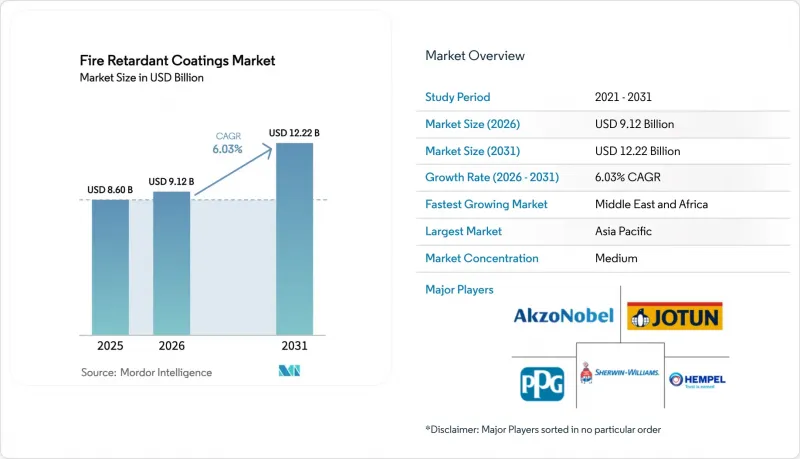
According to Mordor Intelligence, the fire retardant coatings market size was valued at USD 8.60 billion in 2025 and is estimated to grow from USD 9.12 billion in 2026 to reach USD 12.22 billion by 2031, at a CAGR of 6.03% during the forecast period (2026-2031).
This report is Segmented by Resin Type (Silicone Elastomers, Epoxy, Acrylics, Vinyl, Polyurethane, and Others), Technology (Water-Borne, Solvent-Borne, Powder, and Others), Coating Type (Intumescent and Cementitious), End-User Industry (Building and Construction, Oil and Gas, Power, and More), and Geography (Asia-Pacific, North America, and More). Market Forecasts are Provided in Terms of Value (USD).
Global Fire Retardant Coatings Market Trends and Insights
Increasing Construction Activities Across the Globe
In 2024, China's construction output bolstered consistent demand for epoxy-based intumescent coatings that meet GB 14907-2018 standards for multi-story steel frames. Meanwhile, as part of India's Smart Cities Mission, large-scale municipal housing projects are now mandating water-borne formulas in line with the National Building Code. In Saudi Arabia, the NEOM, Red Sea, and Qiddiya projects have a combined requirement for coated steel, leading European suppliers to establish local blending facilities. In Europe and North America, the trend towards modular construction is leaning towards factory-applied powder intumescent layers, which significantly reduce on-site labor. This niche market currently sees competition from only a select few OEM applicators. As a result, the fire retardant coatings market is not just witnessing growth in square meters but is also benefiting from procedural shifts that emphasize high-efficiency chemistries.
Accelerating Oil and Gas Infrastructure Expansion
API Recommended Practice 752 (2024) now quantifies thermal hazards for permanent buildings in refineries, leading engineers to select ablative and hybrid systems able to withstand 1,100 °C hydrocarbon fires for four hours. As LNG projects expand in Qatar and Saudi Arabia, the specification scope broadens. Simultaneously, North American shale operators are retrofitting legacy plants to align with the updated 49 CFR 194 emergency-response regulations. Powder coatings are becoming popular for cable trays and small-bore piping. These coatings not only reduce solvent exposure in confined spaces but also expedite turnaround times. While current adoption remains low, passive fire-protection spending and supplier investments in training are poised to bridge this gap by 2028, thereby enlarging the market for fire-retardant coatings.
Availability of Low-Cost Substitutes
In India, Indonesia, and Nigeria, cost-sensitive developers are increasingly opting for gypsum boards, which are more affordable compared to spray intumescents. While cementitious plasters offer a commendable four-hour fire rating, their weight limits their application in seismic retrofits. In a bid to enhance building safety, insurance firms have begun levying premium penalties on structures without certified coatings. This strategy is gradually tipping the scales in favor of intumescents, narrowing the price-performance divide. To maintain their market share, suppliers are now offering bundled services, including turnkey applications and multi-year warranties. By shifting the conversation from just the upfront material cost to the broader perspective of lifecycle economics, they are ensuring sustained demand in the fire retardant coatings sector.
Other drivers and restraints analyzed in the detailed report include:
- Stricter Fire-Safety Regulations and Building Codes
- Rising Demand for Passive Fire Protection in E-Mobility and Battery Systems
- Volatile Epoxy and Silicone Raw-Material Prices
For complete list of drivers and restraints, kindly check the Table Of Contents.
Segment Analysis
Epoxy resins sustained 34.48% of the fire-retardant coatings market share in 2025 due to robust adhesion and predictable intumescence. Silicone elastomers, expanding at 6.24% CAGR to 2031, answer battery-pack and aerospace needs beyond 600 °C, a temperature realm where epoxies lose structural integrity. Acrylics fill architectural niches, while polyurethane systems are emerging in spray-foam insulation with integrated fire barriers. Hybrid epoxy-silicone stacks are under pilot in German and Korean battery plants for 2027 launches. Such diversification enlarges supplier research and development pipelines and helps guard against commoditization in the fire retardant coatings market.
Epoxies remain cost-effective, yet their bisphenol-A feedstock lines up alongside environmental scrutiny, motivating formulators to explore lignin-based hardeners. Silicones, though premium-priced, offer unmatched thermal shock resistance, and their expanding use in e-mobility raises total consumption. Niche phenolics and polyesters continue to serve marine bulkheads and rail interiors, but their collective share slips as performance standards climb. Resin evolution, therefore, signals both risk and opportunity for stakeholders across the fire retardant coatings industry.
Water-borne products held 46.37% of 2025 revenue, aided by EU and California VOC caps of 250 g/L. Powder variants, although a small share, are forecast to grow at a 6.18% CAGR, powered by automotive and appliance lines that favor single-pass, zero-solvent processes. Solvent-borne systems still serve maintenance jobs on corroded steel where surface prep is imperfect. Radiation-cured and high-solids blends occupy small niches in cold-weather or rapid-turnaround projects.
Powder intumescents require tight particle-size control and electrostatic tuning, challenges that only a limited number of suppliers have mastered. Nonetheless, the technology's low waste rate and significant labor savings render a compelling total-cost argument. Extended humidity cure times remain the Achilles heel for water-borne layers in tropical regions, prompting formulators to add flash-rust inhibitors. As regulations tighten further, adoption curves will continue to support value growth in the fire-retardant coatings market.
Complete Report Scope:
- By Resin Type
- Silicone Elastomers
- Epoxy Resins
- Acrylics
- Vinyl Resins
- Polyurethane
- Other Resin Types
- By Technology
- Water-borne
- Solvent-borne
- Powder Coatings
- Others
- By Coating Type
- Intumescent
- Cementitious
- By End-user Industry
- Building and Construction
- Oil and Gas
- Power Generation
- Transportation
- Industrial and Manufacturing
- Other End-User Industries
- By Geography
- Asia-Pacific
- China
- India
- Japan
- South Korea
- Rest of Asia-Pacific
- North America
- United States
- Canada
- Mexico
- Europe
- Germany
- United Kingdom
- France
- Italy
- Spain
- Russia
- NORDIC Countries
- Rest of Europe
- South America
- Brazil
- Argentina
- Rest of South America
- Middle-East and Africa
- Saudi Arabia
- South Africa
- Rest of Middle-East and Africa
- Asia-Pacific
Geography Analysis
Asia-Pacific commanded a 45.28% share in 2025, bolstered by China's impressive construction output and India's ambitious National Infrastructure Pipeline. Japan's surge in retrofitting, coupled with South Korea's production of electric vehicles, has heightened the demand for silicone-rich formulations. Meanwhile, Southeast Asia is reaping the rewards of industrial park investments, a strategic move linked to supply-chain diversification. The Belt and Road initiative sees powder-coated prefab modules being shipped, expanding regional export flows, and integrating advanced coatings into projects in emerging markets.
North America is riding a wave of momentum, fueled by the United States' infrastructure law. This, alongside bridge rehabilitations and grid upgrades necessitating passive fire protection, underscores the region's robust activity. Canada's oil sands and Mexico's impressive vehicle assembly bolster these volumes. However, a notable shortage of certified applicators has led contractors to negotiate schedules months in advance. This scarcity sometimes results in project deferrals and creates spikes in demand, benefiting suppliers with agile mobile crews.
Europe's ambitious Renovation Wave is harmonizing fire safety with carbon reduction efforts across millions of properties. In Germany and the Nordics, there's a push for halogen-free formulas. While these add extra material costs, they offer insurers significant savings on risk premiums. Following the Grenfell incident, the UK has tightened its market entry with reforms mandating third-party product verification. France is championing bio-based retardants, aligning them with its low-carbon objectives. Meanwhile, sanctions have curtailed Russia's access to Western chemistries, prompting local producers to attempt reverse-engineering of epoxies, though with mixed results in quality.
The Middle East and Africa are the fastest-expanding regions at 5.94% CAGR. This surge is largely attributed to NEOM's colossal steel demands and the UAE's stringent high-rise codes, which mandate two-hour fire ratings. South Africa is modernizing its petrochemical sites in line with SANS 10177 standards. However, logistical challenges outside major provinces are hindering swift adoption. A scarcity of accredited test labs in many African nations means imported certifications are the norm. While this elevates costs, it also raises the bar for quality expectations.
South America is on the upswing. Brazil is enforcing the ABNT NBR 14432 standard for buildings taller than four stories, while Argentina's VOC restrictions are nudging factories towards water-borne systems. In the face of currency fluctuations, there's a trend of hedging and stockpiling raw materials. Chile's mining sector, emphasizing safety, mandates four-hour coatings on critical supports, spurring a niche demand for ablative products. Together, these developments are expanding the horizons of the fire retardant coatings market and diversifying its revenue streams.
- 3M
- Akzo Nobel N.V.
- Albi Protective Coatings
- Benjamin Moore & Co.
- Carboline
- Contego International Inc.
- Hempel AS
- Isolatek International
- Jotun
- NIPPON PAINT (M) SDN. BHD.
- No-Burn, Inc.
- PPG Industries, Inc.
- RPM International Inc
- The Sherwin-Williams Company
- TREMCO ILLBRUCK
Additional Benefits:
- The market estimate (ME) sheet in Excel format
- 3 months of analyst support
TABLE OF CONTENTS
1 Introduction
- 1.1 Study Assumptions and Market Definition
- 1.2 Scope of the Study
2 Research Methodology
3 Executive Summary
4 Market Landscape
- 4.1 Market Drivers
- 4.1.1 Increasing construction activities across the globe
- 4.1.2 Accelerating oil and gas (incl. shale) infrastructure expansion
- 4.1.3 Stricter fire-safety regulations and building codes
- 4.1.4 Rising demand for passive fire protection in e-mobility and battery systems
- 4.1.5 Shift toward bio-based/halogen-free coating chemistries
- 4.2 Market Restraints
- 4.2.1 Availability of low-cost substitutes (cementitious plasters, FR boards)
- 4.2.2 Volatile epoxy/silicone resin and additive prices
- 4.2.3 Shortage of qualified applicators causing installation defects
- 4.3 Value Chain Analysis
- 4.4 Porter's Five Forces
- 4.4.1 Bargaining Power of Suppliers
- 4.4.2 Bargaining Power of Consumers
- 4.4.3 Threat of New Entrants
- 4.4.4 Threat of Substitute Products and Services
- 4.4.5 Degree of Competition
5 Market Size and Growth Forecasts (Value)
- 5.1 By Resin Type
- 5.1.1 Silicone Elastomers
- 5.1.2 Epoxy Resins
- 5.1.3 Acrylics
- 5.1.4 Vinyl Resins
- 5.1.5 Polyurethane
- 5.1.6 Other Resin Types
- 5.2 By Technology
- 5.2.1 Water-borne
- 5.2.2 Solvent-borne
- 5.2.3 Powder Coatings
- 5.2.4 Others
- 5.3 By Coating Type
- 5.3.1 Intumescent
- 5.3.2 Cementitious
- 5.4 By End-user Industry
- 5.4.1 Building and Construction
- 5.4.2 Oil and Gas
- 5.4.3 Power Generation
- 5.4.4 Transportation
- 5.4.5 Industrial and Manufacturing
- 5.4.6 Other End-User Industries
- 5.5 By Geography
- 5.5.1 Asia-Pacific
- 5.5.1.1 China
- 5.5.1.2 India
- 5.5.1.3 Japan
- 5.5.1.4 South Korea
- 5.5.1.5 Rest of Asia-Pacific
- 5.5.2 North America
- 5.5.2.1 United States
- 5.5.2.2 Canada
- 5.5.2.3 Mexico
- 5.5.3 Europe
- 5.5.3.1 Germany
- 5.5.3.2 United Kingdom
- 5.5.3.3 France
- 5.5.3.4 Italy
- 5.5.3.5 Spain
- 5.5.3.6 Russia
- 5.5.3.7 NORDIC Countries
- 5.5.3.8 Rest of Europe
- 5.5.4 South America
- 5.5.4.1 Brazil
- 5.5.4.2 Argentina
- 5.5.4.3 Rest of South America
- 5.5.5 Middle-East and Africa
- 5.5.5.1 Saudi Arabia
- 5.5.5.2 South Africa
- 5.5.5.3 Rest of Middle-East and Africa
- 5.5.1 Asia-Pacific
6 Competitive Landscape
- 6.1 Market Concentration
- 6.2 Strategic Moves
- 6.3 Market Share/Ranking Analysis
- 6.4 Company Profiles (includes Global level Overview, Market level overview, Core Segments, Financials as available, Strategic Information, Market Rank/Share for key companies, Products and Services, and Recent Developments)
- 6.4.1 3M
- 6.4.2 Akzo Nobel N.V.
- 6.4.3 Albi Protective Coatings
- 6.4.4 Benjamin Moore & Co.
- 6.4.5 Carboline
- 6.4.6 Contego International Inc.
- 6.4.7 Hempel AS
- 6.4.8 Isolatek International
- 6.4.9 Jotun
- 6.4.10 NIPPON PAINT (M) SDN. BHD.
- 6.4.11 No-Burn, Inc.
- 6.4.12 PPG Industries, Inc.
- 6.4.13 RPM International Inc
- 6.4.14 The Sherwin-Williams Company
- 6.4.15 TREMCO ILLBRUCK
7 Market Opportunities and Future Outlook
- 7.1 White-space and Unmet-Need Assessment

