PUBLISHER: Mordor Intelligence | PRODUCT CODE: 2122499

PUBLISHER: Mordor Intelligence | PRODUCT CODE: 2122499
HPV Testing And Pap Test - Market Share Analysis, Industry Trends & Statistics, Growth Forecasts (2026 - 2031)
According to Mordor Intelligence, the HPV testing and pap test market size is expected to grow from USD 6.89 billion in 2025 to USD 7.59 billion in 2026 and is forecast to reach USD 12.58 billion by 2031 at 10.63% CAGR over 2026-2031.
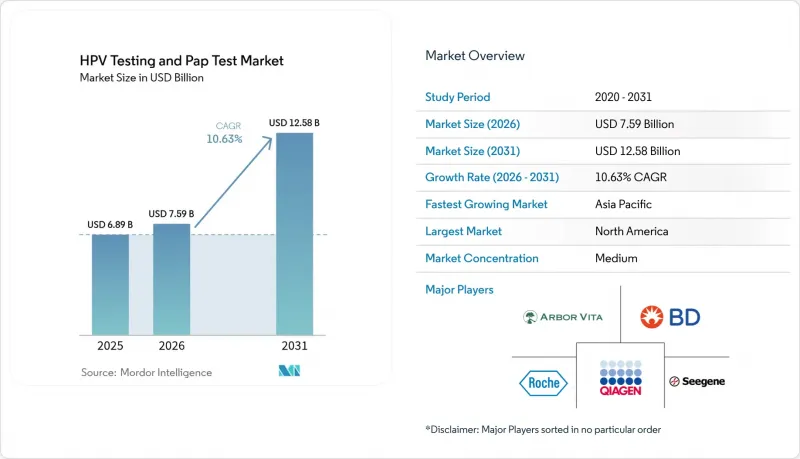
This report is Segmented by Test Type (HPV Test, Pap Test, Co-Test), Product Type (Instruments and Analyzers, and More), Technology (PCR/NAAT, and More), Application (Cervical Cancer Screening, and More), End User (Hospitals & Clinics, and More), and Geography (North America, Europe, Asia-Pacific, Middle East & Africa, South America). Market Forecasts are Provided in Terms of Value (USD).
Global HPV Testing And Pap Test Market Trends and Insights
Rising Prevalence of HPV Infections and Cervical Cancer Burden
Global cervical cancer incidence climbed 4.2% between 2020 and 2024, reversing earlier gains tied to Pap campaigns. Screening gaps created during the pandemic left an estimated 35 million women untested, allowing lesions to progress unchecked. South Asia and Sub-Saharan Africa now carry 70% of mortality, pushing ministries to subsidize molecular HPV tests that deliver 90-95% sensitivity. Shifts in the genotype mix of non-vaccine types 31, 33, 45, 52, and 58 are now more common among women aged 30-39, spurring laboratories to adopt extended-genotyping assays that guide risk-stratified management. Regulators responded in 2024 by publishing draft guidance that formalizes genotyping reflex pathways, streamlines triage, and enhances test value.
Expanding Government-Funded Screening Programs and New Guidelines Favoring HPV Primary Testing
The 2024 USPSTF Grade A recommendation for HPV primary testing catalyzed immediate payer alignment, with major U.S. insurers raising reimbursement to USD 65-72 per assay. England finalized its nationwide switch to HPV-first screening, cutting cytology workload 40% and halving turnaround times. China earmarked RMB 12 billion (USD 1.65 billion) to screen 120 million rural women using domestic PCR kits, while India incorporated HPV testing into its Ayushman Bharat scheme, achieving 62% uptake in pilot states. These mandates compress replacement cycles for legacy microscopes, driving orders for automated molecular platforms and fueling the HPV testing and pap test market in the near term.
High Cost of Advanced Molecular Tests in Low-Resource Settings
PCR-based HPV tests cost USD 15-25 per sample in low- and middle-income countries, compared to USD 2-5 for visual inspection with acetic acid (VIA), the dominant screening method in Sub-Saharan Africa where per-capita health spending averages USD 50 annually. This price gap restricts molecular test adoption to urban tertiary hospitals and donor-funded pilot programs, leaving 80% of the at-risk population reliant on VIA, which has 50-60% sensitivity for high-grade lesions, compared with 90-95% for HPV DNA tests. Zambia's Ministry of Health piloted Cepheid's GeneXpert HPV assay in 2024 across 15 rural clinics, achieving 68% screening uptake, but suspended expansion after donor funding lapsed, citing unsustainable reagent costs of USD 18 per test. India's public health system negotiated HPV test prices down to USD 5-6 through bulk procurement, yet state budgets cover only 40% of eligible women, forcing rationing that prioritizes high-risk age groups (35-45) and excludes younger cohorts.
Other drivers and restraints analyzed in the detailed report include:
- Technological Advancements in Molecular Diagnostics
- AI-Enabled Cytology & Digital Pathology Alleviating Pathologist Shortages
- Rising HPV Vaccination Coverage Reducing Long-Term Screening Volumes
For complete list of drivers and restraints, kindly check the Table Of Contents.
Segment Analysis
HPV Tests are advancing at a 11.26% CAGR, eating into Pap Tests' 53.02% share of the HPV testing and Pap test market recorded in 2025. The USPSTF guidance that elevates HPV primary screening triggered immediate coverage shifts, making standalone molecular assays the economical choice for laboratories processing 300-500 samples per shift.
Self-collection kits cleared in 2024 further accelerate adoption among women overdue for exams, boosting screening uptake by 28% in a large U.S. randomized study. Co-testing persists where malpractice concerns linger, though its 20% volume share is sliding as payers curtail dual-test reimbursement. In emerging markets, Pap Tests remain relevant for facilities lacking PCR capacity, yet falling instrument prices and reagent localization are steadily broadening access to HPV tests, expanding the HPV testing and Pap test market size at double-digit rates.
Recurring reagent sales delivered 54.17% of revenue in 2025, but software platforms are on course for a 12.35% CAGR as AI engines and cloud dashboards move cervical screening into integrated women's health portals. Hologic's Genius platform alone generated USD 180 million in license and subscription revenue in 2025, proof that digital layers now rival consumables in value capture.
Hospitals facing budget freezes increasingly favor software-as-a-service contracts over capital purchases, a pivot that locks clients into multi-year agreements and stabilizes vendor cash flows. Meanwhile, instruments and analyzers lengthen refresh cycles to 8-10 years, dampening hardware demand but broadening installed bases for future software attach. Services training, validation, and maintenance account for 10% of turnover and offer cross-sell opportunities for vendors seeking a holistic share of wallet in the HPV testing and pap test market.
Complete Report Scope:
- By Test Type
- HPV Test
- Pap Test
- Co-test (HPV + Pap)
- By Product Type
- Instruments and Analyzers
- Consumables and Reagents
- Software Platforms
- Services
- By Technology
- PCR / NAAT
- Hybrid Capture
- mRNA-based Assays
- Next-Generation Sequencing
- By Application
- Cervical Cancer Screening
- Vaginal Cancer Screening
- Post-treatment Follow-up
- Clinical Trials & Epidemiology
- By End User
- Hospitals & Clinics
- Diagnostic Laboratories
- Other End Users
- By Geography
- North America
- United States
- Canada
- Mexico
- Europe
- Germany
- United Kingdom
- France
- Italy
- Spain
- Rest of Europe
- Asia-Pacific
- China
- Japan
- India
- Australia
- South Korea
- Rest of Asia-Pacific
- Middle East & Africa
- GCC
- South Africa
- Rest of Middle East & Africa
- South America
- Brazil
- Argentina
- Rest of South America
- North America
Geography Analysis
North America accounted for 43.78% of the HPV testing and Pap test market revenue in 2025. The USPSTF Grade A rating for HPV primary testing spurred reimbursement increases, yet vaccination progress and five-year screening intervals constrain absolute volume growth. Canada's shift to HPV testing in its three largest provinces demonstrates provincial momentum, even as smaller regions weigh budget impacts. Mexico's Seguro Popular program introduced HPV assays in 2024, but uneven lab capacity outside major metros slows uptake.
Asia-Pacific is expanding the fastest, with a 14.97% CAGR. China's RMB 12 billion initiative to screen 120 million women using local PCR kits anchors volume, while India's Ayushman Bharat integration lifted participation to 62% in pilot states. Japan resumed pro-vaccine policy in 2024 and lengthened intervals for vaccinated women, tempering near-term test counts but firming long-range demand through broader prevention. South Korea's 2025 age-band expansion adds 4 million annual tests, even though reimbursement trails true cost.
England finalized its HPV-first rollout, Germany mandated tri-annual HPV screening for women >=35, and France approved HPV primary testing though regional systems staggered implementation. Middle East & Africa and South America combined for 8% share; limited budgets and reagent stockouts inhibit scale, though donor-backed pilots in Brazil, South Africa, and Zambia validate demand when funding aligns. Overall, geographic variance hinges on policy maturity, payer generosity, and laboratory infrastructure, but Asia-Pacific's momentum offsets plateauing North America, keeping the global HPV testing and pap test market on a solid growth arc.
- Abbott Laboratories
- Arbor Vita
- Beckton Dickinson
- bioMerieux
- Cepheid (Danaher)
- Femasys Inc.
- Fujirebio Diagnostics
- Guangdong Hybribio Biotech
- Guided Therapeutics
- Hologic
- Illumina
- LabCorp
- OncoHealth Corp.
- QIAGEN
- Quest Diagnostics
- Roche
- Sansure Biotech
- Seegene
- Siemens Healthineers
- Thermo Fisher Scientific
- Triplex International Biosciences
- Zytovision GmbH
Additional Benefits:
- The market estimate (ME) sheet in Excel format
- 3 months of analyst support
TABLE OF CONTENTS
1 Introduction
- 1.1 Study Assumptions & Market Definition
- 1.2 Scope of the Study
2 Research Methodology
3 Executive Summary
4 Market Landscape
- 4.1 Market Overview
- 4.2 Market Drivers
- 4.2.1 Rising Prevalence of HPV Infections and Cervical Cancer Burden
- 4.2.2 Expanding Government-Funded Screening Programs and New Guidelines Favoring HPV Primary Testing
- 4.2.3 Technological Advancements in Molecular Diagnostics
- 4.2.4 Adoption of Self-Sampling / Home-Based HPV Kits Improving Screening Uptake
- 4.2.5 AI-Enabled Cytology & Digital Pathology Alleviating Pathologist Shortages
- 4.2.6 Integration of HPV Screening into Women's Digital-Health Ecosystems & Bundled Care
- 4.3 Market Restraints
- 4.3.1 High Cost of Advanced Molecular Tests in Low-Resource Settings
- 4.3.2 Variable Reimbursement & Complex Multi-Regional Regulatory Pathways
- 4.3.3 Rising HPV Vaccination Coverage Reducing Long-Term Screening Volumes
- 4.3.4 Supply-Chain Fragility for Specialized Reagents and Plastics Post-Pandemic
- 4.4 Regulatory Landscape
- 4.5 Technological Outlook
- 4.6 Porter's Five Forces Analysis
- 4.6.1 Threat of New Entrants
- 4.6.2 Bargaining Power of Buyers
- 4.6.3 Bargaining Power of Suppliers
- 4.6.4 Threat of Substitute Products
- 4.6.5 Intensity of Competitive Rivalry
5 Market Size & Growth Forecasts
- 5.1 By Test Type
- 5.1.1 HPV Test
- 5.1.2 Pap Test
- 5.1.3 Co-test (HPV + Pap)
- 5.2 By Product Type
- 5.2.1 Instruments and Analyzers
- 5.2.2 Consumables and Reagents
- 5.2.3 Software Platforms
- 5.2.4 Services
- 5.3 By Technology
- 5.3.1 PCR / NAAT
- 5.3.2 Hybrid Capture
- 5.3.3 mRNA-based Assays
- 5.3.4 Next-Generation Sequencing
- 5.4 By Application
- 5.4.1 Cervical Cancer Screening
- 5.4.2 Vaginal Cancer Screening
- 5.4.3 Post-treatment Follow-up
- 5.4.4 Clinical Trials & Epidemiology
- 5.5 By End User
- 5.5.1 Hospitals & Clinics
- 5.5.2 Diagnostic Laboratories
- 5.5.3 Other End Users
- 5.6 By Geography
- 5.6.1 North America
- 5.6.1.1 United States
- 5.6.1.2 Canada
- 5.6.1.3 Mexico
- 5.6.2 Europe
- 5.6.2.1 Germany
- 5.6.2.2 United Kingdom
- 5.6.2.3 France
- 5.6.2.4 Italy
- 5.6.2.5 Spain
- 5.6.2.6 Rest of Europe
- 5.6.3 Asia-Pacific
- 5.6.3.1 China
- 5.6.3.2 Japan
- 5.6.3.3 India
- 5.6.3.4 Australia
- 5.6.3.5 South Korea
- 5.6.3.6 Rest of Asia-Pacific
- 5.6.4 Middle East & Africa
- 5.6.4.1 GCC
- 5.6.4.2 South Africa
- 5.6.4.3 Rest of Middle East & Africa
- 5.6.5 South America
- 5.6.5.1 Brazil
- 5.6.5.2 Argentina
- 5.6.5.3 Rest of South America
- 5.6.1 North America
6 Competitive Landscape
- 6.1 Market Concentration
- 6.2 Market Share Analysis
- 6.3 Company Profiles (includes Global Level Overview, Market Level Overview, Core Segments, Financials as Available, Strategic Information, Market Rank/Share for Key Companies, Products & Services, and Recent Developments)
- 6.3.1 Abbott Laboratories
- 6.3.2 Arbor Vita Corporation
- 6.3.3 Becton, Dickinson and Company
- 6.3.4 bioMerieux SA
- 6.3.5 Cepheid (Danaher)
- 6.3.6 Femasys Inc.
- 6.3.7 Fujirebio Diagnostics
- 6.3.8 Guangdong Hybribio Biotech
- 6.3.9 Guided Therapeutics
- 6.3.10 Hologic Inc.
- 6.3.11 Illumina Inc.
- 6.3.12 LabCorp
- 6.3.13 OncoHealth Corp.
- 6.3.14 Qiagen N.V.
- 6.3.15 Quest Diagnostics
- 6.3.16 Roche Diagnostics
- 6.3.17 Sansure Biotech
- 6.3.18 Seegene Inc.
- 6.3.19 Siemens Healthineers
- 6.3.20 Thermo Fisher Scientific
- 6.3.21 Triplex International Biosciences
- 6.3.22 Zytovision GmbH
7 Market Opportunities & Future Outlook
- 7.1 White-space & Unmet-Need Assessment

