PUBLISHER: Mordor Intelligence | PRODUCT CODE: 2122501

PUBLISHER: Mordor Intelligence | PRODUCT CODE: 2122501
Industrial Analytics - Market Share Analysis, Industry Trends & Statistics, Growth Forecasts (2026 - 2031)
According to Mordor Intelligence, the industrial analytics market size was valued at USD 36.64 billion in 2025 and is estimated to grow from USD 44.57 billion in 2026 to reach USD 97.38 billion by 2031, at a CAGR of 16.92% during the forecast period (2026-2031).
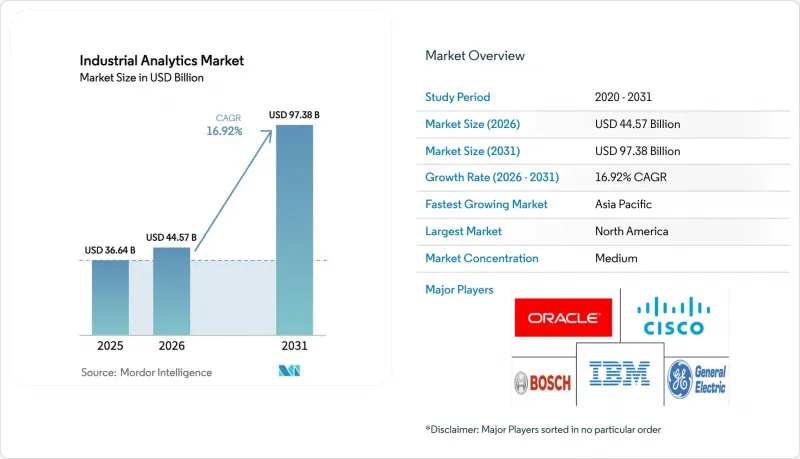
This report is Segmented by Deployment (On-Premises, and Cloud), Component (Software, and Services), Analytics Type (Predictive Analytics, and More), End-User Industry (Manufacturing, Construction, and More), Organization Size (Small and Medium-Sized Enterprises, and More), Application (Asset Performance Management, and More), and Geography. The Market Forecasts are Provided in Terms of Value (USD).
Global Industrial Analytics Market Trends and Insights
Expansion of Edge Computing Capabilities
Edge-localized inference eliminates network bottlenecks for latency-sensitive tasks such as robotic path planning, vision-based quality checks, and substation fault isolation. Honeywell and Google Cloud deployed micro-nodes that process sensor streams on-site, reducing bandwidth costs by 30%. IBM shipped 15-watt edge devices that run predictive models on offshore platforms where connectivity is sporadic. Microsoft Azure Stack integrates seamlessly with Siemens Industrial Edge, allowing manufacturers to train centrally and then push compressed weights to shop-floor gateways. Such architectures ensure uninterrupted operations when networks fail and allow real-time control loops to operate within single-digit millisecond windows. Resulting productivity gains make edge computing one of the highest-impact catalysts for the industrial analytics market.
Integration of Industrial AI in Low-Code Platforms
Drag-and-drop workflows seamlessly embed analytics into maintenance, quality, and logistics processes, eliminating the need for Python or SQL skills. Bain research showed a 60% reduction in deployment time when plants used low-code tools versus traditional programming. Microsoft Power Platform now ships with anomaly-detection models tuned for pumps, motors, and compressors. IFS and ServiceNow link sensor events to work-order generation, allowing technicians to receive prescriptive actions instantly. McKinsey's 2025 Lighthouse Network found that factories that embraced low-code recorded 25% faster root-cause analyses. The ease of configuration lowers barriers for small plants and accelerates the diffusion of industrial analytics market best practices.
Data-Sovereignty Concerns in Cross-Border Cloud Deployments
China's Data Security Law forces multinationals to store operational data on domestic servers, preventing global data-lake consolidation. The EU's GDPR restricts the exporting of employee biometrics used in access control, driving vendors to set up regional inference clusters. India's draft Digital Personal Data Protection Act may adopt similar localization clauses. Each silo raises infrastructure costs, fragments model training, and slows feature rollouts. For the industrial analytics market, this introduces friction that vendors can only mitigate with edge or hybrid architectures.
Other drivers and restraints analyzed in the detailed report include:
- Proliferation of 5G-Enabled Industrial IoT Networks
- Regulatory Push for Energy-Efficient Operations
- Shortage of Industrial-Domain-Specific Data Scientists
For complete list of drivers and restraints, kindly check the Table Of Contents.
Segment Analysis
Cloud-based implementations accounted for 59.12% of the industrial analytics market share in 2025, as manufacturers adopted consumption pricing and pre-trained models. The industrial analytics market size for cloud deployments is projected to expand at a 17.09% CAGR, driven by integrations with Microsoft Azure, AWS IoT SiteWise, and Google Cloud Vertex AI. On-premises systems continue to serve latency-critical workflows in defense and pharmaceutical industries, accounting for 40.88% of demand. Hybrid use cases are multiplying. Schneider Electric's EcoStruxure synchronizes models bi-directionally, allowing regulatory data to remain on-site while benefiting from cloud-based retraining. ABB's Ability Genix offers similar advantages, demonstrating how federated architectures can satisfy sovereignty, uptime, and scalability within a single stack.
The growing mesh of local gateways and centralized MLOps pipelines enables firms to retain sensitive data while benchmarking performance against anonymized peer metrics in the cloud. This blended approach resonates with multinational manufacturers juggling multiple jurisdictions. As orchestration tooling matures, hybrid architectures are expected to dominate new deployments, cementing their role at the core of future industrial analytics market growth.
Software represented 62.34% revenue in 2025, but services are catching up fast with a 17.21% CAGR through 2031. Enterprises outsource sensor integration, feature engineering, and continuous model tuning to partners such as Accenture, Deloitte, and PwC. As a result, the industrial analytics market size for services is expanding faster than the software layer. Vendors, ranging from SAP and IBM to Siemens, bundle managed offerings that include equipment profile libraries, anomaly threshold calibration, and security patching.
Because industrial assets age and process variables drift, analytics initiatives require perpetual recalibration. Customers rely on system integrators to embed change management and domain expertise. This service-centric model transforms analytics from a capital purchase into an operational expenditure, deepening vendor-client relationships and fostering recurring revenue streams that will shape the industrial analytics market through 2031.
Complete Report Scope:
- By Deployment
- On-Premises
- Cloud
- By Component
- Software
- Services
- By Analytics Type
- Descriptive Analytics
- Predictive Analytics
- Prescriptive Analytics
- By End-User Industry
- Manufacturing
- Construction
- Mining
- Transportation and Logistics
- Utilities
- Other End-User Industry
- By Organization Size
- Large Enterprises
- Small and Medium-Sized Enterprises
- By Application
- Asset Performance Management
- Quality and Process Optimization
- Supply-Chain and Inventory Analytics
- Energy Management
- Safety and Risk Analytics
- By Geography
- North America
- United States
- Canada
- Mexico
- Europe
- Germany
- United Kingdom
- France
- Russia
- Rest of Europe
- Asia-Pacific
- China
- Japan
- India
- South Korea
- Australia
- Rest of Asia-Pacific
- Middle East and Africa
- Middle East
- Saudi Arabia
- United Arab Emirates
- Rest of Middle East
- Africa
- South Africa
- Egypt
- Rest of Africa
- Middle East
- South America
- Brazil
- Argentina
- Rest of South America
- North America
Geography Analysis
North America contributed 38.29% of the industrial analytics market share in 2025, driven by investments in the semiconductor, automotive, and oil and gas sectors, linked to the CHIPS and Science Act. Federal incentives stipulate digital-twin capabilities, catalyzing analytics deployments across greenfield fabs. Canada's Strategic Innovation Fund backed aerospace and EV battery pilots, while Mexican nearshoring projects embraced cloud-edge hybrids to accelerate plant commissioning. Fragmented state privacy laws raise compliance overhead but also spur demand for governance modules, indirectly benefiting software vendors.
Asia-Pacific is forecast to record a 17.96% CAGR through 2031. China ties subsidies to smart-manufacturing metrics, pushing factories to retrofit lines with digital twins. India's Production-Linked Incentive scheme requires real-time quality analytics for reimbursement eligibility, creating a multiplier effect for the industrial analytics market. Japan's Society 5.0 promotes human-robot collaboration powered by fatigue-prediction models, while South Korea's smart-factory program subsidizes the adoption of SME analytics. Australia's mining sites utilize edge analytics to enhance haul-truck efficiency, while Southeast Asian exporters implement compliance dashboards to meet EU due diligence requirements.
Europe's growth story revolves around sustainability compliance. The Corporate Sustainability Reporting Directive promotes equipment-level energy audits, while Germany's Industrie 4.0 grants encourage mid-size manufacturers to adopt digital twins. France's Industry of the Future tax incentives and the United Kingdom's Made Smarter grants further expand demand. Eastern markets remain nascent, but local vendors in Russia tailor offerings to national standards to circumvent import restrictions, adding regional flavor to the industrial analytics market.
The Middle East and Africa, along with South America, represent emerging growth pockets. Saudi Arabia's Vision 2030 drives analytics for petrochemicals and utilities, and South Africa's mines deploy safety analytics to detect gas leaks. Brazil's agribusiness chains integrate precision agriculture with food-processing analytics, and Argentina's lithium producers utilize models to reduce water usage. Although absolute spend is lower than in developed regions, pilot projects are accelerating across these territories, widening the global footprint of the industrial analytics market.
- Cisco Systems
- IBM Corporation
- General Electric Company
- Amazon Web Services Inc.
- Oracle Corporation
- Hewlett-Packard Enterprise
- Robert Bosch GmbH
- Microsoft Corporation
- SAP SE
- ABB Ltd.
- Siemens AG
- Hitachi Ltd.
- Honeywell International Inc.
- Schneider Electric SE
- SAS Institute Inc.
- Splunk Inc.
- Rockwell Automation Inc.
- PTC Inc.
- Intel Corporation
- Uptake Technologies Inc.
Additional Benefits:
- The market estimate (ME) sheet in Excel format
- 3 months of analyst support
TABLE OF CONTENTS
1 INTRODUCTION
- 1.1 Study Assumptions and Market Definition
- 1.2 Scope of the Study
2 RESEARCH METHODOLOGY
3 EXECUTIVE SUMMARY
4 MARKET LANDSCAPE
- 4.1 Market Overview
- 4.2 Market Drivers
- 4.2.1 Expansion of Edge Computing Capabilities
- 4.2.2 Integration of Industrial AI in Low-Code Platforms
- 4.2.3 Proliferation of 5G-Enabled Industrial IoT Networks
- 4.2.4 Regulatory Push for Energy-Efficient Operations
- 4.2.5 Standardization of Digital Twins Across Asset-Intensive Sectors
- 4.2.6 Mainstream Adoption of Pay-per-Use Analytics Models
- 4.3 Market Restraints
- 4.3.1 Data-Sovereignty Concerns in Cross-Border Cloud Deployments
- 4.3.2 Shortage of Industrial-Domain-Specific Data Scientists
- 4.3.3 Cyber-physical Security Vulnerabilities in OT Networks
- 4.3.4 Legacy Equipment Integration Costs
- 4.4 Industry Value Chain Analysis
- 4.5 Regulatory Landscape
- 4.6 Technological Outlook
- 4.7 Impact of Macroeconomic Factors on the Market
- 4.8 Porter's Five Forces Analysis
- 4.8.1 Bargaining Power of Suppliers
- 4.8.2 Bargaining Power of Buyers
- 4.8.3 Threat of New Entrants
- 4.8.4 Threat of Substitutes
- 4.8.5 Intensity of Competitive Rivalry
5 MARKET SIZE AND GROWTH FORECASTS (VALUE)
- 5.1 By Deployment
- 5.1.1 On-Premises
- 5.1.2 Cloud
- 5.2 By Component
- 5.2.1 Software
- 5.2.2 Services
- 5.3 By Analytics Type
- 5.3.1 Descriptive Analytics
- 5.3.2 Predictive Analytics
- 5.3.3 Prescriptive Analytics
- 5.4 By End-User Industry
- 5.4.1 Manufacturing
- 5.4.2 Construction
- 5.4.3 Mining
- 5.4.4 Transportation and Logistics
- 5.4.5 Utilities
- 5.4.6 Other End-User Industry
- 5.5 By Organization Size
- 5.5.1 Large Enterprises
- 5.5.2 Small and Medium-Sized Enterprises
- 5.6 By Application
- 5.6.1 Asset Performance Management
- 5.6.2 Quality and Process Optimization
- 5.6.3 Supply-Chain and Inventory Analytics
- 5.6.4 Energy Management
- 5.6.5 Safety and Risk Analytics
- 5.7 By Geography
- 5.7.1 North America
- 5.7.1.1 United States
- 5.7.1.2 Canada
- 5.7.1.3 Mexico
- 5.7.2 Europe
- 5.7.2.1 Germany
- 5.7.2.2 United Kingdom
- 5.7.2.3 France
- 5.7.2.4 Russia
- 5.7.2.5 Rest of Europe
- 5.7.3 Asia-Pacific
- 5.7.3.1 China
- 5.7.3.2 Japan
- 5.7.3.3 India
- 5.7.3.4 South Korea
- 5.7.3.5 Australia
- 5.7.3.6 Rest of Asia-Pacific
- 5.7.4 Middle East and Africa
- 5.7.4.1 Middle East
- 5.7.4.1.1 Saudi Arabia
- 5.7.4.1.2 United Arab Emirates
- 5.7.4.1.3 Rest of Middle East
- 5.7.4.2 Africa
- 5.7.4.2.1 South Africa
- 5.7.4.2.2 Egypt
- 5.7.4.2.3 Rest of Africa
- 5.7.4.1 Middle East
- 5.7.5 South America
- 5.7.5.1 Brazil
- 5.7.5.2 Argentina
- 5.7.5.3 Rest of South America
- 5.7.1 North America
6 COMPETITIVE LANDSCAPE
- 6.1 Market Concentration
- 6.2 Strategic Moves
- 6.3 Market Share Analysis
- 6.4 Company Profiles (includes Global Level Overview, Market Level Overview, Core Segments, Financials as available, Strategic Information, Market Rank/Share for key companies, Products and Services, and Recent Developments)
- 6.4.1 Cisco Systems
- 6.4.2 IBM Corporation
- 6.4.3 General Electric Company
- 6.4.4 Amazon Web Services Inc.
- 6.4.5 Oracle Corporation
- 6.4.6 Hewlett-Packard Enterprise
- 6.4.7 Robert Bosch GmbH
- 6.4.8 Microsoft Corporation
- 6.4.9 SAP SE
- 6.4.10 ABB Ltd.
- 6.4.11 Siemens AG
- 6.4.12 Hitachi Ltd.
- 6.4.13 Honeywell International Inc.
- 6.4.14 Schneider Electric SE
- 6.4.15 SAS Institute Inc.
- 6.4.16 Splunk Inc.
- 6.4.17 Rockwell Automation Inc.
- 6.4.18 PTC Inc.
- 6.4.19 Intel Corporation
- 6.4.20 Uptake Technologies Inc.
7 MARKET OPPORTUNITIES AND FUTURE OUTLOOK
- 7.1 White-Space and Unmet-Need Assessment

