PUBLISHER: Mordor Intelligence | PRODUCT CODE: 2122535

PUBLISHER: Mordor Intelligence | PRODUCT CODE: 2122535
Perms And Relaxants - Market Share Analysis, Industry Trends & Statistics, Growth Forecasts (2026 - 2031)
According to Mordor Intelligence, the perms and relaxants market size is expected to grow from USD 1.98 billion in 2025 to USD 2.02 billion in 2026 and is forecast to reach USD 2.24 billion by 2031 at 2.08% CAGR over 2026-2031.
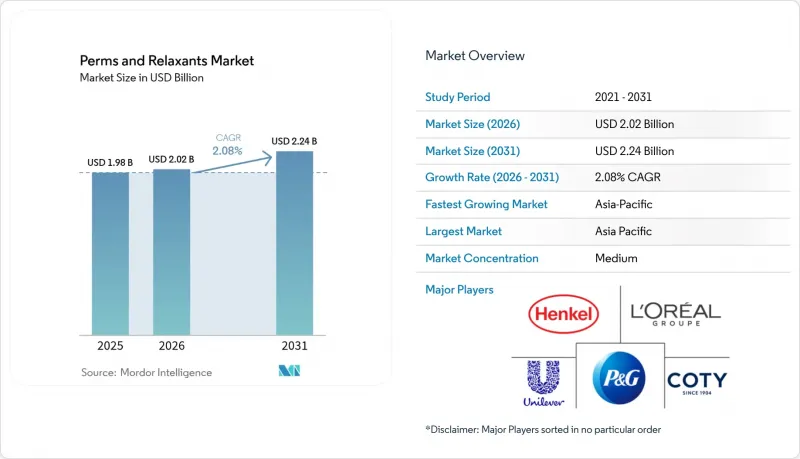
This report is Segmented by Product Type (Perms, Relaxants), Form (Creams/Lotions, Liquids/Solutions, Gels, Others), Distribution Channel (Professional Channels, Retail Channels Including Supermarkets/Hypermarkets, Drugstores/Pharmacies, and More), and Geography (North America, Europe, Asia-Pacific, South America, Middle East and Africa). The Market Forecasts are Provided in Terms of Value (USD).
Global Perms And Relaxants Market Trends and Insights
Rising demand for texture management solutions
Consumer demand for texture modification remains a central driver in the haircare market; however, the underlying motivation has shifted from uniformity to versatility. Industry professionals observe a growing preference for temporary or reversible texture changes, such as perms to enhance volume or relaxants to improve manageability, rather than permanent alterations. This trend is reinforced by social-media platforms, where users frequently display multiple hairstyles over short periods. By late 2024, TikTok's #RelaxerTok had garnered over 600 million views, highlighting that, despite health advisories, a segment of consumers prioritizes aesthetic control. For manufacturers, this signals a clear requirement: product formulations must strike a balance between performance and safety, while marketing strategies should emphasize flexibility over permanence, reflecting the episodic styling behaviors of digitally native consumers.
Growth in professional salon services
Professional channels accounted for 56.28% of market distribution in 2024, underscoring consumers' readiness to pay a premium for expert application when chemical treatments present potential health risks. Salon professionals receive specialized training to minimize scalp contact and limit exposure duration, capabilities that over-the-counter kits often struggle to match. Under the EU's Regulation 1223/2009, thioglycolic acid is permitted at concentrations of up to 11% for professional formulations, compared with 8% for consumer-use products, effectively embedding a regulatory advantage for salon-based services. Nevertheless, the professional segment is experiencing margin pressures driven by rising labor costs and growing competition from direct-to-consumer brands that provide instructional content and virtual guidance. These dynamics indicate that the salon channel will need to adopt integrated digital engagement strategies to maintain its competitive position.
Concerns over chemical safety and hair damage
Heightened health concerns and expanding legal exposure are reshaping the chemical straightening category. NIH research in 2022 linked frequent straightener use to a 4.05% lifetime uterine cancer risk versus 1.64% for non-users, helping trigger more than 8,500 consolidated federal lawsuits alleging undisclosed endocrine-disrupting hazards. The 2023 Black Women's Health Study reported a 30% elevated risk among Black women using lye-based relaxers seven or more times per year for over 15 years, an acute concern for a demographic with 60% current usage and lifetime penetration of 84% to 95%. Trust eroded further when New York State's Department of Health detected formaldehyde in products labeled "formaldehyde-free," prompting additional class actions against major manufacturers. As litigation pressures margins and accelerates reformulation, even as companies dispute causation, closing the credibility gap will require transparent ingredient disclosure, rigorous safety validation, and independent third-party testing.
Other drivers and restraints analyzed in the detailed report include:
- Expanding influence of beauty and social media trends
- Innovation in low-damage and clean formulations
- Regulatory scrutiny on ingredients
For complete list of drivers and restraints, kindly check the Table Of Contents.
Segment Analysis
In 2025, relaxants accounted for 53.02% of the market, reflecting entrenched demand in regions that favor straight-hair aesthetics. Meanwhile, perms are projected to grow at a 4.68% CAGR through 2031, driven by wave and curl trends amplified on Instagram and TikTok. This divergence highlights a generational shift: older consumers maintain relaxant routines for manageability, whereas younger cohorts seek texture for volume and movement. L'Oreal's April 2025 patent for an aerosol-based dye system with potential perm applications illustrates the company's investment in delivery innovation to capture faster-growing segments. Regulatory changes, such as Canada's February 2025 ban on thioglycolic acid esters, are prompting manufacturers to adopt alternative reducing agents like cysteamine or enzymatic processes, aligning with clean-beauty positioning.
Relaxants face added complexity from litigation over elevated uterine cancer risk, with over 8,500 federal lawsuits creating a margin and marketing overhang, even as TikTok's #RelaxerTok surpassed 600 million views, demonstrating social-media influence on consumer behavior. Africa remains a growth opportunity, with countries such as Tunisia and Kenya posting ~10% sales growth over five years ending 2022, fueled by expanding middle classes and aspirational views of texture management. Strategically, relaxant brands must balance legacy formulations for mature markets with reformulated, formaldehyde-free variants tailored to regions with tightening regulations.
Complete Report Scope:
- By Product Type
- Perms
- Relaxants
- By Form
- Creams / Lotions
- Liquids / Solutions
- Gels
- Others
- By Distribution Channel
- Professional Channels
- Retail Channels
- Supermarkets / Hypermarkets
- Drugstores / Pharmacies
- Convenience Stores
- Online Stores
- Other Retail Channel
- By Geography
- North America
- United States
- Canada
- Mexico
- Rest of North America
- Europe
- Germany
- United Kingdom
- Italy
- France
- Spain
- Netherlands
- Rest of Europe
- Asia-Pacific
- China
- India
- Japan
- Australia
- Rest of Asia-Pacific
- South America
- Brazil
- Argentina
- Rest of South America
- Middle East and Africa
- South Africa
- Saudi Arabia
- United Arab Emirates
- Rest of Middle East and Africa
- North America
Geography Analysis
Asia-Pacific accounted for 34.05% of the perms and relaxants market in 2025 and is projected to grow at a 3.92% CAGR through 2031, the fastest among regions, driven by rising disposable incomes, a youthful, influencer-guided demographic, and regulatory frameworks in China and Japan that support ingredient innovation. China's NMPA expanded its cosmetic-ingredient database from 2,234 to 3,608 entries in February 2025 and offers subsidies of RMB 5 million for demonstration zones and RMB 1 million per new ingredient, incentivizing localized R&D. Japan updated its Standards of Quasi-drug Ingredients in March 2025, while South Korea issued usage precautions for eyelash perm products in September 2024, reflecting proactive consumer-safety measures.
North America and Europe face contrasting dynamics: the U.S. FDA's proposed formaldehyde ban remains unpublished after multiple delays, while California and Maryland have implemented state-level bans effective in 2025. NIH studies linking frequent straightener use to uterine cancer have fueled over 8,500 lawsuits, creating litigation overhangs that constrain marketing and innovation. Europe enforces Regulation 1223/2009, limiting thioglycolic acid to 8% for general use and 11% for professional applications, with France banning per- and polyfluoroalkyl substances by early 2026, while Canada prohibited thioglycolic acid esters in February 2025, collectively increasing reformulation demands and reputational risk.
South America, the Middle East, and Africa offer growth opportunities amid enforcement challenges: Brazil's ANVISA Resolution 907 mandates product registration and bans animal testing, though illicit products remain prevalent; Godrej, L'Oreal Dark & Lovely, and Namaste's ORS Olive Oil dominate African haircare, while the Middle East, led by Saudi Arabia and the UAE, sees rising beauty spending driven by female workforce participation, despite limited market-size transparency.
- L'Oreal SA
- Procter & Gamble Co.
- Unilever PLC
- Henkel AG & Co. KGaA
- Coty Inc.
- Kao Corporation
- Shiseido Company Ltd.
- Revlon Inc.
- Godrej Consumer Products Ltd.
- Makarizo International
- Jotoco Corp.
- Kadus Professional
- Amka Products (Pty) Ltd.
- Sally Beauty Holdings Inc.
- Farouk Systems Inc.
- Avon Products Inc.
- Amorepacific Corp.
- Namaste Laboratories LLC (ORS)
- TIGI International Ltd.
- Milbon Co., Ltd.
Additional Benefits:
- The market estimate (ME) sheet in Excel format
- 3 months of analyst support
TABLE OF CONTENTS
1 INTRODUCTION
- 1.1 Study Assumptions and Market Definition
- 1.2 Scope of the Study
2 RESEARCH METHODOLOGY
3 EXECUTIVE SUMMARY
4 MARKET DYNAMICS
- 4.1 Market Overview
- 4.2 Market Drivers
- 4.2.1 Rising demand for texture management solutions
- 4.2.2 Growth in professional salon services
- 4.2.3 Expanding influence of beauty and social media trends
- 4.2.4 Increased focus on long-lasting styling solutions
- 4.2.5 Growth in ethnic hair care demand
- 4.2.6 Innovation in low-damage and clean formulations
- 4.3 Market Restraints
- 4.3.1 Concerns over chemical safety and hair damage
- 4.3.2 Regulatory scrutiny on ingredients
- 4.3.3 Shift toward natural hair movements
- 4.3.4 High cost of professional salon services
- 4.4 Consumer Behavior Analysis
- 4.5 Regulatory Landscape
- 4.6 Porter's Five Forces
- 4.6.1 Threat of New Entrants
- 4.6.2 Bargaining Power of Buyers
- 4.6.3 Bargaining Power of Suppliers
- 4.6.4 Threat of Substitute Products
- 4.6.5 Intensity of Competitive Rivalry
5 MARKET SIZE AND GROWTH FORECASTS (VALUE)
- 5.1 By Product Type
- 5.1.1 Perms
- 5.1.2 Relaxants
- 5.2 By Form
- 5.2.1 Creams / Lotions
- 5.2.2 Liquids / Solutions
- 5.2.3 Gels
- 5.2.4 Others
- 5.3 By Distribution Channel
- 5.3.1 Professional Channels
- 5.3.2 Retail Channels
- 5.3.2.1 Supermarkets / Hypermarkets
- 5.3.2.2 Drugstores / Pharmacies
- 5.3.2.3 Convenience Stores
- 5.3.2.4 Online Stores
- 5.3.2.5 Other Retail Channel
- 5.4 By Geography
- 5.4.1 North America
- 5.4.1.1 United States
- 5.4.1.2 Canada
- 5.4.1.3 Mexico
- 5.4.1.4 Rest of North America
- 5.4.2 Europe
- 5.4.2.1 Germany
- 5.4.2.2 United Kingdom
- 5.4.2.3 Italy
- 5.4.2.4 France
- 5.4.2.5 Spain
- 5.4.2.6 Netherlands
- 5.4.2.7 Rest of Europe
- 5.4.3 Asia-Pacific
- 5.4.3.1 China
- 5.4.3.2 India
- 5.4.3.3 Japan
- 5.4.3.4 Australia
- 5.4.3.5 Rest of Asia-Pacific
- 5.4.4 South America
- 5.4.4.1 Brazil
- 5.4.4.2 Argentina
- 5.4.4.3 Rest of South America
- 5.4.5 Middle East and Africa
- 5.4.5.1 South Africa
- 5.4.5.2 Saudi Arabia
- 5.4.5.3 United Arab Emirates
- 5.4.5.4 Rest of Middle East and Africa
- 5.4.1 North America
6 COMPETITIVE LANDSCAPE
- 6.1 Market Concentration
- 6.2 Strategic Moves
- 6.3 Market Share Analysis
- 6.4 Company Profiles (includes Global level Overview, Market level overview, Core Segments, Financials, Strategic Information, Market Rank/Share, Products and Services, Recent Developments)
- 6.4.1 L'Oreal SA
- 6.4.2 Procter & Gamble Co.
- 6.4.3 Unilever PLC
- 6.4.4 Henkel AG & Co. KGaA
- 6.4.5 Coty Inc.
- 6.4.6 Kao Corporation
- 6.4.7 Shiseido Company Ltd.
- 6.4.8 Revlon Inc.
- 6.4.9 Godrej Consumer Products Ltd.
- 6.4.10 Makarizo International
- 6.4.11 Jotoco Corp.
- 6.4.12 Kadus Professional
- 6.4.13 Amka Products (Pty) Ltd.
- 6.4.14 Sally Beauty Holdings Inc.
- 6.4.15 Farouk Systems Inc.
- 6.4.16 Avon Products Inc.
- 6.4.17 Amorepacific Corp.
- 6.4.18 Namaste Laboratories LLC (ORS)
- 6.4.19 TIGI International Ltd.
- 6.4.20 Milbon Co., Ltd.
7 MARKET OPPORTUNITIES AND FUTURE TRENDS

