PUBLISHER: Mordor Intelligence | PRODUCT CODE: 2122547

PUBLISHER: Mordor Intelligence | PRODUCT CODE: 2122547
Cigarette - Market Share Analysis, Industry Trends & Statistics, Growth Forecasts (2026 - 2031)
According to Mordor Intelligence, the cigarette market size is valued at USD 770.89 billion in 2026, growing from the 2025 value of USD 762.34 billion, and is forecast to climb to USD 821.21 billion by 2031, advancing at a 2.25% CAGR during the forecast period.
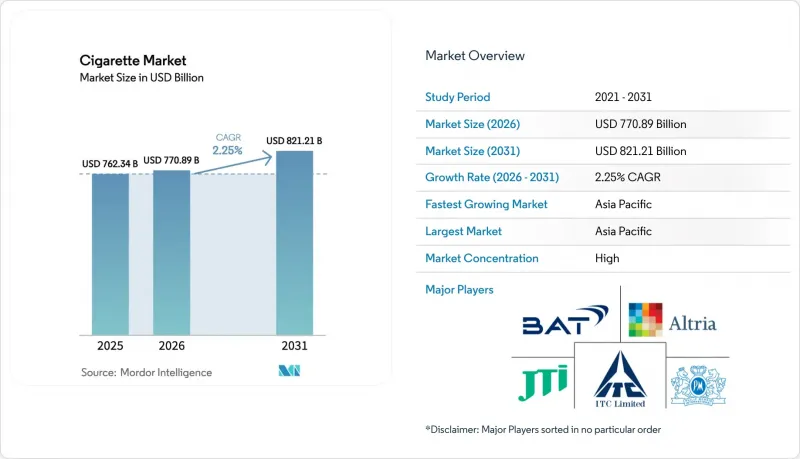
This report is Segmented by Flavor Type (Flavored and Conventional); Format (Slim, Super Slim, King Size, and Regular), Category (Mass and Premium), End User (Men and Women), Distribution Channel (Convenience/Grocery Stores, Specialty Stores and More), and Geography (North America, Europe, Asia-Pacific, South America, and Middle East and Africa). The Market Forecasts are Provided in Terms of Value (USD).
Global Cigarette Market Trends and Insights
Nicotine Addiction Ensuring Resilient Consumer Loyalty
Longitudinal studies indicate that 70% to 80% of daily smokers sustain their consumption levels despite a 20% to 30% increase in excise taxes. This persistence, driven by nicotine's addictive properties, is particularly prominent in the Asia-Pacific region. In this area, cultural acceptance of smoking and limited cessation support contribute to relapse rates exceeding 85% within a year of quit attempts. In the European Union, the Tobacco Products Directive requires health warnings to cover 65% of cigarette pack surfaces. However, between 2020 and 2025, EU cigarette sales declined by only 1.8% annually, demonstrating the minimal impact of visual deterrents on habitual smokers. Similarly, the China National Tobacco Corporation's 2025 report revealed that, despite a 15% increase in retail prices since 2022, male smokers aged 35 to 54 consistently consumed 14.2 cigarettes daily. This indicates that price elasticity is nearly zero for core users. Such steadfast loyalty ensures stable cash flows for tobacco companies, enabling them to invest in reduced-risk products while maintaining traditional portfolios as key profit generators.
Rising Premiumization Trend
Affluent consumers in China, Japan, and Western Europe are increasingly choosing premium cigarette brands priced above USD 8 per pack, associating them with status and perceived quality. Consequently, the premium cigarette segment is growing at an annual rate of 4.02%, nearly twice the overall market rate. In 2025, Philip Morris International's Marlboro Gold and Parliament lines recorded a 6.3% volume growth in the Asia-Pacific. This growth was primarily driven by urban professionals in cities such as Shanghai, Tokyo, and Seoul, who perceive these premium formats as offering reduced tar delivery and superior flavor profiles. Similarly, British American Tobacco's Dunhill and Rothmans brands expanded their share of Europe's premium segment from 18% in 2023 to 22% in 2025. This increase was achieved by emphasizing their heritage and introducing limited-edition packaging, which commands a 40% to 50% price premium over mass-market alternatives. Excise tax structures further support this trend by applying flat per-unit duties instead of ad-valorem rates, making premium cigarettes relatively more affordable on a percentage basis. In 2025, Japan Tobacco's Mevius brand, priced at JPY 600 (USD 4.20) per pack, experienced a 4.1% rise in domestic volume. This growth occurred as smokers consolidated their purchases into fewer, higher-quality sticks, avoiding discount alternatives.
Stringent Regulations Like Nicotine Caps and Plain Packaging
Plain packaging mandates and nicotine content ceilings are diminishing brand equity, which has traditionally supported premium pricing. In April 2024, Australia finalized its Tobacco Plain Packaging Act, requiring all tobacco packs to feature a standardized olive-brown color and uniform typography. Only small brand names are now allowed to differentiate products, as mandated by the Australian Government. Canada's regulations, fully implemented in 2025, go further by requiring health warnings to be displayed on individual cigarettes in addition to the packaging. If the FDA's proposed nicotine cap of 0.7 milligrams per gram is approved, manufacturers will need to reformulate their blends, potentially reducing the sensory satisfaction that underpins brand loyalty. Philip Morris International's 2025 investor presentation noted that plain packaging in the UK and Australia resulted in a 15% to 20% decline in premium-brand volume within 18 months, as consumers shifted to cheaper alternatives when visual branding elements were removed. These regulatory changes favor larger players with cost-efficient production and extensive distribution networks, while smaller brands that rely on packaging aesthetics face significant challenges.
Other drivers and restraints analyzed in the detailed report include:
- Rising Disposable Incomes in Emerging Markets
- Technological Advancements in Production
- Health awareness of tobacco risks
For complete list of drivers and restraints, kindly check the Table Of Contents.
Segment Analysis
In 2025, Conventional products accounted for 85.24% of the cigarette market share, maintaining their dominant position. Flavored variants, however, are projected to grow at a CAGR of 3.45%, primarily due to the adoption of capsule technology, which effectively bypasses direct menthol bans. Following the EU's 2020 menthol prohibition, capsule cigarettes, led by popular brands such as Marlboro Ice Blast and Lucky Strike Click, managed to recover 60% of the flavored segment's lost volume. Meanwhile, regulators in the Asia-Pacific region are deliberating broader flavor bans, with Hong Kong already implementing a total ban set to take effect in 2027. In anticipation of these regulatory changes, manufacturers are diversifying their portfolios by investing in nicotine pouches and heated-tobacco sticks, which deliver flavor without violating restrictions on combustible products.
The growth trajectory of flavored products remains uneven across regions. Europe and North America are driving innovation in this segment, introducing new and diverse flavor options to attract consumers. In contrast, markets such as China and India continue to favor the traditional taste of straight tobacco. In the United States, regulatory pressures are intensifying, with potential restrictions on menthol and capsule products posing a significant threat to the flavored segment. These measures could result in the loss of up to 20% of flavored sales. Despite these challenges, the diversification of flavors continues to resonate with younger adult smokers, ensuring the segment's sustained outperformance and reinforcing its appeal in an evolving market landscape.
In 2025, king-size cigarettes accounted for 52.38% of the market volume. However, super-slim cigarette lines are witnessing significant growth, expanding at a 3.32% CAGR. This growth reflects a deliberate strategy to target women and younger adults, who are increasingly drawn to these formats. British American Tobacco's Vogue and Philip Morris's Virginia Slims recorded a notable 5.7% increase in volume across Europe and North America in 2025. Additionally, Japan Tobacco's Pianissimo achieved a 9.2% share in the domestic market, further solidifying its position. Slim cigarette formats command a price premium of 20%-30%, attributed to their specialized production processes.
Despite their popularity, public health organizations emphasize that slimmer diameters do not mitigate toxicant exposure. In line with this, the WHO has recommended banning descriptors that imply a lower health risk to consumers. Regular cigarette formats continue to dominate in price-sensitive markets such as India and Indonesia, where affordability plays a critical role in consumer preferences. On the other hand, super-slim cigarette sticks remain a niche product outside of South Korea and Japan but are instrumental in reinforcing premium brand positioning. Innovations in filter design and paper porosity have been pivotal in maintaining optimal draw resistance and flavor delivery, even with reduced tobacco content, ensuring that consumer satisfaction is not compromised.
Complete Report Scope:
- Flavor Type
- Flavored
- Unflavored
- Format
- Slim
- Super Slim
- King Size
- Regular
- Category
- Mass
- Premium
- End User
- Men
- Women
- Distribution Channels
- Convenience/Grocery Stores
- Specialty Stores
- Online Retail Stores
- Other Distribution Channels
- Geography
- North America
- United States
- Canada
- Mexico
- Rest of North America
- Europe
- Germany
- United Kingdom
- Italy
- France
- Spain
- Netherlands
- Poland
- Belgium
- Sweden
- Rest of Europe
- Asia-Pacific
- China
- India
- Japan
- Australia
- Indonesia
- South Korea
- Thailand
- Singapore
- Rest of Asia-Pacific
- South America
- Brazil
- Argentina
- Colombia
- Chile
- Peru
- Middle East and Africa
- South Africa
- Saudi Arabia
- United Arab Emirates
- Nigeria
- Egypt
- Morocco
- Turkey
- Rest of Middle East and Africa
- North America
Geography Analysis
Asia-Pacific, which accounted for 48.26% of the 2025 market share, is expected to lead all regions with an annual growth rate of 3.47% through 2031. This growth is attributed to a large population, increasing incomes, and relatively relaxed regulatory environments. China, contributing 40% to 45% of global cigarette consumption, sees its China National Tobacco Corporation producing over 2.3 trillion sticks annually. However, per-capita consumption has stabilized at 14.2 cigarettes daily for male smokers as urbanization and growing health awareness limit growth. In India, the cigarette market expanded by 4.1% in 2025, driven by growth in formal-sector employment and a shift from beedis and loose tobacco. Brands like Gudang Garam and Djarum leveraged cultural preferences for spiced tobacco and faced minimal regulatory challenges. Japan's market, while contracting with a 2.1% volume decline in 2025, maintained value growth through premiumization. Brands such as Japan Tobacco's Mevius and Seven Stars commanded prices exceeding JPY 600 (USD 4.20) per pack.
Europe, which held 22% to 24% of the 2025 market share, is experiencing annual volume declines of 1.2% to 1.8%. Factors such as plain packaging, high excise taxes, and widespread smoking bans are reducing consumption. The UK's Tobacco and Vapes Bill, passed in November 2024, aims to phase out the legal market over 15 to 20 years by banning sales to individuals born after January 1, 2009. In Germany, Europe's largest market, cigarette sales fell by 2.3% in 2025. However, premium brands like Marlboro and Dunhill gained market share as consumers shifted towards fewer, higher-quality sticks. The European Commission's proposed excise duty increase, which will raise minimum rates to EUR 3.60 per pack by 2027, is expected to further suppress demand. This impact will be particularly pronounced in Eastern European countries like Poland and Romania, where prices currently remain 50% to 60% lower than in Western Europe.
North America, which accounted for 15% to 17% of 2025 sales, is witnessing volume declines exceeding 2.5% annually in both the U.S. and Canada as smoking prevalence falls below 12% of adults. The FDA's January 2025 proposal to cap nicotine levels at 0.7 milligrams per gram represents a historic regulatory intervention. It aims to reduce the appeal of cigarettes and accelerate the transition to e-cigarettes or cessation. Mexico, however, shows resilience with a 1.2% volume increase in 2025. This growth is supported by a younger demographic and weaker enforcement of smoke-free regulations. South America, led by Brazil, Argentina, and Colombia, contributed 6% to 8% of 2025 sales and is growing at an annual rate of 2.8%. This growth is driven by rising incomes and stable smoking prevalence, which remains between 18% and 22%. While Brazil's National Health Surveillance Agency tightened advertising restrictions in 2024, enforcement remains inconsistent outside major cities. The Middle East and Africa, collectively accounting for 8% to 10% of 2025 sales, are growing at an annual rate of 3.1%. Egypt, Turkey, and South Africa are leading this volume growth, although political instability and currency fluctuations pose challenges. In Nigeria, urban cigarette consumption is growing at a rate of 5% to 6% annually. However, counterfeit products, which account for an estimated 30% to 40% of the market, are hindering formal market expansion.
- China National Tobacco Corporation
- Philip Morris International
- British American Tobacco PLC
- Japan Tobacco International
- Imperial Brands PLC
- Altria Group Inc.
- ITC Limited
- KT&G Corp.
- Gudang Garam Tbk
- Djarum Group
- 22nd Century Group
- Taiwan Tobacco & Liquor Corp.
- VST Industries Ltd.
- Godfrey Phillips India Ltd.
- Vector Group Ltd.
- Scandinavian Tobacco Group
- Smoore International Holdings
- Vietnam National Tobacco Corp.
- PT Wismilak Inti Makmur
- Bulgartabac Holding AD
- Eastern Company S.A.E.
- Karelia Tobacco Company Inc.
Additional Benefits:
- The market estimate (ME) sheet in Excel format
- 3 months of analyst support
TABLE OF CONTENTS
1 INTRODUCTION
- 1.1 Study Assumptions and Market Definition
- 1.2 Scope of the Study
2 RESEARCH METHODOLOGY
3 EXECUTIVE SUMMARY
4 MARKET LANDSCAPE
- 4.1 Market Overview
- 4.2 Market Drivers
- 4.2.1 Nicotine Addiction Ensuring Resilient Consumer Loyalty
- 4.2.2 Rising Premiumization Trend
- 4.2.3 Rising Disposable Incomes in Emerging Markets
- 4.2.4 Technological Advancements in Production
- 4.2.5 Effective Marketing and Peer Influence Sustain Demand Among Millennials
- 4.2.6 Introduction of Herbal and Nicotine-Free Flavors
- 4.3 Market Restraints
- 4.3.1 Stringent Regulations Like Nicotine Caps and Plain Packaging
- 4.3.2 Health Awareness of Tobacco Risks
- 4.3.3 Shift to Smokeless Alternatives Like E-Cigarettes
- 4.3.4 Aggressive Public Health Campaigns
- 4.4 Supply Chain Analysis
- 4.5 Regulatory Outlook
- 4.6 Porter's Five Forces
- 4.6.1 Threat of New Entrants
- 4.6.2 Bargaining Power of Buyers/Consumers
- 4.6.3 Bargaining Power of Suppliers
- 4.6.4 Threat of Substitute Products
- 4.6.5 Intensity of Competitive Rivalry
5 MARKET SIZE AND GROWTH FORECASTS (VALUE)
- 5.1 Flavor Type
- 5.1.1 Flavored
- 5.1.2 Unflavored
- 5.2 Format
- 5.2.1 Slim
- 5.2.2 Super Slim
- 5.2.3 King Size
- 5.2.4 Regular
- 5.3 Category
- 5.3.1 Mass
- 5.3.2 Premium
- 5.4 End User
- 5.4.1 Men
- 5.4.2 Women
- 5.5 Distribution Channels
- 5.5.1 Convenience/Grocery Stores
- 5.5.2 Specialty Stores
- 5.5.3 Online Retail Stores
- 5.5.4 Other Distribution Channels
- 5.6 Geography
- 5.6.1 North America
- 5.6.1.1 United States
- 5.6.1.2 Canada
- 5.6.1.3 Mexico
- 5.6.1.4 Rest of North America
- 5.6.2 Europe
- 5.6.2.1 Germany
- 5.6.2.2 United Kingdom
- 5.6.2.3 Italy
- 5.6.2.4 France
- 5.6.2.5 Spain
- 5.6.2.6 Netherlands
- 5.6.2.7 Poland
- 5.6.2.8 Belgium
- 5.6.2.9 Sweden
- 5.6.2.10 Rest of Europe
- 5.6.3 Asia-Pacific
- 5.6.3.1 China
- 5.6.3.2 India
- 5.6.3.3 Japan
- 5.6.3.4 Australia
- 5.6.3.5 Indonesia
- 5.6.3.6 South Korea
- 5.6.3.7 Thailand
- 5.6.3.8 Singapore
- 5.6.3.9 Rest of Asia-Pacific
- 5.6.4 South America
- 5.6.4.1 Brazil
- 5.6.4.2 Argentina
- 5.6.4.3 Colombia
- 5.6.4.4 Chile
- 5.6.4.5 Peru
- 5.6.5 Middle East and Africa
- 5.6.5.1 South Africa
- 5.6.5.2 Saudi Arabia
- 5.6.5.3 United Arab Emirates
- 5.6.5.4 Nigeria
- 5.6.5.5 Egypt
- 5.6.5.6 Morocco
- 5.6.5.7 Turkey
- 5.6.5.8 Rest of Middle East and Africa
- 5.6.1 North America
6 COMPETITIVE LANDSCAPE
- 6.1 Market Concentration
- 6.2 Strategic Moves
- 6.3 Market Ranking Analysis
- 6.4 Company Profiles (includes Global-level Overview, Market-level Overview, Core Segments, Financials (if available), Strategic Information, Market Rank/Share, Products and Services, Recent Developments)
- 6.4.1 China National Tobacco Corporation
- 6.4.2 Philip Morris International
- 6.4.3 British American Tobacco PLC
- 6.4.4 Japan Tobacco International
- 6.4.5 Imperial Brands PLC
- 6.4.6 Altria Group Inc.
- 6.4.7 ITC Limited
- 6.4.8 KT&G Corp.
- 6.4.9 Gudang Garam Tbk
- 6.4.10 Djarum Group
- 6.4.11 22nd Century Group
- 6.4.12 Taiwan Tobacco & Liquor Corp.
- 6.4.13 VST Industries Ltd.
- 6.4.14 Godfrey Phillips India Ltd.
- 6.4.15 Vector Group Ltd.
- 6.4.16 Scandinavian Tobacco Group
- 6.4.17 Smoore International Holdings
- 6.4.18 Vietnam National Tobacco Corp.
- 6.4.19 PT Wismilak Inti Makmur
- 6.4.20 Bulgartabac Holding AD
- 6.4.21 Eastern Company S.A.E.
- 6.4.22 Karelia Tobacco Company Inc.
7 MARKET OPPORTUNITIES AND FUTURE OUTLOOK

