PUBLISHER: Mordor Intelligence | PRODUCT CODE: 2122575

PUBLISHER: Mordor Intelligence | PRODUCT CODE: 2122575
South America Dietary Supplement - Market Share Analysis, Industry Trends & Statistics, Growth Forecasts (2026 - 2031)
According to Mordor Intelligence, the South America dietary supplements market size is expected to increase from USD 8.85 billion in 2026 to reach USD 12.89 billion by 2031, growing at a CAGR of 6.58% over 2026-2031.
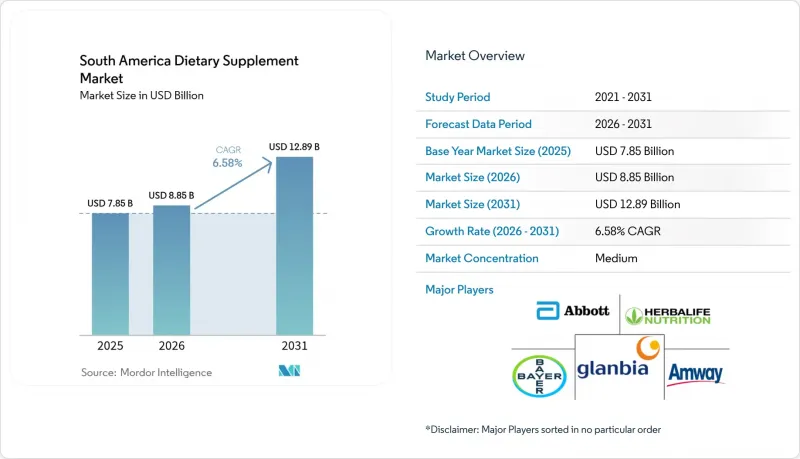
This report is Segmented by Type (Vitamins and Minerals, Herbal Supplements, Fatty Acids, Probiotics, and More), Form (Tablets, Capsules and Softgels, Powders, and More), End User (Men, Women, Kids/Children), Distribution Channel (Supermarkets/Hypermarkets, Health and Wellness Stores, Online Retail Channels, and More), and Geography. The Market Forecasts are Provided in Terms of Value (USD).
South America Dietary Supplement Market Trends and Insights
Increased Focus on Preventive Healthcare
In South America, out-of-pocket health expenditures accounted for 32.4% of total health spending, ranking among the highest globally, according to the World Health Organization. This significant financial burden forces households to independently fund wellness interventions, often as a preventive measure to avoid the high costs associated with advanced medical care, as reported by the World Health Organization. Non-communicable diseases, such as diabetes, hypertension, and cardiovascular disorders, contributed to 77% of deaths in the region, highlighting an urgent demographic need for nutrient-based strategies to mitigate health risks. Additionally, the lack of adequate primary care services in rural and peri-urban areas has further fueled the demand for self-care solutions. Consumers increasingly rely on over-the-counter supplements as a substitute for physician consultations, driven by accessibility challenges and cost considerations. This shift has transformed the role of dietary supplements, positioning them as essential tools for proactive health management rather than optional wellness products. Consequently, this change has significantly influenced both the frequency of purchases and the composition of consumer baskets.
Supplements Targeting Women Consumers Fueling Growth
In 2025, women constituted 35.42% of end-user demand, driven by the growing availability of life-stage-specific formulations tailored to address key health concerns such as prenatal nutrition, menopause management, and bone health. Iron deficiency continues to be a significant issue among women of reproductive age across South America, while calcium and vitamin D supplementation remain critical for preventing osteoporosis in post-menopausal women. Brazil's Rede Cegonha maternal health initiative, supported by the Brazilian Ministry of Health, played a pivotal role in raising awareness about the importance of folic acid and DHA supplementation during pregnancy. This initiative laid a strong clinical foundation for the growth of commercial prenatal brands. In 2024 and 2025, leading companies such as Nestle, Bayer, and Abbott expanded their prenatal product portfolios. These companies leveraged endorsements from gynecologists and implemented pharmacy-based educational campaigns to strengthen their market presence. The segment benefits from a higher willingness-to-pay among female consumers, who prioritize products with transparent ingredient lists and clinical validation. This consumer preference enables brands to command premium pricing compared to mass-market multivitamins.
Presence of Counterfeit Products Hampering Growth
In January 2026, ANVISA banned four supplement brands for failing to meet safety and quality standards. Meanwhile, in October 2025, INVIMA issued Alert 131-2025, cautioning consumers about illegal supplements in Colombia. Counterfeit products not only erode consumer trust in legitimate brands but also amplify the damage when negative media highlights adverse events tied to these substandard formulations. In Brazil, Argentina, and Peru, informal retail channels remain susceptible to unregistered products that lack proper labeling, traceability, or verification of active ingredients. Despite tightening regulations, enforcement gaps endure. Resource-limited agencies find it challenging to inspect cross-border e-commerce shipments and keep tabs on small-scale distributors. When counterfeit versions of their products inflict harm, legitimate manufacturers risk reputational damage. This has led them to invest in anti-counterfeiting technologies, including holographic labels, QR-code authentication, and blockchain-based supply-chain tracking.
Other drivers and restraints analyzed in the detailed report include:
- Growing Preference for Clean-Label, Plant-Based and Vegan Formulas
- Healthy-Ageing Focus Accelerating Multivitamin Uptake Among Consumers
- Rising Consumer Skepticism Toward Synthetic Additives and Mega-Dose Safety Concerns
For complete list of drivers and restraints, kindly check the Table Of Contents.
Segment Analysis
In 2025, vitamins and minerals accounted for 28.18% of the market, reflecting strong consumer trust in multivitamins, vitamin C, and calcium supplements. Probiotics, however, are projected to grow at a 7.62% CAGR through 2031 as gut-health science moves from research to mainstream wellness. Bayer's September 2025 launch of Iberoflora probiotics in Latin America, featuring strains like Lactobacillus rhamnosus GG and Bifidobacterium lactis BB-12, underscores the focus on strain-specific formulations backed by clinical trials. In Brazil and Argentina, where traditional medicine remains significant, herbal supplements with botanicals like chamomile, ginger, and turmeric are gaining traction as natural alternatives to synthetic products. Omega-3 fatty acids, derived from fish oil and algae, support cardiovascular and cognitive health, but consumption in South America remains below WHO recommendations due to limited cold-water fish availability and high costs.
Digestive enzymes such as lactase, amylase, and protease address gastrointestinal sensitivities, while collagen peptides, amino acids, and specialized formulations target athletic performance and beauty-from-within needs. Regulatory clarity from ANVISA's Normative Instruction 28/2018, updated multiple times in 2024, has encouraged innovation by defining permissible ingredients, dosages, and health claims while ensuring consumer safety. Probiotics' rapid growth is driven by clinical validation, physician endorsements, and rising awareness of the gut-brain connection, making them a strategic focus for manufacturers aiming to differentiate beyond standard multivitamins.
In 2025, capsules and softgels accounted for 39.28% of the market share, driven by established manufacturing, precise dosing, and broad consumer acceptance. Gummies, however, are expected to grow at an 8.02% CAGR through 2031, fueled by taste-masking technology and non-pill formats appealing to millennials and pediatric consumers. Gummy production requires specialized equipment and expertise to maintain ingredient stability in humid climates like Brazil and Colombia, creating barriers to entry that benefit established players such as Church & Dwight, Bayer, and Nature's Bounty. Pectin-based gummies have replaced gelatin among vegan consumers, while sugar-free options address concerns about added sugar. However, their premium pricing, 15% to 25% higher than tablets, limits adoption to upper-middle-income households. Tablets remain the most affordable option, attracting price-sensitive consumers and supporting high-potency formulations for larger doses.
Powders serve sports nutrition and meal-replacement needs with dosing flexibility and flavor customization, while liquids cater to pediatric and geriatric populations with swallowing difficulties. Niche formats like effervescent tablets, sublingual strips, and transdermal patches offer convenience or bioavailability benefits, justifying higher prices. Under RDC 843/2024, ANVISA enforces uniform notification requirements across all formats, ensuring gummy manufacturers meet the same standards as capsule producers. The rapid growth of gummies reflects a consumer shift toward wellness products combining efficacy with sensory appeal. This trend pressures established brands to reformulate portfolios or risk losing market share to digitally native brands prioritizing user experience over traditional delivery systems.
Complete Report Scope:
- By Type
- Vitamins And Minerals
- Herbal Supplements
- Fatty Acids
- Probiotics
- Enzymes
- Other Product Types
- By Form
- Tablets
- Capsules And Softgels
- Powders
- Gummies
- Liquids
- Others
- By End User
- Men
- Women
- Kids/Children
- By Distribution Channel
- Supermarkets/Hypermarkets
- Health And Wellness Stores
- Online Retail Channels
- Other Distribution Channels
- By Country
- Brazil
- Argentina
- Chile
- Colombia
- Peru
- Rest Of South America
List of Companies Covered in this Report:
- Tecnoquimicas S.A.
- Grupo Omnilife
- Eurofarma Laboratorios S.A.
- Sabinsa Corporation
- Bayer AG
- Abbott Laboratories
- Amway Corporation
- Herbalife Nutrition Ltd
- Nestle S.A.
- Pfizer Inc.
- Glanbia PLC
- Sanofi S.A.
- Procter & Gamble Co.
- GNC Holdings, LLC.
- NOW Foods
- Nature's Bounty, Inc.
- Blackmores Limited
- Kemin Industries, Inc.
- Shaklee Corporation
- Higher Ground Supplements
Additional Benefits:
- The market estimate (ME) sheet in Excel format
- 3 months of analyst support
TABLE OF CONTENTS
1 INTRODUCTION
- 1.1 Study Assumptions and Market Definition
- 1.2 Scope of the Study
2 RESEARCH METHODOLOGY
3 EXECUTIVE SUMMARY
4 MARKET LANDSCAPE
- 4.1 Market Overview
- 4.2 Market Drivers
- 4.2.1 Increased Focus On Preventive Healthcare
- 4.2.2 Supplements Targeting Women Consumers Fueling Growth
- 4.2.3 Growing Preference For Clean-Label, Plant-Based And Vegan Formulas
- 4.2.4 Healthy-Ageing Focus Accelerating Multivitamin Uptake Among Consumers
- 4.2.5 E-Commerce Growth Enhances Supplement Accessibility And Market Reach
- 4.2.6 Research And Development Investments Drive Innovative Product Development And Targeted Solutions
- 4.3 Market Restraints
- 4.3.1 Presence Of Counterfeit Products Hampering Growth
- 4.3.2 Rising Consumer Scepticism Toward Synthetic Additives And Mega-Dose Safety Concerns
- 4.3.3 Tighter Regulations On Dietary Supplements And Borderline Products
- 4.3.4 Price Wars From Local Producers Reduce Profit Margins
- 4.4 Consumer Behavior Analysis
- 4.5 Regulatory Outlook
- 4.6 Porter's Five Forces
- 4.6.1 Threat of New Entrants
- 4.6.2 Bargaining Power of Buyers/Consumers
- 4.6.3 Bargaining Power of Suppliers
- 4.6.4 Threat of Substitute Products
- 4.6.5 Intensity of Competitive Rivalry
5 MARKET SIZE AND GROWTH FORECASTS (VALUE)
- 5.1 By Type
- 5.1.1 Vitamins And Minerals
- 5.1.2 Herbal Supplements
- 5.1.3 Fatty Acids
- 5.1.4 Probiotics
- 5.1.5 Enzymes
- 5.1.6 Other Product Types
- 5.2 By Form
- 5.2.1 Tablets
- 5.2.2 Capsules And Softgels
- 5.2.3 Powders
- 5.2.4 Gummies
- 5.2.5 Liquids
- 5.2.6 Others
- 5.3 By End User
- 5.3.1 Men
- 5.3.2 Women
- 5.3.3 Kids/Children
- 5.4 By Distribution Channel
- 5.4.1 Supermarkets/Hypermarkets
- 5.4.2 Health And Wellness Stores
- 5.4.3 Online Retail Channels
- 5.4.4 Other Distribution Channels
- 5.5 By Country
- 5.5.1 Brazil
- 5.5.2 Argentina
- 5.5.3 Chile
- 5.5.4 Colombia
- 5.5.5 Peru
- 5.5.6 Rest Of South America
6 COMPETITIVE LANDSCAPE
- 6.1 Market Concentration
- 6.2 Strategic Moves
- 6.3 Market Share Analysis
- 6.4 Company Profiles (includes Global-level Overview, Market-level Overview, Core Segments, Financials (if available), Strategic Information, Market Rank/Share, Products and Services, Recent Developments)
- 6.4.1 Tecnoquimicas S.A.
- 6.4.2 Grupo Omnilife
- 6.4.3 Eurofarma Laboratorios S.A.
- 6.4.4 Sabinsa Corporation
- 6.4.5 Bayer AG
- 6.4.6 Abbott Laboratories
- 6.4.7 Amway Corporation
- 6.4.8 Herbalife Nutrition Ltd
- 6.4.9 Nestle S.A.
- 6.4.10 Pfizer Inc.
- 6.4.11 Glanbia PLC
- 6.4.12 Sanofi S.A.
- 6.4.13 Procter & Gamble Co.
- 6.4.14 GNC Holdings, LLC.
- 6.4.15 NOW Foods
- 6.4.16 Nature's Bounty, Inc.
- 6.4.17 Blackmores Limited
- 6.4.18 Kemin Industries, Inc.
- 6.4.19 Shaklee Corporation
- 6.4.20 Higher Ground Supplements
7 MARKET OPPORTUNITIES AND FUTURE OUTLOOK

