PUBLISHER: Mordor Intelligence | PRODUCT CODE: 2122580

PUBLISHER: Mordor Intelligence | PRODUCT CODE: 2122580
E-pharmacy - Market Share Analysis, Industry Trends & Statistics, Growth Forecasts (2026 - 2031)
According to Mordor Intelligence, the e-pharmacy market size is expected to increase from USD 104.73 billion in 2025 to USD 125.52 billion in 2026 and reach USD 310.38 billion by 2031, growing at a CAGR of 19.85% over 2026-2031.
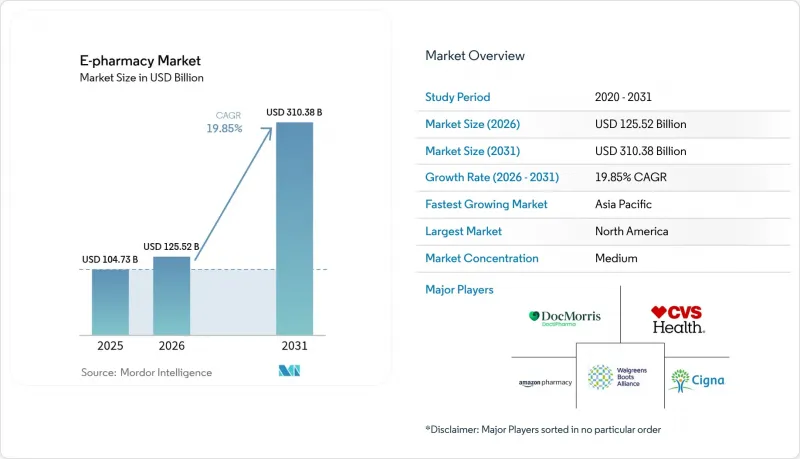
This report is Segmented by Drug Type (Prescription Drugs and Over-The-Counter Drugs), Product Type (Skin Care, and More), Therapeutic Area (Diabetes, Cardiovascular, Respiratory, and More), Platform (Mobile Users and Desktop Users), and Geography (North America, Europe, Asia-Pacific, Middle East & Africa, and South America). The Market Forecasts are Provided in Terms of Value (USD).
Global E-pharmacy Market Trends and Insights
Government Mandates for Electronic Prescriptions
New rules such as the U.S. HTI-4 standardize NCPDP SCRIPT and real-time benefit checks by 2027, removing paper friction and favoring platforms that already run certified APIs. Greece took a similar all-digital stance for public reimbursement in 2024, while the EU targets cross-border exchange in 2025. These mandates compress prescription hand-off times and cut abandonment at the counter, but require independents to fund costly software upgrades. The compliance floor therefore tilts share toward scaled players that can amortize integration costs, deepening consolidation in the E-pharmacy market.
Growing Geriatric Population and Chronic Disease Burden
The world's 60-plus cohort will reach 1.4 billion by 2030, driving medication volume for diabetes, cardiovascular, and respiratory disorders. Automated refill reminders and home shipping solve mobility barriers, lifting adherence and reducing hospital readmissions that payers track under value-based care models. LillyDirect's home insulin delivery exemplifies the convergence of specialty therapy, telehealth, and E-pharmacy fulfillment. These dynamics lock in recurring revenue and reinforce the E-pharmacy market as a clinical partner rather than just a distribution node.
Fragmented International Regulatory Framework
EU cross-border dispensing requires manual re-verification in many states because only 12 of 27 countries exchanged e-prescriptions by mid-2024. India obliges separate state licences, a factor in PharmEasy's valuation crash to USD 458 million in 2024. In the United States, just 53 websites carried NABP's VIPPS seal in 2024. These mismatches add onboarding time, duplicate audits, and legal risk, trimming the E-pharmacy market growth trajectory.
Other drivers and restraints analyzed in the detailed report include:
- Strategic Collaborations Among Payers, PBMs, and E-Pharmacies
- Investments in Advanced Fulfillment and Same-Day Logistics
- Proliferation of Illegitimate Online Pharmacies
For complete list of drivers and restraints, kindly check the Table Of Contents.
Segment Analysis
Over-the-counter medicines will rise at a 21.54% CAGR through 2031, outstripping prescription growth even though Rx products owned 71.62% E-pharmacy market share in 2025. The ACNU rule trims switch timelines to 18 months, prompting manufacturers to pursue statins and PPIs for consumer use. Subscription bundles inside apps lower refill friction and reinforce brand loyalty. Nevertheless, high-priced biologics keep prescription revenue dominant, especially for specialty indications, maintaining the revenue core of the E-pharmacy market.
The E-pharmacy market size captured by OTC products will climb steadily as self-care trends align with digitized guidance tools. Price sensitivity persists because insurers seldom cover non-prescription items, nudging shoppers toward generics. Rx drugs, while slower growing, remain essential for chronic conditions that demand clinical oversight and benefit from real-time benefit checks introduced under HTI-4.
Cold and flu remedies held 24.85% of 2025 product share, but vitamins and dietary supplements will chart a 22.32% CAGR through 2031 as consumers pivot to preventive wellness[3]. Amazon owns 73% of online supplement sales and leverages recommendations plus Prime shipping to lock in monthly subscriptions, a dynamic that deepens its stake in the E-pharmacy market.
E-commerce guidelines now compel visible NSF or USP testing badges, raising compliance thresholds that favor larger sellers. Wellness stack baskets-immune vitamins, probiotics, plant-based proteins-boost average order value and reduce seasonality. The E-pharmacy market size for supplements will therefore widen faster than legacy OTC categories tied to episodic illness.
Complete Report Scope:
- By Drug Type
- Prescription Drugs
- Over-The-Counter (OTC) Drugs
- By Product Type
- Skin Care
- Dental
- Cold & Flu
- Vitamins & Dietary Supplements
- Weight Management
- Other Product Types
- By Therapeutic Area
- Diabetes
- Cardiovascular
- Respiratory
- Gastrointestinal
- Other Therapeutic Areas
- By Platform
- Mobile Users
- Desktop Users
- Geography
- North America
- United States
- Canada
- Mexico
- Europe
- Germany
- United Kingdom
- France
- Italy
- Spain
- Rest of Europe
- Asia-Pacific
- China
- Japan
- India
- Australia
- South Korea
- Rest of Asia-Pacific
- Middle East & Africa
- GCC
- South Africa
- Rest of Middle East & Africa
- South America
- Brazil
- Argentina
- Rest of South America
- North America
Geography Analysis
North America accounted for 42.65% of 2025 revenue, driven by USD 1,300 per capita drug spend and abundant insurance coverage. Store closures by CVS, Walgreens, and Rite Aid between 2024-2027 create access gaps that Amazon Pharmacy and Optum Rx fill with same-day logistics. U.S. HTI-4 standards remove prescribing friction, and VIPPS accreditation differentiates legitimate sites. Canada and Mexico lag amid fragmented rules, though cross-border Canadian imports remain a consumer workaround.
Asia-Pacific is the fastest-growing region, with a 20.54% CAGR through 2031. China's 600 million digital health users fuel Alibaba Health's USD 2.3 billion 2024 revenue and JD Health's USD 4.8 billion 2023 revenue. India wrestles with multi-state licences, driving consolidation as Tata 1mg and Apollo Pharmacy blend online and offline assets. Japan's older demographic and strict pharmacist consultations temper growth, whereas Australia's MedAdvisor shows adherence gains that insurers reward.
Europe holds a 25% share but faces cross-border hurdles. Only a minority of EU states exchange e-prescriptions seamlessly, constraining DocMorris, which posted a CHF 84.8 million loss in H1 2024. Greece mandated full e-prescribing in 2024, offering a template for Southern Europe. The U.K.'s NHS App connects to brick-and-mortar fulfillment, limiting pure-play upside. Gulf states and South Africa pursue digital pilots, while Brazil and Argentina move slowly due to logistics and regulatory uncertainty.
- Alibaba Health Information Tech
- Alto Pharmacy
- Amazon Pharmacy (PillPack)
- Apollo Pharmacy
- Axelia Solutions (PharmEasy)
- Capsule Corp.
- Chemist Warehouse Group
- Cigna Corporation (Express Scripts)
- CVS Health
- DocMorris
- Flipkart Health+
- GoodRx Holdings Inc.
- JD Health International
- Netmeds
- NowRx
- Optum
- Phoenix Group (Germany)
- Tata 1mg
- The Kroger
- Walgreens Boots Alliance
Additional Benefits:
- The market estimate (ME) sheet in Excel format
- 3 months of analyst support
TABLE OF CONTENTS
1 Introduction
- 1.1 Study Assumptions & Market Definition
- 1.2 Scope Of The Study
2 Research Methodology
3 Executive Summary
4 Market Landscape
- 4.1 Market Overview
- 4.2 Market Drivers
- 4.2.1 Government Mandates for Electronic Prescriptions
- 4.2.2 Growing Geriatric Population and Chronic Disease Burden
- 4.2.3 Strategic Collaborations among Payers, PBMs, and E-Pharmacies
- 4.2.4 Investments in Advanced Fulfilment and Same-Day Logistics
- 4.2.5 Integration with Digital Health and Remote Monitoring Platforms
- 4.2.6 Expansion of Direct-to-Consumer Distribution by Drug Manufacturers
- 4.3 Market Restraints
- 4.3.1 Fragmented International Regulatory Framework
- 4.3.2 Proliferation of Illegitimate Online Pharmacies
- 4.3.3 High Cold-Chain and Compliance Costs
- 4.3.4 Complex Reimbursement and Pricing Controls
- 4.4 Value / Supply-Chain Analysis
- 4.5 Regulatory & Technological Outlook
- 4.6 Porter's Five Forces Analysis
- 4.6.1 Threat Of New Entrants
- 4.6.2 Bargaining Power Of Buyers
- 4.6.3 Bargaining Power Of Suppliers
- 4.6.4 Threat Of Substitutes
- 4.6.5 Competitive Rivalry
5 Market Size & Growth Forecasts (Value, USD)
- 5.1 By Drug Type
- 5.1.1 Prescription Drugs
- 5.1.2 Over-The-Counter (OTC) Drugs
- 5.2 By Product Type
- 5.2.1 Skin Care
- 5.2.2 Dental
- 5.2.3 Cold & Flu
- 5.2.4 Vitamins & Dietary Supplements
- 5.2.5 Weight Management
- 5.2.6 Other Product Types
- 5.3 By Therapeutic Area
- 5.3.1 Diabetes
- 5.3.2 Cardiovascular
- 5.3.3 Respiratory
- 5.3.4 Gastrointestinal
- 5.3.5 Other Therapeutic Areas
- 5.4 By Platform
- 5.4.1 Mobile Users
- 5.4.2 Desktop Users
- 5.5 Geography
- 5.5.1 North America
- 5.5.1.1 United States
- 5.5.1.2 Canada
- 5.5.1.3 Mexico
- 5.5.2 Europe
- 5.5.2.1 Germany
- 5.5.2.2 United Kingdom
- 5.5.2.3 France
- 5.5.2.4 Italy
- 5.5.2.5 Spain
- 5.5.2.6 Rest of Europe
- 5.5.3 Asia-Pacific
- 5.5.3.1 China
- 5.5.3.2 Japan
- 5.5.3.3 India
- 5.5.3.4 Australia
- 5.5.3.5 South Korea
- 5.5.3.6 Rest of Asia-Pacific
- 5.5.4 Middle East & Africa
- 5.5.4.1 GCC
- 5.5.4.2 South Africa
- 5.5.4.3 Rest of Middle East & Africa
- 5.5.5 South America
- 5.5.5.1 Brazil
- 5.5.5.2 Argentina
- 5.5.5.3 Rest of South America
- 5.5.1 North America
6 Competitive Landscape
- 6.1 Market Concentration
- 6.2 Market Share Analysis
- 6.3 Company Profiles (includes Global level Overview, Market level overview, Core Business Segments, Financials, Headcount, Key Information, Market Rank, Market Share, Products and Services, and analysis of Recent Developments)
- 6.3.1 Alibaba Health Information Tech
- 6.3.2 Alto Pharmacy
- 6.3.3 Amazon Pharmacy (PillPack)
- 6.3.4 Apollo Pharmacy
- 6.3.5 Axelia Solutions (PharmEasy)
- 6.3.6 Capsule Corp.
- 6.3.7 Chemist Warehouse Group
- 6.3.8 Cigna Corporation (Express Scripts)
- 6.3.9 CVS Health Corporation
- 6.3.10 DocMorris (Zur Rose Group AG)
- 6.3.11 Flipkart Health+
- 6.3.12 GoodRx Holdings Inc.
- 6.3.13 JD Health International
- 6.3.14 Netmeds.com
- 6.3.15 NowRx
- 6.3.16 Optum Rx Inc.
- 6.3.17 Phoenix Group (Germany)
- 6.3.18 Tata 1mg
- 6.3.19 The Kroger Co.
- 6.3.20 Walgreens Boots Alliance
7 Market Opportunities & Future Outlook
- 7.1 White-Space & Unmet-Need Assessment

