PUBLISHER: Mordor Intelligence | PRODUCT CODE: 2122613

PUBLISHER: Mordor Intelligence | PRODUCT CODE: 2122613
AI In Social Media - Market Share Analysis, Industry Trends & Statistics, Growth Forecasts (2026 - 2031)
According to Mordor Intelligence, the AI in social media market size is expected to grow from USD 2.69 billion in 2025 to USD 3.42 billion in 2026 and is forecast to reach USD 11.37 billion by 2031 at 27.15% CAGR over 2026-2031.
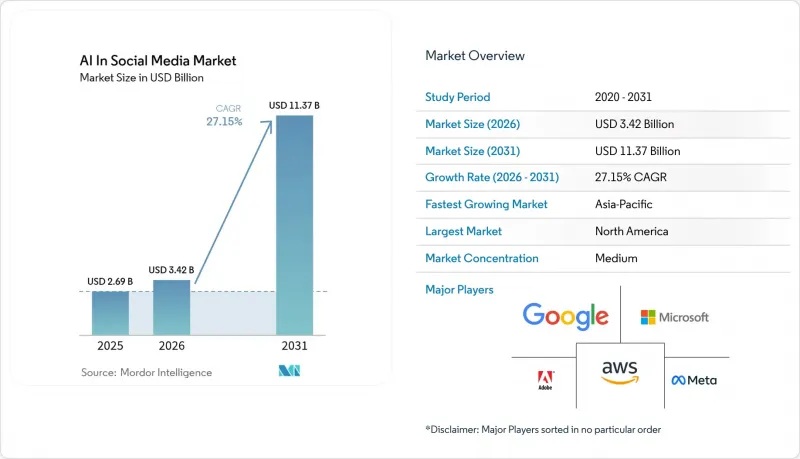
This report is Segmented by Technology (Machine Learning and Deep Learning and Natural Language Processing (NLP)), Application (Customer Experience Management, Sales and Marketing, and More), Service (Managed Service and Professional Service), Organization Size (SMEs, Large Enterprises), End-User Industry (Retail, E-Commerce, and More), and Geography. The Market Forecasts are Provided in Terms of Value (USD).
Global AI In Social Media Market Trends and Insights
Integration of AI for Hyper-Targeted Social Media Advertising
Generative engines now refine audience segmentation in the AI in social media market, letting advertisers tailor copy, imagery, and call-to-action wording on the fly. Meta reports a 40% spending uplift when campaigns deploy AI-driven recommendations, confirming the revenue upside. TikTok pilots virtual sales hosts that both entertain and guide checkout, raising engagement and in-stream purchase rates. Gen-Z users welcome these bespoke feeds, yet 88% also seek tighter AI governance, illustrating the privacy-effectiveness tension. Networks must therefore blend performance objectives with transparent consent flows as regulatory drafts take shape.
Mobile-First Rise in Time Spent on Social Platforms
Smartphones account for most daily sessions, so developers shift inference workloads onto devices where possible. Edge processing cuts latency, trims cloud fees, and enables contextual prompts, such as location-aware recommendations. The EDPS notes that on-device execution aligns with strict data localization rules across Europe. Research on arXiv finds handheld models still risk stereotype leakage, spurring investment in differential-privacy techniques. Vendors also experiment with mixed architectures that send only partial vectors to the cloud, balancing speed and compliance.
Scarcity of AI Talent for Social-Graph Optimization
Graph neural networks powering friend suggestions and feed ranking demand niche expertise. Meta has offered signing bonuses up to USD 100 million to attract staff, intensifying the squeeze. Emerging-market firms struggle most, so many outsource model tuning or adopt auto-ML pipelines, which can reduce quality in edge cases. University partnerships and open-curriculum platforms aim to widen the talent pool, yet hiring lags growth projections over the next three years.
Other drivers and restraints analyzed in the detailed report include:
- AI-Powered Social-Commerce Engines Boosting Conversion
- Foundation-Model APIs Lowering Entry Barriers for In-Feed Generative Content
- Limited AI Budgets Among SMEs in Emerging Economies
For complete list of drivers and restraints, kindly check the Table Of Contents.
Segment Analysis
Machine learning and deep learning engines held 61.35% of AI in social media market share in 2025, underlining their critical role in ranking feeds and spotting policy violations.The AI in social media market keeps scaling these models to manage video formats and emerging multimodal posts. Historic datasets stretching back to 2020 show steady accuracy improvements as transformers replaced older CNN-RNN hybrids.
Natural language processing is advancing even faster, posting a 29.10% CAGR for 2026-2031 on the back of chat assistants and automatic copywriting. LLMs, now outperforming rule-based filters by 73% in toxicity detection, expand safety layers while adding brand-tone control. The AI in social media market size for NLP-driven tools is poised to widen as low-resource language packs reach commercial viability. Concurrently, computer vision stacks integrate with audio-text encoders, paving paths for unified content understanding.
Sales and marketing dominated 2025 with 47.85% of revenue, riding AI ad-optimization that lifted return on spend for early adopters. That slice equates to the largest portion of the AI in social media market size and will retain precedence through subscription-based creative suites. Predictive lead-scoring and budget pacing algorithms automate once manual spreadsheets, freeing marketers to focus on narrative arcs instead of bid toggles.
Image and video recognition, forecast to grow at 27.95% CAGR, benefits from user migration to short-form clips. The AI in social media market leverages real-time scene labeling, product tagging, and AR overlays that spur impulse buys. Deepfake detectors now accompany these pipelines to maintain authenticity gates. Paired with emerging video-to-text captioning, platforms streamline accessibility compliance while improving search discoverability.
Complete Report Scope:
- By Technology
- Machine Learning and Deep Learning
- Natural Language Processing (NLP)
- By Application
- Customer Experience Management
- Sales and Marketing
- Image and Video Recognition
- Predictive Risk Assessment
- Other Applications
- By Service
- Managed Service
- Professional Service
- By Organization Size
- Small and Medium Enterprises
- Large Enterprises
- By End-User Industry
- Retail
- E-commerce
- Banking, Financial Services and Insurance (BFSI)
- Media and Advertising
- Education
- Other Industries
- By Geography
- North America
- United States
- Canada
- Mexico
- South America
- Brazil
- Argentina
- Rest of South America
- Europe
- United Kingdom
- Germany
- France
- Spain
- Russia
- Rest of Europe
- Asia Pacific
- China
- Japan
- India
- South Korea
- Australia and New Zealand
- Rest of Asia Pacific
- Middle East and Africa
- Middle East
- Saudi Arabia
- UAE
- Turkey
- Rest of Middle East
- Africa
- South Africa
- Nigeria
- Rest of Africa
- Middle East
- North America
Geography Analysis
North America held 37.75% revenue in 2025, driven by Meta, Alphabet, Microsoft, and a dense start-up pipeline around Silicon Valley. The region's cloud incumbents anchor foundational model training, and its venture ecosystem funds content-tech verticals that expand the AI in social media market. Government grants focus on trustworthy AI, encouraging bias audits and transparency APIs that complement federal privacy proposals.
Asia Pacific is the fastest-advancing territory with a 29.75% CAGR through 2031. China's USD 2.1 billion in generative-AI funding, India's thriving developer base, and Korea's 5G coverage combine to scale user adoption beyond 1 billion social-media accounts. The AI in social media market share grows as local networks integrate multilingual LLMs tuned to Hindi, Bahasa, and Thai dialects, capturing cohorts under-served by Western platforms.
Europe navigates stricter oversight, but privacy-led design spurs on-device research. The AI in social media market size reflects slower headline growth yet higher spend per user because enterprises pay premiums for compliant toolkits. The Middle East and Africa witness rising mobile uptake; telco-bundled data and fintech wallets fuel content creation across Swahili, Arabic, and Hausa. Latin America integrates social-commerce plug-ins, aligning influencer culture with cross-border payments to unlock fresh opportunities.
- Google LLC
- Microsoft Corporation
- Meta Platforms Inc.
- Amazon Web Services Inc.
- IBM Corporation
- Adobe Inc.
- Salesforce Inc.
- Baidu Inc.
- Snap Inc.
- Hootsuite Media Inc.
- Meltwater ASA
- Sprout Social Inc.
- Sprinklr Inc.
- HubSpot Inc.
- ByteDance Ltd.
- Tencent Holdings Ltd.
- X Corp. (formerly Twitter)
- Snapchat Inc.
- TikTok (ByteDance)
- Discord Inc.
- Talkwalker SA
Additional Benefits:
- The market estimate (ME) sheet in Excel format
- 3 months of analyst support
TABLE OF CONTENTS
1 INTRODUCTION
- 1.1 Study Assumptions and Market Definition
- 1.2 Scope of the Study
2 RESEARCH METHODOLOGY
3 EXECUTIVE SUMMARY
4 MARKET LANDSCAPE
- 4.1 Market Overview
- 4.2 Market Drivers
- 4.2.1 Integration of AI for hyper-targeted social-media advertising (mainstream)
- 4.2.2 Mobile-first rise in time-spent on social platforms (mainstream)
- 4.2.3 AI-powered social-commerce engines boosting conversion (mainstream)
- 4.2.4 Foundation-model APIs lowering entry barriers for in-feed generative content (under-the-radar)
- 4.2.5 On-device inference unlocking privacy-preserving personalization (under-the-radar)
- 4.2.6 Synthetic-influencer adoption amplifying brand reach at lower cost (under-the-radar)
- 4.3 Market Restraints
- 4.3.1 Scarcity of AI talent for social-graph optimisation (mainstream)
- 4.3.2 Limited AI budgets among SMEs in emerging economies (mainstream)
- 4.3.3 Heightened regulatory scrutiny on user-generated data pipelines (under-the-radar)
- 4.3.4 Model hallucination risks eroding brand trust (under-the-radar)
- 4.4 Value Chain Analysis
- 4.5 Regulatory Landscape
- 4.6 Technological Outlook (AI Toolchain Roadmap)
- 4.7 Porter's Five Forces Analysis
- 4.7.1 Threat of New Entrants
- 4.7.2 Bargaining Power of Buyers
- 4.7.3 Bargaining Power of Suppliers
- 4.7.4 Threat of Substitutes
- 4.7.5 Intensity of Competitive Rivalry
- 4.8 Investment Analysis
- 4.9 Assessment of Impact of COVID-19 and Economic Slowdown
5 MARKET SIZE AND GROWTH FORECASTS (VALUE)
- 5.1 By Technology
- 5.1.1 Machine Learning and Deep Learning
- 5.1.2 Natural Language Processing (NLP)
- 5.2 By Application
- 5.2.1 Customer Experience Management
- 5.2.2 Sales and Marketing
- 5.2.3 Image and Video Recognition
- 5.2.4 Predictive Risk Assessment
- 5.2.5 Other Applications
- 5.3 By Service
- 5.3.1 Managed Service
- 5.3.2 Professional Service
- 5.4 By Organization Size
- 5.4.1 Small and Medium Enterprises
- 5.4.2 Large Enterprises
- 5.5 By End-User Industry
- 5.5.1 Retail
- 5.5.2 E-commerce
- 5.5.3 Banking, Financial Services and Insurance (BFSI)
- 5.5.4 Media and Advertising
- 5.5.5 Education
- 5.5.6 Other Industries
- 5.6 By Geography
- 5.6.1 North America
- 5.6.1.1 United States
- 5.6.1.2 Canada
- 5.6.1.3 Mexico
- 5.6.2 South America
- 5.6.2.1 Brazil
- 5.6.2.2 Argentina
- 5.6.2.3 Rest of South America
- 5.6.3 Europe
- 5.6.3.1 United Kingdom
- 5.6.3.2 Germany
- 5.6.3.3 France
- 5.6.3.4 Spain
- 5.6.3.5 Russia
- 5.6.3.6 Rest of Europe
- 5.6.4 Asia Pacific
- 5.6.4.1 China
- 5.6.4.2 Japan
- 5.6.4.3 India
- 5.6.4.4 South Korea
- 5.6.4.5 Australia and New Zealand
- 5.6.4.6 Rest of Asia Pacific
- 5.6.5 Middle East and Africa
- 5.6.5.1 Middle East
- 5.6.5.1.1 Saudi Arabia
- 5.6.5.1.2 UAE
- 5.6.5.1.3 Turkey
- 5.6.5.1.4 Rest of Middle East
- 5.6.5.2 Africa
- 5.6.5.2.1 South Africa
- 5.6.5.2.2 Nigeria
- 5.6.5.2.3 Rest of Africa
- 5.6.5.1 Middle East
- 5.6.1 North America
6 COMPETITIVE LANDSCAPE
- 6.1 Market Concentration
- 6.2 Strategic Moves
- 6.3 Market Share Analysis
- 6.4 Company Profiles (includes Global level Overview, Market level overview, Core Segments, Financials as available, Strategic Information, Market Rank/Share for key companies, Products and Services, and Recent Developments)
- 6.4.1 Google LLC
- 6.4.2 Microsoft Corporation
- 6.4.3 Meta Platforms Inc.
- 6.4.4 Amazon Web Services Inc.
- 6.4.5 IBM Corporation
- 6.4.6 Adobe Inc.
- 6.4.7 Salesforce Inc.
- 6.4.8 Baidu Inc.
- 6.4.9 Snap Inc.
- 6.4.10 Hootsuite Media Inc.
- 6.4.11 Meltwater ASA
- 6.4.12 Sprout Social Inc.
- 6.4.13 Sprinklr Inc.
- 6.4.14 HubSpot Inc.
- 6.4.15 ByteDance Ltd.
- 6.4.16 Tencent Holdings Ltd.
- 6.4.17 X Corp. (formerly Twitter)
- 6.4.18 Snapchat Inc.
- 6.4.19 TikTok (ByteDance)
- 6.4.20 Discord Inc.
- 6.4.21 Talkwalker SA
7 MARKET OPPORTUNITIES AND FUTURE OUTLOOK
- 7.1 White-space and Unmet-need Assessment

