PUBLISHER: Mordor Intelligence | PRODUCT CODE: 2122648

PUBLISHER: Mordor Intelligence | PRODUCT CODE: 2122648
Military Helmet And Helmet Mounted Display Systems - Market Share Analysis, Industry Trends & Statistics, Growth Forecasts (2026 - 2031)
According to Mordor Intelligence, the military helmet and helmet mounted display systems market size is expected to grow from USD 6.18 billion in 2025 to USD 6.44 billion in 2026 and is forecasted to reach USD 7.94 billion by 2031 at a 4.28% CAGR over 2026-2031.
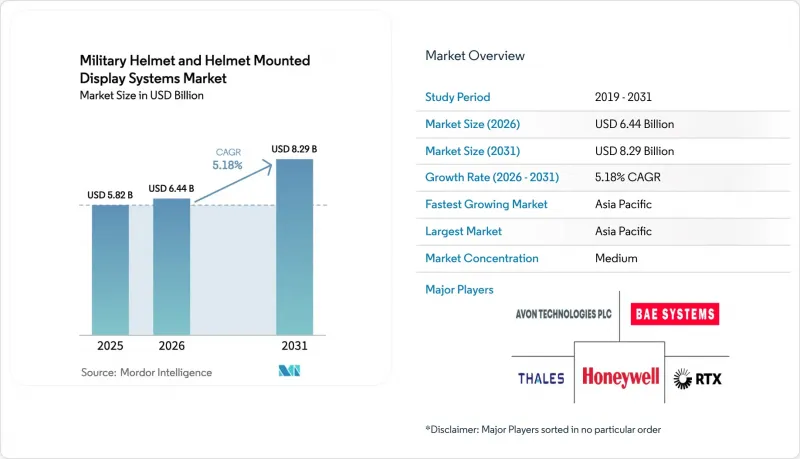
This report is Segmented by Product Type (Helmets, Helmet Mounted Displays, and Accessories), Application (Combat Operations, Training Exercises, and Search and Rescue, and Surveillance), End User (Army, Navy, Air Force, and Special Forces), and Geography (North America, South America, Europe, and More). The Market Forecasts are Provided in Terms of Value (USD).
Global Military Helmet And Helmet Mounted Display Systems Market Trends and Insights
Expanding Soldier Modernization Programs Drive Advanced Helmet Procurement
Soldier-modernization programs are channeling unprecedented capital into modular headborne platforms that combine ballistic shells, sensor rails, and AI-ready power architecture. The US Army's Next Generation Integrated Head Protection System (NG-IHPS) extension signaled multi-year demand visibility. France's FELIN refresh and India's F-INSAS mandate compatibility with domestic radios, underscoring the premium placed on open architectures. Vendors able to demonstrate software-defined upgrade paths now rank higher in source selection evaluations, a shift that favors firms investing in digital road maps over purely ballistic innovations.
Cross-Border Tensions and Asymmetric Threats Accelerate Protection Upgrades
Russia's campaign in Ukraine and simmering disputes in the South China Sea have compressed replacement cycles for infantry helmets. Poland's 2024 order for 50,000 UHMWPE helmets rated for multi-hit STANAG 2920 performance exemplified urgent regional demand. Urban conflict further pushes militaries to adopt displays that overlay 360-degree camera feeds, as demonstrated by Israel's Iron Vision deployment in 2024. The operational lesson is clear: survivability now requires both blunt-force protection and real-time situational awareness.
Defense Budget Reallocations Compress Soldier-Equipment Spending
Competing priorities in cyber defense, space, and autonomy trim near-term headgear allocations. The US FY 2025 budget allocated 18% of the total to cyber and space RDT&E, potentially crowding out incremental equipment upgrades.European planners rechanneled fresh funds into missile defense and ammunition, delaying several infantry programs. Vendors now frame proposals around network-centric effects or lifecycle cost savings to retain funding.
Other drivers and restraints analyzed in the detailed report include:
- C4ISR Integration Transforms Helmets into Intelligence Nodes
- AI-Enabled Threat Detection Enhances Situational Awareness
- Testing and Qualification Cycles Delay Deployment and Revenue Recognition
For complete list of drivers and restraints, kindly check the Table Of Contents.
Segment Analysis
Helmet-mounted displays accounted for 54.21% of the military helmet and helmet-mounted display systems market in 2025 and are expected to expand at a faster rate, with a 4.48% CAGR, through 2031. The military helmet and helmet-mounted display systems market size for displays is forecast to grow further as F-35 Lot 17 production and IVAS infantry rollouts overlap. Ground forces deploy waveguide optics that deliver AR overlays previously limited to pilots. In parallel, shells evolve slowly, driven mainly by improvements in composite materials rather than new designs, resulting in longer replacement cycles.
The accessory segment generates recurring revenue from retrofit kits but remains smaller in absolute terms. The integration of OLEDoS microdisplays reduces display power draw by 30%, thereby shrinking battery packs and mitigating neck-load trade-offs. Vendors offering vertically integrated solutions across shell, display, and power domains position themselves for multi-year platform contracts.
Complete Report Scope:
- By Product Type
- Helmets
- Helmet Mounted Displays
- Accessories
- By Application
- Combat Operations
- Training Exercises
- Search and Rescue
- Surveillance
- By End User
- Army
- Navy
- Air Force
- Special Forces
- By Geography
- North America
- United States
- Canada
- Mexico
- South America
- Brazil
- Rest of South America
- Europe
- United Kingdom
- France
- Germany
- Spain
- Russia
- Rest of Europe
- Asia-Pacific
- China
- India
- Japan
- South Korea
- Rest of Asia-Pacific
- Middle East and Africa
- Middle East
- United Arab Emirates
- Saudi Arabia
- Israel
- Rest of Middle East
- Africa
- South Africa
- Rest of Africa
- Middle East
- North America
Geography Analysis
Asia-Pacific generated 41.15% of 2025 revenue and is forecast to lead growth at a 4.83% CAGR. India's Atmanirbhar Bharat policy funnels volume to domestic supplier MKU, while China funds indigenous programs shielded from Western export controls. Japan and South Korea integrate helmet displays into next-generation fighter and infantry systems to maintain interoperability with US forces.
North America remains the second-largest market as the US Army, Marine Corps, and Air Force field NG-IHPS, Integrated Head System, and F-35 HMDS upgrades. Canada's DICE program selected Galvion for headborne protection, resulting in extended regional production runs.
Europe's outlook is mixed: higher collective defense spending following the Ukraine crisis favors programs in Poland, Germany, and the UK, yet fragmented national budgets slow the continent-wide scale. The Middle East accelerates purchases of modular helmets and displays tailored for desert and urban operations; Galvion's 35,000-unit order from an undisclosed customer illustrates the region's appetite for rapid deliveries. Africa and South America remain in the early stages but could unlock long-term upside as local assembly projects mature.
- Avon Technologies plc
- BAE Systems plc
- Gentex Corporation
- L3Harris Technologies, Inc.
- Thales Group
- Safran SA
- Rheinmetall AG
- Honeywell International Inc.
- Elbit Systems Ltd.
- MKU Limited
- Galvion Ltd
- NP Aerospace Limited
- ULBRICHTS GmbH
- ArmorSource LLC
- ASELSAN A.S.
Additional Benefits:
- The market estimate (ME) sheet in Excel format
- 3 months of analyst support
TABLE OF CONTENTS
1 INTRODUCTION
- 1.1 Study Assumptions and Market Definition
- 1.2 Scope of the Study
2 RESEARCH METHODOLOGY
3 EXECUTIVE SUMMARY
4 MARKET LANDSCAPE
- 4.1 Market Overview
- 4.2 Market Drivers
- 4.2.1 Expanding soldier modernization programs are driving demand for advanced helmet systems
- 4.2.2 Rising cross-border tensions and asymmetric warfare are increasing adoption of enhanced soldier protection
- 4.2.3 Mandated head injury protection standards are reinforcing procurement of certified military helmets
- 4.2.4 Integration of C4ISR sensors into soldier systems is accelerating helmet-mounted display adoption
- 4.2.5 Advancements in AI-enabled threat detection are improving situational awareness through helmet-mounted displays
- 4.2.6 Growing demand for lightweight, multi-hit capable composite materials is enhancing helmet performance
- 4.3 Market Restraints
- 4.3.1 Defense budget reallocations toward cyber and unmanned systems are constraining helmet procurement
- 4.3.2 Lengthy testing and qualification cycles are delaying field deployment timelines
- 4.3.3 Power supply and energy management limitations are restricting on-helmet electronics capability
- 4.3.4 Electromagnetic emission and signature exposure risks are raising operational survivability concerns
- 4.4 Value Chain Analysis
- 4.5 Regulatory Landscape
- 4.6 Technological Outlook
- 4.7 Porter's Five Forces Analysis
- 4.7.1 Bargaining Power of Suppliers
- 4.7.2 Bargaining Power of Buyers
- 4.7.3 Threat of New Entrants
- 4.7.4 Threat of Substitutes
- 4.7.5 Competitive Rivalry
5 MARKET SIZE AND GROWTH FORECASTS (VALUE)
- 5.1 By Product Type
- 5.1.1 Helmets
- 5.1.2 Helmet Mounted Displays
- 5.1.3 Accessories
- 5.2 By Application
- 5.2.1 Combat Operations
- 5.2.2 Training Exercises
- 5.2.3 Search and Rescue
- 5.2.4 Surveillance
- 5.3 By End User
- 5.3.1 Army
- 5.3.2 Navy
- 5.3.3 Air Force
- 5.3.4 Special Forces
- 5.4 By Geography
- 5.4.1 North America
- 5.4.1.1 United States
- 5.4.1.2 Canada
- 5.4.1.3 Mexico
- 5.4.2 South America
- 5.4.2.1 Brazil
- 5.4.2.2 Rest of South America
- 5.4.3 Europe
- 5.4.3.1 United Kingdom
- 5.4.3.2 France
- 5.4.3.3 Germany
- 5.4.3.4 Spain
- 5.4.3.5 Russia
- 5.4.3.6 Rest of Europe
- 5.4.4 Asia-Pacific
- 5.4.4.1 China
- 5.4.4.2 India
- 5.4.4.3 Japan
- 5.4.4.4 South Korea
- 5.4.4.5 Rest of Asia-Pacific
- 5.4.5 Middle East and Africa
- 5.4.5.1 Middle East
- 5.4.5.1.1 United Arab Emirates
- 5.4.5.1.2 Saudi Arabia
- 5.4.5.1.3 Israel
- 5.4.5.1.4 Rest of Middle East
- 5.4.5.2 Africa
- 5.4.5.2.1 South Africa
- 5.4.5.2.2 Rest of Africa
- 5.4.5.1 Middle East
- 5.4.1 North America
6 COMPETITIVE LANDSCAPE
- 6.1 Market Concentration
- 6.2 Strategic Moves
- 6.3 Market Share Analysis
- 6.4 Company Profiles (includes Global level Overview, Market level overview, Core Segments, Financials as available, Strategic Information, Market Rank/Share for key companies, Products and Services, and Recent Developments)
- 6.4.1 Avon Technologies plc
- 6.4.2 BAE Systems plc
- 6.4.3 Gentex Corporation
- 6.4.4 L3Harris Technologies, Inc.
- 6.4.5 Thales Group
- 6.4.6 Safran SA
- 6.4.7 Rheinmetall AG
- 6.4.8 Honeywell International Inc.
- 6.4.9 Elbit Systems Ltd.
- 6.4.10 MKU Limited
- 6.4.11 Galvion Ltd
- 6.4.12 NP Aerospace Limited
- 6.4.13 ULBRICHTS GmbH
- 6.4.14 ArmorSource LLC
- 6.4.15 ASELSAN A.S.
7 MARKET OPPORTUNITIES AND FUTURE OUTLOOK
- 7.1 White-space and Unmet-Need Assessment

