PUBLISHER: Mordor Intelligence | PRODUCT CODE: 2122667

PUBLISHER: Mordor Intelligence | PRODUCT CODE: 2122667
Capacitive Sensors - Market Share Analysis, Industry Trends & Statistics, Growth Forecasts (2026 - 2031)
According to Mordor Intelligence, the capacitive sensor market size was valued at USD 32.87 billion in 2025 and estimated to grow from USD 34.43 billion in 2026 to reach USD 43.41 billion by 2031, at a CAGR of 4.74% during the forecast period (2026-2031).
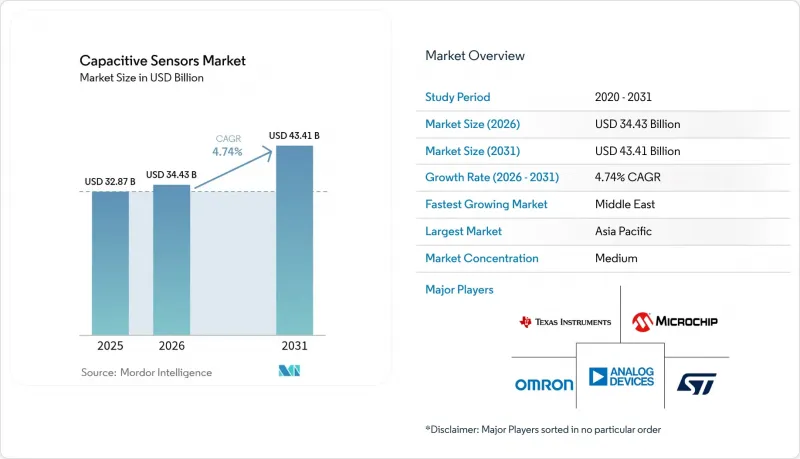
This report is Segmented by Type (Touch Sensor, Motion Sensor, and More), End-User Industry (Consumer Electronics, Automotive, and More), Sensing Principle (Self-Capacitance, Mutual Capacitance, Surface Capacitance, and More), Form Factor (Surface-Mount Sensors, Through-Hole Sensors, Flexible/Thin-Film Sensors, and More), and Geography. The Market Forecasts are Provided in Terms of Value (USD).
Global Capacitive Sensors Market Trends and Insights
Growing Adoption of Capacitive Touch Screens in Consumer Electronics
Smartphone, tablet, and wearable device makers continue to replace resistive technologies with advanced mutual and projected capacitance. Flexible OLED production lines commissioned by Samsung in 2024 integrate projected capacitance to enable foldable displays that maintain uniform sensitivity across bending radii. Automakers embrace the same architectures for infotainment units, steering-wheel controls, and augmented-reality head-up displays. These design choices enhance the average capacitive sensor content per vehicle, fostering volume economies that extend to industrial machinery and white goods. Meanwhile, haptic drivers embedded beneath glass enable tactile confirmation on flat surfaces, reducing accidental activations and improving accessibility for visually impaired users. Vendors are therefore prioritizing firmware toolkits that allow OEMs to fine-tune latency, set thresholds, and implement multi-finger gestures without requiring new hardware spins.
Increasing Integration of Capacitive Sensors in Automotive Human-Machine Interfaces
Euro NCAP safety protocols, updated in 2024, evaluate steering-wheel grip sensors that track driver attention through capacitive channels, driving tier-one suppliers to certify automotive-grade controllers to AEC-Q100 standards. Tesla and BMW have demonstrated that capacitive sensor arrays can reliably detect hands-on-wheel conditions, even when operators wear gloves a critical feature for Level 2+ autonomy. Capacitive surfaces are also appearing on exterior charge-port doors and interior ambient-lighting sliders, replacing mechanical switches that are susceptible to dust ingress. Because automotive EMI levels rise with electrified powertrains, suppliers now bundle differential sensing and spread-spectrum modulation to maintain immunity. Long product life cycles in the sector lock in multiyear revenue streams for qualified sensor ICs, giving automotive integrations an outsized strategic impact on the capacitive sensor market.
Supply Shortage and Price Volatility of Indium Tin Oxide
Indium prices fluctuated by more than 40% in 2024 as mining operations in China and South Korea were disrupted by supply chain issues amid geopolitical tensions. Display manufacturers competing for the same metal exacerbated scarcity, forcing sensor vendors to lengthen lead times and carry higher inventories. Polymer conductors and silver nanowires offer potential relief but remain expensive to scale for high-volume touchscreen overlays. Some OEMs redesigned user interfaces to reduce transparent conductor area, but such compromises limit gesture zones and brand differentiation. Strategic stockpiling and multi-sourcing contracts are, therefore, temporary stopgaps until alternative materials mature.
Other drivers and restraints analyzed in the detailed report include:
- Rising Demand for Industrial Automation and Robotics
- Growth of Wearable and IoT Devices Requiring Low Power Capacitive Sensing
- Sensitivity to Electromagnetic Interference in Industrial Environments
For complete list of drivers and restraints, kindly check the Table Of Contents.
Segment Analysis
The touch-sensor subsegment retained a 44.02% revenue share within the capacitive sensor market in 2025, thanks to entrenched demand for smartphones and tablets, combined with rising installations in countertop appliances. This dominance provides stable volumes that drive wafer-level cost declines, permitting touch ICs to enter price-sensitive markets such as education tablets and entry-level cars. Touch sensors also proliferate in medical-grade monitors that must withstand chemical sterilization, where glass or polymer overlays protect electrodes without compromising accuracy. Meanwhile, developers enrich firmware with palm-rejection logic to minimize ghost touches on large panels used in conference systems.
Proximity sensors exhibit the swiftest momentum, expanding at a 5.03% CAGR to 2031 as contactless elevator panels and hospital room controls become standard. The subsegment leverages capacitive fields to detect objects through non-conductive layers, enabling liquid-level monitoring in pharmaceutical vessels where optical probes cloud over. Emerging packaging lines integrate proximity arrays around fillers to halt operation if an operator's arm breaches safety envelopes, improving compliance with ISO 13849. Motion and position sensors, although smaller in unit volume, find profitable niches in virtual-reality controllers and precision robotics, where bidirectional resolution of under 5 µm commands margins exceed 30%.
Consumer electronics accounted for 40.35% of the capacitive sensor market in 2025, anchored by mobile phones that package up to five separate capacitive solutions for display input, side-key replacement, and camera AF modules. Growth is plateauing in saturated geographies, but new form factors, such as foldables and rollables, refresh replacement cycles. Gaming consoles utilize large surface capacitive panels for motion tracking, sustaining mid-single-digit growth.
Healthcare registers the highest forward trajectory at 4.82% CAGR. Regulatory frameworks that emerged in response to the COVID-19 crisis mandate touchless or wipe-friendly user interfaces for ventilators, patient terminals, and laboratory equipment. Capacitive buttons sealed under PET films meet IP67 standards, allowing for aggressive disinfection without mechanical degradation. Hospitals also deploy capacitive hand-gesture panels outside intensive-care rooms to reduce pathogen transfer. Automotive retains its historical importance, with electric cars adding capacitive charge-port lids and seat-occupancy detection, while aerospace seeks radiation-hardened parts for cockpit modernization programs.
Complete Report Scope:
- By Type
- Touch Sensor
- Motion Sensor
- Position Sensor
- Proximity Sensor
- Other Types
- By End-User Industry
- Consumer Electronics
- Automotive
- Aerospace and Defense
- Healthcare
- Food and Beverages
- Oil and Gas
- Industrial Machinery
- Other End-User Industry
- By Sensing Principle
- Self-Capacitance
- Mutual Capacitance
- Surface Capacitance
- Projected Capacitance
- By Form Factor
- Surface-Mount Sensors
- Through-Hole Sensors
- Flexible/Thin-Film Sensors
- Embedded IC Sensors
- By Geography
- North America
- United States
- Canada
- Mexico
- Europe
- Germany
- United Kingdom
- France
- Russia
- Rest of Europe
- Asia-Pacific
- China
- Japan
- India
- South Korea
- Australia
- Rest of Asia-Pacific
- Middle East and Africa
- Middle East
- Saudi Arabia
- United Arab Emirates
- Rest of Middle East
- Africa
- South Africa
- Egypt
- Rest of Africa
- Middle East
- South America
- Brazil
- Argentina
- Rest of South America
- North America
Geography Analysis
Asia-Pacific retained 39.05% of global revenue in 2025, anchored by China's vertically integrated display and smartphone supply chains. South Korea's panel makers scale up foldable OLED production, driving localized demand for projected-capacitance controllers, while Taiwan's EMS providers secure strategic wafer allocations to support the notebook rebound. India's incentives for semiconductor packaging have attracted multinational IDMs to establish bumping and test capacity, opening pathways for domestic appliance brands to adopt local sensor ICs. Japan's robotics sector remains a premium buyer of high-accuracy position sensors, especially for semiconductor lithography stages where sub-micron control is compulsory.
North America demonstrates steady adoption across the automotive, aerospace, and medical electronics sectors. U.S. electric-vehicle makers specify steering-wheel touch sensors that resist EMI bursts generated during 800-V fast charging, fostering collaboration between Detroit's tier-one automakers and Silicon Valley startups. Canadian medical device firms are embracing projected capacitance to meet no-gap cleaning regulations for dental equipment. Europe parallels North America in maturity but channels sustainability mandates-such as circular-economy rules-into a demand for reparable capacitive panels rather than glued-in resistive touch films.
The Middle East is expected to record the fastest 4.98% CAGR through 2031. Smart-city programs in the United Arab Emirates integrate capacitive occupancy sensors within lighting poles to modulate energy consumption during periods of low traffic. Saudi Arabia's Vision 2030 industrial zones are outfitting packaging and bottling lines with hygienic, touchless controls. South America grows moderately as Brazilian automotive plants upgrade to capacitive charge-port lids for domestic electric vehicle launches. Africa remains nascent, but fintech kiosks in Nigeria demonstrate early demand for robust touch surfaces that can withstand dust and high humidity.
- Texas Instruments Incorporated
- STMicroelectronics N.V.
- Analog Devices Inc.
- Microchip Technology Inc.
- Omron Corporation
- Infineon Technologies AG
- NXP Semiconductors N.V.
- Fujitsu Limited
- 3M Company
- Siemens AG
- Sony Group Corporation
- TDK Corporation
- ROHM Co., Ltd.
- Synaptics Incorporated
- Cypress Semiconductor Corporation (Infineon)
Additional Benefits:
- The market estimate (ME) sheet in Excel format
- 3 months of analyst support
TABLE OF CONTENTS
1 INTRODUCTION
- 1.1 Study Assumptions and Market Definition
- 1.2 Scope of the Study
2 RESEARCH METHODOLOGY
3 EXECUTIVE SUMMARY
4 MARKET LANDSCAPE
- 4.1 Market Overview
- 4.2 Market Drivers
- 4.2.1 Growing Adoption of Capacitive Touch Screens in Consumer Electronics
- 4.2.2 Increasing Integration of Capacitive Sensors in Automotive Human Machine Interfaces
- 4.2.3 Rising Demand for Industrial Automation and Robotics
- 4.2.4 Growth of Wearable and IoT Devices Requiring Low Power Capacitive Sensing
- 4.2.5 Emergence of Transparent Conductive Polymers as Alternative to Indium Tin Oxide
- 4.2.6 Regulatory Push for Hygienic Contactless Interfaces in Food Processing and Healthcare
- 4.3 Market Restraints
- 4.3.1 Supply Shortage and Price Volatility of Indium Tin Oxide
- 4.3.2 Sensitivity to Electromagnetic Interference in Industrial Environments
- 4.3.3 Patent Thickets Around Multi-Touch Algorithms Increasing Licensing Costs
- 4.3.4 Limitations in Detecting Gloved Touches in Harsh Environments
- 4.4 Industry Value Chain Analysis
- 4.5 Impact of Macroeconomic Factors
- 4.6 Technological Outlook
- 4.7 Porter's Five Forces Analysis
- 4.7.1 Threat of New Entrants
- 4.7.2 Bargaining Power of Buyers
- 4.7.3 Bargaining Power of Suppliers
- 4.7.4 Threat of Substitute Products
- 4.7.5 Intensity of Competitive Rivalry
- 4.8 Regulatory Landscape
5 MARKET SIZE AND GROWTH FORECASTS (VALUE)
- 5.1 By Type
- 5.1.1 Touch Sensor
- 5.1.2 Motion Sensor
- 5.1.3 Position Sensor
- 5.1.4 Proximity Sensor
- 5.1.5 Other Types
- 5.2 By End-User Industry
- 5.2.1 Consumer Electronics
- 5.2.2 Automotive
- 5.2.3 Aerospace and Defense
- 5.2.4 Healthcare
- 5.2.5 Food and Beverages
- 5.2.6 Oil and Gas
- 5.2.7 Industrial Machinery
- 5.2.8 Other End-User Industry
- 5.3 By Sensing Principle
- 5.3.1 Self-Capacitance
- 5.3.2 Mutual Capacitance
- 5.3.3 Surface Capacitance
- 5.3.4 Projected Capacitance
- 5.4 By Form Factor
- 5.4.1 Surface-Mount Sensors
- 5.4.2 Through-Hole Sensors
- 5.4.3 Flexible/Thin-Film Sensors
- 5.4.4 Embedded IC Sensors
- 5.5 By Geography
- 5.5.1 North America
- 5.5.1.1 United States
- 5.5.1.2 Canada
- 5.5.1.3 Mexico
- 5.5.2 Europe
- 5.5.2.1 Germany
- 5.5.2.2 United Kingdom
- 5.5.2.3 France
- 5.5.2.4 Russia
- 5.5.2.5 Rest of Europe
- 5.5.3 Asia-Pacific
- 5.5.3.1 China
- 5.5.3.2 Japan
- 5.5.3.3 India
- 5.5.3.4 South Korea
- 5.5.3.5 Australia
- 5.5.3.6 Rest of Asia-Pacific
- 5.5.4 Middle East and Africa
- 5.5.4.1 Middle East
- 5.5.4.1.1 Saudi Arabia
- 5.5.4.1.2 United Arab Emirates
- 5.5.4.1.3 Rest of Middle East
- 5.5.4.2 Africa
- 5.5.4.2.1 South Africa
- 5.5.4.2.2 Egypt
- 5.5.4.2.3 Rest of Africa
- 5.5.4.1 Middle East
- 5.5.5 South America
- 5.5.5.1 Brazil
- 5.5.5.2 Argentina
- 5.5.5.3 Rest of South America
- 5.5.1 North America
6 COMPETITIVE LANDSCAPE
- 6.1 Market Concentration
- 6.2 Strategic Moves
- 6.3 Market Share Analysis
- 6.4 Company Profiles (includes Global level Overview, Market level overview, Core Segments, Financials as available, Strategic Information, Market Rank/Share for key companies, Products and Services, and Recent Developments)
- 6.4.1 Texas Instruments Incorporated
- 6.4.2 STMicroelectronics N.V.
- 6.4.3 Analog Devices Inc.
- 6.4.4 Microchip Technology Inc.
- 6.4.5 Omron Corporation
- 6.4.6 Infineon Technologies AG
- 6.4.7 NXP Semiconductors N.V.
- 6.4.8 Fujitsu Limited
- 6.4.9 3M Company
- 6.4.10 Siemens AG
- 6.4.11 Sony Group Corporation
- 6.4.12 TDK Corporation
- 6.4.13 ROHM Co., Ltd.
- 6.4.14 Synaptics Incorporated
- 6.4.15 Cypress Semiconductor Corporation (Infineon)
7 MARKET OPPORTUNITIES AND FUTURE OUTLOOK
- 7.1 White-Space and Unmet-Need Assessment

