PUBLISHER: Mordor Intelligence | PRODUCT CODE: 2122687

PUBLISHER: Mordor Intelligence | PRODUCT CODE: 2122687
Tocotrienol - Market Share Analysis, Industry Trends & Statistics, Growth Forecasts (2025 - 2031)
According to Mordor Intelligence, the tocotrienol market was valued at USD 501.09 million in 2025 and is expected to reach USD 536.21 million in 2026, with a projected value of USD 749.45 million by 2031, growing at a CAGR of 6.93% during the forecast period.
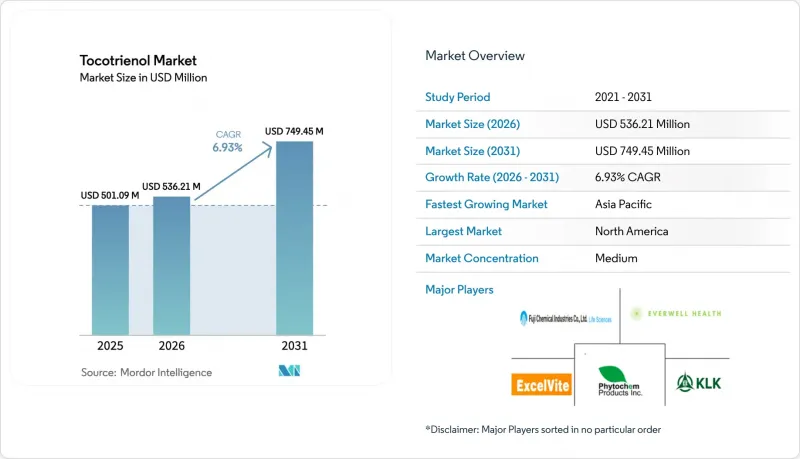
This report is Segmented by Source (Palm Oil, Rice Bran Oil, Annatto Seeds, and Others), Product Type (Y Tocotrienol, A-Tocotrienol, and Others), Application (Dietary Supplements, Fortified/Functional Food and Beverage, Beauty and Personal Care Products, Pharmaceuticals, and Others), and Geography (North America, Europe, and More). The Market Forecasts are Provided in Terms of Value (USD).
Global Tocotrienol Market Trends and Insights
Rising consumer awareness of antioxidant and cardiovascular benefits
Increasing consumer awareness of the health benefits of antioxidants, particularly their role in cardiovascular health, is driving global demand for tocotrienol-based products. Consumers are prioritizing functional ingredients that reduce oxidative stress, support heart health, and enhance overall wellness. This trend is creating opportunities for tocotrienols in supplements, functional foods, and nutraceuticals. In 2023, cardiovascular disease accounted for 919,032 deaths, representing 1 in every 3 deaths, underscoring the critical public health need and strengthening consumer interest in heart-healthy ingredients . Tocotrienols, recognized for their strong antioxidant properties and potential cardiovascular benefits, are increasingly included in dietary supplements and fortified products to address this demand. Growing health awareness among consumers is prompting manufacturers to develop clean-label, scientifically validated tocotrienol formulations, fostering market growth and innovation in both human and animal nutrition segments.
Expanding use in dietary supplements and functional foods
The increasing interest in dietary supplements and functional foods is driving the demand for tocotrienols, as consumers prioritize ingredients offering specific health benefits such as antioxidant protection, heart health, and anti-aging support. Products highlighting health-related claims are gaining significant traction in the market. For instance, healthy snack products with low-fat or reduced-fat claims are projected to achieve the highest unit sales growth in 2025, followed by products with antioxidant claims, according to the Institute of Food Technologists . This trend underscores a broader movement toward functional, nutrient-enriched options across snacks, beverages, and supplements. Tocotrienols, known for their strong antioxidant properties and clean-label attributes, are increasingly being utilized in capsules, powders, functional bars, beverages, and fortified foods. This allows manufacturers to meet the demands of health-conscious consumers while distinguishing their offerings in the competitive functional food and nutraceutical market.
High extraction and purification costs
The isolation of tocotrienols from sources such as palm oil, rice bran oil, or annatto seeds involves multi-stage processes, including supercritical CO2 extraction, molecular distillation, and chromatographic purification. These processes require significant capital investments, with costs exceeding USD 5 million per production line, and incur operating expenses that are 40-60% higher compared to the synthesis of synthetic vitamin E. Supercritical CO2 extraction operates under conditions of 300-400 bar pressure and 40-60°C, necessitating specialized pressure vessels and CO2 recycling systems. Such infrastructure is typically feasible only for vertically integrated refiners like ExcelVite and KLK Oleo, which can distribute these costs across high-volume production, as noted in industrial process engineering literature. Molecular distillation, or short-path distillation, is used to further concentrate tocotrienols to pharmaceutical-grade purity (>=90% tocotrienol content). However, this process achieves a recovery rate of only 60-70%, resulting in raw material waste that smaller processors may find challenging to manage.
Other drivers and restraints analyzed in the detailed report include:
- Clean-label demand for natural ingredients
- Demand shift toward natural vitamin E over synthetic
- Palm-oil sustainability limits ESG-driven buyers
For complete list of drivers and restraints, kindly check the Table Of Contents.
Segment Analysis
Palm oil accounted for 75.49% of the source-based market share in 2025, supported by Malaysia and Indonesia's integrated refining infrastructure, which processes 85% of global palm oil output. This infrastructure enables the capture of tocotrienol-rich fractions, such as deodorizer distillate, as a byproduct with minimal additional capital investment. Annatto seeds are projected to grow at a CAGR of 9.05% through 2031, driven by their unique tocopherol-free composition (>=95% delta- and gamma-tocotrienols). This composition eliminates alpha-tocopherol's competitive inhibition of tocotrienol absorption, a biochemical advantage highlighted by American River Nutrition during the rebranding of its DeltaGold line in 2025.
In Q1 2025, Sawit Kinabalu's Kunak Lipids subsidiary began large-scale tocotrienol extraction from palm oil refinery byproducts. This initiative targets Chinese cosmetics manufacturers through a memorandum of understanding (MoU) with Shanghai-based Boce Trade Service Company. This vertical integration strategy transforms waste streams into high-margin nutraceutical feedstock, positioning Malaysia as a cost-competitive supplier for Asia-Pacific demand. Annatto's growth trajectory demonstrates a strategic bifurcation in the market. Palm oil caters to cost-sensitive applications, including animal feed, mass-market supplements, and functional foods. In contrast, annatto secures a premium position in cardiovascular and cognitive health supplements, where its tocopherol-free purity justifies price premiums of 40-60%. Rice bran oil occupies an intermediate position, appealing to Japanese and Indian formulators seeking regional sourcing and non-GMO certification, while avoiding the sustainability concerns associated with palm oil.
Complete Report Scope:
- By Source
- Palm Oil
- Rice Bran Oil
- Annatto Seeds
- Others
- By Product Type
- Y-Tocotrienol
- a-Tocotrienol
- Others
- Application
- Dietary Supplements
- Fortified/Functional Food and Beverage
- Beauty and Personal Care Products
- Pharmaceuticals
- Others
- Geography
- North America
- United States
- Canada
- Mexico
- Rest of North America
- Europe
- Spain
- United Kingdom
- Germany
- France
- Italy
- Rest of Europe
- Asia-Pacific
- China
- Japan
- India
- Australia
- Rest of Asia-Pacific
- South America
- Brazil
- Argentina
- Rest of South America
- Middle East and Africa
- Saudi Arabia
- South Africa
- Rest of Middle East and Africa
- North America
Geography Analysis
In 2025, North America accounted for 38.78% of the geographic market share, supported by the demand for clean-label supplements, FDA GRAS status for palm tocotrienol complexes, and well-established distribution networks through natural product retailers such as Whole Foods, Sprouts, and Vitamin Shoppe, as well as e-commerce platforms like Amazon and iHerb. The region's regulatory framework under the Dietary Supplement Health and Education Act (DSHEA) allows structure-function claims, enabling brands to market tocotrienols for purposes such as "cardiovascular support," "antioxidant protection," and "healthy aging" without requiring pre-market approval, provided the claims are substantiated and avoid references to disease treatment.
The Asia-Pacific market is projected to grow at a CAGR of 8.56% through 2031, driven by Malaysia and Indonesia's integrated palm-oil-to-tocotrienol supply chains, increasing middle-class demand for premium supplements in China and India, and regulatory approvals for cognitive health claims in Malaysia. Japan and South Korea focus on rice bran oil-derived tocotrienols for domestic supplement and cosmetic formulations, emphasizing regional sourcing and non-GMO attributes. India's dietary supplement market is expanding at double-digit rates, with tocotrienols positioned for cardiovascular and diabetic health applications, supported by clinical evidence that resonates with physicians and health-conscious consumers. Australia and New Zealand contribute 8-10% of the Asia-Pacific volume, with clean-label and sustainability-certified tocotrienols (e.g., RSPO, non-GMO) commanding premium pricing in natural product channels.
Europe accounts for 20-25% of global market volume, with Germany, France, and the United Kingdom leading consumption. The European Food Safety Authority (EFSA) permits tocotrienols as nutrient sources under EU Regulation 1170/2009. However, restrictive health claim approvals limit marketing language to generic statements such as "antioxidant" and "cell protection," rather than condition-specific claims. This regulatory conservatism restricts premium pricing and channels tocotrienols primarily into multivitamins and fortified foods, rather than standalone therapeutic supplements.
- Everwell Health Holdings, LLC
- ExcelVite Sdn. Bhd.
- Kuala Lumpur Kepong Berhad
- Fuji Chemical Industries Co., Ltd.
- BASF SE
- BGG World
- Phytochem Products Inc.
- Yichun Dahaigui Life Science
- Cayman Chemical
- AC Grace Company
- Musim Mas Group
- SourceOne Global Partners
- Parchem Fine & Specialty Chemicals
- BTSA Biotechnologias Aplicadas
- Matrix Fine Sciences
- Orah Nutrichem Exim
- Phytogaia Sdn. Bhd.
- Archer Daniels Midland
- DSM Nutritional Products
- Palm Nutraceuticals
Additional Benefits:
- The market estimate (ME) sheet in Excel format
- 3 months of analyst support
TABLE OF CONTENTS
1 INTRODUCTION
- 1.1 Study Assumptions and Market Definition
- 1.2 Scope of the Study
2 RESEARCH METHODOLOGY
3 EXECUTIVE SUMMARY
4 MARKET LANDSCAPE
- 4.1 Market Overview
- 4.2 Market Drivers
- 4.2.1 Rising consumer awareness of antioxidant and cardiovascular benefits
- 4.2.2 Expanding use in dietary supplements and functional foods
- 4.2.3 Clean-label demand for natural ingredients
- 4.2.4 Demand shift toward natural vitamin E over synthetic
- 4.2.5 Growing adoption of vitamin E in cosmetics and personal care
- 4.2.6 Regulatory green-light for higher natural E inclusion in animal feed
- 4.3 Market Restraints
- 4.3.1 High extraction and purification costs
- 4.3.2 Palm-oil sustainability limits ESG-driven buyers
- 4.3.3 Regulatory ambiguity on new therapeutic claims
- 4.3.4 Limited certified non-GMO raw-material supply chains
- 4.4 Supply Chain Analysis
- 4.5 Regulatory and Technological Outlook
- 4.6 Porter's Five Forces Analysis
- 4.6.1 Threat of New Entrants
- 4.6.2 Bargaining Power of Buyers
- 4.6.3 Bargaining Power of Suppliers
- 4.6.4 Threat of Substitutes
- 4.6.5 Intensity of Competitive Rivalry
5 MARKET SIZE AND GROWTH FORECATS (VALUE)
- 5.1 By Source
- 5.1.1 Palm Oil
- 5.1.2 Rice Bran Oil
- 5.1.3 Annatto Seeds
- 5.1.4 Others
- 5.2 By Product Type
- 5.2.1 Y-Tocotrienol
- 5.2.2 a-Tocotrienol
- 5.2.3 Others
- 5.3 Application
- 5.3.1 Dietary Supplements
- 5.3.2 Fortified/Functional Food and Beverage
- 5.3.3 Beauty and Personal Care Products
- 5.3.4 Pharmaceuticals
- 5.3.5 Others
- 5.4 Geography
- 5.4.1 North America
- 5.4.1.1 United States
- 5.4.1.2 Canada
- 5.4.1.3 Mexico
- 5.4.1.4 Rest of North America
- 5.4.2 Europe
- 5.4.2.1 Spain
- 5.4.2.2 United Kingdom
- 5.4.2.3 Germany
- 5.4.2.4 France
- 5.4.2.5 Italy
- 5.4.2.6 Rest of Europe
- 5.4.3 Asia-Pacific
- 5.4.3.1 China
- 5.4.3.2 Japan
- 5.4.3.3 India
- 5.4.3.4 Australia
- 5.4.3.5 Rest of Asia-Pacific
- 5.4.4 South America
- 5.4.4.1 Brazil
- 5.4.4.2 Argentina
- 5.4.4.3 Rest of South America
- 5.4.5 Middle East and Africa
- 5.4.5.1 Saudi Arabia
- 5.4.5.2 South Africa
- 5.4.5.3 Rest of Middle East and Africa
- 5.4.1 North America
6 COMPETITIVE LANDSCAPE
- 6.1 Market Concentration
- 6.2 Strategic Moves
- 6.3 Market Ranking Analysis
- 6.4 Company Profiles {(includes Global level Overview, Market level overview, Core Segments, Financials as available, Strategic Information, Market Rank/Share for key companies, Products and Services, and Recent Developments)}
- 6.4.1 Everwell Health Holdings, LLC
- 6.4.2 ExcelVite Sdn. Bhd.
- 6.4.3 Kuala Lumpur Kepong Berhad
- 6.4.4 Fuji Chemical Industries Co., Ltd.
- 6.4.5 BASF SE
- 6.4.6 BGG World
- 6.4.7 Phytochem Products Inc.
- 6.4.8 Yichun Dahaigui Life Science
- 6.4.9 Cayman Chemical
- 6.4.10 AC Grace Company
- 6.4.11 Musim Mas Group
- 6.4.12 SourceOne Global Partners
- 6.4.13 Parchem Fine & Specialty Chemicals
- 6.4.14 BTSA Biotechnologias Aplicadas
- 6.4.15 Matrix Fine Sciences
- 6.4.16 Orah Nutrichem Exim
- 6.4.17 Phytogaia Sdn. Bhd.
- 6.4.18 Archer Daniels Midland
- 6.4.19 DSM Nutritional Products
- 6.4.20 Palm Nutraceuticals
7 MARKET OPPORTUNITIES AND FUTURE OUTLOOK

