PUBLISHER: Mordor Intelligence | PRODUCT CODE: 2122707

PUBLISHER: Mordor Intelligence | PRODUCT CODE: 2122707
Single-use Bioreactor - Market Share Analysis, Industry Trends & Statistics, Growth Forecasts (2026 - 2031)
According to Mordor Intelligence, the single-use bioreactor market size is projected to be USD 5.47 billion in 2025, USD 6.28 billion in 2026, and reach USD 13.07 billion by 2031, growing at a CAGR of 15.78% from 2026 to 2031.
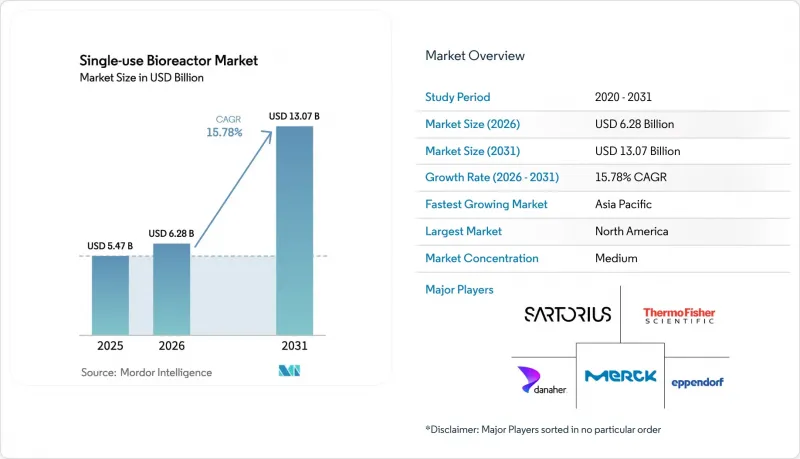
This report is Segmented by Product Type (Stirred-Tank, Wave-Induced, Fixed-Bed, Orbitally-Shaken & Other SUBs), Volume Range (Less Than 100 L, 100-500 L, and More), Application (Research & Process Development, and More), End-User (Pharmaceutical & Biopharmaceutical Companies, and More), and Geography (North America, Europe, and More). The Market Forecasts are Provided in Terms of Value (USD).
Global Single-use Bioreactor Market Trends and Insights
Intensifying Shift From Stainless-Steel to Disposable Bioprocessing Systems
Pharmaceutical manufacturers are retiring legacy stainless trains in favor of single-use platforms that remove cleaning validation, lower water use by up to 80%, and cut turnaround cycles from weeks to days. Danaher's Cytiva division reported resurgent disposable-consumable sales in late 2024, underscoring dependence on bag assemblies and sensors. Sartorius indicated 75% of Bioprocess Solutions revenue stems from consumables, highlighting customer lock-in once validation is complete. Labor costs for steaming and documentation also tilt economics toward pre-sterilized bags in Western markets, although Indian and Chinese biosimilar firms still favor hybrid plants because import tariffs inflate consumable costs.
Rapid Growth of Cell & Gene Therapies Elevating Demand for Flexible Small-Batch Manufacturing
Autologous CAR-T treatments require 50 mL-10 L runs, volumes incompatible with 500 L stainless reactors. Bristol Myers Squibb reserved USD 380 million in capacity with Cellares in 2024 for its automated Cell Shuttle platform that pairs single-use bioreactors with closed cell-processing hardware. FDA approvals for multiple CAR-T constructs in 2024-2025 and the agency's Advanced Manufacturing Technologies pathway spur decentralized manufacturing near oncology centers. Univercells' 50 L NevoLine system can be shipped in a container to remote clinics, reinforcing modular deployments.
Leachables & Extractables Compliance Uncertainty
Multilayer polyethylene films may leach plasticizers that delay approvals. FDA and EMA require up to 18 months of studies costing USD 0.5-1 million per assembly. High-potency products heighten risk, prompting some Japanese sponsors to retain stainless tanks for commercial lots.
Other drivers and restraints analyzed in the detailed report include:
- Cost-Saving Potential in Early-Stage Clinical Production
- Accelerated Vaccine Programs Post-COVID-19
- High Recurring Consumable Costs
For complete list of drivers and restraints, kindly check the Table Of Contents.
Segment Analysis
Stirred-tank systems commanded 57.26% of 2025 revenue, reinforcing their role as the workhorse for mammalian cell culture. The single-use bioreactor market size for stirred-tank units is sustained by antibody titers exceeding 5 g/L. Orbitally-shaken vessels are expanding at 18.68% annually on adoption by academic labs, while wave-induced designs serve seed-train and viral-vector work. PBS Biotech's vertical-wheel approach improves oxygen transfer with lower shear. Thermo Fisher's sensor-embedded DynaDrive extends digital monitoring into benchtop volumes.
Adoption patterns reflect validation stringency. Commercial antibody makers value historical data from stirred tanks, but early-stage gene therapy teams favor orbitals that fit inside biosafety cabinets. Fixed-bed reactors fill perfusion niches, while the single-use bioreactor industry continues to test hybrid perfusion/fed-batch models that reduce media use.
The 500-2,000 L band represented 43.72% of 2025 revenue and remains the core of CDMO offerings. The single-use bioreactor market share for this range aligns with Phase III batch sizes that yield 5-10 kg per run. Danaher's 500 L and 2,000 L X-platform models shorten installation to eight weeks, accelerating client onboarding.
Sub-100 L systems are forecast to grow at 19.42% as CAR-T makers and universities deploy benchtop tools. Conversely, designs above 2,000 L face engineering limits; experimental 4,000 L bags remain scarce and expensive, capping growth despite demand for large-scale biosimilars.
Complete Report Scope:
- By Product Type
- Stirred-Tank SUBs
- Wave-Induced SUBs
- Fixed-Bed SUBs
- Orbitally-Shaken & Other SUBs
- By Volume Range
- Less than 100 L
- 100 - 500 L
- 500 - 2 000 L
- More than 2,000 L
- By Application
- Research & Process Development
- Clinical-Scale Production
- Commercial-Scale Biopharmaceutical Manufacturing
- By End-User
- Pharmaceutical & Biopharmaceutical Companies
- Contract Development & Manufacturing Organisations (CDMOs/CMOs)
- Academic & Research Institutes
- By Geography
- North America
- United States
- Canada
- Mexico
- Europe
- Germany
- France
- United Kingdom
- Italy
- Spain
- Rest of Europe
- Asia-Pacific
- China
- Japan
- India
- South Korea
- Australia
- Rest of Asia-Pacific
- Middle East & Africa
- GCC
- South Africa
- Rest of Middle East & Africa
- South America
- Brazil
- Argentina
- Rest of South America
- North America
Geography Analysis
North America accounted for 36.11% of 2025 revenue, buoyed by U.S. headquarters and an FDA program that expedites advanced manufacturing reviews. Growth is plateauing as capacity saturates, prompting suppliers to pivot to Asia-Pacific, projected to grow at 17.02% through 2031. Thermo Fisher's 2025 design centers in Singapore and Shanghai reflect this tilt.
Europe ranks second, led by Germany, Switzerland, and the UK, where water-usage rules encourage disposable systems. Merck KGaA's EUR 300 million Darmstadt hub and Sartorius' consumable-centric model illustrate the focus on high-margin supplies. Post-Brexit dual approvals add modest complexity, yet mutual recognition eases trade.
Asia-Pacific governments pursue sovereign production. South Korea's Samsung Biologics signed USD 3.3 billion in contracts in 2024, and China's Suzhou cluster scales single-use suites for domestic biosimilars. India's Serum Institute uses disposable lines to meet WHO prequalification for African supply.
Middle East & Africa and South America nurture containerized facilities. WHO hubs in South Africa and Argentina rely on modular reactors, and Brazil's Farmanguinhos uses single-use equipment to localize vaccine output. The United Arab Emirates' biotech free-zones mirror these moves, signaling continued diffusion.
- ABEC
- Bioengineering
- Cellexus
- Celltainer
- CerCell
- Danaher
- Entegris
- Eppendorf
- Getinge
- Meissner Filtration
- Merck
- PBS Biotech
- Pierre Guerin
- Rentschler Biopharma
- Sartorius
- Solaris Biotech
- Thermo Fisher Scientific
- Univercells Technologies
Additional Benefits:
- The market estimate (ME) sheet in Excel format
- 3 months of analyst support
TABLE OF CONTENTS
1 Introduction
- 1.1 Study Assumptions & Market Definition
- 1.2 Scope of the Study
2 Research Methodology
3 Executive Summary
4 Market Landscape
- 4.1 Market Overview
- 4.2 Market Drivers
- 4.2.1 Intensifying Shift from Stainless-Steel to Disposable Bioprocessing Systems
- 4.2.2 Rapid Growth of Cell & Gene Therapies Elevating Demand for Flexible Small-Batch Manufacturing
- 4.2.3 Cost-Saving Potential in Early-Stage Clinical Production
- 4.2.4 Accelerated Vaccine Programs Post-COVID-19
- 4.2.5 Decentralized Micro-Facility Models in Emerging Markets
- 4.2.6 Growing Availability Of Y-Irradiation Capacity Resolving Sterilization Bottlenecks
- 4.3 Market Restraints
- 4.3.1 Leachables & Extractables Compliance Uncertainty
- 4.3.2 High Recurring Consumable Costs
- 4.3.3 PFAS Regulatory Scrutiny on Single-Use Plastics
- 4.3.4 Limited Scalability Beyond 6,000 L Hampering Late-Stage Commercial Runs
- 4.4 Value / Supply-Chain Analysis
- 4.5 Regulatory Landscape
- 4.6 Technological Outlook
- 4.7 Porter's Five Forces Analysis
- 4.7.1 Threat of New Entrants
- 4.7.2 Bargaining Power of Suppliers
- 4.7.3 Bargaining Power of Buyers
- 4.7.4 Threat of Substitutes
- 4.7.5 Intensity of Competitive Rivalry
5 Market Size & Growth Forecasts (Value in USD)
- 5.1 By Product Type
- 5.1.1 Stirred-Tank SUBs
- 5.1.2 Wave-Induced SUBs
- 5.1.3 Fixed-Bed SUBs
- 5.1.4 Orbitally-Shaken & Other SUBs
- 5.2 By Volume Range
- 5.2.1 Less than 100 L
- 5.2.2 100 - 500 L
- 5.2.3 500 - 2 000 L
- 5.2.4 More than 2,000 L
- 5.3 By Application
- 5.3.1 Research & Process Development
- 5.3.2 Clinical-Scale Production
- 5.3.3 Commercial-Scale Biopharmaceutical Manufacturing
- 5.4 By End-User
- 5.4.1 Pharmaceutical & Biopharmaceutical Companies
- 5.4.2 Contract Development & Manufacturing Organisations (CDMOs/CMOs)
- 5.4.3 Academic & Research Institutes
- 5.5 By Geography
- 5.5.1 North America
- 5.5.1.1 United States
- 5.5.1.2 Canada
- 5.5.1.3 Mexico
- 5.5.2 Europe
- 5.5.2.1 Germany
- 5.5.2.2 France
- 5.5.2.3 United Kingdom
- 5.5.2.4 Italy
- 5.5.2.5 Spain
- 5.5.2.6 Rest of Europe
- 5.5.3 Asia-Pacific
- 5.5.3.1 China
- 5.5.3.2 Japan
- 5.5.3.3 India
- 5.5.3.4 South Korea
- 5.5.3.5 Australia
- 5.5.3.6 Rest of Asia-Pacific
- 5.5.4 Middle East & Africa
- 5.5.4.1 GCC
- 5.5.4.2 South Africa
- 5.5.4.3 Rest of Middle East & Africa
- 5.5.5 South America
- 5.5.5.1 Brazil
- 5.5.5.2 Argentina
- 5.5.5.3 Rest of South America
- 5.5.1 North America
6 Competitive Landscape
- 6.1 Market Concentration
- 6.2 Market Share Analysis
- 6.3 Company Profiles (includes Global level Overview, Market level overview, Core Segments, Financials as available, Strategic Information, Market Rank/Share for key companies, Products and Services, and Recent Developments)
- 6.3.1 ABEC
- 6.3.2 Bioengineering AG
- 6.3.3 Cellexus
- 6.3.4 Celltainer
- 6.3.5 CerCell
- 6.3.6 Danaher
- 6.3.7 Entegris
- 6.3.8 Eppendorf AG
- 6.3.9 Getinge
- 6.3.10 Meissner Filtration
- 6.3.11 Merck KGaA
- 6.3.12 PBS Biotech
- 6.3.13 Pierre Guerin
- 6.3.14 Rentschler Biopharma
- 6.3.15 Sartorius Stedim Biotech
- 6.3.16 Solaris Biotech
- 6.3.17 Thermo Fisher Scientific
- 6.3.18 Univercells Technologies
7 Market Opportunities & Future Outlook
- 7.1 White-space & Unmet-Need Assessment

