PUBLISHER: Mordor Intelligence | PRODUCT CODE: 2122738

PUBLISHER: Mordor Intelligence | PRODUCT CODE: 2122738
Cell-free Protein Expression - Market Share Analysis, Industry Trends & Statistics, Growth Forecasts (2026 - 2031)
According to Mordor Intelligence, the cell-free protein expression market size is expected to increase from USD 318.15 million in 2025 to USD 339.72 million in 2026 and reach USD 499.73 million by 2031, growing at a CAGR of 8.02% over 2026-2031.
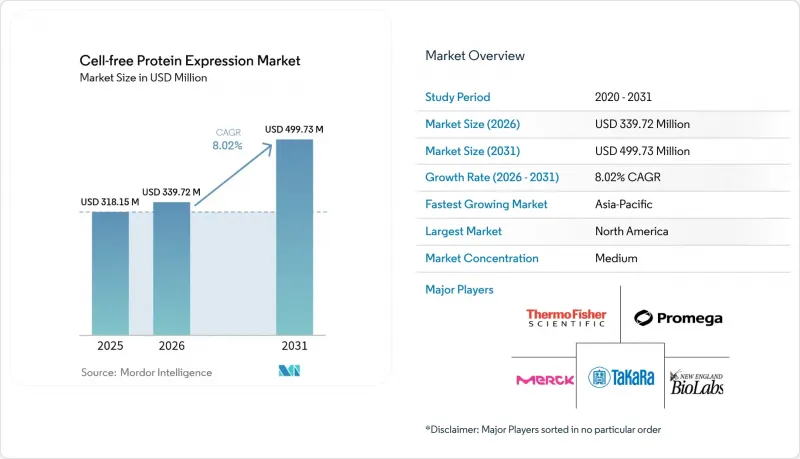
This report is Segmented by Product Type (Kits, Reagents & Consumables, and More), Expression System (E. Coli, and More), Expression Mode (Batch, and More), Reaction Format (Liquid, and More), Application (Enzyme Engineering, and More), End User (Pharmaceutical & Biotechnology Companies, and More), and Geography (North America, and More). The Market Forecasts are Provided in Terms of Value (USD).
Global Cell-free Protein Expression Market Trends and Insights
Rapid Adoption for High-Throughput Protein Engineering & Synthetic Biology
Cell-free workflows collapse cloning, colony picking, and scale-up into a same-day process, letting researchers screen hundreds of variants in 96- or 384-well plates while living-cell systems would require weeks. DARPA's USD 87 million BioMaDE awards in 2024 funded modular lysate platforms that prototype enzymes and biosensors for defense applications. Commercial kits bundling lysate and energy mixes standardize performance across labs and lower entry barriers. Seamless integration with Golden Gate and Gibson assembly now transforms a digital DNA design into functional protein inside 24 hours, fundamentally shortening discovery cycles in academia and start-ups.
Rising Demand for Biologics & Personalized Therapeutics
More than 3,800 biologics were in clinical development in 2025, creating urgency for flexible platforms that crank out patient-specific proteins within days. Cell-free systems meet turn-around targets for personalized cancer vaccines, something CHO cells cannot achieve at clinical scale. Sutro Biopharma's XpressCF, built on E. coli lysates, advanced to Phase II trials in 2025, proving regulators will review cell-free-produced therapeutics when process controls comply with cGMP. FDA guidance in 2024 cemented that host-free manufacturing falls under existing biologic rules so long as analytical characterization is robust. Hospitals in low-resource regions now explore freeze-dried kits to print therapeutic enzymes on site, sidestepping cold-chain dependencies.
High Reagent Costs & Scalability Challenges
Energy cocktails, nucleotides, and lysate prep account for up to 70% of production cost, often topping USD 500 per milligram for mammalian extracts, dwarfing fermentation economics. Continuous-exchange reactors improve yields five-fold but still trail fed-batch titers by two orders of magnitude. Merck KGaA shaved 30% off reagent expense in 2024 with its ReadyToProcess CFPS line, yet management admits 10-liter scale remains uneconomical for mainstream antibodies. Absence of scale economies in lysate production confines adoption to high-value or time-critical proteins.
Other drivers and restraints analyzed in the detailed report include:
- Advantages Over Cell-Based Systems (Speed, Toxic Protein Handling)
- Government On-Demand Biomanufacturing Preparedness Initiatives
- Limited Post-Translational Modification Capability
For complete list of drivers and restraints, kindly check the Table Of Contents.
Segment Analysis
Kits captured growing mindshare as lyophilized formats removed the cold-chain barrier and bundled protocols eliminated troubleshooting. Kits are on track to expand at an 11.52% CAGR between 2026 and 2031, outpacing reagents despite the latter's 44.22% revenue lead in 2025. This trajectory illustrates how pre-optimized mixes shorten learning curves for small biotechs and academic labs. Instruments that automate pipetting and purification complement kit adoption, as seen with Nuclera's eProtein platform rollout to 12 pharma labs in 2025. Reagents will remain indispensable for experienced users customizing buffer chemistries, yet kit convenience drives the incremental user base. Accessories and service bundles, including contract lysate prep, grow in tandem because newcomers often outsource complex targets.
The cell-free protein expression market size for insect-cell lysates is expected to climb at 10.74% CAGR, nibbling share from E. coli's 51.75% dominance in 2025. Demand for eukaryotic glycosylation propels hybrid and insect solutions for vaccine antigens and antibody fragments. Wheat-germ extracts sit in the middle ground, favored for membrane proteins that aggregate in bacteria. Start-ups such as LenioBio combine E. coli yield advantages with exogenous enzymes to approximate mammalian quality at lower cost. Rabbit reticulocyte and mammalian systems persist in niche roles where post-translational fidelity trumps cost.
Complete Report Scope:
- By Product Type
- Kits
- Reagents & Consumables
- Instruments and Systems
- Accessories & Services
- By Expression System
- E. coli
- Wheat Germ
- Rabbit Reticulocyte
- Insect Cell
- Mammalian
- Hybrid / Others
- By Expression Mode
- Batch Expression
- Continuous-Flow Expression
- Continuous-Exchange Cell-Free (CECF)
- By Reaction Format
- Liquid (Fresh Lysate)
- Lyophilized (Freeze-Dried)
- Microfluidic / Chip-Based
- By Application
- Enzyme Engineering
- Protein-Protein Interaction
- Protein Labelling
- High-Throughput Production
- Therapeutic Protein Production
- Others
- By End User
- Pharmaceutical & Biotechnology Companies
- Academic & Research Institutes
- Contract Research Organisations (CROs)
- Diagnostic Developers
- Others
- By Geography
- North America
- United States
- Canada
- Mexico
- Europe
- Germany
- France
- United Kingdom
- Italy
- Spain
- Rest of Europe
- Asia-Pacific
- China
- Japan
- India
- South Korea
- Australia
- Rest of Asia-Pacific
- Middle East & Africa
- GCC
- South Africa
- Rest of Middle East & Africa
- South America
- Brazil
- Argentina
- Rest of South America
- North America
Geography Analysis
North America commanded 39.54% of 2025 revenue, reflecting NIH and DoD spending on rapid-response platforms. The region also hosts leading kit suppliers and most FDA-regulated clinical programs. Europe follows, buoyed by Horizon Europe's EUR 200 million grants that subsidize personalized-medicine pilots, particularly in Germany and the United Kingdom.
Asia-Pacific posts the fastest regional growth at 10.28% CAGR, underwritten by China's RMB 1.2 billion stimulus for domestic lysate production and automation tools. Japan's Osaka and Fukuoka hubs target 72-hour vaccine turnaround to bolster pandemic preparedness. India funds centers of excellence building low-cost kits for crop-protection enzymes and point-of-care diagnostics.
South America and the Middle East & Africa remain small today, though Brazil explores veterinary vaccines and South Africa pilots rural diagnostic antigen production. Adoption hinges on lowering kit prices and clarifying local biologics regulations.
- Arbor Bioscience (Daicel)
- Bioneer
- Bio-Rad Laboratories
- CellFree Sciences Co., Ltd.
- Creative Biolabs
- Cube Biotech
- Danahar
- GeneCopoeia
- Jena Bioscience
- LenioBio
- Merck
- New England Biolabs
- Nuclera Nucleics Ltd.
- Profacgen
- Promega
- Sutro Biopharma Inc.
- Synthelis
- Takara Bio
- Thermo Fisher Scientific
- VectorBuilder Inc.
Additional Benefits:
- The market estimate (ME) sheet in Excel format
- 3 months of analyst support
TABLE OF CONTENTS
1 Introduction
- 1.1 Study Assumptions & Market Definition
- 1.2 Scope of the Study
2 Research Methodology
3 Executive Summary
4 Market Landscape
- 4.1 Market Overview
- 4.2 Market Drivers
- 4.2.1 Rapid Adoption for High-Throughput Protein Engineering & Synthetic Biology
- 4.2.2 Rising Demand for Biologics & Personalized Therapeutics
- 4.2.3 Advantages Over Cell-Based Systems (Speed, Toxic Protein Handling)
- 4.2.4 Government "On-Demand Biomanufacturing" Preparedness Initiatives
- 4.2.5 Freeze-Dried Kits Enabling Decentralized Protein Printing
- 4.2.6 AI/ML-Driven Yield Optimization & Automation Integration
- 4.3 Market Restraints
- 4.3.1 High Reagent Costs & Scalability Challenges
- 4.3.2 Limited Post-Translational Modification Capability
- 4.3.3 Fragmented IP Landscape & Patent Thickets
- 4.3.4 Regulatory Pathway Uncertainty for Therapeutic Proteins
- 4.4 Value / Supply-Chain Analysis
- 4.5 Regulatory Landscape
- 4.6 Technological Outlook
- 4.7 Porter's Five Forces Analysis
- 4.7.1 Bargaining Power of Suppliers
- 4.7.2 Bargaining Power of Buyers
- 4.7.3 Threat of New Entrants
- 4.7.4 Threat of Substitutes
- 4.7.5 Intensity of Competitive Rivalry
5 Market Size & Growth Forecasts (Value in USD)
- 5.1 By Product Type
- 5.1.1 Kits
- 5.1.2 Reagents & Consumables
- 5.1.3 Instruments and Systems
- 5.1.4 Accessories & Services
- 5.2 By Expression System
- 5.2.1 E. coli
- 5.2.2 Wheat Germ
- 5.2.3 Rabbit Reticulocyte
- 5.2.4 Insect Cell
- 5.2.5 Mammalian
- 5.2.6 Hybrid / Others
- 5.3 By Expression Mode
- 5.3.1 Batch Expression
- 5.3.2 Continuous-Flow Expression
- 5.3.3 Continuous-Exchange Cell-Free (CECF)
- 5.4 By Reaction Format
- 5.4.1 Liquid (Fresh Lysate)
- 5.4.2 Lyophilized (Freeze-Dried)
- 5.4.3 Microfluidic / Chip-Based
- 5.5 By Application
- 5.5.1 Enzyme Engineering
- 5.5.2 Protein-Protein Interaction
- 5.5.3 Protein Labelling
- 5.5.4 High-Throughput Production
- 5.5.5 Therapeutic Protein Production
- 5.5.6 Others
- 5.6 By End User
- 5.6.1 Pharmaceutical & Biotechnology Companies
- 5.6.2 Academic & Research Institutes
- 5.6.3 Contract Research Organisations (CROs)
- 5.6.4 Diagnostic Developers
- 5.6.5 Others
- 5.7 By Geography
- 5.7.1 North America
- 5.7.1.1 United States
- 5.7.1.2 Canada
- 5.7.1.3 Mexico
- 5.7.2 Europe
- 5.7.2.1 Germany
- 5.7.2.2 France
- 5.7.2.3 United Kingdom
- 5.7.2.4 Italy
- 5.7.2.5 Spain
- 5.7.2.6 Rest of Europe
- 5.7.3 Asia-Pacific
- 5.7.3.1 China
- 5.7.3.2 Japan
- 5.7.3.3 India
- 5.7.3.4 South Korea
- 5.7.3.5 Australia
- 5.7.3.6 Rest of Asia-Pacific
- 5.7.4 Middle East & Africa
- 5.7.4.1 GCC
- 5.7.4.2 South Africa
- 5.7.4.3 Rest of Middle East & Africa
- 5.7.5 South America
- 5.7.5.1 Brazil
- 5.7.5.2 Argentina
- 5.7.5.3 Rest of South America
- 5.7.1 North America
6 Competitive Landscape
- 6.1 Market Concentration
- 6.2 Market Share Analysis
- 6.3 Company Profiles (includes Global level Overview, Market level overview, Core Segments, Financials as available, Strategic Information, Market Rank/Share for key companies, Products and Services, and Recent Developments)
- 6.3.1 Arbor Bioscience (Daicel)
- 6.3.2 Bioneer Corporation
- 6.3.3 Bio-Rad Laboratories Inc.
- 6.3.4 CellFree Sciences Co., Ltd.
- 6.3.5 Creative Biolabs
- 6.3.6 Cube Biotech GmbH
- 6.3.7 Danahar
- 6.3.8 GeneCopoeia Inc.
- 6.3.9 Jena Bioscience GmbH
- 6.3.10 LenioBio GmbH
- 6.3.11 Merck KGaA
- 6.3.12 New England Biolabs Inc.
- 6.3.13 Nuclera Nucleics Ltd.
- 6.3.14 Profacgen
- 6.3.15 Promega Corporation
- 6.3.16 Sutro Biopharma Inc.
- 6.3.17 Synthelis
- 6.3.18 Takara Bio Inc.
- 6.3.19 Thermo Fisher Scientific Inc.
- 6.3.20 VectorBuilder Inc.
7 Market Opportunities & Future Outlook
- 7.1 White-space & Unmet-Need Assessment

