PUBLISHER: Mordor Intelligence | PRODUCT CODE: 2122748

PUBLISHER: Mordor Intelligence | PRODUCT CODE: 2122748
Data Wrangling - Market Share Analysis, Industry Trends & Statistics, Growth Forecasts (2026 - 2031)
According to Mordor Intelligence, the data wrangling market size is expected to grow from USD 3.48 billion in 2025 to USD 3.87 billion in 2026 and is forecast to reach USD 6.54 billion by 2031 at 11.08% CAGR over 2026-2031.
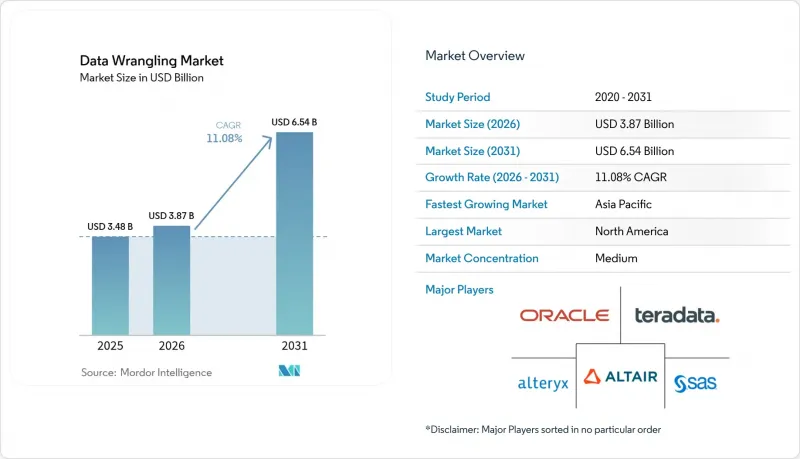
This report is Segmented by Data Type (Structured Data, Semi-Structured Data, and Unstructured Data), Component (Software and Services), Business Function (Finance, Marketing and Sales, Operations, and More), End-User Industry (IT and Telecommunication, BFSI, Retail and E-Commerce, and More), and Geography. The Market Forecasts are Provided in Terms of Value (USD).
Global Data Wrangling Market Trends and Insights
Growing Volumes of Data Generated Across Industries
McKinsey estimates that global data-center outlays will reach USD 6.7 trillion by 2030, of which USD 5.2 trillion relates directly to AI workloads. Edge devices, 5G rollouts, and digitization of manufacturing lines are fueling data creation that outpaces legacy ETL capacity. Asia-Pacific exemplifies this trajectory with 12,206 MW of operational data-center power and 14,338 MW under development in 2024. Enterprises therefore pivot to platforms capable of processing diverse, high-frequency feeds in local jurisdictions that impose sovereignty guardrails.
Advancement in AI and Big-Data Technologies Enabling Automation
Vendors such as Alteryx have embedded generative assistants that recommend transformation steps and generate summaries in natural language. Gartner's 2025 taxonomy of agentic analytics points to autonomous pipelines that self-correct for schema drift and optimize compute allocation. Databricks accelerated this trend by acquiring Lilac AI, adding LLM-based data-quality scoring to its lakehouse stack. While AI raises productivity, organizations temper adoption with hybrid deployment strategies that mitigate compute cost spikes.
Limited Awareness of Data-Wrangling Tools Among SMEs
MSMEs account for 98.9% of all businesses in Central and West Asia, yet scarce digital skills and budget constraints leave many reliant on spreadsheets. Policy bodies advocate training subsidies and cloud vouchers to broaden adoption, while vendors pursue freemium tiers and local reseller partnerships to penetrate this price-sensitive segment.
Other drivers and restraints analyzed in the detailed report include:
- Rising Demand for Self-Service Data Preparation Among Business Users
- Stricter Data-Quality and Governance Regulations
- Escalating Cloud-Compute Costs for Gen-AI-Enhanced Wrangling Workloads
For complete list of drivers and restraints, kindly check the Table Of Contents.
Segment Analysis
Structured data contributed USD 2.01 billion to the data wrangling market size in 2025, equal to 57.85% revenue. Relational tables remain pivotal for transactional integrity and core reporting. Even so, modern pipelines must fuse logs, clickstreams, and sensor feeds into warehouse and lakehouse environments. SQL-centric visual builders that auto-generate lineage maps help enterprises maintain governance as row counts surge.
The unstructured segment is projected to add USD 1.19 billion in incremental revenue between 2026 and 2031 at a 12.32% CAGR, the highest pace among data types. LLM-powered classification and computer vision capabilities unlock insights within contracts, engineering drawings, and video frames. Providers differentiate by offering integrated vector indexing, multimodal metadata extraction, and privacy-aware redaction modules that comply with cross-border regulations.
Software tools held 68.85% of the data wrangling market in 2025, translating to USD 2.4 billion in license and subscription fees. Cloud-native suites weave preparation, cataloging, and governance into one workspace. Vendors cement stickiness by bundling prep functionality inside analytics or ML workloads, turning data wrangling into a workflow rather than a standalone task.
Services revenue, forecast to grow 12.45% annually, reflects demand for architecture design, migration, and managed operations. Deloitte's collaboration with Databricks on Data as a Service for Banking underscores the lift that expert partners provide during modernization initiatives. As lakehouses and distributed fabrics mature, many firms outsource pipeline monitoring to specialists who deliver 24 X 7 support under outcome-based contracts.
Complete Report Scope:
- By Data Type
- Structured Data
- Semi-structured Data
- Unstructured Data
- By Component
- Software
- Self-service data-preparation platforms
- Embedded prep modules in BI/AI suites
- Services
- Managed Services
- Professional / Consulting Services
- Software
- By Business Function
- Finance
- Marketing and Sales
- Operations
- Human Resources
- Legal and Compliance
- By End-user Industry
- IT and Telecommunication
- BFSI
- Retail and E-commerce
- Healthcare
- Government and Public Sector
- Other End-user Industries
- By Geography
- North America
- United States
- Canada
- Mexico
- Europe
- Germany
- United Kingdom
- France
- Italy
- Spain
- Rest of Europe
- Asia-Pacific
- China
- Japan
- India
- South Korea
- Australia
- Rest of Asia-Pacific
- South America
- Brazil
- Argentina
- Rest of South America
- Middle East and Africa
- Middle East
- Saudi Arabia
- United Arab Emirates
- Turkey
- Rest of Middle East
- Africa
- South Africa
- Egypt
- Nigeria
- Rest of Africa
- Middle East
- North America
Geography Analysis
North America held 37.10% of global revenue in 2025, reflecting deep cloud penetration, established hyperscale data-center networks, and sustained venture funding for AI-first platforms. United States enterprises drive the bulk of spend, illustrated by Microsoft's USD 42.4 billion cloud revenue in Q1 2025 and Fabric's 80% customer surge. Canada aligns with skills and regulatory frameworks, whereas Mexico's manufacturing clusters embrace local lakehouse deployments to comply with data-residency laws. Cost pressures are pushing many firms toward workload-aware tiering that keeps frequently accessed datasets on fast object storage and archives cold data on-premises.
Asia-Pacific is forecast to log an 11.75% CAGR, making it the fastest-growing theater for the data wrangling market. Regional enterprises benefit from the 12,206 MW operational data-center footprint, an expanding 5G user base, and sovereign cloud offerings in China, India, and Indonesia. Local providers collaborate with global platforms to offer in-territory edges that satisfy latency and regulation constraints. Strong e-commerce and fintech ecosystems in Singapore and Hong Kong demand real-time customer 360 solutions, intensifying the call for scalable preparation engines.
Europe holds a mature but regulation-heavy environment where GDPR and operational risk mandates dictate procurement criteria. German automotive manufacturers deploy digital twins that blend plant telemetry with enterprise resource planning data. United Kingdom banks advance lineage automation to satisfy Prudential Regulation Authority expectations. Meanwhile, South America, and Middle East, and Africa remain nascent but promising. Brazil's open banking initiative stimulates API traffic that must be standardized, and Saudi Arabia's cloud-first directives increase demand for localized data fabrics that balance cultural and legal considerations.
- Alteryx Inc.
- TIBCO Software Inc.
- Altair Engineering Inc.
- Teradata Corporation
- Oracle Corporation
- SAS Institute Inc.
- Datameer Inc.
- DataRobot Inc.
- Cloudera Inc.
- Cambridge Semantics Inc.
- Informatica Inc.
- Microsoft Corporation
- IBM Corporation
- QlikTech International AB (Talend)
- Databricks Inc.
- KNIME GmbH
- Dataiku SAS
- Matillion Ltd.
- Paxata (DataRobot)
- Tamr Inc.
- Astera Software
- Savant Labs
- Airbyte Inc.
Additional Benefits:
- The market estimate (ME) sheet in Excel format
- 3 months of analyst support
TABLE OF CONTENTS
1 INTRODUCTION
- 1.1 Study Assumptions and Market Definition
- 1.2 Scope of the Study
2 RESEARCH METHODOLOGY
3 EXECUTIVE SUMMARY
4 MARKET LANDSCAPE
- 4.1 Market Overview
- 4.2 Market Drivers
- 4.2.1 Growing volumes of data generated across industries
- 4.2.2 Advancement in AI and big-data technologies enabling automation
- 4.2.3 Rising demand for self-service data preparation among business users
- 4.2.4 Stricter data-quality and governance regulations
- 4.2.5 Migration to data-lakehouse architectures driving cross-format wrangling
- 4.2.6 Emergence of no-code LLM co-pilots that accelerate transformations
- 4.3 Market Restraints
- 4.3.1 Limited awareness of data-wrangling tools among SMEs
- 4.3.2 Data-security driven access restrictions on sensitive datasets
- 4.3.3 Shortage of cloud data-engineering talent for large-scale wrangling
- 4.3.4 Escalating cloud-compute costs for Gen-AI-enhanced wrangling workloads
- 4.4 Value Chain Analysis
- 4.5 Regulatory Landscape
- 4.6 Technological Outlook
- 4.7 Porter's Five Forces Analysis
- 4.7.1 Bargaining Power of Suppliers
- 4.7.2 Bargaining Power of Buyers
- 4.7.3 Threat of New Entrants
- 4.7.4 Threat of Substitutes
- 4.7.5 Intensity of Competitive Rivalry
- 4.8 Investment Analysis
- 4.9 Assessment of the Impact of Macroeconomic Trends on the Market
5 MARKET SIZE AND GROWTH FORECASTS (VALUE)
- 5.1 By Data Type
- 5.1.1 Structured Data
- 5.1.2 Semi-structured Data
- 5.1.3 Unstructured Data
- 5.2 By Component
- 5.2.1 Software
- 5.2.1.1 Self-service data-preparation platforms
- 5.2.1.2 Embedded prep modules in BI/AI suites
- 5.2.2 Services
- 5.2.2.1 Managed Services
- 5.2.2.2 Professional / Consulting Services
- 5.2.1 Software
- 5.3 By Business Function
- 5.3.1 Finance
- 5.3.2 Marketing and Sales
- 5.3.3 Operations
- 5.3.4 Human Resources
- 5.3.5 Legal and Compliance
- 5.4 By End-user Industry
- 5.4.1 IT and Telecommunication
- 5.4.2 BFSI
- 5.4.3 Retail and E-commerce
- 5.4.4 Healthcare
- 5.4.5 Government and Public Sector
- 5.4.6 Other End-user Industries
- 5.5 By Geography
- 5.5.1 North America
- 5.5.1.1 United States
- 5.5.1.2 Canada
- 5.5.1.3 Mexico
- 5.5.2 Europe
- 5.5.2.1 Germany
- 5.5.2.2 United Kingdom
- 5.5.2.3 France
- 5.5.2.4 Italy
- 5.5.2.5 Spain
- 5.5.2.6 Rest of Europe
- 5.5.3 Asia-Pacific
- 5.5.3.1 China
- 5.5.3.2 Japan
- 5.5.3.3 India
- 5.5.3.4 South Korea
- 5.5.3.5 Australia
- 5.5.3.6 Rest of Asia-Pacific
- 5.5.4 South America
- 5.5.4.1 Brazil
- 5.5.4.2 Argentina
- 5.5.4.3 Rest of South America
- 5.5.5 Middle East and Africa
- 5.5.5.1 Middle East
- 5.5.5.1.1 Saudi Arabia
- 5.5.5.1.2 United Arab Emirates
- 5.5.5.1.3 Turkey
- 5.5.5.1.4 Rest of Middle East
- 5.5.5.2 Africa
- 5.5.5.2.1 South Africa
- 5.5.5.2.2 Egypt
- 5.5.5.2.3 Nigeria
- 5.5.5.2.4 Rest of Africa
- 5.5.5.1 Middle East
- 5.5.1 North America
6 COMPETITIVE LANDSCAPE
- 6.1 Market Concentration
- 6.2 Strategic Moves
- 6.3 Market Share Analysis
- 6.4 Company Profiles (includes Global-level Overview, Market-level overview, Core Segments, Financials as available, Strategic Information, Market Rank/Share for key companies, Products and Services, and Recent Developments)
- 6.4.1 Alteryx Inc.
- 6.4.2 TIBCO Software Inc.
- 6.4.3 Altair Engineering Inc.
- 6.4.4 Teradata Corporation
- 6.4.5 Oracle Corporation
- 6.4.6 SAS Institute Inc.
- 6.4.7 Datameer Inc.
- 6.4.8 DataRobot Inc.
- 6.4.9 Cloudera Inc.
- 6.4.10 Cambridge Semantics Inc.
- 6.4.11 Informatica Inc.
- 6.4.12 Microsoft Corporation
- 6.4.13 IBM Corporation
- 6.4.14 QlikTech International AB (Talend)
- 6.4.15 Databricks Inc.
- 6.4.16 KNIME GmbH
- 6.4.17 Dataiku SAS
- 6.4.18 Matillion Ltd.
- 6.4.19 Paxata (DataRobot)
- 6.4.20 Tamr Inc.
- 6.4.21 Astera Software
- 6.4.22 Savant Labs
- 6.4.23 Airbyte Inc.
7 MARKET OPPORTUNITIES AND FUTURE OUTLOOK
- 7.1 White-space and Unmet-Need Assessment

