PUBLISHER: Mordor Intelligence | PRODUCT CODE: 2122756

PUBLISHER: Mordor Intelligence | PRODUCT CODE: 2122756
Vietnam Agricultural Machinery - Market Share Analysis, Industry Trends & Statistics, Growth Forecasts (2026 - 2031)
According to Mordor Intelligence, the Vietnam agricultural machinery market size was valued at USD 564.61 million in 2025 and is estimated to grow from USD 601.21 million in 2026 to USD 842.34 million by 2031, at a CAGR of 6.98% during the forecast period (2026-2031).
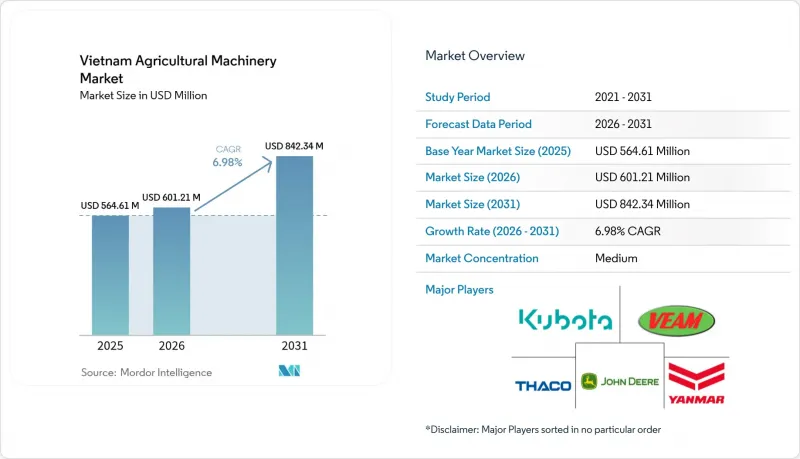
This report is Segmented by Product Type (Tractors, Planting and Seeding Machinery, Harvesting Machinery, Spraying and Drones, Haying and Forage Machinery, and Other Product Types), and by Service Model (Owner-Operated Machines and Custom-Hiring and Rental Services). The Market Forecasts are Provided in Terms of Value (USD).
Vietnam Agricultural Machinery Market Trends and Insights
Shrinking Agricultural Labor Pool
In 2025, the agricultural workforce in Vietnam accounted for 51.94% of the rural labor force, a 4.3% decrease from earlier benchmarks. The Mekong Delta witnessed the sharpest decline. Out-migration, climate shocks, and an aging farmer base are forcing growers to replace manual labor with machinery, yet the pool of skilled operators able to handle Global Positioning System-guided combines is tightening. Custom-hiring services now dominate harvest windows, but operator wages spike during peak periods, pushing interest in autonomous and semi-autonomous equipment. Kubota's January 2025 technical bulletin confirms research on wet-field automation tailored for monsoon conditions. As labor costs keep rising, mechanization becomes less an option and more a survival strategy.
Expansion of Government-Subsidized Mechanization Credit Lines
The July 2024 banking circular opened financial leasing for agricultural machinery, complementing a green credit portfolio that reached 730 trillion Vietnamese dong (approximately USD 29.5 billion) by late 2024. Provincial programs in Can Tho, An Giang, and Dong Thap then layered subsidies covering up to half the cost of transplanters and precision seeders. World Bank capacity-building projects further reduce lenders' risk by anchoring public-private partnerships in value chains. Cooperative models, such as Vinh Cuong in Ca Mau, report per-hectare cost savings of USD 6 to USD 8 because the credit pipeline lets them scale fleets quickly. Domestic assemblers, pricing 10% to 20% below imports, benefit disproportionately because subsidies make their lower ticket prices even more attractive to smallholders.
Highly Fragmented Farm Sizes
Vietnam has many farms spread across numerous parcels, with an average farm size of less than one hectare. Among these, the majority operate on small plots. This significant fragmentation limits economies of scale, as transporting machinery like combine harvesters to small plots diminishes efficiency gains. Additionally, irregularly shaped fields and narrow paths hinder the use of larger agricultural implements. Land laws impose restrictions on consolidation, limiting holdings in the Mekong Delta and other regions. Unless ultra-compact machinery is developed or land tenure regulations are revised, this structural limitation is projected to continue hindering the growth of the Vietnam agricultural machinery market.
Other drivers and restraints analyzed in the detailed report include:
- Surge in Rice-Export Cashflows Funding Machine Upgrades
- On-Farm Data Monetization Platforms Boosting Telematics Demand
- Rising Cyber-Security Threats to Connected Machinery
For complete list of drivers and restraints, kindly check the Table Of Contents.
Segment Analysis
Tractors held 42.3% of the Vietnam agricultural machinery market share in 2025, reflecting their central role in tillage across 7.7 million hectares of paddy. Sub-35-horsepower four-wheel-drive units dominate because they navigate narrow bunds and wet fields. The Vietnam agricultural machinery market for tractors is projected to grow in step with credit lines that cut upfront costs and localization that trims prices. Kubota Corporation and Yanmar Holdings Co., Ltd. are refining 20-40 horsepower models with autonomous features to bridge the labor gap, while domestic assemblers are chasing the sub-USD 10,000 tier. Farmers replacing two-wheel units favor compact four-wheel models that can double as transport, widening the addressable base.
Spraying and drones, though only a mid-single-digit slice of revenue today, will post the fastest growth at a 7.8% CAGR to 2031. Unit cost parity with manual spraying and up to 75% labor savings underpin that expansion. The Vietnam agricultural machinery market size for drones could accelerate further if pilot-licensing rules standardize safety and unlock insurance coverage. Registrations already top 2,800 units, and Real-time Robotics undercuts imports by 20%-30%. Because drones capture real-time crop imagery, they dovetail with carbon-credit verification, giving adopters a second revenue stream.
Complete Report Scope:
- By Product Type
- Tractors
- By Engine Power
- Less than 15 HP
- 15 to 30 HP
- 31 to 45 HP
- 46-75 HP
- More than 75 HP
- By Drive Type
- Two-Wheel Drive
- Four-Wheel Drive
- By Engine Power
- Harvesting Machinery
- Planting and Seeding Machinery
- Spraying and Drones
- Haying and Forage Machinery
- Other Product Types
- Tractors
- By Service Model
- Owner-Operated Machines
- Custom-Hiring and Rental Services
List of Companies Covered in this Report:
- Kubota Corporation
- Yanmar Holdings Co., Ltd.
- Vietnam Engine and Agricultural Machinery Corp (VEAM)
- Truong Hai Group Corporation (THACO)
- Deere & Company (TTC Bien Hoa)
- Mahindra & Mahindra Ltd.
- Yamabiko Corporation
- LS Mtron Co., Ltd. (LS Group)
- Zetor Tractors a.s. (HTC Investments)
- Zoomlion Heavy Industry Science and Technology Co., Ltd.
- Netafim Ltd. (Orbia Group)
- Vermeer Manufacturing Co.
Additional Benefits:
- The market estimate (ME) sheet in Excel format
- 3 months of analyst support
TABLE OF CONTENTS
1 Introduction
- 1.1 Study Assumptions and Market Definition
- 1.2 Scope of the Study
2 Research Methodology
3 Executive Summary
4 Market Landscape
- 4.1 Market Overview
- 4.2 Market Drivers
- 4.2.1 Shrinking agricultural labor pool
- 4.2.2 Expansion of government-subsidized mechanization credit lines
- 4.2.3 Surge in rice-export cashflows funding machine upgrades
- 4.2.4 Rapid drop in drone-spraying service costs
- 4.2.5 Domestic original equipment manufacturer localization drive
- 4.2.6 On-farm data monetization platforms boosting telematics demand
- 4.3 Market Restraints
- 4.3.1 Highly fragmented farm sizes
- 4.3.2 Low rural electrification hindering electric tractors
- 4.3.3 Rising cyber-security threats to connected machinery
- 4.3.4 Skilled-operator shortage inflating service costs
- 4.4 Regulatory Landscape
- 4.5 Technological Outlook
- 4.6 Porter's Five Forces Analysis
- 4.6.1 Bargaining Power of Suppliers
- 4.6.2 Bargaining Power of Buyers
- 4.6.3 Threat of New Entrants
- 4.6.4 Threat of Substitutes
- 4.6.5 Intensity of Competitive Rivalry
5 Market Size and Growth Forecasts (Value)
- 5.1 By Product Type
- 5.1.1 Tractors
- 5.1.1.1 By Engine Power
- 5.1.1.1.1 Less than 15 HP
- 5.1.1.1.2 15 to 30 HP
- 5.1.1.1.3 31 to 45 HP
- 5.1.1.1.4 46-75 HP
- 5.1.1.1.5 More than 75 HP
- 5.1.1.2 By Drive Type
- 5.1.1.2.1 Two-Wheel Drive
- 5.1.1.2.2 Four-Wheel Drive
- 5.1.1.1 By Engine Power
- 5.1.2 Harvesting Machinery
- 5.1.3 Planting and Seeding Machinery
- 5.1.4 Spraying and Drones
- 5.1.5 Haying and Forage Machinery
- 5.1.6 Other Product Types
- 5.1.1 Tractors
- 5.2 By Service Model
- 5.2.1 Owner-Operated Machines
- 5.2.2 Custom-Hiring and Rental Services
6 Competitive Landscape
- 6.1 Market Concentration
- 6.2 Strategic Moves
- 6.3 Market Share Analysis
- 6.4 Company Profiles (Includes Global-Level Overview, Market-Level Overview, Core Segments, Financials as Available, Strategic Information, Market Rank/Share for Key Companies, Products and Services, and Recent Developments)
- 6.4.1 Kubota Corporation
- 6.4.2 Yanmar Holdings Co., Ltd.
- 6.4.3 Vietnam Engine and Agricultural Machinery Corp (VEAM)
- 6.4.4 Truong Hai Group Corporation (THACO)
- 6.4.5 Deere & Company (TTC Bien Hoa)
- 6.4.6 Mahindra & Mahindra Ltd.
- 6.4.7 Yamabiko Corporation
- 6.4.8 LS Mtron Co., Ltd. (LS Group)
- 6.4.9 Zetor Tractors a.s. (HTC Investments)
- 6.4.10 Zoomlion Heavy Industry Science and Technology Co., Ltd.
- 6.4.11 Netafim Ltd. (Orbia Group)
- 6.4.12 Vermeer Manufacturing Co.
7 Market Opportunities and Future Outlook

