PUBLISHER: Mordor Intelligence | PRODUCT CODE: 2122761

PUBLISHER: Mordor Intelligence | PRODUCT CODE: 2122761
VoLTE - Market Share Analysis, Industry Trends & Statistics, Growth Forecasts (2026 - 2031)
According to Mordor Intelligence, the VoLTE market size was valued at USD 60.88 billion in 2025 and estimated to grow from USD 86.84 billion in 2026 to reach USD 513.23 billion by 2031, at a CAGR of 42.65% during the forecast period (2026-2031).
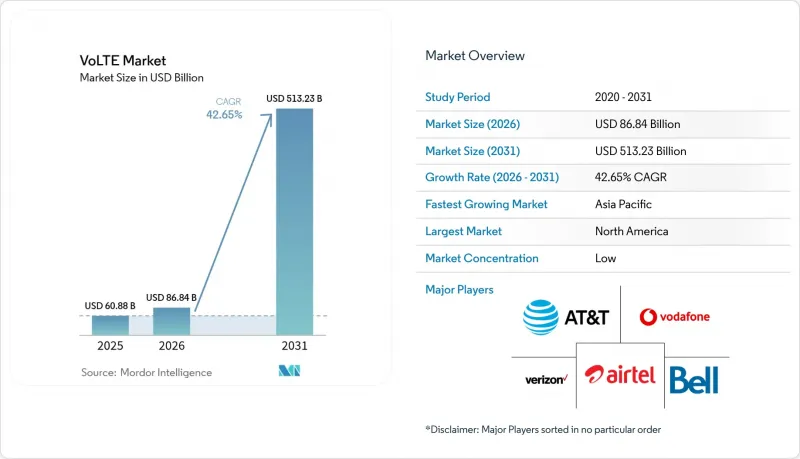
This report is Segmented by End-User Industry (Corporate, Commercial, Government), Device Category (Smartphones, and More), Technology (Voice Over IMS, and More), Call Type (HD Voice, and More), Operator Type (Mobile Network Operators, Mobile Virtual Network Operators, and More), and Geography. The Market Forecasts are Provided in Terms of Value (USD).
Global VoLTE Market Trends and Insights
Growing LTE Network Coverage & Smartphone Penetration
LTE now covers around 95% of populations in developed economies and continues to scale across emerging markets. Smartphone penetration surpassed 74% worldwide in 2024, and most 5G-capable devices ship with VoLTE enabled out-of-box. Operators migrate voice traffic to VoLTE to reclaim 3G spectrum and lower operating costs. Wider rural LTE footprints in India and Brazil, often co-funded by governments, extend VoLTE to previously underserved communities. The alignment of network readiness, device capability, and policy incentives positions VoLTE as the default voice layer during the 4G-to-5G transition.
Regulatory Sunset of 3G Networks Accelerating VoLTE Migration
The FCC's mandated 3G switch-off schedule and Europe's 2025 sunset recommendation eliminate fallback circuit-switched voice, compelling operators to provision. Rapid spectrum refarming for 5G and stringent E911 location-accuracy rules make VoLTE implementation non-negotiable. Equipment vendors gain from brisk IMS core upgrades, and operators report quicker pay-back on VoLTE CAPEX through lower energy costs and reduced legacy maintenance.
Lack of Awareness and Slow Adoption in Low-Income Nations
Subscribers in low-income regions prioritize basic connectivity, so VoLTE's value proposition remains unclear. Feature-phone prevalence and device affordability gaps stall migration even where LTE coverage exists. Operator campaigns must emphasize tangible benefits such as clearer audio and simultaneous voice-data functionality while aligning with government digital-literacy drives.
Other drivers and restraints analyzed in the detailed report include:
- Enterprise Private-LTE Adoption for Mission-Critical Voice
- 5G NSA Deployments Requiring VoLTE for Fallback Voice Continuity
- Roaming/Inter-Operator Interoperability Challenges
For complete list of drivers and restraints, kindly check the Table Of Contents.
Segment Analysis
Government agencies accounted for a 43.9% CAGR through 2031, though the Commercial segment retained the largest 40.55% share of VoLTE market size in 2025. Federal and municipal bodies adopt VoLTE to modernize public-safety communications, integrate broadband push-to-talk, and meet stringent security mandates. First responders in the United States migrate to FirstNet's VoLTE-enabled broadband, enabling multimedia situational awareness.
Expanding smart-city programs employ VoLTE as a resilient fallback for IoT telemetry and emergency alerts. Defense departments deploy encrypted VoLTE on private networks to simplify voice procurement and maintenance. Commercial enterprises leverage existing smartphone fleets to embed HD voice into unified communications, supporting hybrid work and customer-service workflows without heavy hardware investments.
Smartphones retained 66.85% of VoLTE market share in 2025, yet IoT Modules and Wearables log the strongest 45% CAGR. Asset trackers integrate VoLTE modules to relay voice alarms during intrusions, while smartwatches gain autonomous calling functions. Automakers embed VoLTE for automatic crash notification and concierge calling, adding incremental service revenue for operators and OEMs.
Lower-cost feature phones with VoLTE widen addressable bases in emerging markets where OTT voice alternatives consume excessive data. Enterprise IoT deployments require carrier-grade voice for control-room escalation during system faults, converting machines into voice end-points and enlarging the VoLTE market.
Complete Report Scope:
- By End-user Industry
- Corporate
- Commercial
- Government
- By Device Category
- Smartphones
- Feature Phones
- IoT Modules and Wearables
- By Technology
- Voice over IMS (VoIMS)
- Circuit-Switched Fallback (CSFB)
- Single-Radio Voice Call Continuity (SRVCC)
- Voice over LTE via GAN (VOLGA)
- Dual-Radio / Simultaneous Voice and LTE (SVLTE)
- By Call Type
- HD Voice
- Video over LTE
- Rich Communication Services (RCS)
- By Operator Type
- Mobile Network Operators (MNO)
- Mobile Virtual Network Operators (MVNO)
- Private / Enterprise LTE Networks
- By Geography
- North America
- United States
- Canada
- Mexico
- South America
- Brazil
- Argentina
- Rest of South America
- Europe
- United Kingdom
- Germany
- France
- Italy
- Russia
- Rest of Europe
- Asia-Pacific
- China
- Japan
- South Korea
- India
- Australia and New Zealand
- ASEAN
- Rest of Asia-Pacific
- Middle East and Africa
- Middle East
- Saudi Arabia
- UAE
- Turkey
- Israel
- Rest of Middle East
- Africa
- South Africa
- Nigeria
- Kenya
- Rest of Africa
- Middle East
- North America
Geography Analysis
North America commanded 39.45% of 2025 revenue on the back of complete LTE footprints, early smartphone saturation, and FCC-driven 3G sunsets. Operators, including Verizon and AT&T, finalized nationwide VoLTE rollouts and now target latency optimization to support low-latency voice applications. Canadian carriers leverage shared rural infrastructure programs to extend VoLTE coverage into sparsely populated regions, while Mexico's reform-driven spectrum auctions speed up LTE deployment.
Asia-Pacific is forecast to grow at 45.8% CAGR, buoyed by China's 500 million-subscriber VoLTE network and India's Digital India program that subsidizes 4G handsets. Regional giants like Reliance Jio lead with zero-charge VoLTE calling plans, illustrating how inexpensive voice can accelerate adoption. Japan and South Korea exploit dense urban fiber backhaul to layer RCS and ultra-low-latency video over standard VoLTE, attracting premium subscribers.
Europe's coordinated 3G sunset roadmap supports cross-border roaming efforts that bolster traveler confidence in VoLTE continuity. Middle East governments invest in smart-city blueprints, using VoLTE to back up IoT telemetry and emergency services in high-rise clusters. Africa and Latin America trail in revenue terms yet present untapped opportunities as universal service funds finance LTE rollouts and handset affordability programs.
- AT&T Inc.
- Verizon Communications Inc.
- China Mobile Ltd.
- Reliance Jio Infocomm Ltd.
- Vodafone Group Plc
- Bharti Airtel Ltd.
- SK Telecom Co. Ltd.
- KT Corporation
- Orange S.A.
- Deutsche Telekom AG
- Telefonica S.A.
- Telstra Corporation Ltd.
- NTT Docomo Inc.
- China Unicom Ltd.
- China Telecom Corp.
- Bell Canada
- Rogers Communications Inc.
- Etisalat Group
- MTN Group
- Zain Group
- Telkomsel
Additional Benefits:
- The market estimate (ME) sheet in Excel format
- 3 months of analyst support
TABLE OF CONTENTS
1 INTRODUCTION
- 1.1 Study Assumptions and Market Definition
- 1.2 Scope of the Study
2 RESEARCH METHODOLOGY
3 EXECUTIVE SUMMARY
4 MARKET LANDSCAPE
- 4.1 Market Overview
- 4.2 Market Drivers
- 4.2.1 Increasing demand for high-speed mobile broadband voice services
- 4.2.2 Growing LTE network coverage and smartphone penetration
- 4.2.3 Regulatory sunset of 3G networks accelerating VoLTE migration
- 4.2.4 Enterprise private-LTE adoption for mission-critical voice
- 4.2.5 eSIM-centric device ecosystem enabling seamless IMS provisioning
- 4.2.6 5G NSA deployments requiring VoLTE for fallback voice continuity
- 4.3 Market Restraints
- 4.3.1 Lack of awareness and slow adoption in low-income nations
- 4.3.2 Roaming/inter-operator interoperability challenges
- 4.3.3 Vo5G cannibalisation risk dampening late-stage VoLTE CAPEX
- 4.3.4 Battery-drain and QoS hurdles in ultra-dense heterogeneous networks
- 4.4 Value / Supply-Chain Analysis
- 4.5 Regulatory Landscape
- 4.6 Technological Outlook
- 4.7 Porter's Five Forces Analysis
- 4.7.1 Threat of New Entrants
- 4.7.2 Bargaining Power of Buyers/Consumers
- 4.7.3 Bargaining Power of Suppliers
- 4.7.4 Threat of Substitute Products
- 4.7.5 Intensity of Competitive Rivalry
- 4.8 Pricing Analysis
- 4.9 VoLTE Launches by Country
- 4.10 Impact of COVID-19 on the VoLTE Market
- 4.11 Impact of 5G Stand-Alone Roll-outs on VoLTE Economics
- 4.12 Breakdown of VoLTE Connection / Penetration by Country
- 4.12.1 United States
- 4.12.2 Canada
- 4.12.3 United Kingdom
- 4.12.4 Germany
- 4.12.5 China
- 4.12.6 Japan
- 4.12.7 South Korea
5 MARKET SIZE AND GROWTH FORECASTS (VALUE)
- 5.1 By End-user Industry
- 5.1.1 Corporate
- 5.1.2 Commercial
- 5.1.3 Government
- 5.2 By Device Category
- 5.2.1 Smartphones
- 5.2.2 Feature Phones
- 5.2.3 IoT Modules and Wearables
- 5.3 By Technology
- 5.3.1 Voice over IMS (VoIMS)
- 5.3.2 Circuit-Switched Fallback (CSFB)
- 5.3.3 Single-Radio Voice Call Continuity (SRVCC)
- 5.3.4 Voice over LTE via GAN (VOLGA)
- 5.3.5 Dual-Radio / Simultaneous Voice and LTE (SVLTE)
- 5.4 By Call Type
- 5.4.1 HD Voice
- 5.4.2 Video over LTE
- 5.4.3 Rich Communication Services (RCS)
- 5.5 By Operator Type
- 5.5.1 Mobile Network Operators (MNO)
- 5.5.2 Mobile Virtual Network Operators (MVNO)
- 5.5.3 Private / Enterprise LTE Networks
- 5.6 By Geography
- 5.6.1 North America
- 5.6.1.1 United States
- 5.6.1.2 Canada
- 5.6.1.3 Mexico
- 5.6.2 South America
- 5.6.2.1 Brazil
- 5.6.2.2 Argentina
- 5.6.2.3 Rest of South America
- 5.6.3 Europe
- 5.6.3.1 United Kingdom
- 5.6.3.2 Germany
- 5.6.3.3 France
- 5.6.3.4 Italy
- 5.6.3.5 Russia
- 5.6.3.6 Rest of Europe
- 5.6.4 Asia-Pacific
- 5.6.4.1 China
- 5.6.4.2 Japan
- 5.6.4.3 South Korea
- 5.6.4.4 India
- 5.6.4.5 Australia and New Zealand
- 5.6.4.6 ASEAN
- 5.6.4.7 Rest of Asia-Pacific
- 5.6.5 Middle East and Africa
- 5.6.5.1 Middle East
- 5.6.5.1.1 Saudi Arabia
- 5.6.5.1.2 UAE
- 5.6.5.1.3 Turkey
- 5.6.5.1.4 Israel
- 5.6.5.1.5 Rest of Middle East
- 5.6.5.2 Africa
- 5.6.5.2.1 South Africa
- 5.6.5.2.2 Nigeria
- 5.6.5.2.3 Kenya
- 5.6.5.2.4 Rest of Africa
- 5.6.5.1 Middle East
- 5.6.1 North America
6 COMPETITIVE LANDSCAPE
- 6.1 Market Concentration
- 6.2 Strategic Moves
- 6.3 Market Share Analysis
- 6.4 Company Profiles (includes Global level Overview, Market level overview, Core Segments, Financials as available, Strategic Information, Market Rank/Share, Products and Services, Recent Developments)
- 6.4.1 AT&T Inc.
- 6.4.2 Verizon Communications Inc.
- 6.4.3 China Mobile Ltd.
- 6.4.4 Reliance Jio Infocomm Ltd.
- 6.4.5 Vodafone Group Plc
- 6.4.6 Bharti Airtel Ltd.
- 6.4.7 SK Telecom Co. Ltd.
- 6.4.8 KT Corporation
- 6.4.9 Orange S.A.
- 6.4.10 Deutsche Telekom AG
- 6.4.11 Telefonica S.A.
- 6.4.12 Telstra Corporation Ltd.
- 6.4.13 NTT Docomo Inc.
- 6.4.14 China Unicom Ltd.
- 6.4.15 China Telecom Corp.
- 6.4.16 Bell Canada
- 6.4.17 Rogers Communications Inc.
- 6.4.18 Etisalat Group
- 6.4.19 MTN Group
- 6.4.20 Zain Group
- 6.4.21 Telkomsel
7 MARKET OPPORTUNITIES AND FUTURE OUTLOOK

