PUBLISHER: Mordor Intelligence | PRODUCT CODE: 2122779

PUBLISHER: Mordor Intelligence | PRODUCT CODE: 2122779
Surgical Sutures - Market Share Analysis, Industry Trends & Statistics, Growth Forecasts (2026 - 2031)
According to Mordor Intelligence, the surgical sutures market size is expected to increase from USD 5.16 billion in 2025 to USD 5.39 billion in 2026 and reach USD 7.03 billion by 2031, growing at a CAGR of 5.47% over 2026-2031.
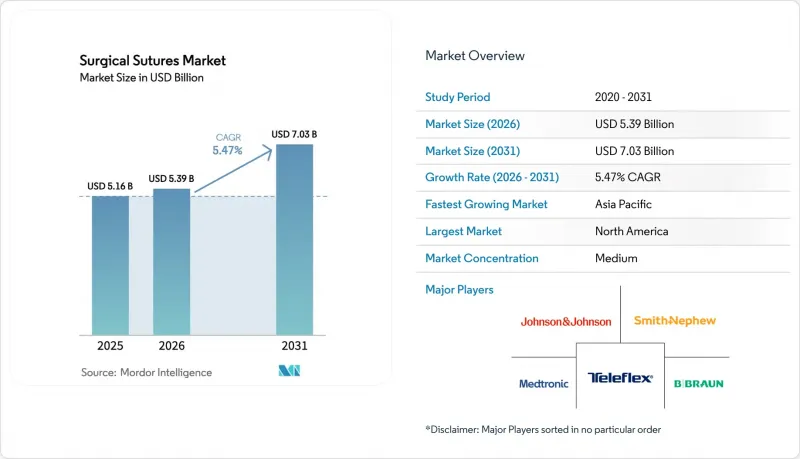
This report is Segmented by Product (Absorbable, Non-Absorbable), Filament Structure (Monofilament, Multifilament), Source (Natural, Synthetic), Coating (Coated, Uncoated), Application (Cardiovascular, General, Orthopedic, Gynecology & Obstetrics, Ophthalmic, and More), End User (Hospitals, and More), and Geography (North America, and More). Market Forecasts are Provided in Terms of Value (USD).
Global Surgical Sutures Market Trends and Insights
Rising Surgical Procedure Volumes Among Ageing Populations
Geriatric demographics are reshaping suture demand by boosting orthopedic, spinal, and cardiovascular case volumes while requiring longer-lasting absorbable filaments that retain tensile strength for 60-90 days. U.S. adults aged >=65 will constitute 21.6% of the population by 2040, increasing annual hip and knee arthroplasties toward 4.7 million procedures. Over 90% of arthroplasty patients during the study period were aged 50 and above. The average age for total hip replacement (THR) patients was 70, and for total knee replacement (TKR) patients, it was 67. Projections indicate a 65% rise in total hip arthroplasties and a 49% increase in knee arthroplasties by 2036. In 2023, Japan's National Clinical Database recorded 895,606 gastroenterological and abdominal surgical procedures. Laparoscopic cholecystectomy led with 118,825 procedures, followed by laparoscopic inguinal hernia surgery (82,669) and open inguinal hernia surgery (63,234). Infection rates double in patients over 75, prompting hospitals to mandate triclosan-coated sutures for high-risk geriatric procedures.
Growing Chronic-Disease Burden Driving Elective Surgeries
Diabetes, obesity, cardiovascular disease, and cancer are pushing predictable high-volume surgeries that favor standardized suture lines. Bariatric procedures in the United States reached 270,089 in 2023, consuming 30% more suture material than standard abdominal cases. Coronary artery bypass grafts totaled 371,000 in 2024, anchoring demand for braided polyester vascular sutures. Oncology resections increasingly rely on absorbable subcuticular closures that avoid follow-up removal in immunosuppressed patients.
Shift Toward Staplers, Sealants & Robotic Closure Systems
Robotic stapling on da Vinci platforms cut suture use 20% per colorectal case in 2024 as procedure counts hit 2.289 million. Fibrin sealants and cyanoacrylate adhesives replace sutures in pediatric and hepatic cases, aided by FDA clearances of eight new tissue-adhesive variants in 2024. CMS raised stapled bariatric surgery reimbursements by USD 220, reinforcing substitution economics.
Other drivers and restraints analyzed in the detailed report include:
- Technological Advances in Bio-Absorbable & Antimicrobial Yarns
- Expansion of Healthcare Infrastructure in Emerging Economies
- Infection Risks Prompting Switch to Adhesive Dressings
For complete list of drivers and restraints, kindly check the Table Of Contents.
Segment Analysis
Absorbable sutures' 53.24% share in 2025 underscores a structural reimbursement shift. Medicare's 2024 Physician Fee Schedule cut payments for suture-removal visits, driving surgeons toward polyglycolic-acid and polydioxanone options. Within the surgical suture market size for absorbables, barbed designs shortened OR time 6-9 minutes, and adoption in orthopedic repairs rose 14%. Non-absorbables persist in vascular and corneal applications demanding permanent tensile strength, but their 3.12% CAGR lags as payors reward elimination of follow-up appointments.
ISO 13485 certifications climbed 9% year-on-year to 1,247 suture manufacturers in 2024, making quality compliance a threshold for GPO contracts. Carbon-neutral bio-based absorbables could rewrite purchasing criteria despite 40%-60% price premiums, limiting early uptake to academic centers.
Monofilament sutures seized 58.46% revenue in 2025 and pace at an 8.02% CAGR as hospital protocols ban multifilaments in contaminated settings. A Lancet meta-analysis covering 47,000 patients proved single-strand closures cut infections by 52% in colorectal and biliary surgeries. Multifilaments still appeal for knot security in microsurgery, yet antimicrobial coatings on braided threads are stop-gap solutions amid infection-control mandates. Barbed designs blur structural lines by offering knotless closures that shave OR minutes and reduce glove fatigue in repetitive closures.
Complete Report Scope:
- By Product
- Absorbable Sutures
- Non-absorbable Sutures
- By Filament Structure
- Monofilament Sutures
- Multifilament Sutures
- By Source
- Natural Sutures
- Synthetic Sutures
- By Coating
- Coated Sutures
- Uncoated Sutures
- By Application
- Cardiovascular Surgery
- General Surgery
- Orthopedic Surgery
- Gynecology & Obstetrics
- Ophthalmic Surgery
- Dental Surgery
- Plastic & Reconstructive Surgery
- Other Applications
- By End User
- Hospitals
- Ambulatory Surgical Centers
- Specialty Clinics
- Other End Users
- By Geography
- North America
- United States
- Canada
- Mexico
- Europe
- Germany
- France
- United Kingdom
- Italy
- Spain
- Rest of Europe
- Asia-Pacific
- China
- Japan
- India
- South Korea
- Australia
- Rest of Asia-Pacific
- Middle East & Africa
- GCC
- South Africa
- Rest of Middle East & Africa
- South America
- Brazil
- Argentina
- Rest of South America
- North America
Geography Analysis
North America's 37.47% share stems from 51 million annual procedures and premium adoption of coated and barbed sutures. GPOs controlling USD 84 billion in contracts enforce bundled deals that shaved 200-300 basis points off standalone suture margins by 2025.
Asia-Pacific posts a 7.36% CAGR, lifted by India's bed count expansion, China's hospital build-out, and Japan's aging orthopedic demand. Europe is tempered by MDR recertification hurdles that sidelined 14% of manufacturers and by EMA reviews restricting triclosan usage. The Middle East and Africa grows as Saudi Arabia's Vision 2030 privatization drives centralized procurement. South America's share remains price-sensitive under Brazil's SUS tenders that emphasize lowest-cost supply.
- Assut Medical Sarl
- B. Braun
- Boston Scientific
- Conmed
- DemeTech Corporation
- Internacional Farmaceutica
- Johnson & Johnson
- Kono Seisakusho Co., Ltd.
- Lotus Surgicals Pvt Ltd
- Medtronic
- Mellon Medical
- Meril Life Sciences
- Peters Surgical
- Samyang Biopharm
- Smiths Group
- Surgical Specialties
- Sutures India (Healthium)
- Teleflex
- W. L. Gore & Associates
Additional Benefits:
- The market estimate (ME) sheet in Excel format
- 3 months of analyst support
TABLE OF CONTENTS
1 Introduction
- 1.1 Study Assumptions & Market Definition
- 1.2 Scope of the Study
2 Research Methodology
3 Executive Summary
4 Market Landscape
- 4.1 Market Overview
- 4.2 Market Drivers
- 4.2.1 Rising Surgical Procedure Volumes among Ageing Populations
- 4.2.2 Growing Chronic-Disease Burden Driving Elective Surgeries
- 4.2.3 Technological Advances in Bio-Absorbable & Antimicrobial Yarns
- 4.2.4 Expansion of Healthcare Infrastructure in Emerging Economies
- 4.2.5 Boom in Ambulatory Surgeries Demanding Fast-Absorbing Sutures
- 4.2.6 Early R&D in 'Smart' Sensor-Enabled Sutures
- 4.3 Market Restraints
- 4.3.1 Shift Toward Staplers, Sealants & Robotic Closure Systems
- 4.3.2 Infection Risks Prompting Switch to Adhesive Dressings
- 4.3.3 Heightened Scrutiny of Antimicrobial-Coated Filaments
- 4.3.4 Geopolitical Raw-Material Supply Disruptions (PDO, Catgut)
- 4.4 Value / Supply-Chain Analysis
- 4.5 Regulatory Landscape
- 4.6 Technological Outlook
- 4.7 Porter's Five Forces Analysis
- 4.7.1 Bargaining Power of Suppliers
- 4.7.2 Bargaining Power of Buyers
- 4.7.3 Threat of New Entrants
- 4.7.4 Threat of Substitutes
- 4.7.5 Intensity of Competitive Rivalry
5 Market Size & Growth Forecasts (Value in USD)
- 5.1 By Product
- 5.1.1 Absorbable Sutures
- 5.1.2 Non-absorbable Sutures
- 5.2 By Filament Structure
- 5.2.1 Monofilament Sutures
- 5.2.2 Multifilament Sutures
- 5.3 By Source
- 5.3.1 Natural Sutures
- 5.3.2 Synthetic Sutures
- 5.4 By Coating
- 5.4.1 Coated Sutures
- 5.4.2 Uncoated Sutures
- 5.5 By Application
- 5.5.1 Cardiovascular Surgery
- 5.5.2 General Surgery
- 5.5.3 Orthopedic Surgery
- 5.5.4 Gynecology & Obstetrics
- 5.5.5 Ophthalmic Surgery
- 5.5.6 Dental Surgery
- 5.5.7 Plastic & Reconstructive Surgery
- 5.5.8 Other Applications
- 5.6 By End User
- 5.6.1 Hospitals
- 5.6.2 Ambulatory Surgical Centers
- 5.6.3 Specialty Clinics
- 5.6.4 Other End Users
- 5.7 By Geography
- 5.7.1 North America
- 5.7.1.1 United States
- 5.7.1.2 Canada
- 5.7.1.3 Mexico
- 5.7.2 Europe
- 5.7.2.1 Germany
- 5.7.2.2 France
- 5.7.2.3 United Kingdom
- 5.7.2.4 Italy
- 5.7.2.5 Spain
- 5.7.2.6 Rest of Europe
- 5.7.3 Asia-Pacific
- 5.7.3.1 China
- 5.7.3.2 Japan
- 5.7.3.3 India
- 5.7.3.4 South Korea
- 5.7.3.5 Australia
- 5.7.3.6 Rest of Asia-Pacific
- 5.7.4 Middle East & Africa
- 5.7.4.1 GCC
- 5.7.4.2 South Africa
- 5.7.4.3 Rest of Middle East & Africa
- 5.7.5 South America
- 5.7.5.1 Brazil
- 5.7.5.2 Argentina
- 5.7.5.3 Rest of South America
- 5.7.1 North America
6 Competitive Landscape
- 6.1 Market Concentration
- 6.2 Market Share Analysis
- 6.3 Company Profiles (includes Global level Overview, Market level overview, Core Segments, Financials as available, Strategic Information, Market Rank/Share for key companies, Products and Services, and Recent Developments)
- 6.3.1 Assut Medical Sarl
- 6.3.2 B. Braun Melsungen AG
- 6.3.3 Boston Scientific Corporation
- 6.3.4 CONMED Corporation
- 6.3.5 DemeTech Corporation
- 6.3.6 Internacional Farmaceutica
- 6.3.7 Johnson & Johnson (Ethicon)
- 6.3.8 Kono Seisakusho Co., Ltd.
- 6.3.9 Lotus Surgicals Pvt Ltd
- 6.3.10 Medtronic plc
- 6.3.11 Mellon Medical B.V.
- 6.3.12 Meril Life Sciences
- 6.3.13 Peters Surgical
- 6.3.14 Samyang Biopharm
- 6.3.15 Smith & Nephew plc
- 6.3.16 Surgical Specialties Corporation
- 6.3.17 Sutures India (Healthium)
- 6.3.18 Teleflex Incorporated
- 6.3.19 W. L. Gore & Associates
7 Market Opportunities & Future Outlook
- 7.1 White-space & Unmet-need Assessment

