PUBLISHER: Mordor Intelligence | PRODUCT CODE: 2122782

PUBLISHER: Mordor Intelligence | PRODUCT CODE: 2122782
Organic Bananas - Market Share Analysis, Industry Trends & Statistics, Growth Forecasts (2026 - 2031)
According to Mordor Intelligence, the organic bananas market size was valued at USD 1.53 billion in 2025 and estimated to grow from USD 1.65 billion in 2026 to reach USD 2.42 billion by 2031, at a CAGR of 7.96% during the forecast period (2026-2031).
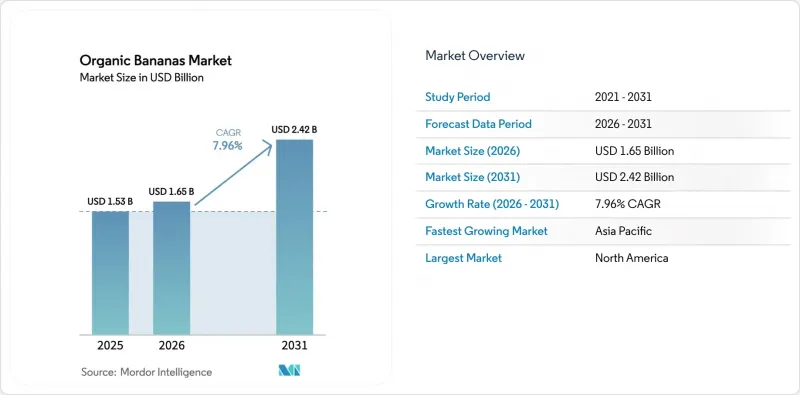
This report is Segmented by Geography (North America, South America, Europe, Asia-Pacific, Middle East, and Africa). The Study Includes Production Analysis (Volume), Consumption Analysis (Value and Volume), Export Analysis (Value and Volume), Import Analysis (Value and Volume), Wholesale Price Trend Analysis, and More. The Market Forecasts are Provided in Terms of Value (USD) and Volume (Metric Tons).
Global Organic Bananas Market Trends and Insights
United States Retail Shift Toward Year-Round Organic Tropical Fruit Assortments
Major retailers in the United States now allocate shelf space for organic bananas throughout the year, establishing a consistent baseline demand for exporters. Multi-year contracts offer predictable cash flows, allowing growers to fund certification audits and implement biosecurity upgrades without concerns over short-term price fluctuations. Walmart requires suppliers to undergo Global Food Safety Initiative audits and maintain valid National Organic Program certifications, which increases compliance costs but also lowers rejection rates at United States ports. In 2024, Whole Foods Market and Kroger expanded their certified sourcing, prioritizing Fair Trade-compliant origins aligned with their corporate sustainability goals. This has strengthened the demand floor, providing producers with protection against the volatility typical of the conventional banana market, though it has also concentrated bargaining power among a limited number of supermarket chains.
Rising EU and United States Import Premiums for Fair Trade and Organic Certification
Importers in the European Union and the United States pay premiums of 15-20% for bananas certified with both organic and Fair Trade seals. These premiums support higher FOB prices, which account for certification, traceability, and Living Wage programs. Fairtrade International has established minimum organic floor prices ranging from USD 9.55 to USD 10.50 per 18.14 kg box, effective from January 2025, along with an additional USD 1 premium per box. This pricing structure helps offset increased labor and compliance costs for many plantations. The EU's electronic Certificates of Inspection system, mandated under regulation 2018/848, minimizes fraudulent claims and enhances value protection. Steady premiums incentivize both large farms and smallholder cooperatives to undertake the three-year conversion process required for full certification. However, smaller operators often face liquidity challenges during this transition period.
Panama TR4 (Fusarium Tropical race 4) Spread Raises Certification Costs for Smallholders
The detection of Tropical Race 4 in Colombia, Peru, and Venezuela has led to the implementation of quarantine and sanitation measures, resulting in an increase in the landed cost of organic fruit. Smallholders are required to invest in disinfectant stations, foot baths, and certified planting materials to maintain their certification. However, many farmers face challenges in meeting these requirements without external assistance. Efforts to breed resistant cultivars are underway in Brazil, but commercial availability is still several years away.
Other drivers and restraints analyzed in the detailed report include:
- Ecuadorian Large-Scale Conversion to Organic Acreage Cuts Pesticide Costs
- Vertical-Farm Micro-Banana Pilots in Japan Unlock High-Margin Urban Supply
- Tightening EU Maximum Residue Levels Shrink Admissible Organic Shipment Volumes
For complete list of drivers and restraints, kindly check the Table Of Contents.
Geography Analysis
North America maintains the largest regional share, accounting for 43% in 2025, driven by the enforcement of the National Organic Program, guaranteed supermarket shelf space, and an expanding near-shore supply from Mexico. This supply chain reduces lead times and lowers freight emissions. Certified growers in Mexico benefit from expedited border crossings into distribution hubs in Texas and California, providing a logistical advantage over South American exporters who rely on longer ocean shipping routes.
Europe holds a substantial share of the market, supported by consistent Fair Trade premiums and reinforced by new Living Wage commitments that align buyer agreements with fair income standards at the farm level. The introduction of updated organic regulations has increased documentation requirements, enhancing importers' confidence in the authenticity and integrity of organic products. Although inflationary pressures have prompted some consumers to opt for lower-priced alternatives, loyalty to organic products remains robust in key markets such as Germany, France, and Denmark.
The Asia-Pacific region is the fastest-growing market, projected to grow at a CAGR of 8.2% during the forecast period, driven by increasing demand from urban consumers in countries such as India, China, and the Philippines. These consumers are purchasing certified organic fruit through online grocery platforms that emphasize traceability. Additionally, Japan is focusing on high-margin vertical farming for bananas, a strategy that eliminates seasonality and mitigates maritime risks. If pilot projects prove successful and regional cold chain infrastructure improves, the organic bananas market in Asia-Pacific is projected to experience significant growth in the coming years.
South America holds a modest yet significant position in the market, with Ecuador leading the way through the substantial conversion of plantation acreage to organic farming and a robust export performance. Countries such as Colombia and Peru, as well as emerging suppliers such as Brazil, are progressively increasing certified organic production. These nations often utilize cooperative models, enabling small growers to share audit costs and ensure compliance with certification standards.
The Middle East and Africa account for a modest yet steadily growing portion of the market, driven by strong growth momentum. The United Arab Emirates functions as a significant hub, re-exporting certified organic fruit throughout the Gulf region. Meanwhile, South Africa is focusing on expanding refrigerated storage facilities to meet the needs of domestic retailers and neighboring countries. Increasing disposable incomes and heightened health awareness are enhancing the region's long-term prospects for organic produce.
- Overview of the Competition
- Recent Developments
- Market Concentration Analysis
Additional Benefits:
- The market estimate (ME) sheet in Excel format
- 3 months of analyst support
TABLE OF CONTENTS
1 Introduction
- 1.1 Study Assumptions and Market Definition
- 1.2 Scope of the Study
2 Research Methodology
3 Executive Summary
4 Market Dynamics
- 4.1 Market Overview
- 4.2 Market Drivers
- 4.2.1 United States retail shift toward year-round organic tropical fruit assortments
- 4.2.2 Rising EU and United States import premiums for Fair-Trade and organic certification
- 4.2.3 Ecuadorian large-scale conversion to organic acreage cuts pesticide costs
- 4.2.4 Mexico's near-shoring of organic supply chains lowers freight emissions
- 4.2.5 AI-enabled disease forecasting reduces organic crop losses in Colombia
- 4.2.6 Vertical-farm micro-banana pilots in Japan unlock high-margin urban supply
- 4.3 Market Restraints
- 4.3.1 Panama TR4 (Fusarium Tropical race 4) spread raises certification costs for smallholders
- 4.3.2 Tightening EU Maximum Residue Levels shrink admissible organic shipment volumes
- 4.3.3 Limited organic-grade refrigerated containers inflate logistics costs
- 4.3.4 Falling retail price premiums in Nordic markets squeeze producer margins
- 4.4 Opportunities
- 4.5 Challenges
- 4.6 Value Chain Analysis
- 4.7 Technologies and usage of Artificial Intelligence in the Industry
- 4.8 Input Market Analysis
- 4.8.1 Suckers/Plantlets
- 4.8.2 Biofertilizers
- 4.8.3 Biopesticides
- 4.9 Distribution Channel Analysis
- 4.10 Market Sentiment Analysis
- 4.11 PESTLE Analysis
5 Market Size and Growth Forecasts (Value and Volume)
- 5.1 By Geography
- 5.1.1 North America
- 5.1.1.1 United States
- 5.1.1.1.1 Production Analysis (Area Harvested, Yield, and Production Volume)
- 5.1.1.1.2 Consumption Analysis (Consumption Value and Volume)
- 5.1.1.1.3 Import Market Analysis (Import Value, Volume, and Key Supplying Markets)
- 5.1.1.1.4 Export Market Analysis (Export Value, Volume, and Key Destination Markets)
- 5.1.1.1.5 Wholesale Price Trend Analysis and Forecast
- 5.1.1.1.6 Regulatory Framework
- 5.1.1.1.7 List of Key Players
- 5.1.1.1.8 Logistics and Infrastructure
- 5.1.1.1.9 Seasonality Analysis
- 5.1.1.2 Canada
- 5.1.1.2.1 Production Analysis (Area Harvested, Yield, and Production Volume)
- 5.1.1.2.2 Consumption Analysis (Consumption Value and Volume)
- 5.1.1.2.3 Import Market Analysis (Import Value, Volume, and Key Supplying Markets)
- 5.1.1.2.4 Export Market Analysis (Export Value, Volume, and Key Destination Markets)
- 5.1.1.2.5 Wholesale Price Trend Analysis and Forecast
- 5.1.1.2.6 Regulatory Framework
- 5.1.1.2.7 List of Key Players
- 5.1.1.2.8 Logistics and Infrastructure
- 5.1.1.2.9 Seasonality Analysis
- 5.1.1.3 Mexico
- 5.1.1.3.1 Production Analysis (Area Harvested, Yield, and Production Volume)
- 5.1.1.3.2 Consumption Analysis (Consumption Value and Volume)
- 5.1.1.3.3 Import Market Analysis (Import Value, Volume, and Key Supplying Markets)
- 5.1.1.3.4 Export Market Analysis (Export Value, Volume, and Key Destination Markets)
- 5.1.1.3.5 Wholesale Price Trend Analysis and Forecast
- 5.1.1.3.6 Regulatory Framework
- 5.1.1.3.7 List of Key Players
- 5.1.1.3.8 Logistics and Infrastructure
- 5.1.1.3.9 Seasonality Analysis
- 5.1.1.1 United States
- 5.1.2 South America
- 5.1.2.1 Ecuador
- 5.1.2.1.1 Production Analysis (Area Harvested, Yield, and Production Volume)
- 5.1.2.1.2 Consumption Analysis (Consumption Value and Volume)
- 5.1.2.1.3 Import Market Analysis (Import Value, Volume, and Key Supplying Markets)
- 5.1.2.1.4 Export Market Analysis (Export Value, Volume, and Key Destination Markets)
- 5.1.2.1.5 Wholesale Price Trend Analysis and Forecast
- 5.1.2.1.6 Regulatory Framework
- 5.1.2.1.7 List of Key Players
- 5.1.2.1.8 Logistics and Infrastructure
- 5.1.2.1.9 Seasonality Analysis
- 5.1.2.2 Colombia
- 5.1.2.2.1 Production Analysis (Area Harvested, Yield, and Production Volume)
- 5.1.2.2.2 Consumption Analysis (Consumption Value and Volume)
- 5.1.2.2.3 Import Market Analysis (Import Value, Volume, and Key Supplying Markets)
- 5.1.2.2.4 Export Market Analysis (Export Value, Volume, and Key Destination Markets)
- 5.1.2.2.5 Wholesale Price Trend Analysis and Forecast
- 5.1.2.2.6 Regulatory Framework
- 5.1.2.2.7 List of Key Players
- 5.1.2.2.8 Logistics and Infrastructure
- 5.1.2.2.9 Seasonality Analysis
- 5.1.2.3 Peru
- 5.1.2.3.1 Production Analysis (Area Harvested, Yield, and Production Volume)
- 5.1.2.3.2 Consumption Analysis (Consumption Value and Volume)
- 5.1.2.3.3 Import Market Analysis (Import Value, Volume, and Key Supplying Markets)
- 5.1.2.3.4 Export Market Analysis (Export Value, Volume, and Key Destination Markets)
- 5.1.2.3.5 Wholesale Price Trend Analysis and Forecast
- 5.1.2.3.6 Regulatory Framework
- 5.1.2.3.7 List of Key Players
- 5.1.2.3.8 Logistics and Infrastructure
- 5.1.2.3.9 Seasonality Analysis
- 5.1.2.1 Ecuador
- 5.1.3 Europe
- 5.1.3.1 Germany
- 5.1.3.1.1 Production Analysis (Area Harvested, Yield, and Production Volume)
- 5.1.3.1.2 Consumption Analysis (Consumption Value and Volume)
- 5.1.3.1.3 Import Market Analysis (Import Value, Volume, and Key Supplying Markets)
- 5.1.3.1.4 Export Market Analysis (Export Value, Volume, and Key Destination Markets)
- 5.1.3.1.5 Wholesale Price Trend Analysis and Forecast
- 5.1.3.1.6 Regulatory Framework
- 5.1.3.1.7 List of Key Players
- 5.1.3.1.8 Logistics and Infrastructure
- 5.1.3.1.9 Seasonality Analysis
- 5.1.3.2 Spain
- 5.1.3.2.1 Production Analysis (Area Harvested, Yield, and Production Volume)
- 5.1.3.2.2 Consumption Analysis (Consumption Value and Volume)
- 5.1.3.2.3 Import Market Analysis (Import Value, Volume, and Key Supplying Markets)
- 5.1.3.2.4 Export Market Analysis (Export Value, Volume, and Key Destination Markets)
- 5.1.3.2.5 Wholesale Price Trend Analysis and Forecast
- 5.1.3.2.6 Regulatory Framework
- 5.1.3.2.7 List of Key Players
- 5.1.3.2.8 Logistics and Infrastructure
- 5.1.3.2.9 Seasonality Analysis
- 5.1.3.3 Netherlands
- 5.1.3.3.1 Production Analysis (Area Harvested, Yield, and Production Volume)
- 5.1.3.3.2 Consumption Analysis (Consumption Value and Volume)
- 5.1.3.3.3 Import Market Analysis (Import Value, Volume, and Key Supplying Markets)
- 5.1.3.3.4 Export Market Analysis (Export Value, Volume, and Key Destination Markets)
- 5.1.3.3.5 Wholesale Price Trend Analysis and Forecast
- 5.1.3.3.6 Regulatory Framework
- 5.1.3.3.7 List of Key Players
- 5.1.3.3.8 Logistics and Infrastructure
- 5.1.3.3.9 Seasonality Analysis
- 5.1.3.1 Germany
- 5.1.4 Asia-Pacific
- 5.1.4.1 India
- 5.1.4.1.1 Production Analysis (Area Harvested, Yield, and Production Volume)
- 5.1.4.1.2 Consumption Analysis (Consumption Value and Volume)
- 5.1.4.1.3 Import Market Analysis (Import Value, Volume, and Key Supplying Markets)
- 5.1.4.1.4 Export Market Analysis (Export Value, Volume, and Key Destination Markets)
- 5.1.4.1.5 Wholesale Price Trend Analysis and Forecast
- 5.1.4.1.6 Regulatory Framework
- 5.1.4.1.7 List of Key Players
- 5.1.4.1.8 Logistics and Infrastructure
- 5.1.4.1.9 Seasonality Analysis
- 5.1.4.2 Philippines
- 5.1.4.2.1 Production Analysis (Area Harvested, Yield, and Production Volume)
- 5.1.4.2.2 Consumption Analysis (Consumption Value and Volume)
- 5.1.4.2.3 Import Market Analysis (Import Value, Volume, and Key Supplying Markets)
- 5.1.4.2.4 Export Market Analysis (Export Value, Volume, and Key Destination Markets)
- 5.1.4.2.5 Wholesale Price Trend Analysis and Forecast
- 5.1.4.2.6 Regulatory Framework
- 5.1.4.2.7 List of Key Players
- 5.1.4.2.8 Logistics and Infrastructure
- 5.1.4.2.9 Seasonality Analysis
- 5.1.4.3 China
- 5.1.4.3.1 Production Analysis (Area Harvested, Yield, and Production Volume)
- 5.1.4.3.2 Consumption Analysis (Consumption Value and Volume)
- 5.1.4.3.3 Import Market Analysis (Import Value, Volume, and Key Supplying Markets)
- 5.1.4.3.4 Export Market Analysis (Export Value, Volume, and Key Destination Markets)
- 5.1.4.3.5 Wholesale Price Trend Analysis and Forecast
- 5.1.4.3.6 Regulatory Framework
- 5.1.4.3.7 List of Key Players
- 5.1.4.3.8 Logistics and Infrastructure
- 5.1.4.3.9 Seasonality Analysis
- 5.1.4.1 India
- 5.1.5 Middle East
- 5.1.5.1 United Arab Emirates
- 5.1.5.1.1 Production Analysis (Area Harvested, Yield, and Production Volume)
- 5.1.5.1.2 Consumption Analysis (Consumption Value and Volume)
- 5.1.5.1.3 Import Market Analysis (Import Value, Volume, and Key Supplying Markets)
- 5.1.5.1.4 Export Market Analysis (Export Value, Volume, and Key Destination Markets)
- 5.1.5.1.5 Wholesale Price Trend Analysis and Forecast
- 5.1.5.1.6 Regulatory Framework
- 5.1.5.1.7 List of Key Players
- 5.1.5.1.8 Logistics and Infrastructure
- 5.1.5.1.9 Seasonality Analysis
- 5.1.5.2 Saudi Arabia
- 5.1.5.2.1 Production Analysis (Area Harvested, Yield, and Production Volume)
- 5.1.5.2.2 Consumption Analysis (Consumption Value and Volume)
- 5.1.5.2.3 Import Market Analysis (Import Value, Volume, and Key Supplying Markets)
- 5.1.5.2.4 Export Market Analysis (Export Value, Volume, and Key Destination Markets)
- 5.1.5.2.5 Wholesale Price Trend Analysis and Forecast
- 5.1.5.2.6 Regulatory Framework
- 5.1.5.2.7 List of Key Players
- 5.1.5.2.8 Logistics and Infrastructure
- 5.1.5.2.9 Seasonality Analysis
- 5.1.5.1 United Arab Emirates
- 5.1.6 Africa
- 5.1.6.1 South Africa
- 5.1.6.1.1 Production Analysis (Area Harvested, Yield, and Production Volume)
- 5.1.6.1.2 Consumption Analysis (Consumption Value and Volume)
- 5.1.6.1.3 Import Market Analysis (Import Value, Volume, and Key Supplying Markets)
- 5.1.6.1.4 Export Market Analysis (Export Value, Volume, and Key Destination Markets)
- 5.1.6.1.5 Wholesale Price Trend Analysis and Forecast
- 5.1.6.1.6 Regulatory Framework
- 5.1.6.1.7 List of Key Players
- 5.1.6.1.8 Logistics and Infrastructure
- 5.1.6.1.9 Seasonality Analysis
- 5.1.6.2 Ethiopia
- 5.1.6.2.1 Production Analysis (Area Harvested, Yield, and Production Volume)
- 5.1.6.2.2 Consumption Analysis (Consumption Value and Volume)
- 5.1.6.2.3 Import Market Analysis (Import Value, Volume, and Key Supplying Markets)
- 5.1.6.2.4 Export Market Analysis (Export Value, Volume, and Key Destination Markets)
- 5.1.6.2.5 Wholesale Price Trend Analysis and Forecast
- 5.1.6.2.6 Regulatory Framework
- 5.1.6.2.7 List of Key Players
- 5.1.6.2.8 Logistics and Infrastructure
- 5.1.6.2.9 Seasonality Analysis
- 5.1.6.1 South Africa
- 5.1.1 North America
6 End Use Applications and Industries
- 6.1 Primary Applications and Emerging Applications
- 6.2 Consumption Breakdown by Industries
7 Competitive Landscape
- 7.1 Overview of the Competition
- 7.2 Recent Developments
- 7.3 Market Concentration Analysis
8 Market Opportunities and Future Trends

