PUBLISHER: Mordor Intelligence | PRODUCT CODE: 2122820

PUBLISHER: Mordor Intelligence | PRODUCT CODE: 2122820
Industrial Lighting - Market Share Analysis, Industry Trends & Statistics, Growth Forecasts (2026 - 2031)
According to Mordor Intelligence, the industrial lighting market size is expected to grow from USD 7.83 billion in 2025 to USD 8.42 billion in 2026 and is forecast to reach USD 12.09 billion by 2031 at 7.5% CAGR over 2026-2031.
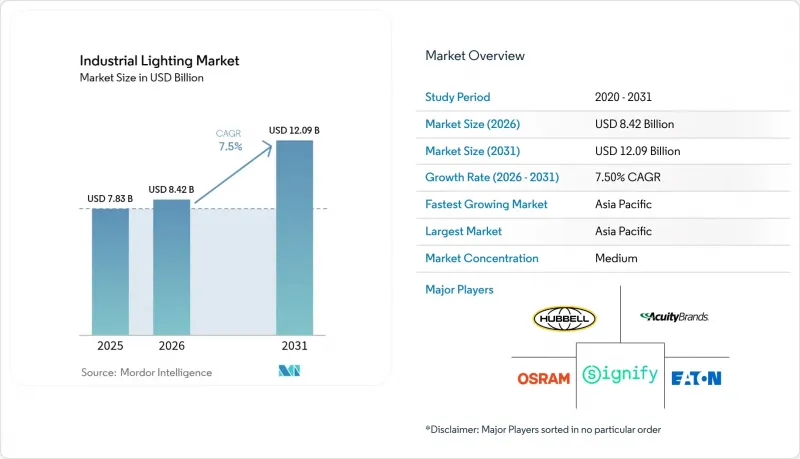
This report is Segmented by Light Source (High-Intensity Discharge, and More), Offering (Lamps and Luminaires, and More), Installation Type (New Build, Retrofit, Replacement), Product Type (High/Low Bay, Flood/Area, and More), End-User Application (Oil and Gas, Mining and Metals, and More), and Geography (North America, South America, and More). The Market Forecasts are Provided in Terms of Value (USD).
Global Industrial Lighting Market Trends and Insights
Steepening LED price-performance curve
LED efficacy has surpassed 200 lumens per watt and production costs keep falling by 15-20% every year, shortening payback periods in factory retrofits. Smart luminaires now embed sensors and wireless radios, eliminating separate control infrastructure and enabling predictive maintenance that reduces unplanned downtime. The combined efficiency and intelligence edge positions LEDs as the default choice for both new builds and upgrades.
Demand for retrofit-ready luminaires
Factories built between 1980 and 2010 approach end-of-life for fluorescent and HID fixtures, yet remain structurally sound. Plug-and-play LED retrofit kits slot into existing wiring and minimize production interruptions, slashing installation labor by up to 40%. Energy savings of 50-70% deliver sub-24-month paybacks, persuading financial controllers to green-light projects even amid economic uncertainty.
Tariff volatility on LED drivers
U.S. duties of up to 25% on drivers imported from Mexico and Canada inflate project costs and complicate procurement schedules. Many manufacturers are rerouting orders to Southeast Asia, but longer shipping times and quality-assurance challenges linger.
Other drivers and restraints analyzed in the detailed report include:
- Stricter workplace-safety illumination codes
- Digital twin-enabled lighting tools
- Cybersecurity concerns over connected fixtures
For complete list of drivers and restraints, kindly check the Table Of Contents.
Segment Analysis
LED held 65.20% of the industrial lighting market share in 2025, and smart variations are growing at a 9.8% CAGR through 2031. Within the industrial lighting market size, high-intensity discharge fixtures retain 20.05% share for extreme-output tasks, while fluorescent slips to 13.65% as energy codes tighten.
Affordability gains and integrated connectivity consolidate LED dominance. Smart LEDs incorporate occupancy sensing and wireless mesh control that bypasses separate wiring. HID persists in steel mills and shipyards demanding >50,000 lumen outputs, yet OEMs now prototype high-power LEDs to disrupt this niche. Organic LED remains a 1.10% sliver, mainly for curved cleanroom surfaces where uniform light prevents contamination.
Lamps and luminaires supplied 48.80% of 2025 revenue, but control systems and sensors are forecast to post a 9.6% CAGR to 2031, the fastest within the industrial lighting market. Control modules optimize burn hours, slash energy by 25-35%, and feed predictive algorithms that flag component fatigue.
Services contribute 29.05% share, with LaaS contracts growing 32.8% annually as finance teams prefer OpEx over CapEx. Providers bundle hardware, controls, and maintenance in one monthly fee, de-risking technology obsolescence for plant owners.
Complete Report Scope:
- By Light Source
- LED
- High-Intensity Discharge (HID)
- Fluorescent
- Induction
- Organic LED (OLED)
- By Offering
- Lamps and Luminaires
- Control Systems and Sensors
- Services (Design, LaaS, Maintenance)
- By Installation Type
- New Build
- Retrofit
- Replacement
- By Product Type
- High / Low Bay
- Flood / Area
- Task and Spotlight
- Explosion-proof / Harsh-Environment
- By End-user Application
- Oil and Gas
- Mining and Metals
- Pharmaceutical and Clean-room
- Discrete and Process Manufacturing
- Warehousing and Logistics
- Food and Beverage
- Chemical and Petrochemical
- By Geography
- North America
- United States
- Canada
- Mexico
- South America
- Brazil
- Argentina
- Rest of South America
- Europe
- Germany
- United Kingdom
- France
- Italy
- Rest of Europe
- Asia-Pacific
- China
- Japan
- South Korea
- India
- Rest of Asia-Pacific
- Middle East
- Saudi Arabia
- United Arab Emirates
- Rest of Middle East
- Africa
- South Africa
- Rest of Africa
- North America
Geography Analysis
Asia-Pacific contributed 39.10% of 2025 revenue and is forecast for an 8.05% CAGR to 2031. China's smart-factory subsidies and India's industrial corridor build-outs keep fixture demand high, while Japan and South Korea specify digital twins in project tenders. Southeast Asia benefits from supply-chain realignment away from China, boosting greenfield lighting installations.
North America captured 30.65% of turnover in 2025, advancing at a 6.95% CAGR. The industrial lighting market share for retrofit projects is greatest here because plants average 30 years old. ANSI/IES updates compel upgrades, yet tariffs on Mexican drivers inflate BOM costs and spur sourcing shifts to Vietnam and Thailand. Canadian carbon-reduction incentives further accelerate LED uptake across heavy industry.
Europe generated 30.25% of 2025 sales and will post a 6.65% CAGR. Germany leads with Industry 4.0 pilots linking lighting to robotics, while France and the UK target energy savings to meet 2030 climate goals. Eastern Europe, including Poland and Czechia, grows faster at 8.95% on the back of EU structural funds earmarked for manufacturing upgrades.
- Signify Holding N.V.
- Cree Lighting, a division of IDEAL INDUSTRIES, Inc.
- Eaton Corporation plc
- Emerson Electric Co.
- Dialight plc
- Legrand SA
- Zumtobel Group AG
- Acuity Brands, Inc.
- ams OSRAM AG
- TRILUX GmbH & Co. KG
- Hubbell Incorporated
- Larson Electronics, LLC
- Hilclare Lighting (Group Sylvania)
- Raytec Ltd
- Glamox AS
- Nemalux Inc.
- R. STAHL AG
- ABB Installation Products Inc.
- Schneider Electric SE
- Cooper Lighting Solutions (Signify)
- TOYODA GOSEI Co., Ltd.
- Seoul Semiconductor Co., Ltd.
- Current (dba GE Current, a DAI Company)
- Warom Technology Incorporated Company
Additional Benefits:
- The market estimate (ME) sheet in Excel format
- 3 months of analyst support
TABLE OF CONTENTS
1 INTRODUCTION
- 1.1 Study Assumptions and Market Definition
- 1.2 Scope of the Study
2 RESEARCH METHODOLOGY
3 EXECUTIVE SUMMARY
4 MARKET LANDSCAPE
- 4.1 Market Overview
- 4.2 Market Drivers
- 4.2.1 LED price/performance curve keeps steepening
- 4.2.2 Demand for retrofit-ready luminaires in aged factories
- 4.2.3 Stricter workplace-safety illumination codes (ANSI/IES)
- 4.2.4 Digital twin-enabled lighting design tools
- 4.2.5 Warehouse automation triggering task-specific optics
- 4.2.6 Lighting-as-a-Service (LaaS) contracts unlocking CapEx
- 4.3 Market Restraints
- 4.3.1 Persistent tariff volatility on LED drivers
- 4.3.2 Industrial cybersecurity concerns over connected fixtures
- 4.3.3 Skills gap for controls commissioning and maintenance
- 4.3.4 Legacy hazardous-location certification timelines
- 4.4 Industry Value Chain Analysis
- 4.5 Regulatory Landscape
- 4.6 Technological Outlook
- 4.7 Porter's Five Forces Analysis
- 4.7.1 Threat of New Entrants
- 4.7.2 Bargaining Power of Suppliers
- 4.7.3 Bargaining Power of Buyers
- 4.7.4 Threat of Substitutes
- 4.7.5 Competitive Rivalry
- 4.8 Impact of Macroeconomic Trends on the Market
- 4.9 Investment Analysis
5 MARKET SIZE AND GROWTH FORECASTS (VALUE)
- 5.1 By Light Source
- 5.1.1 LED
- 5.1.2 High-Intensity Discharge (HID)
- 5.1.3 Fluorescent
- 5.1.4 Induction
- 5.1.5 Organic LED (OLED)
- 5.2 By Offering
- 5.2.1 Lamps and Luminaires
- 5.2.2 Control Systems and Sensors
- 5.2.3 Services (Design, LaaS, Maintenance)
- 5.3 By Installation Type
- 5.3.1 New Build
- 5.3.2 Retrofit
- 5.3.3 Replacement
- 5.4 By Product Type
- 5.4.1 High / Low Bay
- 5.4.2 Flood / Area
- 5.4.3 Task and Spotlight
- 5.4.4 Explosion-proof / Harsh-Environment
- 5.5 By End-user Application
- 5.5.1 Oil and Gas
- 5.5.2 Mining and Metals
- 5.5.3 Pharmaceutical and Clean-room
- 5.5.4 Discrete and Process Manufacturing
- 5.5.5 Warehousing and Logistics
- 5.5.6 Food and Beverage
- 5.5.7 Chemical and Petrochemical
- 5.6 By Geography
- 5.6.1 North America
- 5.6.1.1 United States
- 5.6.1.2 Canada
- 5.6.1.3 Mexico
- 5.6.2 South America
- 5.6.2.1 Brazil
- 5.6.2.2 Argentina
- 5.6.2.3 Rest of South America
- 5.6.3 Europe
- 5.6.3.1 Germany
- 5.6.3.2 United Kingdom
- 5.6.3.3 France
- 5.6.3.4 Italy
- 5.6.3.5 Rest of Europe
- 5.6.4 Asia-Pacific
- 5.6.4.1 China
- 5.6.4.2 Japan
- 5.6.4.3 South Korea
- 5.6.4.4 India
- 5.6.4.5 Rest of Asia-Pacific
- 5.6.5 Middle East
- 5.6.5.1 Saudi Arabia
- 5.6.5.2 United Arab Emirates
- 5.6.5.3 Rest of Middle East
- 5.6.6 Africa
- 5.6.6.1 South Africa
- 5.6.6.2 Rest of Africa
- 5.6.1 North America
6 COMPETITIVE LANDSCAPE
- 6.1 Market Concentration
- 6.2 Strategic Moves
- 6.3 Market Share Analysis
- 6.4 Company Profiles (includes Global Level Overview, Market Level Overview, Core Segments, Financials as available, Strategic Information, Market Rank/Share, Products and Services, Recent Developments)
- 6.4.1 Signify Holding N.V.
- 6.4.2 Cree Lighting, a division of IDEAL INDUSTRIES, Inc.
- 6.4.3 Eaton Corporation plc
- 6.4.4 Emerson Electric Co.
- 6.4.5 Dialight plc
- 6.4.6 Legrand SA
- 6.4.7 Zumtobel Group AG
- 6.4.8 Acuity Brands, Inc.
- 6.4.9 ams OSRAM AG
- 6.4.10 TRILUX GmbH & Co. KG
- 6.4.11 Hubbell Incorporated
- 6.4.12 Larson Electronics, LLC
- 6.4.13 Hilclare Lighting (Group Sylvania)
- 6.4.14 Raytec Ltd
- 6.4.15 Glamox AS
- 6.4.16 Nemalux Inc.
- 6.4.17 R. STAHL AG
- 6.4.18 ABB Installation Products Inc.
- 6.4.19 Schneider Electric SE
- 6.4.20 Cooper Lighting Solutions (Signify)
- 6.4.21 TOYODA GOSEI Co., Ltd.
- 6.4.22 Seoul Semiconductor Co., Ltd.
- 6.4.23 Current (dba GE Current, a DAI Company)
- 6.4.24 Warom Technology Incorporated Company
7 MARKET OPPORTUNITIES AND FUTURE OUTLOOK
- 7.1 White-space and Unmet-need Assessment

