PUBLISHER: Mordor Intelligence | PRODUCT CODE: 2122821

PUBLISHER: Mordor Intelligence | PRODUCT CODE: 2122821
Zeolites - Market Share Analysis, Industry Trends & Statistics, Growth Forecasts (2026 - 2031)
According to Mordor Intelligence, the zeolites market size is estimated at USD 9.58 billion in 2026, and is expected to reach USD 11.64 billion by 2031, at a CAGR of 3.97% during the forecast period (2026-2031).
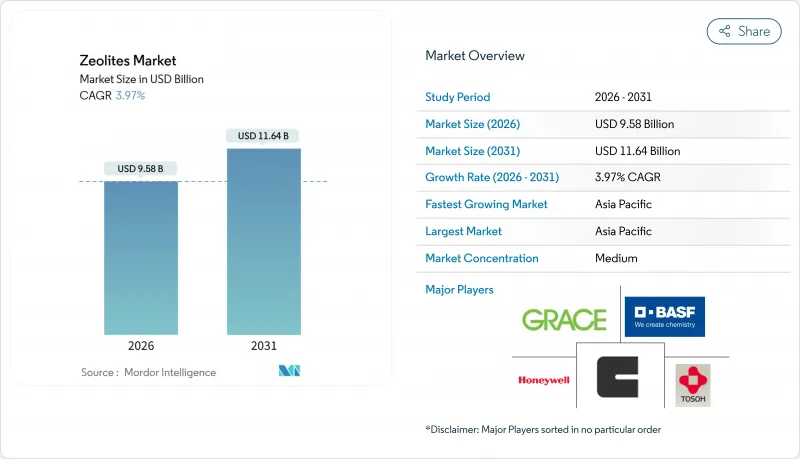
This report is Segmented by Product Type (Natural Zeolite and Synthetic Zeolite), Form (Powder, Granules/Pellets, and More), Application (Adsorbents, Catalysts, and More), End-User Industry (Water Treatment, Air Purification, Agriculture, and More), and Geography (Asia-Pacific, North America, Europe, South America, Middle East and Africa). The Market Forecasts are Provided in Terms of Value (USD).
Global Zeolites Market Trends and Insights
Regulatory Push for Phosphate-Free Detergents
European Regulation 648/2004 mandates labeling of zeolite A, prompting Procter & Gamble, Unilever, and Henkel to switch more than 80% of powder detergents to phosphate-free formulations. Detergent producers enjoy dual functionality because zeolites buffer alkalinity while sequestering hardness ions, letting formulators lower overall surfactant loads by up to 15%. The rule lifts replacement demand across Europe and North America and is now mirrored in Southeast Asian markets, notably Indonesia and Vietnam. As a result, the Zeolites market secures a vital, policy-driven growth floor for detergent builders. Synthetic producers such as Zeolyst International benefit from long-term supply contracts that stabilize utilisation rates even when the commodity chemicals cycle.
Increasing Demand from Water and Wastewater Treatment
Updated U.S. National Pollutant Discharge Elimination System permits tightened ammonia limits below 1 mg/L, steering utilities toward clinoptilolite columns that deliver predictable ion-exchange isotherms. St. Cloud Mining reports that water-treatment volumes rose to 35% of shipments in 2024, up from 28% in 2022. Regeneration economics also favor zeolites because brine cycling restores up to 90% exchange capacity, while activated-sludge retrofits can cost multiples more. Parallel European Union Urban Wastewater revisions keep the compliance spotlight on ammonium and heavy-metal discharge, sustaining long-run growth.
Availability of Low-Cost Silica Gel and Activated Carbon
Silica gel undercuts synthetic zeolites by 20-30% in moisture-control packs, while activated carbon dominates VOC removal due to its macroporosity. For cost-sensitive buyers in construction desiccants, the price advantage often outweighs zeolite regeneration benefits, trimming Zeolites market expansion. Catalyst-grade producers respond with hybrid adsorbents that fuse zeolite selectivity with carbon capacity, but adoption remains niche.
Other drivers and restraints analyzed in the detailed report include:
- Significant Usage in FCC Catalytic Cracking
- Petrochemical Capacity Additions in China and GCC
- Rare-Earth Zeolite Supply-Chain Fragility
For complete list of drivers and restraints, kindly check the Table Of Contents.
Segment Analysis
Synthetic frameworks represented 44.88% of 2025 revenue and are forecast to grow at a 5.67% CAGR, double the pace of natural counterparts. The Zeolites market size attributed to synthetic grades is driven by petrochemical catalysts, where compositional precision improves yield economics. BASF's X3D catalyst embeds nano-zeolites in hierarchical alumina, boosting diffusion and lowering coke laydown, a clear premium feature. Natural clinoptilolite retains cost advantages in agriculture and basic water treatment, yet downstream users seek tighter ion-exchange reproducibility that mines cannot guarantee.
Price differentials remain stark, with synthetic crystals commanding 2-3 times higher unit pricing, a dynamic that keeps natural zeolite tonnage dominant but revenue mixed. Sustainable messaging aids natural-grade sales because mining consumes 40-50% less energy than hydrothermal synthesis, yet regulatory scrutiny now requires trace-metal assays even for agricultural use. Over the forecast horizon, the split likely rebalances toward an even 50-50 volume share as specialty catalysts scale faster than bulk products.
Powder grades retained 60.23% of the Zeolites market share in 2025 by serving detergent, catalyst, and adsorbent producers that prize narrow particle-size distributions. Granules and pellets dominate packed-bed dryers where low pressure drop matters. Membrane and coating formats, though only mid-single-digit volume, will expand at a 6.21% CAGR, propelled by decarbonization projects that require kinetic separations.
DDR-type tubular elements from Resonac Holdings already purify hydrogen streams at 99.99% purity in Japanese pilot plants. ISO 22734 guidelines standardize gas-separation membrane tests, adding certification rigor that should speed broader uptake. Investment hurdles persist, as installed module costs hover near USD 800 per m2, but early adopters in petrochemical hubs value lower energy intensity versus pressure-swing adsorption.
Complete Report Scope:
- By Product Type
- Natural Zeolite
- Synthetic Zeolite
- By Form
- Powder
- Granules / Pellets
- Honeycomb / Blocks
- Membranes / Coatings
- By Application
- Adsorbents
- Catalysts
- Detergents
- Other Applications (Refining and Biogas)
- By End-user Industry
- Water Treatment
- Air Purification
- Agriculture
- Petrochemical
- Construction
- Others (Medical, Nuclear)
- By Geography
- Asia-Pacific
- China
- India
- Japan
- South Korea
- ASEAN
- Rest of Asia-Pacific
- North America
- United States
- Canada
- Mexico
- Europe
- Germany
- United Kingdom
- France
- Italy
- Nordics
- Rest of Europe
- South America
- Brazil
- Argentina
- Chile
- Rest of South America
- Middle East and Africa
- Saudi Arabia
- United Arab Emirates
- South Africa
- Egypt
- Rest of Middle East and Africa
- Asia-Pacific
Geography Analysis
Asia-Pacific commanded 45.26% of the Zeolites market demand in 2025 and will rise at a 6.23% CAGR to 2031. China's Shenghong Petrochemical and Yulong complexes add sizeable FCC units, while Aramco-SINOPEC-Fujian plans lock in local catalyst sourcing. Japan and South Korea spearhead membrane pilots for hydrogen refueling, and India accelerates clinoptilolite adoption as part of nationwide wastewater upgrades.
The North America zeolites market is influenced by St. Cloud Mining's 42,000-45,000 tons per year natural-zeolite output and stringent EPA ammonia rules. Canada's oil-sands upgraders keep catalyst demand steady, whereas Mexican refinery modernization under Pemex adds incremental volumes. Europe's share mirrors North America, with detergent builders and water regulations supporting baseline growth; membrane pilots tied to the EU Hydrogen Strategy could unlock upside once module pricing falls.
South America plus the Middle East and Africa collectively contribute the balance. Brazilian agribusiness values clinoptilolite for soil moisture retention, while Chilean copper mines deploy zeolite beds in tailings-pond water treatment. GCC petchem megaprojects such as Ruwais and Jafurah secure multi-year synthetic-zeolite contracts that underpin supplier capacity planning. South African utilities test zeolite columns for heavy-metal removal, and Egyptian refinery upgrades expand catalyst pull-through despite softer regional gasoline demand.
- BASF
- Albemarle Corporation
- Arkema
- Blue Pacific Minerals
- Clariant
- GCMIL
- Honeywell International Inc.
- Huiying Chemical Industry (Quanzhou) Co.
- International Zeolite Corp.
- Interra Global
- KNT Group
- Ningbo Jiahe New Materials Technology Co., Ltd.
- PQ
- Resonac Holdings Corporation
- St. Cloud Mining
- Tosoh Corporation
- W. R. Grace & Co.
- Zeochem
- Zeolyst International
- Zeotech
Additional Benefits:
- The market estimate (ME) sheet in Excel format
- 3 months of analyst support
TABLE OF CONTENTS
1 Introduction
- 1.1 Study Assumptions and Market Definition
- 1.2 Scope of the Study
2 Research Methodology
3 Executive Summary
4 Market Landscape
- 4.1 Market Overview
- 4.2 Market Drivers
- 4.2.1 Regulatory push for phosphate-free detergents
- 4.2.2 Increasing demand from water and wastewater treatment
- 4.2.3 Significant usage in FCC catalytic cracking
- 4.2.4 Petrochemical capacity additions in China and GCC
- 4.2.5 Zeolite membranes for low-carbon hydrogen purification
- 4.3 Market Restraints
- 4.3.1 Availability of low-cost silica gel and activated carbon
- 4.3.2 Volatility in aluminosilicate (bauxite) feedstock
- 4.3.3 Rare-earth zeolite (La, Ce) supply-chain fragility
- 4.4 Value Chain Analysis
- 4.5 Regulatory Outlook
- 4.6 Porter's Five Forces
- 4.6.1 Bargaining Power of Suppliers
- 4.6.2 Bargaining Power of Consumers
- 4.6.3 Threat of New Entrants
- 4.6.4 Threat of Substitute Products and Services
- 4.6.5 Degree of Competition
5 Market Size and Growth Forecasts (Value)
- 5.1 By Product Type
- 5.1.1 Natural Zeolite
- 5.1.2 Synthetic Zeolite
- 5.2 By Form
- 5.2.1 Powder
- 5.2.2 Granules / Pellets
- 5.2.3 Honeycomb / Blocks
- 5.2.4 Membranes / Coatings
- 5.3 By Application
- 5.3.1 Adsorbents
- 5.3.2 Catalysts
- 5.3.3 Detergents
- 5.3.4 Other Applications (Refining and Biogas)
- 5.4 By End-user Industry
- 5.4.1 Water Treatment
- 5.4.2 Air Purification
- 5.4.3 Agriculture
- 5.4.4 Petrochemical
- 5.4.5 Construction
- 5.4.6 Others (Medical, Nuclear)
- 5.5 By Geography
- 5.5.1 Asia-Pacific
- 5.5.1.1 China
- 5.5.1.2 India
- 5.5.1.3 Japan
- 5.5.1.4 South Korea
- 5.5.1.5 ASEAN
- 5.5.1.6 Rest of Asia-Pacific
- 5.5.2 North America
- 5.5.2.1 United States
- 5.5.2.2 Canada
- 5.5.2.3 Mexico
- 5.5.3 Europe
- 5.5.3.1 Germany
- 5.5.3.2 United Kingdom
- 5.5.3.3 France
- 5.5.3.4 Italy
- 5.5.3.5 Nordics
- 5.5.3.6 Rest of Europe
- 5.5.4 South America
- 5.5.4.1 Brazil
- 5.5.4.2 Argentina
- 5.5.4.3 Chile
- 5.5.4.4 Rest of South America
- 5.5.5 Middle East and Africa
- 5.5.5.1 Saudi Arabia
- 5.5.5.2 United Arab Emirates
- 5.5.5.3 South Africa
- 5.5.5.4 Egypt
- 5.5.5.5 Rest of Middle East and Africa
- 5.5.1 Asia-Pacific
6 Competitive Landscape
- 6.1 Market Concentration
- 6.2 Strategic Moves
- 6.3 Market Share / Ranking Analysis
- 6.4 Company Profiles (includes Global level Overview, Market level overview, Core Segments, Financials as available, Strategic Information, Market Rank/Share for key companies, Products and Services, Recent Developments)
- 6.4.1 BASF
- 6.4.2 Albemarle Corporation
- 6.4.3 Arkema
- 6.4.4 Blue Pacific Minerals
- 6.4.5 Clariant
- 6.4.6 GCMIL
- 6.4.7 Honeywell International Inc.
- 6.4.8 Huiying Chemical Industry (Quanzhou) Co.
- 6.4.9 International Zeolite Corp.
- 6.4.10 Interra Global
- 6.4.11 KNT Group
- 6.4.12 Ningbo Jiahe New Materials Technology Co., Ltd.
- 6.4.13 PQ
- 6.4.14 Resonac Holdings Corporation
- 6.4.15 St. Cloud Mining
- 6.4.16 Tosoh Corporation
- 6.4.17 W. R. Grace & Co.
- 6.4.18 Zeochem
- 6.4.19 Zeolyst International
- 6.4.20 Zeotech
7 Market Opportunities and Future Outlook
- 7.1 White-space and Unmet-Need Assessment

