PUBLISHER: Mordor Intelligence | PRODUCT CODE: 2122827

PUBLISHER: Mordor Intelligence | PRODUCT CODE: 2122827
Xerostomia (Dry Mouth Disease) Therapeutics - Market Share Analysis, Industry Trends & Statistics, Growth Forecasts (2026 - 2031)
According to Mordor Intelligence, the xerostomia therapeutics market size is expected to grow from USD 1.85 billion in 2025 to USD 1.93 billion in 2026 and is forecast to reach USD 2.35 billion by 2031 at 4.02% CAGR over 2026-2031.
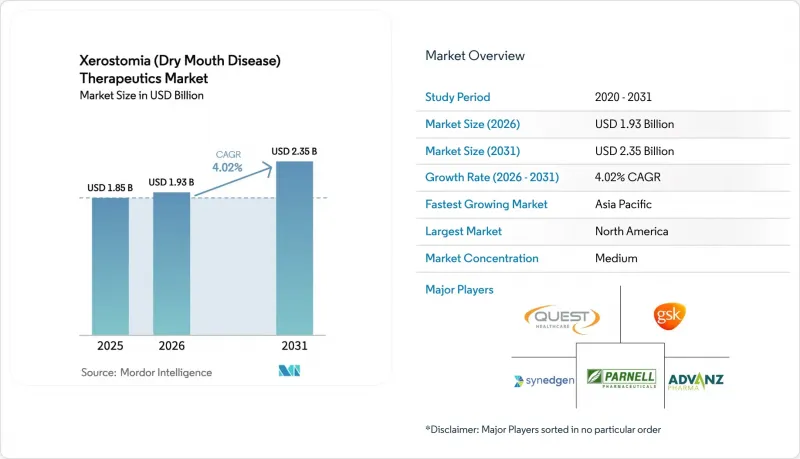
This report is Segmented by Therapeutic Modality (Artificial Saliva/Saliva Substitutes, Salivary Stimulants, and More), Product Form (Sprays, Gels, Lozenges/Pastilles, and More), Distribution Channel (Retail Pharmacies, and More), and Geography (North America, Europe, Asia-Pacific, Middle East & Africa, South America). Market Forecasts are Provided in Terms of Value (USD).
Global Xerostomia (Dry Mouth Disease) Therapeutics Market Trends and Insights
Growing Incidence Among Ageing & Polypharmacy Populations
Polypharmacy prevalence climbed to 68% of seniors in OECD nations by 2025, and anticholinergics, antihypertensives, and antidepressants often combine to triple xerostomia risk. Only 18% of these patients receive preventive saliva substitutes during medication reviews, leaving a treatment gap that payers increasingly notice. Japan reported a 14% increase in hospital admissions for aspiration pneumonia associated with dry mouth in 2024, prompting mandatory oral assessments with anticholinergic therapy to be initiated at a specific point. Medicare spent USD 2.8 billion on xerostomia-related complications in 2025, strengthening reimbursement for substitutes and stimulants. Formulators have responded with low-preservative, once-daily gels tailored to cognitively impaired older adults.
Expanding OTC Availability & E-Commerce Reach
The FDA cleared three saliva sprays for OTC sale in March 2024, and the EMA granted a harmonized OTC path for carboxymethylcellulose gels in September 2024, eliminating physician visits for millions with mild symptoms. Amazon Pharmacy sales of dry-mouth products surged 127% between Q1 2024 and Q4 2025, with subscription refills indicating sticky demand. Telehealth platforms integrated xerostomia screening into diabetes programs, routing 220,000 U.S. users to product recommendations in 2025. Manufacturers enjoy higher direct-to-consumer margins, yet they must invest in digital content to boost brand recall. China remains the missing piece; its regulator has not yet approved OTC status, which is delaying e-commerce momentum in the world's second-largest pharmaceutical market.
High Cost of Prescription Sialogogues
Branded pilocarpine costs USD 450 for 30 days in the United States, and generics still average USD 180, spurring a 31% abandonment rate among new Sjogren's patients. Cevimeline's branded version commands USD 620 monthly, an out-of-reach figure for many Medicare beneficiaries. Indian generics cost approximately INR 3,200 per month, which is approximately 12% of the median household income, limiting uptake to affluent urban users. Generic competition has not typically resulted in price declines of 60-80% because active ingredient synthesis remains complex and supply is concentrated. Prior authorization requirements by 43% of U.S. plans add administrative friction that delays the start of therapy by up to two weeks.
Other drivers and restraints analyzed in the detailed report include:
- Development of Innovative Mucoadhesive & Sustained-Release Formulations
- Emerging Regenerative & Cell-Based Salivary-Gland Therapies
- Stringent Regulatory Hurdles for Novel Formulations
For complete list of drivers and restraints, kindly check the Table Of Contents.
Segment Analysis
Artificial saliva and substitutes held 62.21% of the xerostomia therapeutics market size in 2025, supported by entrenched first-line prescribing in oncology and rheumatology. Electro-stimulation devices are expected to expand at the fastest rate, with a 7.02% CAGR to 2031, aided by Medicare reimbursement codes added in late 2024 that reduced patient co-pays by approximately 40%. Salivary stimulants, both prescription and OTC, remain a mid-tier option because cholinergic side effects limit long-term compliance in roughly one-third of users. Other modalities, such as laser photobiomodulation, account for less than 5% of revenue but could gain traction if payer policies adapt.
Manufacturers are diverging in strategy. Substitute leaders push formulation upgrades, as evident in GlaxoSmithKline's xylitol-enhanced gel, which now offers caries protection. Device newcomers embed Bluetooth modules that log usage, enabling clinicians to remotely tune pulse settings and increase adherence, while also generating data for payer contracting. The xerostomia therapeutics industry, therefore, crosses into connected-care territory, raising entry barriers for traditional consumer goods players.
Complete Report Scope:
- By Therapeutic Modality
- Artificial Saliva / Saliva Substitutes
- Salivary Stimulants
- Electro-stimulation Devices
- Other Therapeutic Modalities
- By Product Form
- Sprays
- Gels
- Lozenges / Pastilles
- Mouthwashes / Rinses
- Other Product Forms
- By Distribution Channel
- Retail Pharmacies
- Hospital Pharmacies
- Online Pharmacies
- By Geography
- North America
- United States
- Canada
- Mexico
- Europe
- Germany
- United Kingdom
- France
- Italy
- Spain
- Rest of Europe
- Asia-Pacific
- China
- Japan
- India
- Australia
- South Korea
- Rest of Asia-Pacific
- Middle East & Africa
- GCC
- South Africa
- Rest of Middle East & Africa
- South America
- Brazil
- Argentina
- Rest of South America
- North America
Geography Analysis
North America accounted for 39.16% of global revenue in 2025, driven by high disease awareness, comprehensive insurance coverage, and aggressive direct-to-consumer advertising. The xerostomia therapeutics market size in the United States represents 85% of the regional total and is stable, as generic erosion and OTC competition offset unit growth. Canada lags due to strict formulary rules that cover only severe cases. At the same time, Mexico's expanded Seguro Popular list is expected to add over one million treated patients by 2027, despite the implementation of tight price controls.
Germany leads per-capita consumption owing to statutory insurance coverage and a dense network of dental clinics. The United Kingdom faces dual regulatory filings post-Brexit, which add months to approval timelines, yet have allowed faster clearance for some niche formulations. France posts strong gel uptake in head-and-neck radiation centers, whereas Italy and Spain restrict OTC reimbursement, suppressing volume growth among price-sensitive seniors. Nordic markets excel online; Sweden sees 42% of xerostomia sales through e-pharmacies, contrasting with Eastern Europe where brick-and-mortar dominance persists.
The Asia-Pacific region is expected to grow at an 8.04% CAGR, the fastest worldwide. China's diabetic population of 140 million drives huge latent demand, and inclusion of key substitutes on the 2024 national reimbursement list stimulated urban sales even at 40% co-pay levels. Japan boasts the world's highest electro-stimulation penetration rate at 18% of domestic sales, reflecting a cultural preference for device solutions. India's launch of ultra-low-cost pilocarpine in 2025 added millions of new users, but the uptake remains skewed towards urban areas. Mature markets, such as Australia and South Korea, favor premium, sustained-release gels backed by full insurance coverage. Southeast Asia began local manufacturing in 2024-2025, slicing import costs and accelerating volume in Indonesia and Thailand.
- 3M
- ADVANZ PHARMA Corp.
- Church & Dwight
- Colgate-Palmolive Company
- Fresenius
- GlaxoSmithKline
- Lupin
- OraCoat (OraHealth)
- Parnell Pharmaceuticals
- Perrigo Company
- Pfizer
- Pharmascience Inc. (Pendopharm)
- Sun Pharmaceuticals Industries
- Sunstar Suisse
- Synedgen Inc.
- Xlear Inc.
- Sonic Healthcare
- SQI Diagnostics
- Thermo Fisher Scientific
- Trinity Biotech
- Quest Healthcare
Additional Benefits:
- The market estimate (ME) sheet in Excel format
- 3 months of analyst support
TABLE OF CONTENTS
1 Introduction
- 1.1 Study Assumptions & Market Definition
- 1.2 Scope of the Study
2 Research Methodology
3 Executive Summary
4 Market Landscape
- 4.1 Market Overview
- 4.2 Market Drivers
- 4.2.1 Growing Incidence Among Ageing & Polypharmacy Populations
- 4.2.2 Expanding OTC Availability & E-Commerce Reach
- 4.2.3 Development of Innovative Muco-Adhesive & Sustained-Release Formulations
- 4.2.4 Emerging Regenerative & Cell-Based Salivary-Gland Therapies
- 4.2.5 AI-Driven Personalised Saliva-Substitute Platforms
- 4.2.6 Growing Awareness About Xerostomia-Related Products
- 4.3 Market Restraints
- 4.3.1 High Cost of Prescription Sialogogues
- 4.3.2 Stringent Regulatory Hurdles for Novel Formulations
- 4.3.3 Limited Long-Term Efficacy of Existing Substitutes
- 4.3.4 Raw-Material (Porcine Mucin, Glycerine) Price Volatility
- 4.4 Regulatory Landscape
- 4.5 Technological Outlook
- 4.6 Porter's Five Forces Analysis
- 4.6.1 Threat of New Entrants
- 4.6.2 Bargaining Power of Buyers
- 4.6.3 Bargaining Power of Suppliers
- 4.6.4 Threat of Substitutes
- 4.6.5 Competitive Rivalry
5 Market Size & Growth Forecasts
- 5.1 By Therapeutic Modality
- 5.1.1 Artificial Saliva / Saliva Substitutes
- 5.1.2 Salivary Stimulants
- 5.1.3 Electro-stimulation Devices
- 5.1.4 Other Therapeutic Modalities
- 5.2 By Product Form
- 5.2.1 Sprays
- 5.2.2 Gels
- 5.2.3 Lozenges / Pastilles
- 5.2.4 Mouthwashes / Rinses
- 5.2.5 Other Product Forms
- 5.3 By Distribution Channel
- 5.3.1 Retail Pharmacies
- 5.3.2 Hospital Pharmacies
- 5.3.3 Online Pharmacies
- 5.4 By Geography
- 5.4.1 North America
- 5.4.1.1 United States
- 5.4.1.2 Canada
- 5.4.1.3 Mexico
- 5.4.2 Europe
- 5.4.2.1 Germany
- 5.4.2.2 United Kingdom
- 5.4.2.3 France
- 5.4.2.4 Italy
- 5.4.2.5 Spain
- 5.4.2.6 Rest of Europe
- 5.4.3 Asia-Pacific
- 5.4.3.1 China
- 5.4.3.2 Japan
- 5.4.3.3 India
- 5.4.3.4 Australia
- 5.4.3.5 South Korea
- 5.4.3.6 Rest of Asia-Pacific
- 5.4.4 Middle East & Africa
- 5.4.4.1 GCC
- 5.4.4.2 South Africa
- 5.4.4.3 Rest of Middle East & Africa
- 5.4.5 South America
- 5.4.5.1 Brazil
- 5.4.5.2 Argentina
- 5.4.5.3 Rest of South America
- 5.4.1 North America
6 Competitive Landscape
- 6.1 Market Concentration
- 6.2 Market Share Analysis
- 6.3 Company Profiles (includes Global level Overview, Market-level Overview, Core Segments, Financials, Strategic Information, Market Rank/Share, Products & Services, Recent Developments)
- 6.3.1 3M
- 6.3.2 ADVANZ PHARMA Corp.
- 6.3.3 Church & Dwight Co., Inc.
- 6.3.4 Colgate-Palmolive Company
- 6.3.5 Fresenius Kabi
- 6.3.6 GlaxoSmithKline plc
- 6.3.7 Lupin Limited
- 6.3.8 OraCoat (OraHealth)
- 6.3.9 Parnell Pharmaceuticals Inc.
- 6.3.10 Perrigo Company plc
- 6.3.11 Pfizer Inc.
- 6.3.12 Pharmascience Inc. (Pendopharm)
- 6.3.13 Sun Pharmaceutical Industries Ltd.
- 6.3.14 Sunstar Suisse S.A.
- 6.3.15 Synedgen Inc.
- 6.3.16 Xlear Inc.
- 6.3.17 Sonic Healthcare
- 6.3.18 SQI Diagnostics
- 6.3.19 Thermo Fisher Scientific Inc.
- 6.3.20 Trinity Biotech
- 6.3.21 Quest Healthcare
7 Market Opportunities & Future Outlook
- 7.1 White-space & Unmet-need Assessment

