PUBLISHER: Mordor Intelligence | PRODUCT CODE: 2122861

PUBLISHER: Mordor Intelligence | PRODUCT CODE: 2122861
Empty Capsule - Market Share Analysis, Industry Trends & Statistics, Growth Forecasts (2026 - 2031)
According to Mordor Intelligence, the empty capsule market size was valued at USD 3.68 billion in 2025 and is estimated to grow from USD 3.95 billion in 2026 to reach USD 5.62 billion by 2031, at a CAGR of 7.32% during the forecast period (2026-2031).
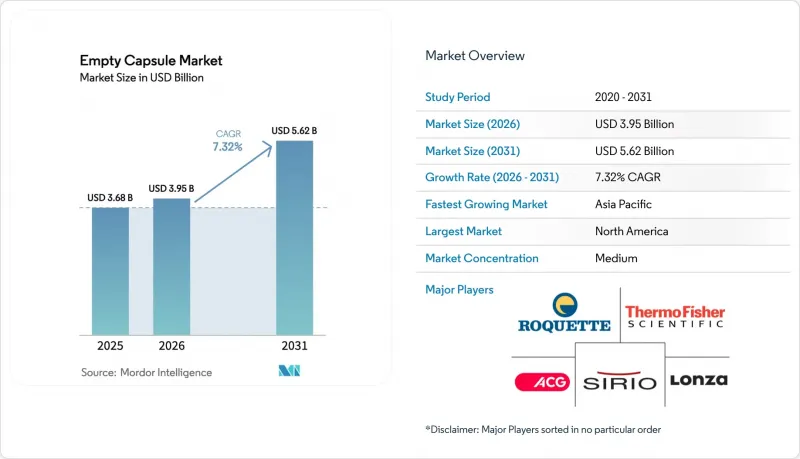
This report is Segmented by Product (Gelatin Capsules and Non-Gelatin Capsules), Raw-Material Source (Animal-Based and Plant & Fermentation-Based), Functionality (Immediate-Release Capsules, and More), Therapeutic Application (Antibiotic & Antibacterial, and More), End User (Pharmaceutical Industry, and More), Geography (North America, and More). The Market Forecasts are Provided in Terms of Value (USD).
Global Empty Capsule Market Trends and Insights
Growing Pharmaceutical Manufacturing Volume
Global drug makers earmarked more than USD 100 billion for new capacity between 2024 and 2026, amplifying demand for encapsulation lines that occupy less floor space and reach validation faster than tablet presses. The FDA cleared 12 advanced continuous capsule-filling applications under its Emerging Technology Program during 2024-2025, accelerating adoption of closed-loop processes with real-time quality control. Redundant plants across multiple regions address supply-chain-resilience mandates that surfaced after pandemic shortages, tilting new oral dose programs toward flexible capsule formats. As a result, suppliers of enteric-coated and sustained-release shells capture premium margins because these formats align with complex dosing regimens in chronic care.
Rising Nutraceutical Consumption
Global supplement sales reached USD 177 billion in 2024, with capsule formats gaining share as consumers associate hard shells with dosage accuracy and premium positioning. DNA-guided nutrition brands pushed custom capsule orders up 22% year over year in 2025, sidestepping the tooling costs that discourage small-batch tablets. Probiotic makers increasingly rely on capsules for gastric-acid protection; encapsulated strains deliver 40-60% higher survivability in simulated gastric fluid than uncoated tablets. Updated FDA labeling guidance emphasizing bioavailability transparency also nudges brands toward capsule formats that simplify dissolution testing.
Volatility in Gelatin Raw-Material Supply
Capsule makers now hold 60-90 days of inventory - double pre-2024 norms - tying up working capital and shaving up to 300 basis points off gross margins during tight markets.
Other drivers and restraints analyzed in the detailed report include:
- Advancements in Capsule-Filling Technology
- Shift Toward Personalized Dose Packaging
- Stringent Religious & Dietary Compliance
For complete list of drivers and restraints, kindly check the Table Of Contents.
Segment Analysis
Non-gelatin shells will grow 10.25% CAGR to 2031, outperforming the empty capsule market by close to 300 basis points as Halal compliance, vegan demand, and probiotic stability concerns rise. Gelatin still delivered 65.56% of revenue in 2025, anchored by its low cost and rapid dissolution, yet HPMC and pullulan now secure premium niches. HPMC capsules extend probiotic shelf life by virtue of their 4-6% moisture content, while pullulan's superior oxygen barrier serves antioxidants despite a 40-50% price premium.
Softgels remain vital for lipophilic APIs but face scrutiny over 8-12% API loss during sealing. Starch-based and modified-starch shells, still in pilot phases, promise mid-term alternatives with moisture resilience. Hybrid gelatin-HPMC blends launched in 2025 balance certification and performance, signaling more SKU convergence ahead.
Animal-derived gelatin held 68.53% share in 2025, yet plant and fermentation inputs will log 10.85% CAGR, aided by disease-related supply shocks and ethically driven consumption. Porcine gelatin's cost edge keeps it a staple outside Muslim-majority markets, while bovine gelatin satisfies Halal claims at a 15-20% premium. Pharma-grade HPMC supply remains tight, capping rapid migration, but pullulan's 0.5 cc/m2/day oxygen permeability secures high-value nutraceutical orders. Starch and algal polysaccharides lag amid brittleness and harvest variability.
Complete Report Scope:
- By Product Type
- Gelatin Capsules
- Hard Gelatin Capsules
- Soft Gelatin Capsules
- Non-Gelatin Capsules
- HPMC Capsules
- Pullulan Capsules
- Starch-based Capsules
- Other Plant-based Capsules
- Gelatin Capsules
- By Raw-Material Source
- Animal-Based
- Porcine Gelatin
- Bovine Gelatin
- Fish-derived Gelatin
- Plant & Fermentation-Based
- HPMC
- Pullulan
- Starch
- Algal Polysaccharides
- Animal-Based
- By Functionality
- Immediate-Release
- Sustained / Extended-Release
- Delayed / Enteric-Release
- Others (Colon-Targeted / pH-Sensitive and Dual / Multiple-Release)
- By Therapeutic Application
- Antibiotic & Antibacterial
- Vitamins & Dietary Supplements
- Antacid & Antiflatulent
- Cardiovascular Therapy
- Pain Management & CNS
- Probiotics & Gut Health
- Metabolic & Endocrine Disorders
- Other Applications
- By End User
- Pharmaceutical Industry
- Nutraceutical & Functional-Food Industry
- Cosmetic & Personal-Care Industry
- Contract Development & Manufacturing Org. (CDMOs)
- Research & Academic Laboratories
- Veterinary & Animal-Health Sector
- By Geography
- North America
- United States
- Canada
- Mexico
- Europe
- Germany
- United Kingdom
- France
- Italy
- Spain
- Rest of Europe
- Asia-Pacific
- China
- India
- Japan
- Australia
- South Korea
- Rest of Asia-Pacific
- Middle East and Africa
- GCC
- South Africa
- Rest of Middle East and Africa
- South America
- Brazil
- Argentina
- Rest of South America
- North America
Geography Analysis
North America generated 42.13% of 2025 revenue, driven by FDA incentives that favor domestic continuous manufacturing and by USD 27 billion in recent U.S. pharma investment, yet labor costs hold regional CAGR below Asia-Pacific. Canada benefits from clinical-trial clustering, while Mexico rises as a near-shore alternative circumventing trans-Pacific logistics. Environmental compliance - such as California's Proposition 65 - adds incremental per-unit costs but reinforces quality differentiation.
Europe accounted for roughly 29% of global demand in 2025. Germany, France, and the United Kingdom lead consumption, yet fragmented national rules lengthen validation cycles. Onshoring accelerates after pandemic-era shortages, as evidenced by Lonza's CHF 150 million Swiss expansion and Roquette's French HPMC line. Dual inventories for EU and post-Brexit UK specifications add complexity, while Southern European austerity caps price escalation.
Asia-Pacific is the growth engine, advancing 10.51% CAGR through 2031. China and India, together supplying nearly 70% of regional capsules, add capacity under NMPA and PLI incentives, respectively. Sirio Pharma's acquisition spree and ACG's 50-billion-unit Mumbai expansion underscore scale ambitions. Japan targets premium enteric niches, South Korea pursues vegetarian communities, and Australia leverages its clinical-trial ecosystem. The Middle East & Africa, at a significant share in 2025, gain from Halal mandates and GCC healthcare spend, while South America struggles with currency swings despite Brazil's localized expansions.
- ACG Worldwide
- Aenova Group
- Bright Pharma Caps
- CapsCanada Corporation
- Er-Kang Pharmaceutical Co. Ltd.
- Fujifilm Corp. (Fujicaps)
- HealthCaps India Ltd.
- Lonza Group
- Medi-Caps Ltd.
- Natural Capsules Ltd.
- Nectar Lifesciences Ltd.
- Patheon (Thermo Fisher)
- Qingdao Yiqing Medicinal Capsules Co. Ltd.
- Qualicaps (Roquette)
- Shanxi Guangsheng Medicinal Capsules Co. Ltd.
- Shanxi JC Biological Technology Co. Ltd.
- Sirio Pharma Co., Ltd.
- Suheung Capsule Co., Ltd.
- Sunil Healthcare Ltd.
- Zhejiang Huangyan Gelatin Capsule Co. Ltd.
- Zhejiang Ruixin Capsules Co. Ltd.
Additional Benefits:
- The market estimate (ME) sheet in Excel format
- 3 months of analyst support
TABLE OF CONTENTS
1 Introduction
- 1.1 Study Assumptions & Market Definition
- 1.2 Scope of the Study
2 Research Methodology
3 Executive Summary
4 Market Landscape
- 4.1 Market Overview
- 4.2 Market Drivers
- 4.2.1 Growing pharmaceutical manufacturing volume
- 4.2.2 Rising nutraceutical consumption
- 4.2.3 Advancements in capsule-filling technology
- 4.2.4 Shift toward personalized dose packaging
- 4.2.5 Integration of digital health technologies
- 4.2.6 Expansion of continuous manufacturing infrastructure
- 4.3 Market Restraints
- 4.3.1 Volatility in gelatin raw-material supply
- 4.3.2 Stringent religious & dietary compliance
- 4.3.3 Limited availability of pharma-grade HPMC
- 4.3.4 Climate-induced supply-chain instability
- 4.4 Supply-Chain Analysis
- 4.5 Regulatory Landscape
- 4.6 Technological Outlook
- 4.7 Porter's Five Forces
- 4.7.1 Threat of New Entrants
- 4.7.2 Bargaining Power of Buyers
- 4.7.3 Bargaining Power of Suppliers
- 4.7.4 Threat of Substitutes
- 4.7.5 Intensity of Competitive Rivalry
5 Market Size & Growth Forecasts (Value, USD)
- 5.1 By Product Type
- 5.1.1 Gelatin Capsules
- 5.1.1.1 Hard Gelatin Capsules
- 5.1.1.2 Soft Gelatin Capsules
- 5.1.2 Non-Gelatin Capsules
- 5.1.2.1 HPMC Capsules
- 5.1.2.2 Pullulan Capsules
- 5.1.2.3 Starch-based Capsules
- 5.1.2.4 Other Plant-based Capsules
- 5.1.1 Gelatin Capsules
- 5.2 By Raw-Material Source
- 5.2.1 Animal-Based
- 5.2.1.1 Porcine Gelatin
- 5.2.1.2 Bovine Gelatin
- 5.2.1.3 Fish-derived Gelatin
- 5.2.2 Plant & Fermentation-Based
- 5.2.2.1 HPMC
- 5.2.2.2 Pullulan
- 5.2.2.3 Starch
- 5.2.2.4 Algal Polysaccharides
- 5.2.1 Animal-Based
- 5.3 By Functionality
- 5.3.1 Immediate-Release
- 5.3.2 Sustained / Extended-Release
- 5.3.3 Delayed / Enteric-Release
- 5.3.4 Others (Colon-Targeted / pH-Sensitive and Dual / Multiple-Release)
- 5.4 By Therapeutic Application
- 5.4.1 Antibiotic & Antibacterial
- 5.4.2 Vitamins & Dietary Supplements
- 5.4.3 Antacid & Antiflatulent
- 5.4.4 Cardiovascular Therapy
- 5.4.5 Pain Management & CNS
- 5.4.6 Probiotics & Gut Health
- 5.4.7 Metabolic & Endocrine Disorders
- 5.4.8 Other Applications
- 5.5 By End User
- 5.5.1 Pharmaceutical Industry
- 5.5.2 Nutraceutical & Functional-Food Industry
- 5.5.3 Cosmetic & Personal-Care Industry
- 5.5.4 Contract Development & Manufacturing Org. (CDMOs)
- 5.5.5 Research & Academic Laboratories
- 5.5.6 Veterinary & Animal-Health Sector
- 5.6 By Geography
- 5.6.1 North America
- 5.6.1.1 United States
- 5.6.1.2 Canada
- 5.6.1.3 Mexico
- 5.6.2 Europe
- 5.6.2.1 Germany
- 5.6.2.2 United Kingdom
- 5.6.2.3 France
- 5.6.2.4 Italy
- 5.6.2.5 Spain
- 5.6.2.6 Rest of Europe
- 5.6.3 Asia-Pacific
- 5.6.3.1 China
- 5.6.3.2 India
- 5.6.3.3 Japan
- 5.6.3.4 Australia
- 5.6.3.5 South Korea
- 5.6.3.6 Rest of Asia-Pacific
- 5.6.4 Middle East and Africa
- 5.6.4.1 GCC
- 5.6.4.2 South Africa
- 5.6.4.3 Rest of Middle East and Africa
- 5.6.5 South America
- 5.6.5.1 Brazil
- 5.6.5.2 Argentina
- 5.6.5.3 Rest of South America
- 5.6.1 North America
6 Competitive Landscape
- 6.1 Market Concentration
- 6.2 Market Share Analysis
- 6.3 Company Profiles (includes Global level Overview, Market level overview, Core Segments, Financials as available, Strategic Information, Market Rank/Share for key companies, Products & Services, and Recent Developments)
- 6.3.1 ACG Worldwide
- 6.3.2 Aenova Group
- 6.3.3 Bright Pharma Caps Inc.
- 6.3.4 CapsCanada Corporation
- 6.3.5 Er-Kang Pharmaceutical Co. Ltd.
- 6.3.6 Fujifilm Corp. (Fujicaps)
- 6.3.7 HealthCaps India Ltd.
- 6.3.8 Lonza Group (Capsugel)
- 6.3.9 Medi-Caps Ltd.
- 6.3.10 Natural Capsules Ltd.
- 6.3.11 Nectar Lifesciences Ltd.
- 6.3.12 Patheon (Thermo Fisher)
- 6.3.13 Qingdao Yiqing Medicinal Capsules Co. Ltd.
- 6.3.14 Qualicaps (Roquette)
- 6.3.15 Shanxi Guangsheng Medicinal Capsules Co. Ltd.
- 6.3.16 Shanxi JC Biological Technology Co. Ltd.
- 6.3.17 Sirio Pharma Co., Ltd.
- 6.3.18 Suheung Capsule Co., Ltd.
- 6.3.19 Sunil Healthcare Ltd.
- 6.3.20 Zhejiang Huangyan Gelatin Capsule Co. Ltd.
- 6.3.21 Zhejiang Ruixin Capsules Co. Ltd.
7 Market Opportunities & Future Outlook
- 7.1 White-Space & Unmet-Need Assessment

