PUBLISHER: Mordor Intelligence | PRODUCT CODE: 2122866

PUBLISHER: Mordor Intelligence | PRODUCT CODE: 2122866
Satellite Antenna - Market Share Analysis, Industry Trends & Statistics, Growth Forecasts (2026 - 2031)
According to Mordor Intelligence, the satellite antenna market size reached USD 7.14 billion in 2026 and is on track to hit USD 12.62 billion by 2031, advancing at a 12.07% CAGR over the period.
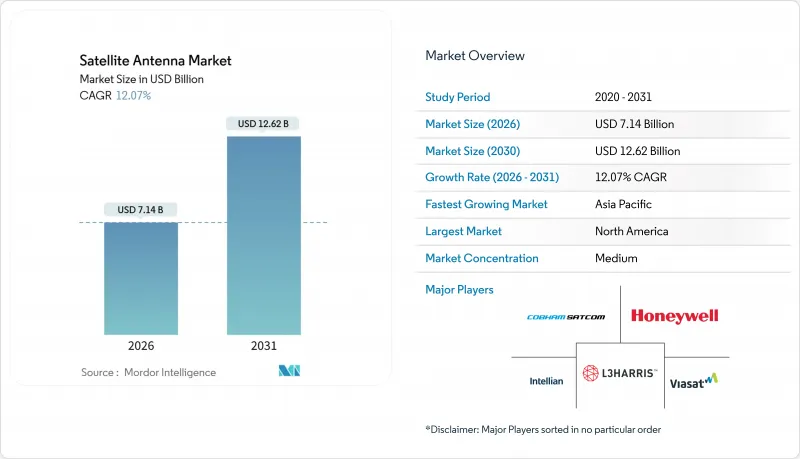
This report is Segmented by Frequency Band (C Band, X Band, Ku Band, Ka Band, L/S Band, and VHF/UHF Band), Antenna Type (Parabolic Reflector, Flat-Panel ESA/RSA, Horn, Dielectric-Resonator, FRP-Radome, and Metal-Stamp), Application (Spaceborne, Airborne, Maritime, and Land), End-User (Commercial, Government and Defense), and Geography. Market Forecasts are Provided in Value (USD).
Global Satellite Antenna Market Trends and Insights
Proliferation of LEO Broadband Constellations
More than 6,750 Starlink spacecraft orbited by late-2024, with Eutelsat OneWeb completing its 648-satellite first-generation network the same year. Amazon's Project Kuiper must orbit 1,663 satellites by July 2026 to preserve spectrum, locking in demand for user terminals as milestones near. These mega-constellations oblige antennas that track multiple fast-moving targets, pushing ESAs over parabolic dishes in aviation, maritime, and land-mobile segments. Parity pricing on flat panels is emerging as volumes climb, and constellation operators often subsidize hardware to accelerate subscriber uptake. The resulting ecosystem shift compresses cost per megabit, encouraging telcos in remote regions to adopt satellite backhaul for last-mile broadband.
Rapid Militarization of Space (MilSATCOM)
The U.S. Department of the Air Force awarded L3Harris a USD 1.2 billion terminal contract in mid-2024, underscoring defense appetite for multi-orbit resiliency. NATO released a resilient SATCOM framework that mandates terminal agility between commercial and military satellites within milliseconds to avoid jamming . Asian defense agencies mirror this posture: India launched dedicated communications satellites in 2024 and Japan funded new X-band ground stations in its 2025 budget. These initiatives elevate demand for X- and Ka-band hardware with encryption, embedded cybersecurity, and anti-jam waveforms. Established primes with classified-program experience retain an edge, although flat-panel innovators are gaining traction by partnering with system integrators.
Export-Control Bottlenecks on ESA Chipsets
The Bureau of Industry and Security tightened export controls on gallium nitride in 2024, slowing phased-array chipset deliveries to Asia-Pacific buyers. China countered by restricting outbound gallium and germanium, prompting non-Chinese fabs to qualify alternative supply chains at higher cost. ITAR rules add six-to-nine-month delays for many commercial transactions, as Kymeta disclosed in investor materials. Hanwha Phasor chose to open a U.S. subsidiary to navigate the regime, duplicating engineering resources and elongating roadmaps. These constraints elevate terminal pricing in price-sensitive regions and complicate multinational deployment schedules.
Other drivers and restraints analyzed in the detailed report include:
- High Throughput Satellite Payload Adoption
- Commercial In-Flight Connectivity Boom
- Ku/Ka-Band Rain Fade in Equatorial Regions
For complete list of drivers and restraints, kindly check the Table Of Contents.
Segment Analysis
Ka Band is projected to record an 11.80% annual expansion to 2031, making it the fastest-growing slice of the satellite antenna market. SES O3b mPOWER and Viasat ViaSat-3 both rely on Ka spot beams that can be flexed regionally, and their combined demand anchors multiyear procurement of dual-band ESAs. In contrast, C Band retained a 38.75% satellite antenna market share in 2025, serving government teleports, disaster-recovery nodes, and broadcast uplinks that prize rain-fade resilience. Ku Band remains a workhorse for direct-to-home and first-generation aeronautical links, yet growth is slowing as capacity migrates upward in frequency. L/S and VHF/UHF bands hold niche roles in mobile satellite services and legacy defense radios.
Operators lean on Ka-band for higher spectral efficiency and abundant regulatory allocations secured at the 2023 World Radiocommunication Conference. Integrators now bundle adaptive coding to tame equatorial fade and employ dual-band architectures that steer traffic to Ku during severe weather, preserving quality of service. This mixed-spectrum approach allows premium airlines to guarantee streaming-grade inflight plans and lets oil-rig operators keep SCADA networks online during storms. As unit costs fall, Ka antennas move down-market into small merchant ships and remote agriculture, broadening the customer base without cannibalizing C-band reliability tiers.
Parabolic reflectors held 44.10% of 2025 revenue, a testament to proven mechanics and low upfront cost for fixed sites. Nonetheless, flat-panel designs are scaling at a 34.2% CAGR, the standout rate in the satellite antenna market through 2031, thanks to thin profiles that reduce drag on aircraft and eliminate moving parts on vehicles. Ball Aerospace partnered with Flex to bring automotive surface-mount economics to phased-array lines, targeting a 40% price cut per unit. Kymeta's Osprey u8 priced below USD 9,000 in 2024, slashing entry costs for small craft. Horn, dielectric-resonator, FRP-radome, and metal-stamp variants play supportive roles, either as specialty radiators or protective housings.
Manufacturers diversify with hybrid solutions, such as Intellian's v240MT that marries a 2.4 m parabolic dish with software-defined modems allowing agile GEO-LEO handoffs. Optical beamforming prototypes from All.Space replace radio-frequency phase shifters with liquid-crystal elements, trimming component counts by 60%, boosting yield, and lowering power draw. Meanwhile, Greenerwave's reconfigurable intelligent surfaces aim to steer beams without active RF components, a potentially transformative path for battery-powered land portable terminals.
Complete Report Scope:
- By Frequency Band
- C Band
- X Band
- Ku Band
- Ka Band
- L/S Band
- VHF/UHF Band
- By Antenna Type
- Parabolic Reflector
- Flat-Panel (ESA/RSA)
- Horn
- Dielectric-Resonator
- FRP-Radome
- Metal-Stamp
- By Application
- Spaceborne
- Airborne
- Maritime
- Land (Mobile and Fixed)
- By End-User
- Commercial
- Government and Defense
- By Geography
- North America
- United States
- Canada
- Mexico
- Europe
- Germany
- United Kingdom
- France
- Italy
- Spain
- Russia
- Rest of Europe
- Asia-Pacific
- China
- Japan
- India
- South Korea
- Australia
- Rest of Asia-Pacific
- Middle East
- Saudi Arabia
- United Arab Emirates
- Turkey
- Rest of Middle East
- Africa
- South Africa
- Nigeria
- Rest of Africa
- South America
- Brazil
- Argentina
- Rest of South America
- North America
Geography Analysis
North America anchored 41.50% of 2025 revenue, propelled by early LEO deployments, the Space Force's modernization roadmap, and streamlined FAA processes. Defense primes such as L3Harris and Viasat enjoy multi-year contracts that stabilize domestic demand even as commercial aviation retrofits accelerate. Canada's rural broadband programs also procure thousands of fixed terminals, expanding the customer base beyond mobility verticals. While growth slows as installed bases mature, aftermarket upgrades for dual-band capability sustain volumes.
Asia-Pacific is projected to advance at a 9.7% CAGR to 2031, the strongest regional trajectory in the satellite antenna market. China's plan to orbit 13,000 satellites by 2030 mandates tens of thousands of ground terminals each year, and the nation is spinning up domestic GaN foundries to reduce exposure to U.S. export controls. India targets a USD 44 billion space economy by 2033, catalyzing public-private joint ventures in antenna fabrication. Japan's quasi-zenith satellite expansion and South Korea's defense export ambitions add further pull. Regulatory bodies in Australia and Indonesia now pre-approve Starlink terminal imports, reflecting policy momentum across the region.
Europe balances sovereign security goals and commercial aspirations. The European Space Agency's IRIS2 secure-connectivity constellation received EUR 150 million in funding in 2024, directly subsidizing user-terminal procurements for critical infrastructure operators . OneWeb's completed network supplies broadband to maritime operators in the North Sea and Mediterranean, requiring dual-band antennas that roam between LEO and GEO links. The Middle East invests in Ka-band ground stations to support lunar gateway missions and resilient communication for remote oilfields. Sub-Saharan Africa and South America lag on capital outlays, yet Starlink's direct-to-consumer model circumvents telco partners, shipping self-install kits to rural households and sparking incremental demand for low-cost ESAs.
- Honeywell International Inc.
- CPI International Inc.
- Kymeta Corp.
- Norsat International Inc.
- Cobham SATCOM
- L3Harris Technologies Inc.
- Viasat Inc.
- Airbus Defence and Space
- Gilat Satellite Networks Ltd.
- Maxar Technologies
- Ball Aerospace
- Intellian Technologies
- Isotropic Systems (All.Space)
- Hanwha Phasor
- SES S.A. (O3b mPOWER User Terminals)
- Thales Alenia Space
- MT Mechatronics
- SatixFy Ltd.
- General Dynamics Mission Systems
- LEOcloud Inc.
- Hughes Network Systems
Additional Benefits:
- The market estimate (ME) sheet in Excel format
- 3 months of analyst support
TABLE OF CONTENTS
1 INTRODUCTION
- 1.1 Study Assumptions and Market Definition
- 1.2 Scope of the Study
2 RESEARCH METHODOLOGY
3 EXECUTIVE SUMMARY
4 MARKET LANDSCAPE
- 4.1 Market Overview
- 4.2 Market Drivers
- 4.2.1 Proliferation of LEO Broadband Constellations
- 4.2.2 Rapid Militarization of Space (MilSATCOM)
- 4.2.3 High Throughput Satellite Payload Adoption
- 4.2.4 Commercial In-Flight Connectivity Boom
- 4.2.5 ESA-Based Flat-Panel Cost Curve Deflation
- 4.2.6 Lunar and Cislunar Mission Communications Demand
- 4.3 Market Restraints
- 4.3.1 Ku-/Ka-Band Rain Fade in Equatorial Regions
- 4.3.2 Export-Control Bottlenecks on Phased-Array Chipsets
- 4.3.3 Mounting Orbital-Debris Insurance Premiums
- 4.3.4 CAPEX Crunch at Emerging-Market Telcos
- 4.4 Industry Value Chain Analysis
- 4.5 Regulatory Landscape
- 4.6 Technological Outlook
- 4.7 Impact of Macroeconomic Factors
- 4.8 Porter's Five Forces Analysis
- 4.8.1 Threat of New Entrants
- 4.8.2 Bargaining Power of Suppliers
- 4.8.3 Bargaining Power of Buyers
- 4.8.4 Threat of Substitutes
- 4.8.5 Competitive Rivalry
5 MARKET SIZE AND GROWTH FORECASTS (VALUE)
- 5.1 By Frequency Band
- 5.1.1 C Band
- 5.1.2 X Band
- 5.1.3 Ku Band
- 5.1.4 Ka Band
- 5.1.5 L/S Band
- 5.1.6 VHF/UHF Band
- 5.2 By Antenna Type
- 5.2.1 Parabolic Reflector
- 5.2.2 Flat-Panel (ESA/RSA)
- 5.2.3 Horn
- 5.2.4 Dielectric-Resonator
- 5.2.5 FRP-Radome
- 5.2.6 Metal-Stamp
- 5.3 By Application
- 5.3.1 Spaceborne
- 5.3.2 Airborne
- 5.3.3 Maritime
- 5.3.4 Land (Mobile and Fixed)
- 5.4 By End-User
- 5.4.1 Commercial
- 5.4.2 Government and Defense
- 5.5 By Geography
- 5.5.1 North America
- 5.5.1.1 United States
- 5.5.1.2 Canada
- 5.5.1.3 Mexico
- 5.5.2 Europe
- 5.5.2.1 Germany
- 5.5.2.2 United Kingdom
- 5.5.2.3 France
- 5.5.2.4 Italy
- 5.5.2.5 Spain
- 5.5.2.6 Russia
- 5.5.2.7 Rest of Europe
- 5.5.3 Asia-Pacific
- 5.5.3.1 China
- 5.5.3.2 Japan
- 5.5.3.3 India
- 5.5.3.4 South Korea
- 5.5.3.5 Australia
- 5.5.3.6 Rest of Asia-Pacific
- 5.5.4 Middle East
- 5.5.4.1 Saudi Arabia
- 5.5.4.2 United Arab Emirates
- 5.5.4.3 Turkey
- 5.5.4.4 Rest of Middle East
- 5.5.5 Africa
- 5.5.5.1 South Africa
- 5.5.5.2 Nigeria
- 5.5.5.3 Rest of Africa
- 5.5.6 South America
- 5.5.6.1 Brazil
- 5.5.6.2 Argentina
- 5.5.6.3 Rest of South America
- 5.5.1 North America
6 COMPETITIVE LANDSCAPE
- 6.1 Market Concentration
- 6.2 Strategic Moves
- 6.3 Market Share Analysis
- 6.4 Company Profiles (includes Global level Overview, Market level overview, Core Segments, Financials as available, Strategic Information, Market Rank/Share for key companies, Products and Services, and Recent Developments)
- 6.4.1 Honeywell International Inc.
- 6.4.2 CPI International Inc.
- 6.4.3 Kymeta Corp.
- 6.4.4 Norsat International Inc.
- 6.4.5 Cobham SATCOM
- 6.4.6 L3Harris Technologies Inc.
- 6.4.7 Viasat Inc.
- 6.4.8 Airbus Defence and Space
- 6.4.9 Gilat Satellite Networks Ltd.
- 6.4.10 Maxar Technologies
- 6.4.11 Ball Aerospace
- 6.4.12 Intellian Technologies
- 6.4.13 Isotropic Systems (All.Space)
- 6.4.14 Hanwha Phasor
- 6.4.15 SES S.A. (O3b mPOWER User Terminals)
- 6.4.16 Thales Alenia Space
- 6.4.17 MT Mechatronics
- 6.4.18 SatixFy Ltd.
- 6.4.19 General Dynamics Mission Systems
- 6.4.20 LEOcloud Inc.
- 6.4.21 Hughes Network Systems
7 MARKET OPPORTUNITIES AND FUTURE OUTLOOK
- 7.1 White-Space and Unmet-Need Assessment

