PUBLISHER: Mordor Intelligence | PRODUCT CODE: 2122878

PUBLISHER: Mordor Intelligence | PRODUCT CODE: 2122878
Hosiery - Market Share Analysis, Industry Trends & Statistics, Growth Forecasts (2026 - 2031)
According to Mordor Intelligence, the hosiery market size is projected to be USD 68.12 billion in 2025, USD 71.21 billion in 2026, and reach USD 92.87 billion by 2031, growing at a CAGR of 5.45% from 2026 to 2031.
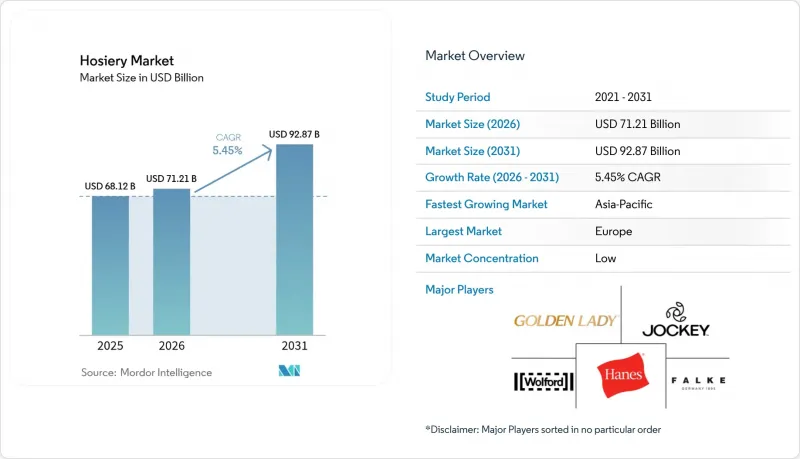
This report is Segmented by Product Type (Body Stockings, Socks, Knee-Highs and Hold-Ups, Tights and Pantyhose, and Hosiery Accessories), End-User (Women, Men, and Kids), Price Range (Mass and Premium), Distribution Channel (Supermarkets/Hypermarkets, Specialty Stores, Online Retail Stores, and More), and Geography. The Market Forecasts are Provided in Terms of Value (USD).
Global Hosiery Market Trends and Insights
Rising demand for fashionable hosiery like patterned and designer stockings
Hosiery has transitioned from being a purely functional necessity to becoming a significant fashion statement, with retailers in the United Kingdom reporting notable sales growth in 2024. Marks and Spencer recorded a 50% increase in sales of patterned and designer stockings, while John Lewis experienced a 55% rise. Additionally, the direct-to-consumer brand Heist Studios successfully doubled its revenue. This change highlights how younger consumers now view legwear as an accessory rather than a basic commodity. As a result, brands are introducing seasonal collections that feature intricate designs, bold colors, and collaborations with fashion influencers. This trend has proven advantageous for premium-tier brands, which are able to achieve higher profit margins through limited-edition products and compelling storytelling. At the same time, it has led to fragmented shelf space as mass-market retailers expand their stock-keeping unit (SKU) offerings to meet the demands of variety-seeking shoppers. Social commerce is playing a critical role in amplifying this trend, with TikTok hashtags related to hosiery content attracting billions of views and live-stream shopping in China converting impulse browsing into immediate purchases. Brands that focus on investments in visual merchandising, partnerships with influencers, and rapid product development cycles are capturing a larger share of the market, while those relying on static catalog assortments risk losing relevance in this dynamic and competitive environment.
Increasing women's workforce participation requiring professional attire
In 2024, women's labor-force participation stabilized at 58.9% in the United States and 65.6% in the European Union, sustaining the demand for professional hosiery as hybrid work arrangements became the standard and selective dress codes returned [1]. This trend has reinforced the popularity of sheer tights, control-top pantyhose, and seamless styles that pair well with tailored trousers and skirts, ensuring a stable revenue base for established brands. Additionally, there is a growing need for hosiery among women employed in service sectors, healthcare, and hospitality, where durable and comfortable options are essential for enduring long work shifts. This has created opportunities for the development of technical fabrics that incorporate features such as compression for improved circulation and moisture management for enhanced comfort. Brands that strategically segment their product offerings based on specific professions and practical use cases, rather than relying on generic work categories, can capture a larger share of customer spending and reduce product returns caused by mismatched performance expectations.
Consumer concerns over chemicals in dyes and preservatives used in production
Heightened awareness of the environmental and health impacts of textile chemicals has driven significant regulatory actions and consumer backlash. The European Union's Registration, Evaluation, Authorisation, and Restriction of Chemicals (REACH) framework has restricted a large number of substances, while the OEKO-TEX Standard 100 has banned a wide range of chemicals used in dyes and preservatives, with full implementation expected in the coming years. In the United States, California's Proposition 65 has introduced specific warnings for textiles containing certain azo dyes and formaldehyde-based finishes. This has compelled brands to reformulate their products to avoid labeling requirements that could deter consumers from making purchases. Additionally, the Zero Discharge of Hazardous Chemicals (ZDHC) Manufacturing Restricted Substances List version 3.2 has become a widely recognized industry standard. Major retailers now require suppliers to comply with these guidelines and conduct random audits to ensure adherence. Reformulating products has introduced additional costs for brands using traditional dye systems, along with extended lead times as suppliers validate new chemical formulations. Smaller producers, often lacking the resources for research and development, face increasing pressure to exit the market. In contrast, vertically integrated companies that manage their own dyeing and finishing processes are better equipped to adapt quickly, enabling them to gain a competitive advantage and capture market share from non-compliant competitors.
Other drivers and restraints analyzed in the detailed report include:
- Global fitness movement boosting performance hosiery for workouts and athletics
- Product innovations like moisture-wicking, anti-bacterial, and temperature-specific tights
- Shift to sustainable alternatives limiting synthetic hosiery demand
For complete list of drivers and restraints, kindly check the Table Of Contents.
Segment Analysis
Socks accounted for 65.73% of the projected 2025 revenue, reflecting their widespread use across casual, athletic, and professional settings. This dominance highlights their versatility and essential role in everyday wear. However, tights and pantyhose are expected to grow at a compound annual growth rate (CAGR) of 6.83% through 2031. This growth is driven by increasing workplace formality and advancements in sheer fabric technologies, which enhance both functionality and aesthetics. The sock category benefits from two primary demand drivers. First, performance socks designed for athletics incorporate features such as moisture-wicking and anti-bacterial properties, catering to active consumers. Second, fashion socks with bold designs and premium materials appeal to style-conscious buyers and yield higher profit margins. For example, Bombas has built a business exceeding USD 300 million by focusing on comfort features such as reinforced heels and seamless toes. This success demonstrates that consumers are willing to pay premium prices for products that combine functionality and comfort.
Body stockings cater to niche markets in fashion and intimate apparel, offering unique options for specific consumer preferences. Meanwhile, knee-highs and hold-ups attract individuals seeking comfort without the need for full-leg coverage. Hosiery accessories, including garters, clips, and storage solutions, remain a low-margin and low-growth segment with limited potential for innovation. The faster growth of tights and pantyhose highlights a shift toward products that effectively blend fashion and functionality. Features such as seamless construction, control-top designs, and moisture-wicking fabrics address consumer concerns related to comfort and durability. Additionally, innovations like bonded panels and laser-cut edges help eliminate visible panty lines, which is a significant factor influencing purchases for professional and evening wear. Graduated compression variants further appeal to travelers and healthcare workers by offering circulation benefits, addressing both health and comfort needs.
Women accounted for 68.32% of the 2025 revenue, driven by demand for professional attire, fashion hosiery, and shapewear. However, the men's hosiery market is projected to grow at a compound annual growth rate (CAGR) of 6.97% through 2031, as the blending of workplace formality and athleisure trends reduces traditional gender distinctions. SKIMS reported that men's products contributed significantly to its sales, while the French brand Les Belles noted that half of the customers purchasing men's tights identified as male. This indicates a growing acceptance of men's hosiery beyond niche markets. The growth of the men's hosiery market is primarily attributed to three key categories: formal dress socks for professional use, performance socks for athletic activities, and compression tights for travel and recovery purposes. In contrast, kids' hosiery remains stable, supported by school uniform requirements and seasonal gifting, though it continues to lag behind adult segments in terms of innovation and profit margins.
The potential for growth in men's hosiery extends beyond product development to include marketing strategies and retail positioning. Historically, legacy brands have marketed men's socks as purely functional items, with limited emphasis on their fashion appeal. Bombas, a direct-to-consumer brand, has achieved notable revenue by focusing on comfort-oriented features such as reinforced heels and seamless toes. This demonstrates that men are willing to invest in products that provide functional benefits and enhanced comfort.
Complete Report Scope:
- By Product Type
- Body Stockings
- Socks
- Knee-highs and Hold-ups
- Tights and Pantyhose
- Hosiery accessories
- By End-User
- Women
- Men
- Kids
- By Price Range
- Mass
- Premium
- By Distribution Channel
- Supermarkets and Hypermarkets
- Specialty Stores
- Online Retail Stores
- Other Distribution Channels
- By Geography
- North America
- United States
- Canada
- Mexico
- Rest of North America
- Europe
- Germany
- United Kingdom
- Italy
- France
- Spain
- Netherlands
- Poland
- Belgium
- Sweden
- Rest of Europe
- Asia-Pacific
- China
- India
- Japan
- Australia
- Indonesia
- South Korea
- Thailand
- Singapore
- Rest of Asia-Pacific
- South America
- Brazil
- Argentina
- Colombia
- Chile
- Peru
- Rest of South America
- Middle East and Africa
- South Africa
- Saudi Arabia
- United Arab Emirates
- Nigeria
- Egypt
- Morocco
- Turkey
- Rest of Middle East and Africa
- North America
Geography Analysis
Europe continues to lead the global hosiery market, contributing 39.88% of the projected revenue for 2025. This leadership is supported by its renowned fashion capitals, a well-established retail infrastructure, and strict textile regulations that favor brands with strong compliance capabilities. Key markets such as Germany, the United Kingdom, Italy, and France drive demand due to professional attire requirements and high per-capita hosiery consumption. Additionally, Eastern European markets offer growth potential as disposable incomes increase and Western fashion trends gain popularity. The European Union's Textile Strategy 2024, which enforces extended producer responsibility and minimum recycled-content thresholds, is encouraging the use of eco-friendly fibers while creating challenges for non-compliant imports. Despite revenue challenges, such as Wolford's fiscal 2024 sales decline by 30% to EUR 126.9 million, brands like Wolford and Falke maintain loyal customer bases due to their heritage and technical expertise . However, European companies must carefully balance sustainability investments with profit margins, as consumers remain hesitant to pay higher prices despite their stated environmental concerns.
The Asia-Pacific region is the fastest-growing segment in the global hosiery market, with a projected compound annual growth rate (CAGR) of 7.43% through 2031. This growth is fueled by urbanization, rising middle-class incomes, and the increasing adoption of Western fashion in countries such as China, India, and Southeast Asia. According to McKinsey's State of Fashion 2025 report, China's share of United States apparel imports declined by approximately 6 percentage points between 2019 and 2023, as production shifted to India, Vietnam, and Bangladesh, where labor costs are 50% lower than in China. India has emerged as a significant sourcing hub for hosiery manufacturers, supported by approximately USD 2.5 billion in Production-Linked Incentives for textiles and a threefold increase in foreign direct investment since 2019. These developments position the region as a cost-effective and nearshoring alternative for global manufacturers.
Other regions, including North America, South America, and the Middle East and Africa, collectively hold smaller shares of the global hosiery market but exhibit distinct characteristics. North America benefits from the growing popularity of athleisure and the rise of direct-to-consumer innovations, with brands such as Bombas gaining traction. South America is experiencing steady growth driven by urbanization and the modernization of retail infrastructure. In contrast, the Middle East and Africa remain emerging markets, limited by lower per-capita incomes and underdeveloped retail infrastructure outside major urban areas. Companies entering these regions need to adopt standardized product platforms while customizing sizing, pricing, and distribution strategies to align with local market conditions and achieve profitability.
- Hanesbrands Inc.
- Golden Lady Company S.p.A.
- Wolford AG
- Falke KGaA
- Jockey International Inc.
- CSP International Fashion Group
- Spanx Inc.
- SKIMS
- Heist Studios
- Renfro Brands (Burlington)
- Calzedonia Group
- Adidas AG (Hosiery)
- Nike Inc. (Hosiery)
- Bombas
- Lululemon Athletica (Hosiery)
- Puma SE (Socks)
- Under Armour Inc. (Hosiery)
- G-III Apparel Group (Donna Karan)
- Iconix Brand Group
- Carolina Hosiery Mill Inc.
Additional Benefits:
- The market estimate (ME) sheet in Excel format
- 3 months of analyst support
TABLE OF CONTENTS
1 INTRODUCTION
- 1.1 Study Assumptions and Market Definition
- 1.2 Scope of the Study
2 RESEARCH METHODOLOGY
3 EXECUTIVE SUMMARY
4 MARKET LANDSCAPE
- 4.1 Market Overview
- 4.2 Market Drivers
- 4.2.1 Rising demand for fashionable hosiery like patterned and designer stockings
- 4.2.2 Increasing women's workforce participation requiring professional attire
- 4.2.3 Global fitness movement boosting performance hosiery for workouts and athletics
- 4.2.4 Product innovations like moisture-wicking, anti-bacterial, and temperature-specific tights
- 4.2.5 Adoption of Western fashion trends in emerging markets
- 4.2.6 Sustainability initiatives using eco-friendly fibers and biodegradable yarns
- 4.3 Market Restraints
- 4.3.1 Consumer concerns over chemicals in dyes and preservatives used in production
- 4.3.2 Shift to sustainable alternatives limiting synthetic hosiery demand
- 4.3.3 Volatility in raw material prices disrupting production schedules
- 4.3.4 Supply chain disruptions affecting availability and consistency
- 4.4 Value Chain Analysis
- 4.5 Regulatory Outlook
- 4.6 Porter's Five Forces
- 4.6.1 Threat of New Entrants
- 4.6.2 Bargaining Power of Buyers
- 4.6.3 Bargaining Power of Suppliers
- 4.6.4 Threat of Substitute Products
- 4.6.5 Intensity of Competitive Rivalry
5 MARKET SIZE AND GROWTH FORECASTS (VALUE)
- 5.1 By Product Type
- 5.1.1 Body Stockings
- 5.1.2 Socks
- 5.1.3 Knee-highs and Hold-ups
- 5.1.4 Tights and Pantyhose
- 5.1.5 Hosiery accessories
- 5.2 By End-User
- 5.2.1 Women
- 5.2.2 Men
- 5.2.3 Kids
- 5.3 By Price Range
- 5.3.1 Mass
- 5.3.2 Premium
- 5.4 By Distribution Channel
- 5.4.1 Supermarkets and Hypermarkets
- 5.4.2 Specialty Stores
- 5.4.3 Online Retail Stores
- 5.4.4 Other Distribution Channels
- 5.5 By Geography
- 5.5.1 North America
- 5.5.1.1 United States
- 5.5.1.2 Canada
- 5.5.1.3 Mexico
- 5.5.1.4 Rest of North America
- 5.5.2 Europe
- 5.5.2.1 Germany
- 5.5.2.2 United Kingdom
- 5.5.2.3 Italy
- 5.5.2.4 France
- 5.5.2.5 Spain
- 5.5.2.6 Netherlands
- 5.5.2.7 Poland
- 5.5.2.8 Belgium
- 5.5.2.9 Sweden
- 5.5.2.10 Rest of Europe
- 5.5.3 Asia-Pacific
- 5.5.3.1 China
- 5.5.3.2 India
- 5.5.3.3 Japan
- 5.5.3.4 Australia
- 5.5.3.5 Indonesia
- 5.5.3.6 South Korea
- 5.5.3.7 Thailand
- 5.5.3.8 Singapore
- 5.5.3.9 Rest of Asia-Pacific
- 5.5.4 South America
- 5.5.4.1 Brazil
- 5.5.4.2 Argentina
- 5.5.4.3 Colombia
- 5.5.4.4 Chile
- 5.5.4.5 Peru
- 5.5.4.6 Rest of South America
- 5.5.5 Middle East and Africa
- 5.5.5.1 South Africa
- 5.5.5.2 Saudi Arabia
- 5.5.5.3 United Arab Emirates
- 5.5.5.4 Nigeria
- 5.5.5.5 Egypt
- 5.5.5.6 Morocco
- 5.5.5.7 Turkey
- 5.5.5.8 Rest of Middle East and Africa
- 5.5.1 North America
6 COMPETITIVE LANDSCAPE
- 6.1 Market Concentration
- 6.2 Strategic Moves
- 6.3 Market Ranking Analysis
- 6.4 Company Profiles (includes Global-level Overview, Market-level Overview, Core Segments, Financials (if available), Strategic Information, Market Rank/Share, Products and Services, Recent Developments)
- 6.4.1 Hanesbrands Inc.
- 6.4.2 Golden Lady Company S.p.A.
- 6.4.3 Wolford AG
- 6.4.4 Falke KGaA
- 6.4.5 Jockey International Inc.
- 6.4.6 CSP International Fashion Group
- 6.4.7 Spanx Inc.
- 6.4.8 SKIMS
- 6.4.9 Heist Studios
- 6.4.10 Renfro Brands (Burlington)
- 6.4.11 Calzedonia Group
- 6.4.12 Adidas AG (Hosiery)
- 6.4.13 Nike Inc. (Hosiery)
- 6.4.14 Bombas
- 6.4.15 Lululemon Athletica (Hosiery)
- 6.4.16 Puma SE (Socks)
- 6.4.17 Under Armour Inc. (Hosiery)
- 6.4.18 G-III Apparel Group (Donna Karan)
- 6.4.19 Iconix Brand Group
- 6.4.20 Carolina Hosiery Mill Inc.
7 MARKET OPPORTUNITIES AND FUTURE OUTLOOK

