PUBLISHER: Mordor Intelligence | PRODUCT CODE: 2122880

PUBLISHER: Mordor Intelligence | PRODUCT CODE: 2122880
Marine Steering System - Market Share Analysis, Industry Trends & Statistics, Growth Forecasts (2026 - 2031)
According to Mordor Intelligence, the marine steering systems market size is expected to grow from USD 3.52 billion in 2025 to USD 3.69 billion in 2026 and is forecast to reach USD 4.7 billion by 2031 at 4.94% CAGR over 2026-2031.
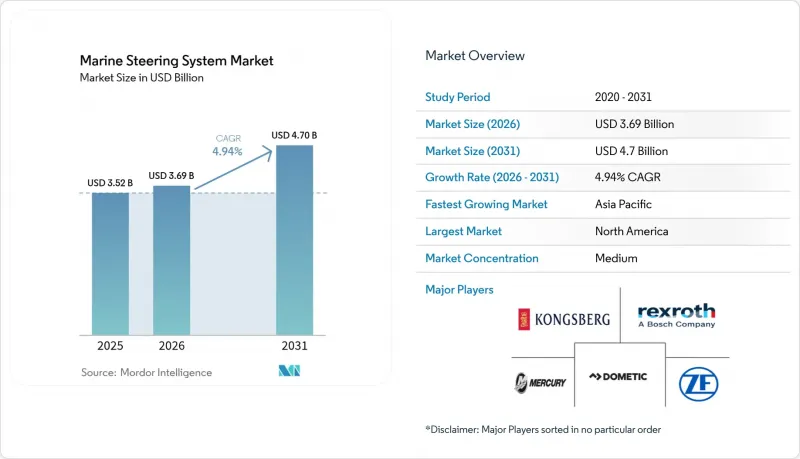
This report is Segmented by Product Type (Rotary Vane Type, Ram Type, and More), Actuation Technology (Conventional Hydraulic, Electro-Hydraulic, and More), Control Mode (Manual, and More), Vessel Type (Passenger and More), Propulsion Configuration (Inboard and More), Distribution Channel (OEM Fitment and Aftermarket Retrofit), and Geography. The Market Forecasts are Provided in Terms of Value (USD).
Global Marine Steering System Market Trends and Insights
Naval Modernization Programmes in Asia and Europe
Rising defense budgets propel steady procurement of multi-role frigates, amphibious carriers, and submarines across China, South Korea, Japan, Germany, and the Netherlands. Each hull specifies cyber-secure, redundancy-rich steering systems capable of mating with integrated bridge and combat-management suites. China's People's Liberation Army Navy operated 234 major surface combatants in 2024, outnumbering the 219 units fielded by the U.S. Navy, a fleet expansion that keeps domestic yards at full tilt and draws on steering subcontractors throughout regional supply chains. Parallel NATO programs in Europe reinforce demand for electric or electro-hydraulic actuators that minimize acoustic signatures, accommodate dynamic-positioning holds, and support unmanned wingman craft.
Growth in Global Recreational Boating Fleet
Powerboat and personal-watercraft sales recorded 230,000-240,000 units in the United States during 2024 as buyers sought joystick docking, wireless helm controls, and integrated autopilots that simplify skippering for novice owners. OEMs bundle smart steering with propulsion upgrades, creating a compelling aftermarket funnel for older hulls. The segment's domestic economic footprint sustains parts, service, and electronics revenues that cushion cyclical swings in new-boat registrations.
Cyclical Downturn in Commercial Shipbuilding
Container-ship new-build bookings remain historically elevated, yet tanker, bulk, and general-cargo contracts softened through 2024 as operators delayed capital expenditures. Asian yards adjust output to match this mix, reducing baseline demand for standard helm sets even as retrofit work rises to offset capacity fluctuations.
Other drivers and restraints analyzed in the detailed report include:
- Retrofitting Demand Driven by IMO Mandates
- OEM Push Toward Electric-Power Steering for Outboards
- High Upfront Cost of Electric Steering Conversions
For complete list of drivers and restraints, kindly check the Table Of Contents.
Segment Analysis
Rotary-vane designs retained 42.41% of the marine steering systems market share in 2025, anchored by reliability and simple service protocols. Yet electro-mechanical integrated units headline growth with a 8.86% CAGR through 2031 as shipyards specify precision control, noise reduction, and embedded diagnostics. Ram cylinders continue in heavy-lift naval and offshore support craft where extreme torque and redundancy are mandatory. Rack-and-pinion assemblies serve niche inland and small-craft segments needing compact footprints.
Demand tilts toward software-defined actuators that self-calibrate and interface with collision-avoidance algorithms. Classification societies now certify cyber-secure firmware, nudging operators toward new-generation electric or hybrid products rather than refurbishing legacy hydraulics. Consequently, the marine steering systems market sees product road-maps converge on modular electro-mechanical cartridges deployable across vessel classes.
Hydraulic circuits still delivered 51.86% of 2025 installations, yet fully electric power steering is accelerating at 15.9% annually. Hybrid electro-hydraulic packages bridge the transition, offering on-demand pumps that spin only when commanded, trimming idle losses, and enabling engine-off maneuvering. Mechanical cable systems persist in low-horsepower craft but face gradual replacement as joystick and autopilot features move down-market.
Electric actuators achieve sub-millisecond lag and integrate regenerative braking that eases hotel-load demands on hybrid vessels. As flag administrations tighten oil-to-water discharge limits, operators view fluid-free architectures as both compliance facilitators and lifecycle cost reducers. This performance-plus-sustainability mix cements electric technology as the marine steering systems market's most disruptive trend.
Complete Report Scope:
- By Product Type
- Rotary Vane
- Ram-Type
- Rack-and-Pinion
- Electro-Mechanical (Integrated)
- By Actuation Technology
- Conventional Hydraulic
- Electro-Hydraulic
- Fully Electric Power Steering (EPS)
- Mechanical/Cable
- By Control Mode
- Manual
- Auto-Pilot
- DP/Autonomous Integration
- By Vessel Type
- Passenger (Cruise, Ferry, Yacht)
- Commercial Cargo and Workboats
- Naval and Coast-Guard
- Offshore Energy Support
- By Propulsion Configuration
- Inboard
- Outboard
- Sterndrive
- By Distribution Channel
- OEM Fitment
- Aftermarket Retrofit
- By Geography
- North America
- United States
- Canada
- Rest of North America
- South America
- Brazil
- Argentina
- Rest of South America
- Europe
- Germany
- United Kingdom
- France
- Spain
- Russia
- Rest of Europe
- Asia-Pacific
- China
- Japan
- South Korea
- India
- Rest of Asia-Pacific
- Middle East and Africa
- United Arab Emirates
- Saudi Arabia
- Egypt
- Turkey
- South Africa
- Rest of Middle East and Africa
- North America
Geography Analysis
North America held 45.98% of the marine steering system market in 2025 and is forecast to grow on robust discretionary spending and 85 million boating participants maintain high turnover in powerboat inventories, while U.S. Coast Guard cybersecurity directives accelerate the adoption of encrypted digital helms across commercial fleets. Canadian Arctic patrol programs further support the sophisticated steering demand for ice-classified hulls.
Asia-Pacific leads growth with an 8.27% CAGR to 2031. Chinese naval expansion, underscored by 234 major warships in active service, fuels domestic shipbuilding production as yards aim for self-reliance in critical subsystems. Japan, South Korea, and Singapore pioneer autonomous surface research, seeding demand for AI-compatible helm actuators. Regional electrification policies add momentum, particularly in coastal tourism and island logistics fleets where zero-emission mandates emerge.
Europe records growth, anchored by NATO frigate programs and stringent environmental statutes. The European Maritime Safety Agency's STEERSAFE recommendations obligate continuous monitoring of rudder angle, load, and response times, leading operators to specify sensor-rich steering gear. Norway's operational autonomous passenger ferry pilot validates real-world readiness of digital helm solutions, encouraging wider municipal deployments across the continent. Concurrently, the EU AI Act provides legal clarity for machine-learning functions embedded in steering firmware, spurring vendor investments.
- Dometic Marine
- Mercury Marine
- ZF Friedrichshafen AG
- Bosch Rexroth
- Kongsberg Maritime
- Kobelt Manufacturing
- Damen Marine Components
- Wills Ridley Ltd
- HyDrive Engineering Pty Ltd
- Hypro Marine
- Techno Italia Kft
- Dometic Group
- Yamaha Motor Co.
- Uflex SRL
- Lecomble and Schmitt
- Vetus B.V.
- Jastram Engineering
- Glendinning Products
- Engine Monitor Inc. (EMI)
- Multisteer (India)
Additional Benefits:
- The market estimate (ME) sheet in Excel format
- 3 months of analyst support
TABLE OF CONTENTS
1 Introduction
- 1.1 Study Assumptions and Market Definition
- 1.2 Scope of the Study
2 Research Methodology
3 Executive Summary
4 Market Landscape
- 4.1 Market Overview
- 4.2 Market Drivers
- 4.2.1 Naval modernisation programmes in Asia and Europe
- 4.2.2 Growth in global recreational boating fleet
- 4.2.3 Retrofitting demand driven by IMO steering gear testing mandates
- 4.2.4 OEM push toward electric-power steering for outboards
- 4.2.5 Surge in autonomous-ready 'fly-by-wire' rudder actuators
- 4.2.6 Demand for low-sulphur-fuel compatible electro-hydraulic fluids
- 4.3 Market Restraints
- 4.3.1 Cyclical downturn in commercial shipbuilding
- 4.3.2 High upfront cost of electric steering conversions
- 4.3.3 Shortage of marine-grade semiconductor chips for steering controllers
- 4.3.4 Class-society cyber-resilience rules delaying digital steering roll-outs
- 4.4 Value/Supply-Chain Analysis
- 4.5 Regulatory Landscape
- 4.6 Technological Outlook
- 4.7 Porter's Five Forces
- 4.7.1 Threat of New Entrants
- 4.7.2 Bargaining Power of Buyers
- 4.7.3 Bargaining Power of Suppliers
- 4.7.4 Threat of Substitutes
- 4.7.5 Intensity of Competitive Rivalry
5 Market Size and Growth Forecasts (Value (USD))
- 5.1 By Product Type
- 5.1.1 Rotary Vane
- 5.1.2 Ram-Type
- 5.1.3 Rack-and-Pinion
- 5.1.4 Electro-Mechanical (Integrated)
- 5.2 By Actuation Technology
- 5.2.1 Conventional Hydraulic
- 5.2.2 Electro-Hydraulic
- 5.2.3 Fully Electric Power Steering (EPS)
- 5.2.4 Mechanical/Cable
- 5.3 By Control Mode
- 5.3.1 Manual
- 5.3.2 Auto-Pilot
- 5.3.3 DP/Autonomous Integration
- 5.4 By Vessel Type
- 5.4.1 Passenger (Cruise, Ferry, Yacht)
- 5.4.2 Commercial Cargo and Workboats
- 5.4.3 Naval and Coast-Guard
- 5.4.4 Offshore Energy Support
- 5.5 By Propulsion Configuration
- 5.5.1 Inboard
- 5.5.2 Outboard
- 5.5.3 Sterndrive
- 5.6 By Distribution Channel
- 5.6.1 OEM Fitment
- 5.6.2 Aftermarket Retrofit
- 5.7 By Geography
- 5.7.1 North America
- 5.7.1.1 United States
- 5.7.1.2 Canada
- 5.7.1.3 Rest of North America
- 5.7.2 South America
- 5.7.2.1 Brazil
- 5.7.2.2 Argentina
- 5.7.2.3 Rest of South America
- 5.7.3 Europe
- 5.7.3.1 Germany
- 5.7.3.2 United Kingdom
- 5.7.3.3 France
- 5.7.3.4 Spain
- 5.7.3.5 Russia
- 5.7.3.6 Rest of Europe
- 5.7.4 Asia-Pacific
- 5.7.4.1 China
- 5.7.4.2 Japan
- 5.7.4.3 South Korea
- 5.7.4.4 India
- 5.7.4.5 Rest of Asia-Pacific
- 5.7.5 Middle East and Africa
- 5.7.5.1 United Arab Emirates
- 5.7.5.2 Saudi Arabia
- 5.7.5.3 Egypt
- 5.7.5.4 Turkey
- 5.7.5.5 South Africa
- 5.7.5.6 Rest of Middle East and Africa
- 5.7.1 North America
6 Competitive Landscape
- 6.1 Market Concentration
- 6.2 Strategic Moves
- 6.3 Market Share Analysis
- 6.4 Company Profiles (Includes Global level Overview, Market Level Overview, Core Segments, Financials as Available, Strategic Information, Market Rank/Share for Key Companies, Products and Services, and Recent Developments)
- 6.4.1 Dometic Marine
- 6.4.2 Mercury Marine
- 6.4.3 ZF Friedrichshafen AG
- 6.4.4 Bosch Rexroth
- 6.4.5 Kongsberg Maritime
- 6.4.6 Kobelt Manufacturing
- 6.4.7 Damen Marine Components
- 6.4.8 Wills Ridley Ltd
- 6.4.9 HyDrive Engineering Pty Ltd
- 6.4.10 Hypro Marine
- 6.4.11 Techno Italia Kft
- 6.4.12 Dometic Group
- 6.4.13 Yamaha Motor Co.
- 6.4.14 Uflex SRL
- 6.4.15 Lecomble and Schmitt
- 6.4.16 Vetus B.V.
- 6.4.17 Jastram Engineering
- 6.4.18 Glendinning Products
- 6.4.19 Engine Monitor Inc. (EMI)
- 6.4.20 Multisteer (India)
7 Market Opportunities and Future Outlook

