PUBLISHER: Mordor Intelligence | PRODUCT CODE: 2122919

PUBLISHER: Mordor Intelligence | PRODUCT CODE: 2122919
Infrared Detector - Market Share Analysis, Industry Trends & Statistics, Growth Forecasts (2026 - 2031)
According to Mordor Intelligence, the infrared detector market size is expected to increase from USD 0.70 billion in 2025 to USD 0.74 billion in 2026 and reach USD 0.98 billion by 2031, growing at a CAGR of 5.79% over 2026-2031.
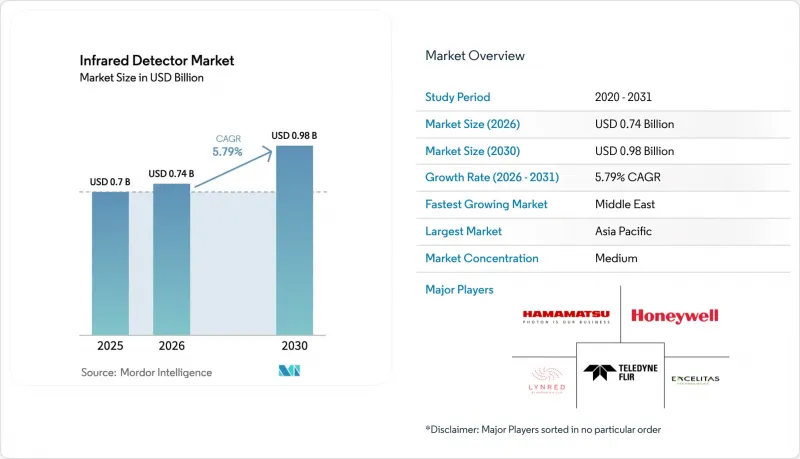
This report is Segmented by Detector Type (Thermal, and Photo Quantum), Cooling Technology (Uncooled, and Cooled), Material (Microbolometer, Ingaas, MCT, Pyroelectric, and Thermopile), Spectral Range (NIR, SWIR, MWIR, LWIR, and FIR), Application(people and Motion Sensing, and More), End-Use Industry (Aerospace and Defense, and More), and Geography. The Market Forecasts are Provided in Terms of Value (USD).
Global Infrared Detector Market Trends and Insights
Miniaturization of Uncooled Micro-bolometer Arrays Empowering IoT Motion Sensors in Asia
Pixel pitches below 12 micrometers have allowed Japanese and South Korean suppliers to ship nearly 8 million focal-plane arrays for battery-powered IoT occupancy sensors in 2025, up 35% year on year. Building-automation integrators adopted the smaller die to satisfy energy-efficiency codes that tie HVAC loads to verified room presence. Lens diameters shrank in parallel, allowing thermal modules to fit into light fixtures and wall switches that previously lacked space for 17-micrometer arrays. Manufacturing cost per square millimeter dropped about 40%, opening mid-tier smartphones to embedded thermal cameras. Passive operation avoids the eye-safety reviews associated with active near-infrared illumination, easing consumer-product certification under IEC 62471.
Mandatory Predictive-Maintenance Thermography in EU Process Industries
The Energy Efficiency Directive 2023/1791 obliges refiners, chemical plants, and steel mills to run quarterly thermography on motors, switchgear, and piping. Germany and France extended the scope in 2024 to medium-sized sites, tripling the addressable facility count to 12,000. Handheld and drone-mounted cameras with 0.05 °C resolution displaced contact probes in hazardous zones. U.K. and Dutch insurers now rebate between 5% and 10% of annual premiums when plants upload continuous thermal data to asset-management clouds. Camera vendors responded by bundling LTE modules and encrypted gateways, features that raise average selling price by roughly 20% versus offline units.
Export-control (ITAR-like) Limits on High-spec Cooled Detectors
U.S. ITAR and EU dual-use lists classify cooled arrays above 640X480 resolution and below 20 mK noise as defense articles, adding up to 12 months for export licensing and legal fees over USD 100,000 per shipment. Asian and Middle Eastern buyers pivot to lower-spec microbolometers or seek domestically produced cooled detectors that skirt the threshold, trading performance for procurement speed. Western suppliers report 25% fewer international orders in 2025 compared with 2024 because of license denials. The restriction also fragments global R&D collaboration as cross-border technical-data exchanges now require government-approved agreements. Emerging superlattice materials aim to reset the regulatory floor, but widespread qualification remains at least four years away.
Other drivers and restraints analyzed in the detailed report include:
- Surge in LiDAR-grade Near-IR Detectors for Autonomous and EV Platforms in China
- IR Gas-Leak Detection Mandates for Green-Hydrogen Plants across Middle East
- Price Erosion in Passive PIR Components
For complete list of drivers and restraints, kindly check the Table Of Contents.
Segment Analysis
Photo quantum arrays are projected to expand at an 11.80% CAGR, nearly double the overall infrared detector market, as automakers embed indium-gallium-arsenide avalanche photodiodes in highway-range LiDAR and mercury-cadmium-telluride in night-vision cameras. Thermal detectors, holding 68.46% of 2025 revenue, dominate cost-sensitive industrial and building-automation roles where passive operation and ambient-temperature tolerance outweigh the speed advantages of quantum devices. Because mature microbolometer supply chains can fabricate 640X480 arrays for under USD 50, the thermal camp anchors mass-market pricing. Yet the automotive pivot toward Level 3 autonomy raises per-vehicle detector content, nudging volume into the quantum camp and lifting average selling prices inside the infrared detector market.
Quantum growth depends on high-yield epitaxy of indium-gallium-arsenide and mercury-cadmium-telluride on lattice-matched substrates that remain scarce and expensive. Japan and Taiwan are scaling 200-millimeter epitaxial reactors to widen wafer diameters, which could cut die cost by as much as 30% once line yields exceed 60%. If those capacity ramps stay on track, the infrared detector market size attributed to quantum arrays for automotive and spectroscopy may reach USD 0.30 billion by 2031. Industrial thermography retains a stronghold for thermal detectors, but their share will slip below 60% as quantum adoption broadens into high-speed machine vision and hyperspectral biomedical imaging. The infrared detector industry thus faces a two-track future in which price-led thermal arrays coexist with performance-driven quantum devices.
Uncooled devices captured 83.71% of 2025 revenue as smartphone add-ons, driver-monitoring cameras, and drone gimbals require low-power, room-temperature operation. The segment's cost advantage widened with wafer-level packaging that slashes assembly expense 40% and compresses module footprints below 10 millimeters. Cooled designs, however, are growing at a 10.90% CAGR because defense and long-range border-surveillance programs demand sub-20 millikelvin sensitivity. These programs procure high-price cooled cameras, often exceeding USD 20,000 each, and therefore punch above their unit volumes in dollar terms, enlarging the infrared detector market size for cryogenic systems.
Advances in pulse-tube and linear-drive Stirling coolers have extended the mean time between failures to 15,000 hours, easing maintenance burdens that once deterred commercial buyers. Scientific instruments and astronomy payloads are also adopting cooled focal-plane arrays for mid-wave spectroscopy, where thermal noise must be suppressed below detector shot noise. While cooled shipments remain a minority, their revenue share could top 22% by 2031 if export-control bottlenecks ease. The net result keeps uncooled architectures at volume leadership yet allows cooled niches to regain pricing leverage inside the broader infrared detector market.
Complete Report Scope:
- By Detector Type
- Thermal Detector
- Photo (Quantum) Detector
- By Cooling Technology
- Uncooled Infrared Detector
- Cooled Infrared Detector
- By Material
- Microbolometer
- InGaAs (Indium Gallium Arsenide)
- MCT (Mercury Cadmium Telluride)
- Pyroelectric
- Thermopile
- By Spectral Range
- Near-Wave Infrared (NIR)
- Short-Wave Infrared (SWIR)
- Mid-Wave Infrared (MWIR)
- Long-Wave Infrared (LWIR)
- Far-Infrared (FIR)
- By Application
- People and Motion Sensing
- Temperature Measurement / Thermography
- Industrial Process Monitoring
- Spectroscopy and Biomedical Imaging
- Fire and Gas Detection
- Automotive ADAS and LiDAR
- Environmental and Agriculture Monitoring
- Other Applications (Building and HVAC Automation, Smart Homes, Military and Defense, etc.)
- By End-Use Industry
- Aerospace and Defense
- Industrial Manufacturing
- Automotive
- Oil, Gas and Energy
- Healthcare and Life Sciences
- Consumer Electronics
- Smart Infrastructure
- Others
- By Geography
- North America
- United States
- Canada
- Mexico
- South America
- Brazil
- Argentina
- Rest of South America
- Europe
- Germany
- United Kingdom
- France
- Italy
- Spain
- Rest of Europe
- Asia Pacific
- China
- Japan
- South Korea
- India
- Australia
- New Zealand
- Rest of Asia-Pacific
- Middle East and Africa
- Middle East
- United Arab Emirates
- Saudi Arabia
- Turkey
- Rest of Middle East
- Africa
- South Africa
- Nigeria
- Kenya
- Rest of Africa
- Middle East
- North America
Geography Analysis
Asia-Pacific generated 40.15% of 2025 revenue, lifted by China's 9 million electric-vehicle shipments and regional semiconductor inspection demand. The infrared detector market size for Asia-Pacific could exceed USD 0.40 billion by 2031 if LiDAR attach rates reach 30% on new cars. Japan anchors epitaxial wafer supply, while South Korea scales indium-gallium-arsenide fabs to support domestic memory foundries. Emerging Southeast Asian drone makers are adopting LWIR microbolometers for crop-health surveys, broadening application footprints across the bloc.
Europe contributed roughly 25% of 2025 sales on the back of thermography mandates in process plants and defense spending on cooled mid-wave systems. Replacement cycles every five to seven years generate predictable base-load demand, while tightened industrial-emissions rules add incremental unit sales. Leading detector houses in France and Germany leverage proximity to NATO prime contractors, enabling rapid customization for armored-vehicle sights and soldier-borne systems. Eastern Europe shows early adoption of building-automation sensors to satisfy updated EU energy codes, offering a diffuse but rising tail for uncooled volumes.
The Middle East, though less than 8% of 2025 revenue, is forecast at a 10.30% CAGR as Saudi and Emirati hydrogen projects translate policy into procurement. Each gigawatt of electrolyzer capacity pulls in about 500 mid-wave and LWIR cameras for leak detection, a density far above that in legacy oil-and-gas facilities. North America remains defense-heavy, with multi-year Army and Homeland Security programs ensuring steady orders for cooled arrays. South America and Africa together account for less than 10% of global sales because limited financing and political risk slow large-scale deployments, though Brazilian agriculture and South African mining provide targeted growth niches.
- Teledyne FLIR
- Lynred (ULIS + Sofradir)
- Hamamatsu Photonics
- Excelitas Technologies
- Honeywell International
- Murata Manufacturing
- Texas Instruments
- Omron Corporation
- Raytheon Technologies
- Leonardo DRS
- SCD - SemiConductor Devices
- BAE Systems plc
- L3Harris Technologies
- InfraTec GmbH
- iRay Technology
- Hikmicro (Hangzhou)
- Guide Sensmart (Wuhan Guide)
- DALI Technology
- Emberion Oy
- Seek Thermal
Additional Benefits:
- The market estimate (ME) sheet in Excel format
- 3 months of analyst support
TABLE OF CONTENTS
1 INTRODUCTION
- 1.1 Study Assumptions and Market Definition
- 1.2 Scope of the Study
2 RESEARCH METHODOLOGY
3 EXECUTIVE SUMMARY
4 MARKET LANDSCAPE
- 4.1 Market Overview
- 4.2 Market Drivers
- 4.2.1 Miniaturisation of Uncooled Micro-bolometer Arrays Empowering IoT Motion Sensors in Asia
- 4.2.2 Mandatory Predictive-Maintenance Thermography in EU Process Industries
- 4.2.3 Surge in LiDAR-grade Near-IR Detectors for Autonomous and EV Platforms in China
- 4.2.4 IR Gas-Leak Detection Mandates for Green-Hydrogen Plants across Middle East
- 4.2.5 Semiconductor Fab Inspection Demand for SWIR Cameras in Taiwan and South Korea
- 4.2.6 Border-Surveillance Modernisation Programs in US and India
- 4.3 Market Restraints
- 4.3.1 Export-control (ITAR-like) Limits on High-spec Cooled Detectors
- 4.3.2 Price Erosion in Passive PIR Components
- 4.3.3 Thermal Drift and Calibration Issues in Offshore Oil-&-Gas Deployment
- 4.3.4 Counterfeit Detector Channels in Emerging Markets
- 4.4 Industry Value-Chain Analysis
- 4.5 Regulatory Landscape
- 4.6 Technological Outlook
- 4.7 Porter's Five Forces Analysis
- 4.7.1 Bargaining Power of Buyers
- 4.7.2 Bargaining Power of Suppliers
- 4.7.3 Threat of New Entrants
- 4.7.4 Threat of Substitutes
- 4.7.5 Competitive Rivalry
5 MARKET SIZE AND GROWTH FORECASTS (VALUE)
- 5.1 By Detector Type
- 5.1.1 Thermal Detector
- 5.1.2 Photo (Quantum) Detector
- 5.2 By Cooling Technology
- 5.2.1 Uncooled Infrared Detector
- 5.2.2 Cooled Infrared Detector
- 5.3 By Material
- 5.3.1 Microbolometer
- 5.3.2 InGaAs (Indium Gallium Arsenide)
- 5.3.3 MCT (Mercury Cadmium Telluride)
- 5.3.4 Pyroelectric
- 5.3.5 Thermopile
- 5.4 By Spectral Range
- 5.4.1 Near-Wave Infrared (NIR)
- 5.4.2 Short-Wave Infrared (SWIR)
- 5.4.3 Mid-Wave Infrared (MWIR)
- 5.4.4 Long-Wave Infrared (LWIR)
- 5.4.5 Far-Infrared (FIR)
- 5.5 By Application
- 5.5.1 People and Motion Sensing
- 5.5.2 Temperature Measurement / Thermography
- 5.5.3 Industrial Process Monitoring
- 5.5.4 Spectroscopy and Biomedical Imaging
- 5.5.5 Fire and Gas Detection
- 5.5.6 Automotive ADAS and LiDAR
- 5.5.7 Environmental and Agriculture Monitoring
- 5.5.8 Other Applications (Building and HVAC Automation, Smart Homes, Military and Defense, etc.)
- 5.6 By End-Use Industry
- 5.6.1 Aerospace and Defense
- 5.6.2 Industrial Manufacturing
- 5.6.3 Automotive
- 5.6.4 Oil, Gas and Energy
- 5.6.5 Healthcare and Life Sciences
- 5.6.6 Consumer Electronics
- 5.6.7 Smart Infrastructure
- 5.6.8 Others
- 5.7 By Geography
- 5.7.1 North America
- 5.7.1.1 United States
- 5.7.1.2 Canada
- 5.7.1.3 Mexico
- 5.7.2 South America
- 5.7.2.1 Brazil
- 5.7.2.2 Argentina
- 5.7.2.3 Rest of South America
- 5.7.3 Europe
- 5.7.3.1 Germany
- 5.7.3.2 United Kingdom
- 5.7.3.3 France
- 5.7.3.4 Italy
- 5.7.3.5 Spain
- 5.7.3.6 Rest of Europe
- 5.7.4 Asia Pacific
- 5.7.4.1 China
- 5.7.4.2 Japan
- 5.7.4.3 South Korea
- 5.7.4.4 India
- 5.7.4.5 Australia
- 5.7.4.6 New Zealand
- 5.7.4.7 Rest of Asia-Pacific
- 5.7.5 Middle East and Africa
- 5.7.5.1 Middle East
- 5.7.5.1.1 United Arab Emirates
- 5.7.5.1.2 Saudi Arabia
- 5.7.5.1.3 Turkey
- 5.7.5.1.4 Rest of Middle East
- 5.7.5.2 Africa
- 5.7.5.2.1 South Africa
- 5.7.5.2.2 Nigeria
- 5.7.5.2.3 Kenya
- 5.7.5.2.4 Rest of Africa
- 5.7.5.1 Middle East
- 5.7.1 North America
6 COMPETITIVE LANDSCAPE
- 6.1 Market Concentration
- 6.2 Strategic Moves
- 6.3 Market Share Analysis
- 6.4 Company Profiles (includes Global Level Overview, Market Level Overview, Core Segments, Financials as available, Strategic Information, Market Rank/Share, Products and Services, Recent Developments)
- 6.4.1 Teledyne FLIR
- 6.4.2 Lynred (ULIS + Sofradir)
- 6.4.3 Hamamatsu Photonics
- 6.4.4 Excelitas Technologies
- 6.4.5 Honeywell International
- 6.4.6 Murata Manufacturing
- 6.4.7 Texas Instruments
- 6.4.8 Omron Corporation
- 6.4.9 Raytheon Technologies
- 6.4.10 Leonardo DRS
- 6.4.11 SCD - SemiConductor Devices
- 6.4.12 BAE Systems plc
- 6.4.13 L3Harris Technologies
- 6.4.14 InfraTec GmbH
- 6.4.15 iRay Technology
- 6.4.16 Hikmicro (Hangzhou)
- 6.4.17 Guide Sensmart (Wuhan Guide)
- 6.4.18 DALI Technology
- 6.4.19 Emberion Oy
- 6.4.20 Seek Thermal
7 MARKET OPPORTUNITIES AND FUTURE OUTLOOK
- 7.1 White-Space and Unmet-Need Assessment

