PUBLISHER: Mordor Intelligence | PRODUCT CODE: 2122964

PUBLISHER: Mordor Intelligence | PRODUCT CODE: 2122964
Synthetic Graphite - Market Share Analysis, Industry Trends & Statistics, Growth Forecasts (2026 - 2031)
According to Mordor Intelligence, the synthetic graphite market size is estimated at USD 3.64 billion in 2026, and is expected to reach USD 5.07 billion by 2031, at a CAGR of 6.85% during the forecast period (2026-2031).
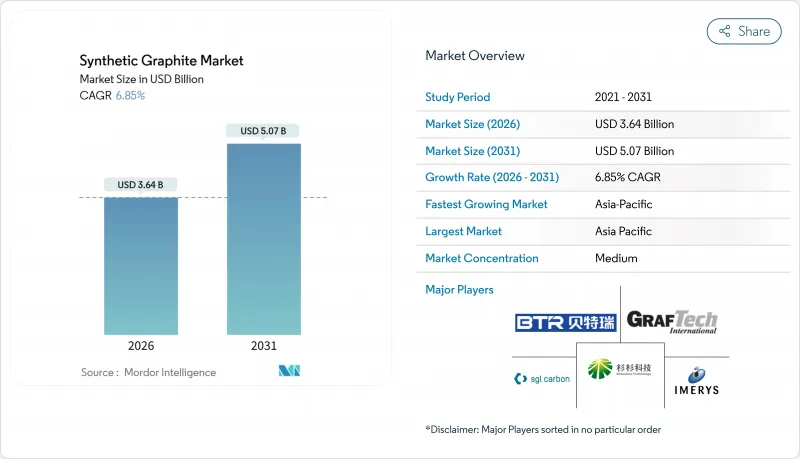
This report is Segmented by Product Type (Graphite Anode, Graphite Block, and Other Types), Application (Batteries, Metallurgy, and More ), End-User Industry (Automotive, Steel and Metals, Energy and Power, and More), and Geography (Asia-Pacific, North America, Europe, South America, and Middle-East and Africa). The Market Forecasts are Provided in Terms of Value (USD) and Volume (Tons).
Global Synthetic Graphite Market Trends and Insights
Increasing Demand for Electric-Vehicle Li-ion Batteries
Battery-grade synthetic graphite must meet purity below 50 ppm metallic impurities and particle-size distributions of 10-20 μm, standards that are drawing sizeable investment into coating and purification lines. General Motors' 2024 offtake agreement with Vianode locks in 150,000 t p.a. of anode material from the Ontario gigafactory, demonstrating OEM willingness to underwrite greenfield capacity for foreign-entity-of-concern (FEOC) compliance. Announced North American projects total roughly 200,000 t p.a. for 2024-2026, dwarfing the region's negligible pre-2023 capacity. Silicon-graphite composites such as NanoGraf's Onyx deliver 30% higher gravimetric energy density while keeping cycle life above 1,000 full equivalents, raising performance benchmarks that pure graphite must match. Pricing remains bifurcated: coated, high-purity grades used in fast-charging packs command USD 12,000-15,000 per tonne, versus USD 8,000-9,000 per tonne for commodity material. U.S. Inflation Reduction Act content thresholds-60% in 2025, rising to 80% in 2027-further amplify the regional pull for compliant synthetic graphite.
Growing Utilization of Ultra-High-Power EAFs in Steelmaking
UHP electrodes allow tap-to-tap times below 40 minutes, so even with lower graphite consumption intensity per heat, total annual electrode demand still climbs as throughput accelerates. POSCO's plan to localize 20,000 t p.a. of 300 mm UHP electrodes by 2026 illustrates how steelmakers are hedging against Chinese export uncertainties and freight volatility. Qualified suppliers of sub-1.0 X 10⁻⁶ °C-1 CTE needle coke remain fewer than ten globally, a constraint that preserves some pricing power in this segment. India's twin producers, Graphite India and HEG, together supply about 300,000 t p.a., yet Chinese imports priced 15-20% lower continue to squeeze margins. Compliance remains stringent; ISO 9001 and ASTM C1028 are universally demanded by tier-one steel producers.
High Manufacturing Cost and Energy Intensity
Synthetic graphite production consumes 10-15 MWh of electricity per tonne owing to graphitization at 2,800-3,000 °C. European industrial power averaged EUR 150-180 per MWh in 2024, so energy now absorbs 40-45% of cash costs versus 25-30% in China. SGL Carbon reported a 12% margin decline in 2024, citing energy inflation and fixed price contracts. Equipment makers Imerys and Mersen are piloting induction furnaces that cut energy by 15-20%, but the capital costs of EUR 50-60 million per 10,000 t module slow adoption. Feedstock tightness also persists; fewer than ten refineries produce qualifying needle coke, and expansions lag market demand by about two years. EU carbon prices near EUR 80-90 per t CO2 add another USD 1,200-1,500 per tonne if producers lack capture solutions.
Other drivers and restraints analyzed in the detailed report include:
- Faster-Charging Premium EV Models Requiring Ultra-High-Purity Anodes
- Government Incentives for Local Anode Material Gigafactories
- Price Gap with Natural Graphite Prompting Blended Anodes
For complete list of drivers and restraints, kindly check the Table Of Contents.
Segment Analysis
The Others segment, covering nuclear-grade, semiconductor, and flexible grades, held a 55.87% share, anchored by lengthy qualification cycles. Graphite anode represented roughly 25% of 2025 revenue, is expanding at an 8.27% CAGR, the fastest among product categories. Anode suppliers are capturing 18-22% EBITDA margins on coated grades, whereas electrode makers posted only 8-12% amid Chinese import pressure. Silicon-graphite composites shipped from Group14's Moses Lake plant displaced 4,000 t of conventional anode during 2025, illustrating how premium EV models erode pure-graphite volumes.
Nuclear-grade graphite stays niche (<5,000 t p.a.) but commands higher revenue as the UK and Canada advance small-modular-reactor programs. ASTM D7219 and EU REACH rules on polycyclic aromatic hydrocarbons pose compliance hurdles, yet most major producers already meet these thresholds.
Complete Report Scope:
- By Product Type
- Graphite Anode
- Graphite Block
- Other Types
- By Application
- Batteries
- Metallurgy
- Parts and Components
- Nuclear
- Other Applications
- By End-Use Industry
- Automotive
- Steel and Metals
- Energy and Power
- Electronics and Electrical
- Chemical and Petrochemical
- Aerospace and Defense
- Other End-user Industries
- By Geography
- Asia-Pacific
- China
- India
- Japan
- South Korea
- Indonesia
- Malaysia
- Thailand
- Vietnam
- Rest of Asia-Pacific
- North America
- United States
- Canada
- Mexico
- Europe
- Germany
- United Kingdom
- France
- Italy
- Spain
- Nordics
- Russia
- Rest of Europe
- South America
- Brazil
- Argentina
- Colombia
- Middle-East and Africa
- Saudi Arabia
- United Arab Emirates
- South Africa
- Nigeria
- Egypt
- Rest of Middle-East and Africa
- Asia-Pacific
Geography Analysis
Asia-Pacific commanded 55.58% revenue in 2025 and is predicted to grow at a 7.73% CAGR through 2031. Chinese export-licensing on graphite tightened global supply, yet utilization still ran only 50-60% in 2024, revealing domestic overcapacity. Japan and South Korea are adding anode capacity, but both remain net importers of needle coke, a chokepoint that maintains China's upstream leverage. India's electrode makers filed anti-dumping petitions in 2024 after Chinese imports undercut domestic prices by 15-20%, pushing both firms toward higher-margin specialty grades. Local anode plants do not yet match Southeast Asia's cell-assembly boom, so most synthetic graphite is still imported.
North America accounts for significant consumption and is witnessing higher demand supported by the Inflation Reduction Act. Superior Graphite's 24,000 t Arkansas plant, NOVONIX's Chattanooga expansion, and Syrah's Vidalia line will add about 50,000 t p.a. by 2026. Canada's CAD 3.2 billion Vianode investment aims for 150,000 t p.a. by 2028, backed by a long-term General Motors agreement. U.S. FEOC rules beginning in 2025 exclude Chinese-origin graphite from the USD 7,500 consumer tax credit, accelerating domestic sourcing.
Europe is witnessing a continuously growing demand despite energy-cost headwinds. Germany's SGL Carbon and Graphit Kropfmuhl focus on specialty grades, while Imerys and Mersen cover nuclear and chemical uses. Norway's hydropower advantage gives Vianode's smaller 20,000 t line a carbon footprint below 5 kg CO2/kg, compared with 15-20 kg for coal-based Chinese output. Russian needle-coke exports fell 30-40% post-2022 sanctions, tightening European feedstock supply. South America, the Middle East, and Africa are expected to witness considerable growth rates supported by rising industrialization in the regions, mainly the expansion of the steel and automotive industry.
- Anovion LLC
- Asbury Carbons
- BTR New Material Group Co., Ltd.
- Fengda Carbon New Material Co., Ltd.
- GrafTech International
- Graphit Kropfmuhl GmbH
- Graphite India Limited
- HEG Limited
- Imerys
- Mersen
- Mitsubishi Chemical Group Corporation
- Nippon Carbon Co Ltd.
- NOVONIX Ltd.
- Resonac Holdings Corporation
- SEC CARBON, LIMITED.
- SGL Carbon
- Shanghai PTL New Energy Technology Co., Ltd.
- Shanghai Shanshan Technology Co., Ltd.
- Superior Graphite
- Tokai COBEX GmbH
- Vianode
Additional Benefits:
- The market estimate (ME) sheet in Excel format
- 3 months of analyst support
TABLE OF CONTENTS
1 Introduction
- 1.1 Study Assumptions and Market Definition
- 1.2 Scope of the Study
2 Research Methodology
3 Executive Summary
4 Market Landscape
- 4.1 Market Overview
- 4.2 Market Drivers
- 4.2.1 Increasing demand for electric-vehicle Li-ion batteries
- 4.2.2 Growing utilization of ultra-high-power (UHP) EAFs in steelmaking
- 4.2.3 Faster-charging premium EV models requiring ultra-high-purity anodes
- 4.2.4 Government incentives for local anode material gigafactories
- 4.2.5 Silicon-graphite composite anodes scaling in next-gen batteries
- 4.3 Market Restraints
- 4.3.1 High manufacturing cost and energy intensity
- 4.3.2 Price gap with natural graphite prompting blended anodes
- 4.3.3 Early commercialisation of sodium-ion batteries reducing graphite demand
- 4.4 Value Chain Analysis
- 4.5 Porter's Five Forces
- 4.5.1 Bargaining Power of Suppliers
- 4.5.2 Bargaining Power of Buyers
- 4.5.3 Threat of New Entrants
- 4.5.4 Threat of Substitutes
- 4.5.5 Degree of Competition
5 Market Size and Growth Forecasts (Value and Volume)
- 5.1 By Product Type
- 5.1.1 Graphite Anode
- 5.1.2 Graphite Block
- 5.1.3 Other Types
- 5.2 By Application
- 5.2.1 Batteries
- 5.2.2 Metallurgy
- 5.2.3 Parts and Components
- 5.2.4 Nuclear
- 5.2.5 Other Applications
- 5.3 By End-Use Industry
- 5.3.1 Automotive
- 5.3.2 Steel and Metals
- 5.3.3 Energy and Power
- 5.3.4 Electronics and Electrical
- 5.3.5 Chemical and Petrochemical
- 5.3.6 Aerospace and Defense
- 5.3.7 Other End-user Industries
- 5.4 By Geography
- 5.4.1 Asia-Pacific
- 5.4.1.1 China
- 5.4.1.2 India
- 5.4.1.3 Japan
- 5.4.1.4 South Korea
- 5.4.1.5 Indonesia
- 5.4.1.6 Malaysia
- 5.4.1.7 Thailand
- 5.4.1.8 Vietnam
- 5.4.1.9 Rest of Asia-Pacific
- 5.4.2 North America
- 5.4.2.1 United States
- 5.4.2.2 Canada
- 5.4.2.3 Mexico
- 5.4.3 Europe
- 5.4.3.1 Germany
- 5.4.3.2 United Kingdom
- 5.4.3.3 France
- 5.4.3.4 Italy
- 5.4.3.5 Spain
- 5.4.3.6 Nordics
- 5.4.3.7 Russia
- 5.4.3.8 Rest of Europe
- 5.4.4 South America
- 5.4.4.1 Brazil
- 5.4.4.2 Argentina
- 5.4.4.3 Colombia
- 5.4.5 Middle-East and Africa
- 5.4.5.1 Saudi Arabia
- 5.4.5.2 United Arab Emirates
- 5.4.5.3 South Africa
- 5.4.5.4 Nigeria
- 5.4.5.5 Egypt
- 5.4.5.6 Rest of Middle-East and Africa
- 5.4.1 Asia-Pacific
6 Competitive Landscape
- 6.1 Market Concentration
- 6.2 Strategic Moves
- 6.3 Market Share(%)/Ranking Analysis
- 6.4 Company Profiles (includes Global level Overview, Market level overview, Core Segments, Financials as available, Strategic Information, Market Rank/Share for key companies, Products and Services, and Recent Developments)
- 6.4.1 Anovion LLC
- 6.4.2 Asbury Carbons
- 6.4.3 BTR New Material Group Co., Ltd.
- 6.4.4 Fengda Carbon New Material Co., Ltd.
- 6.4.5 GrafTech International
- 6.4.6 Graphit Kropfmuhl GmbH
- 6.4.7 Graphite India Limited
- 6.4.8 HEG Limited
- 6.4.9 Imerys
- 6.4.10 Mersen
- 6.4.11 Mitsubishi Chemical Group Corporation
- 6.4.12 Nippon Carbon Co Ltd.
- 6.4.13 NOVONIX Ltd.
- 6.4.14 Resonac Holdings Corporation
- 6.4.15 SEC CARBON, LIMITED.
- 6.4.16 SGL Carbon
- 6.4.17 Shanghai PTL New Energy Technology Co., Ltd.
- 6.4.18 Shanghai Shanshan Technology Co., Ltd.
- 6.4.19 Superior Graphite
- 6.4.20 Tokai COBEX GmbH
- 6.4.21 Vianode
7 Market Opportunities and Future Outlook
- 7.1 White-Space and Unmet-Need Assessment
- 7.2 Bio-graphite as a Sustainable Resource for Battery Material

