PUBLISHER: Mordor Intelligence | PRODUCT CODE: 2122990

PUBLISHER: Mordor Intelligence | PRODUCT CODE: 2122990
Acetylene - Market Share Analysis, Industry Trends & Statistics, Growth Forecasts (2026 - 2031)
According to Mordor Intelligence, the acetylene market size is expected to increase from 11.68 Million tons in 2025 to 11.98 Million tons in 2026 and reach 13.58 Million tons by 2031, growing at a CAGR of 2.54% over 2026-2031.
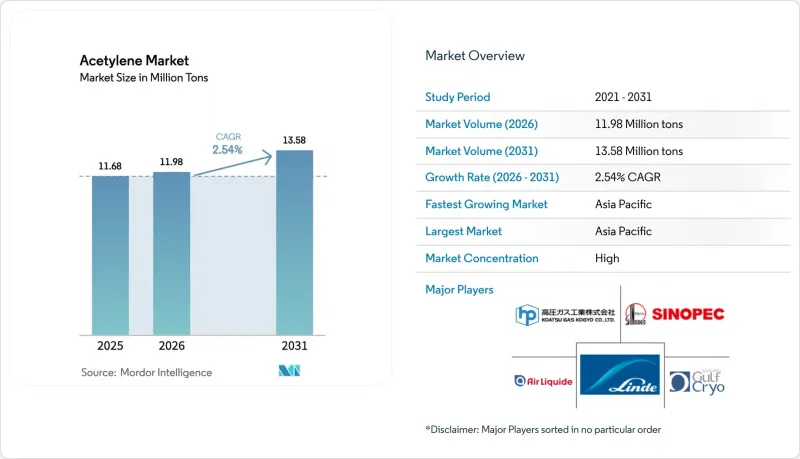
This report is Segmented by Application (Metal Working, Chemical Raw Materials, Glass Processing, Lamps, and Other Applications) and Geography (Asia-Pacific, North America, Europe, South America, and Middle-East and Africa). The Market Forecasts are Provided in Terms of Volume (Tons).
Global Acetylene Market Trends and Insights
Growing Demand From Metalworking And Fabrication
Legacy oxy-acetylene cutting and welding technologies retain prominence in construction sites, shipyards, and remote maintenance settings where reliable grid power is unavailable. The acetylene market benefits from the gas's 3,160 °C flame temperature, which cuts steel faster than alternative fuels. However, plasma and laser systems are making inroads in automated workshops, incrementally trimming acetylene volumes in high-precision fabrication. Demand therefore skews toward low-volume, high-mobility tasks and infrastructure builds in emerging economies, keeping growth in line with overall market averages.
Rising PVC And Downstream Vinyl Production In Asia
Cost-advantaged coal-to-calcium-carbide complexes in China underpin the acetylene route to vinyl chloride monomer, sustaining regional dominance even as global producers favor ethylene-based chemistry. Recent capacity additions in Inner Mongolia and Xinjiang leverage amortized assets and local energy subsidies, boosting near-term consumption. Provincial emission caps are tightening, yet ASEAN vinyl producers in Thailand, Vietnam, and Indonesia are scaling downstream PVC output, partially offsetting any decarbonization-driven slowdowns in mainland China.
Stringent Environmental And Safety Regulations
Global regulations deem acetylene as highly flammable and unstable. To counteract decomposition, they mandate the use of porous-mass cylinders filled with solvent. Compliance with U.S. OSHA PSM, European REACH, and China's dual-carbon mandates raises production and handling costs. Smaller distributors struggle to absorb audit expenses and frequent cylinder inspections, thereby consolidating supply in the hands of multinational firms that can leverage scale to meet the stricter standards.
Other drivers and restraints analyzed in the detailed report include:
- Infrastructure-Led Construction Boom In Emerging Economies
- Surge In Acetylene-Black Use For Li-Ion Batteries
- Substitution By Alternative Fuel Gases (Propane, LPG, LNG)
For complete list of drivers and restraints, kindly check the Table Of Contents.
Segment Analysis
Global metal working accounted for 65.04% of the acetylene market share in 2025. The segment owes its volume lead to decades of entrenched oxy-acetylene infrastructure in construction, shipbuilding, and field maintenance. However, capital-intensive plasma and laser systems are capturing precision jobs inside automated factories, generating a gradual volume shift. Chemical raw materials trail in absolute tonnage yet post the fastest 3.27% CAGR, reflecting renewed interest in acetylene-based 1,4-butanediol, tetrahydrofuran, and vinyl acetate. Environmental regulators encourage this pivot by scrutinizing ethylene-derived routes, prompting specialty-chemical producers to revisit acetylene's C2 advantage. Glass processing, lamps, and other niche uses maintain stable but low volumes, collectively offering limited upside to the wider acetylene market size narrative.
The acetylene industry is also witnessing heightened research and development into biochar-to-calcium-carbide routes and plasma-assisted methane cracking. These emerging pathways promise lower carbon footprints and could qualify for green-chemistry incentives in Europe and East Asia. Should technology demonstrations scale successfully, chemical applications may accelerate further, tightening supply in traditional welding markets and intensifying the search for efficiency gains among metal-fabrication end users. Overall, application-mix evolution supports price stability even as volumes shift toward high-margin specialty outlets.
Complete Report Scope:
- By Application
- Metal Working
- Chemical Raw Materials
- Glass Processing
- Lamps
- Other Applications
- By Geography
- Asia-Pacific
- China
- India
- Japan
- South Korea
- ASEAN Countries
- Rest of Asia-Pacific
- North America
- United States
- Canada
- Mexico
- Europe
- Germany
- United Kingdom
- France
- Italy
- Spain
- NORDIC Countries
- Turkey
- Russia
- Rest of Europe
- South America
- Brazil
- Argentina
- Rest of South America
- Middle-East and Africa
- Saudi Arabia
- United Arab Emirates
- Qatar
- Nigeria
- Egypt
- South Africa
- Rest of Middle-East and Africa
- Asia-Pacific
Geography Analysis
Asia-Pacific held 81.91% of global volume in 2025 and is on track for a 2.71% CAGR to 2031, underscoring its dual status as the principal producer and consumer of acetylene. China anchors this dominance through fully amortized coal-to-calcium-carbide complexes in Xinjiang and Inner Mongolia that deliver dissolved acetylene to vinyl chloride, solvent, and battery-carbon value chains. New units-such as Xinjiang Mingli Gas's facility-represent late-cycle additions ahead of stricter emissions ceilings that will temper future expansions. Japan and South Korea exhibit mature consumption centered on electronics and precision welding, whereas Thailand's Denka-SCG plant elevates the country to regional hub status for battery-grade acetylene black.
Imports and recovery from petrochemical steam crackers, utilizing dimethylformamide extraction, predominantly meet North America's demand. Integrated chemical companies monetize by-product acetylene internally, leaving metal-fabrication markets to merchant gas firms. Regulatory compliance under OSHA drives consistent but flat growth, and substitution by propane is most pronounced in high-labor-cost regions that optimize total ownership economics over peak flame temperature.
Europe tallies a similar volume share to North America but faces higher compliance costs under REACH and the Industrial Emissions Directive. Germany's BASF operates an acetylene unit at Ludwigshafen that feeds captive chemical chains rather than merchant outlets, illustrating the trend toward integrated producer-consumer models. The United Kingdom and French markets remain dependent on cylinder distribution for shipbuilding and aerospace maintenance, yet propane displacement limits incremental growth potential.
South America and the Middle East-Africa together represent a small share of the acetylene market. Brazil and Argentina experience project-driven spikes tied to infrastructure megaprojects, though currency volatility and import dependency cap sustained gains. In the Middle East, Saudi Arabia and the UAE show robust demand linked to NEOM and Expo 2030 construction, but logistics constraints necessitate strategic storage hubs to ensure continuity of supply. Nigeria and Egypt remain nascent, characterized by fragmented distribution networks that often operate outside formal regulatory frameworks.
- Air Liquide
- Air Products and Chemicals Inc.
- Asia Technical Gas Co. Pte Ltd.
- Axcel Gases
- BASF SE
- Butler Gas Products
- China Petrochemical Corporation.
- Coregas Pty Ltd.
- Denka Company Limited
- Gruppo SIAD
- Gulf Cryo
- Jinhong Gas Co. Ltd.
- Koatsu Gas Kogyo Co. Ltd.
- Linde plc
- Messer Group GmbH
- Nippon Sanso Holdings Corporation
- NOL Group
- Pune Air Products
- TOHO ACETYLENE Co.
- Transform Materials
Additional Benefits:
- The market estimate (ME) sheet in Excel format
- 3 months of analyst support
TABLE OF CONTENTS
1 Introduction
- 1.1 Study Assumptions and Market Definition
- 1.2 Scope of the Study
2 Research Methodology
3 Executive Summary
4 Market Landscape
- 4.1 Market Overview
- 4.2 Market Drivers
- 4.2.1 Growing demand from metalworking and fabrication
- 4.2.2 Rising PVC and downstream vinyl production in Asia
- 4.2.3 Infrastructure-led construction boom in emerging economies
- 4.2.4 Surge in acetylene-black use for Li-ion batteries
- 4.2.5 Modular on-site acetylene generators gaining traction
- 4.3 Market Restraints
- 4.3.1 Stringent environmental and safety regulations
- 4.3.2 Substitution by alternative fuel gases (propane, LPG, LNG)
- 4.3.3 Escalating industrial-insurance premiums after safety incidents
- 4.4 Value Chain Analysis
- 4.5 Porter's Five Forces
- 4.5.1 Bargaining Power of Suppliers
- 4.5.2 Bargaining Power of Buyers
- 4.5.3 Threat of New Entrants
- 4.5.4 Threat of Substitutes
- 4.5.5 Degree of Competition
5 Market Size and Growth Forecasts (Volume)
- 5.1 By Application
- 5.1.1 Metal Working
- 5.1.2 Chemical Raw Materials
- 5.1.3 Glass Processing
- 5.1.4 Lamps
- 5.1.5 Other Applications
- 5.2 By Geography
- 5.2.1 Asia-Pacific
- 5.2.1.1 China
- 5.2.1.2 India
- 5.2.1.3 Japan
- 5.2.1.4 South Korea
- 5.2.1.5 ASEAN Countries
- 5.2.1.6 Rest of Asia-Pacific
- 5.2.2 North America
- 5.2.2.1 United States
- 5.2.2.2 Canada
- 5.2.2.3 Mexico
- 5.2.3 Europe
- 5.2.3.1 Germany
- 5.2.3.2 United Kingdom
- 5.2.3.3 France
- 5.2.3.4 Italy
- 5.2.3.5 Spain
- 5.2.3.6 NORDIC Countries
- 5.2.3.7 Turkey
- 5.2.3.8 Russia
- 5.2.3.9 Rest of Europe
- 5.2.4 South America
- 5.2.4.1 Brazil
- 5.2.4.2 Argentina
- 5.2.4.3 Rest of South America
- 5.2.5 Middle-East and Africa
- 5.2.5.1 Saudi Arabia
- 5.2.5.2 United Arab Emirates
- 5.2.5.3 Qatar
- 5.2.5.4 Nigeria
- 5.2.5.5 Egypt
- 5.2.5.6 South Africa
- 5.2.5.7 Rest of Middle-East and Africa
- 5.2.1 Asia-Pacific
6 Competitive Landscape
- 6.1 Market Concentration
- 6.2 Strategic Moves
- 6.3 Market Share/Ranking Analysis
- 6.4 Company Profiles (includes Global level Overview, Market level overview, Core Segments, Financials, Strategic Info, Market Rank/Share, Products and Services, Recent Developments)
- 6.4.1 Air Liquide
- 6.4.2 Air Products and Chemicals Inc.
- 6.4.3 Asia Technical Gas Co. Pte Ltd.
- 6.4.4 Axcel Gases
- 6.4.5 BASF SE
- 6.4.6 Butler Gas Products
- 6.4.7 China Petrochemical Corporation.
- 6.4.8 Coregas Pty Ltd.
- 6.4.9 Denka Company Limited
- 6.4.10 Gruppo SIAD
- 6.4.11 Gulf Cryo
- 6.4.12 Jinhong Gas Co. Ltd.
- 6.4.13 Koatsu Gas Kogyo Co. Ltd.
- 6.4.14 Linde plc
- 6.4.15 Messer Group GmbH
- 6.4.16 Nippon Sanso Holdings Corporation
- 6.4.17 NOL Group
- 6.4.18 Pune Air Products
- 6.4.19 TOHO ACETYLENE Co.
- 6.4.20 Transform Materials
7 Market Opportunities and Future Outlook
- 7.1 White-space and Unmet-need Assessment

