PUBLISHER: Mordor Intelligence | PRODUCT CODE: 2122991

PUBLISHER: Mordor Intelligence | PRODUCT CODE: 2122991
Fruit And Vegetable Juice - Market Share Analysis, Industry Trends & Statistics, Growth Forecasts (2026 - 2031)
According to Mordor Intelligence, the fruit and vegetable juice market size was valued at USD 110.14 billion in 2025 and estimated to grow from USD 116.23 billion in 2026 to reach USD 152.13 billion by 2031, at a CAGR of 5.53% during the forecast period (2026-2031).
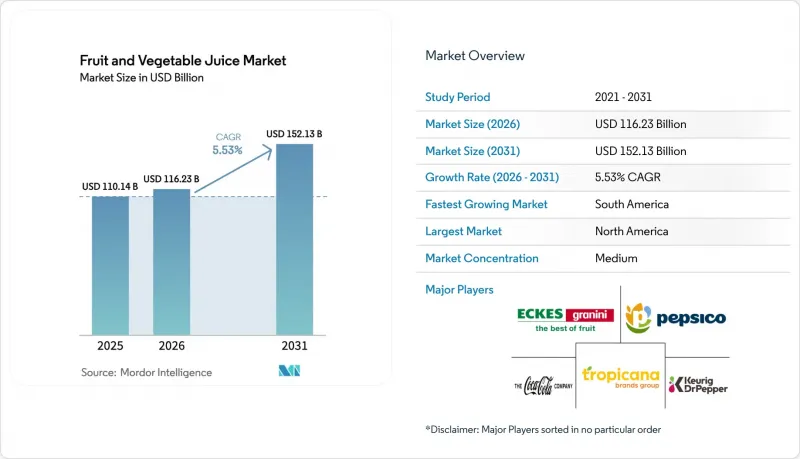
This report is Segmented by Product Type (100% Juice and More), Category (Fruit Juice, Vegetable Juice), Nature (Conventional, Organic), Packaging Material (Tetra Pak Cartons, PET Bottles, and More), Distribution Channel (Supermarkets/Hypermarkets, Convenience/Grocery Stores, and More), and Geography (North America, Europe, and More). The Market Forecasts are Provided in Terms of Value (USD).
Global Fruit And Vegetable Juice Market Trends and Insights
Product innovation and flavor diversification serving as key growth drivers in the juice market
Innovation in product development and flavor diversification is driving growth in the global market, as companies introduce new recipes, formats, and flavor combinations to cater to both health-conscious and indulgence-seeking consumers. Manufacturers are enhancing offerings with features such as reduced sugar, added fiber, and plant-based hydration, transforming traditional juices into functional products that support premium pricing and encourage repeat purchases. Flavor profiles are evolving beyond conventional options like orange and apple to include dessert-inspired, botanical, and vegetable-forward varieties. Examples include Ocean Spray's limited-edition Strawberry Shortcake juice and V8's Beet Ginger Lemon, which address the demand for more complex taste experiences. These advancements align with cleaner labels and natural positioning, as seen in brands like Naked and Tropicana expanding health-focused lines, while cold-pressed companies such as Suja Juice and Raw Pressery offer preservative-free options that maintain fresh taste. Diversified flavor architectures also target specific usage occasions, from family-oriented products like Mott's Sensibles with fruit-vegetable blends for children to adult-focused functional hydration concepts such as V8+Hydrate, which incorporates sweet potato juice. Global brands are localizing innovation pipelines with regionally relevant variants, such as Tropicana's Special Start range featuring pressed blood orange and pink grapefruit in Europe, and Asia-Pacific blends tailored to local preferences, enhancing market penetration in high-growth regions. Cold-pressed and organic lines from brands like En Route and Evolution Fresh further highlight how innovative processing and unique combinations deliver freshness and wellness benefits, sustaining consumer interest and supporting premiumization in the global market.
Increasing demand for fortified and functional juices driving market expansion
The increasing consumer preference for fortified and functional beverages is driving growth in the global market. This trend reflects a shift towards products that provide targeted health benefits beyond basic hydration, aligning with wellness-focused lifestyles. Fortification with vitamins, minerals, probiotics, or antioxidants transforms traditional juices into functional offerings, catering to demands for immunity, energy, or digestive support while preserving natural flavor profiles. A 2023 survey by the Korea Rural Economic Institute revealed that 8.1% of adults preferred 100% fruit juice, while 5.4% opted for health functional drinks, underscoring the growing appeal of functional enhancements within broader health trends. Companies are capitalizing on this demand through innovative product development. For instance, V8 enhances vegetable-based juices with added fiber and low-sugar formulations, positioning them as daily digestive aids that complement fruit-based nutrition. POM Wonderful integrates pomegranate antioxidants into its juices, emphasizing heart health benefits and premium positioning through clinical claims. Similarly, Lakewood Organic Juices enriches its organic product lines with additional vitamins derived from pure fruits and vegetables, avoiding synthetic additives to meet clean-label preferences. These strategies, centered on fortification, functionality, and brand-specific innovations, expand product accessibility, encourage trial among health-conscious consumers, and support sustained market growth globally.
High sugar content in juice products poses a challenge to market growth
The high sugar content in juice products poses a significant challenge for market growth as regulators and health-conscious consumers increasingly associate sugary beverages with obesity, diabetes, and poor dietary quality. This issue is particularly pronounced in ambient and chilled juice products, such as juice drinks and cocktails, which often contain added sugars or concentrates that elevate total sugar levels beyond the perceived "natural" fruit content, undermining their health appeal. The U.S. FDA's updated Nutrition Facts label has intensified scrutiny by mandating a distinct "Added Sugars" line, directly highlighting sugars from concentrated fruit and vegetable juices as contributors to overconsumption. Excessive added sugars make it difficult for consumers to stay within calorie limits while meeting nutrient needs, prompting many to use labels to limit sugar intake. Consequently, high-sugar juices are increasingly relegated to occasional treats, particularly when compared to water, unsweetened teas, or low-sugar functional beverages. Brands like Minute Maid have responded by reformulating products and introducing no-added-sugar or reduced-sugar variants to address volume loss and reputational risks. Similarly, Capri-Sun has launched reduced-sugar and no-added-sugar options in several markets, clearly communicating sugar reductions on packaging to reassure label-conscious buyers. These developments reflect how regulatory pressures and evolving dietary guidelines are driving producers to balance consumer expectations for sweetness with the demand for lower-sugar alternatives, constraining demand for traditional high-sugar juices and challenging overall market growth.
Other drivers and restraints analyzed in the detailed report include:
- Rising consumer preference for natural juices and clean label offerings
- Demand for convenient, on-the-go juice options driven by busy consumer lifestyles
- Increasing concerns regarding the use of preservatives and additives in juices
For complete list of drivers and restraints, kindly check the Table Of Contents.
Segment Analysis
100% juice is expected to retain a dominant 38.47% market share in 2025, supported by premiumization strategies that emphasize superior purity and targeted innovations. Cold-pressed 100% juice exemplifies this trend, utilizing high-pressure processing instead of thermal pasteurization to preserve enzymes. This process enables brands to command prices of USD 8-12 per liter, compared to USD 3-5 for conventional juice, appealing to health-conscious consumers who prioritize nutrient integrity over cost. Brands like BluePrint capitalize on this trend by offering cold-pressed green juice lines featuring ingredients such as kale, apple, and romaine, emphasizing freshness and justifying premium pricing for wellness-focused buyers. FDA labeling regulations further reinforce the positioning of 100% juice by requiring clear percentage declarations, which prevent misleading health claims and build consumer trust. This regulatory framework supports the premium segment even as Nectar continues to grow by addressing affordability gaps.
Nectar is strengthening its position in the global market by focusing on affordability, with products containing 25-99% juice content achieving the highest growth rate among product types, at a CAGR of 6.02% through 2031. This growth outpaces juice drinks with less than 25% juice content, which face challenges such as classification by the WHO as sugar-sweetened beverages and taxation in markets like Mexico, Chile, and South Africa. Cost efficiency is a significant factor in Nectar's appeal, as the use of water and sweeteners reduces raw fruit input by 30-50%, enabling retail prices that are 20-30% lower than 100% juice. Concentrate technology ensures flavor intensity is maintained, making these products accessible to a broader audience. Brands like Sunberry Farms are leveraging this cost structure by introducing tropical nectar blends, such as guava-mango, at competitive price points, effectively targeting price-sensitive emerging markets without compromising taste. Additionally, nectar benefits from a regulatory advantage, as reducing juice content to 50-75% allows brands to avoid "high sugar" labels under front-of-pack warning systems, maintaining consumer appeal despite increasing health scrutiny.
Vegetable juice is gaining traction in the beverage industry, driven by its functional positioning and alignment with health-conscious consumer preferences. With a projected CAGR of 8.41% through 2031, vegetable juice is emerging as a strong growth segment despite fruit juice's anticipated 93.75% market share in 2025. Lower sugar content in options like carrot, beet, and celery juices, offering 40-60% less sugar than orange juice, coupled with nitrates linked to cardiovascular benefits, positions vegetable juice as a healthier alternative. This trend reflects broader sugar-reduction initiatives, enabling vegetable juices to meet health guidelines without requiring added sweeteners or reformulation. For instance, Campbell Soup's V8 brand has introduced turmeric and ginger variants, appealing to consumers seeking anti-inflammatory benefits while avoiding regulatory scrutiny. Hybrid blends, such as apple-carrot or pineapple-beet, further ease the transition for consumers by combining vegetable nutrients with fruit sweetness.
Fruit juice continues to dominate the market due to its established flavor appeal and widespread availability, but the rapid growth of vegetable juice signals a shift toward functional benefits over traditional taste preferences. In regions with aggressive sugar-reduction policies, vegetable juices are gaining momentum, supported by brands like Biotta, which offer pure vegetable options such as celery-plus or beet blends that emphasize nitrate-rich functionality. Hybrid products also address sugar concerns by integrating vegetable nutrition into familiar fruit profiles. This dynamic highlights how vegetable juice is challenging fruit juice's entrenched position, fostering market evolution through nutrient-dense, low-sugar innovations that expand consumption occasions and cater to health-focused consumers.
Complete Report Scope:
- By Product Type
- 100% Juice
- Nectar (25-99% Juice)
- Juice Drinks (Below 25% Juice)
- By Category
- Fruit Juice
- Vegetable Juice
- By Nature
- Conventional
- Organic
- By Packaging Material
- Tetra Pak Cartons
- PET Bottles
- Glass Bottles
- Cans
- Pouches and Others
- By Distribution Channel
- Supermarkets/Hypermarkets
- Convenience/Grocery Stores
- Online Retail Stores
- Others
- By Geography
- North America
- United States
- Canada
- Mexico
- Rest of North America
- Europe
- Germany
- United Kingdom
- Italy
- France
- Spain
- Netherlands
- Poland
- Belgium
- Sweden
- Rest of Europe
- Asia-Pacific
- China
- India
- Japan
- Australia
- Indonesia
- South Korea
- Thailand
- Singapore
- Rest of Asia-Pacific
- South America
- Brazil
- Argentina
- Colombia
- Chile
- Peru
- Rest of South America
- Middle East and Africa
- South Africa
- Saudi Arabia
- United Arab Emirates
- Nigeria
- Egypt
- Morocco
- Turkey
- Rest of Middle East and Africa
- North America
Geography Analysis
North America maintained a leading position with a 31.16% share in 2025, driven by stringent FDA Juice HACCP regulations. These regulations, requiring a 5-log pathogen reduction for unpasteurized products, have significantly enhanced the quality standards for cold-pressed juices. This has bolstered consumer confidence in premium, minimally processed offerings. The safety protocols enable brands to market high-pressure processed juices as both safe and nutrient-rich, aligning with the growing demand for health-focused products. Companies like Suja Juice have leveraged these regulations to produce enzyme-retaining green blends, distributed nationwide, turning compliance into a competitive advantage for refrigerated distribution. The region's robust infrastructure and focus on innovation have positioned it as a benchmark for quality-driven growth, influencing global standards.
South America is projected to achieve the highest regional CAGR of 7.21% through 2031, supported by urbanization in cities such as Sao Paulo and Buenos Aires. The expansion of cold-chain infrastructure in these areas has facilitated the distribution of cold-pressed juices, unlocking the potential of the premium segment. Argentina's agricultural output of apples and grapes has established it as a key nectar export hub, with processors like Citrosuco offering cost-efficient blends that balance affordability and fruit content for mass-market appeal. Chile and Peru contribute through counter-seasonal citrus production, supplying North American markets during winter. Meanwhile, Colombia's rising middle class is driving demand for premium juices, though regulatory fragmentation across the region complicates unified product launches and limits scalability.
Europe's market growth has slowed due to EFSA sugar-labeling mandates, which challenge fruit-heavy product profiles. Germany and the United Kingdom lead in organic juice penetration through private-label programs emphasizing clean-label attributes to meet transparency demands. In the United Kingdom, Britvic's Robinsons brand exemplifies dominance with squash concentrates that align with portion-control trends by reducing sugar per serving. France and Spain maintain high orange juice consumption but face competition from sparkling water brands positioned as lower-calorie alternatives. Meanwhile, Asia-Pacific sees growth driven by India's labeling regulations and China's e-commerce expansion, while the Middle East and Africa markets remain nascent with infrastructure challenges.
- PepsiCo Inc.
- The Coca-Cola Company
- Keurig Dr Pepper Inc.
- Kraft Heinz Company
- Campbell Soup Company
- Fresh Del Monte Produce Inc.
- Ocean Spray Cranberries Inc.
- Florida's Natural Growers
- Eckes-Granini Group
- Welch Foods Inc.
- Suja Life LLC
- Tropicana Brands Group
- Britvic plc
- SunOpta Inc.
- Lassonde Industries Inc.
- Harvest Hill Beverage Company
- Made Group
- Langer Juice Company
- Bolthouse Farms
- Asahi Group Holdings (Calpis)
Additional Benefits:
- The market estimate (ME) sheet in Excel format
- 3 months of analyst support
TABLE OF CONTENTS
1 INTRODUCTION
- 1.1 Study Assumptions and Market Definition
- 1.2 Scope of the Study
2 RESEARCH METHODOLOGY
3 EXECUTIVE SUMMARY
4 MARKET DYNAMICS
- 4.1 Market Overview
- 4.2 Market Drivers
- 4.2.1 Product innovation and flavor diversification serving as key growth drivers in the juice market
- 4.2.2 Increasing demand for fortified and functional juices driving market expansion
- 4.2.3 Rising consumer preference for natural juices and clean label offerings
- 4.2.4 Demand for convenient, on-the-go juice options driven by busy consumer lifestyles
- 4.2.5 Growing health awareness among consumers boosting the fruit and vegetable juice market
- 4.2.6 Expansion of retail and e-commerce channels facilitating market growth
- 4.3 Market Restraints
- 4.3.1 High sugar content in juice products poses a challenge to market growth
- 4.3.2 Growing demand for low or no-sugar ready-to-drink (RTD) beverages
- 4.3.3 Increasing concerns regarding the use of preservatives and additives in juices
- 4.3.4 Shift in consumer preference toward whole fruits and vegetables impacts market performance
- 4.4 Value Chain Analysis
- 4.5 Regulatory Landscape
- 4.6 Technological Outlook
- 4.7 Porter's Five Forces Analysis
- 4.7.1 Threat of New Entrants
- 4.7.2 Bargaining Power of Suppliers
- 4.7.3 Bargaining Power of Buyers
- 4.7.4 Threat of Substitutes
- 4.7.5 Intensity of Competitive Rivalry
5 MARKET SIZE AND GROWTH FORECASTS (VALUE)
- 5.1 By Product Type
- 5.1.1 100% Juice
- 5.1.2 Nectar (25-99% Juice)
- 5.1.3 Juice Drinks (Below 25% Juice)
- 5.2 By Category
- 5.2.1 Fruit Juice
- 5.2.2 Vegetable Juice
- 5.3 By Nature
- 5.3.1 Conventional
- 5.3.2 Organic
- 5.4 By Packaging Material
- 5.4.1 Tetra Pak Cartons
- 5.4.2 PET Bottles
- 5.4.3 Glass Bottles
- 5.4.4 Cans
- 5.4.5 Pouches and Others
- 5.5 By Distribution Channel
- 5.5.1 Supermarkets/Hypermarkets
- 5.5.2 Convenience/Grocery Stores
- 5.5.3 Online Retail Stores
- 5.5.4 Others
- 5.6 By Geography
- 5.6.1 North America
- 5.6.1.1 United States
- 5.6.1.2 Canada
- 5.6.1.3 Mexico
- 5.6.1.4 Rest of North America
- 5.6.2 Europe
- 5.6.2.1 Germany
- 5.6.2.2 United Kingdom
- 5.6.2.3 Italy
- 5.6.2.4 France
- 5.6.2.5 Spain
- 5.6.2.6 Netherlands
- 5.6.2.7 Poland
- 5.6.2.8 Belgium
- 5.6.2.9 Sweden
- 5.6.2.10 Rest of Europe
- 5.6.3 Asia-Pacific
- 5.6.3.1 China
- 5.6.3.2 India
- 5.6.3.3 Japan
- 5.6.3.4 Australia
- 5.6.3.5 Indonesia
- 5.6.3.6 South Korea
- 5.6.3.7 Thailand
- 5.6.3.8 Singapore
- 5.6.3.9 Rest of Asia-Pacific
- 5.6.4 South America
- 5.6.4.1 Brazil
- 5.6.4.2 Argentina
- 5.6.4.3 Colombia
- 5.6.4.4 Chile
- 5.6.4.5 Peru
- 5.6.4.6 Rest of South America
- 5.6.5 Middle East and Africa
- 5.6.5.1 South Africa
- 5.6.5.2 Saudi Arabia
- 5.6.5.3 United Arab Emirates
- 5.6.5.4 Nigeria
- 5.6.5.5 Egypt
- 5.6.5.6 Morocco
- 5.6.5.7 Turkey
- 5.6.5.8 Rest of Middle East and Africa
- 5.6.1 North America
6 COMPETITIVE LANDSCAPE
- 6.1 Market Concentration
- 6.2 Strategic Moves
- 6.3 Market Share Analysis
- 6.4 Company Profiles (includes Global level Overview, Market level overview, Core Segments, Financials as available, Strategic Information, Market Rank/Share for key companies, Products and Services, and Recent Developments)
- 6.4.1 PepsiCo Inc.
- 6.4.2 The Coca-Cola Company
- 6.4.3 Keurig Dr Pepper Inc.
- 6.4.4 Kraft Heinz Company
- 6.4.5 Campbell Soup Company
- 6.4.6 Fresh Del Monte Produce Inc.
- 6.4.7 Ocean Spray Cranberries Inc.
- 6.4.8 Florida's Natural Growers
- 6.4.9 Eckes-Granini Group
- 6.4.10 Welch Foods Inc.
- 6.4.11 Suja Life LLC
- 6.4.12 Tropicana Brands Group
- 6.4.13 Britvic plc
- 6.4.14 SunOpta Inc.
- 6.4.15 Lassonde Industries Inc.
- 6.4.16 Harvest Hill Beverage Company
- 6.4.17 Made Group
- 6.4.18 Langer Juice Company
- 6.4.19 Bolthouse Farms
- 6.4.20 Asahi Group Holdings (Calpis)
7 MARKET OPPORTUNITIES AND FUTURE OUTLOOK

