PUBLISHER: Mordor Intelligence | PRODUCT CODE: 2123007

PUBLISHER: Mordor Intelligence | PRODUCT CODE: 2123007
Mobile Application Testing Services (MATS) - Market Share Analysis, Industry Trends & Statistics, Growth Forecasts (2026 - 2031)
According to Mordor Intelligence, the mobile application testing services market size is expected to grow from USD 7.70 billion in 2025 to USD 9.02 billion in 2026 and is forecast to reach USD 19.84 billion by 2031 at 17.09% CAGR over 2026-2031.
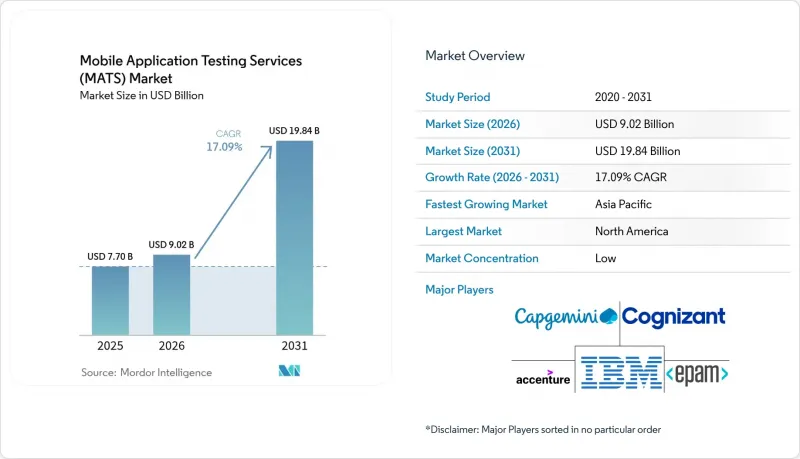
This report is Segmented by Application Type (Native Apps, Web Apps, and More), Service Type (Functional Testing Services, Performance and Load Testing Services, and More), Testing Approach (Manual Testing, Automated Testing, and More), End-User Industry (Gaming, BFSI, Healthcare and Life Sciences, and More), and Geography. The Market Forecasts are Provided in Terms of Value (USD).
Global Mobile Application Testing Services (MATS) Market Trends and Insights
Rising Global Smartphone Penetration Accelerates Testing Demand
Smartphone adoption in India, Indonesia, and the Philippines climbed sharply in 2025 as the average 5G handset fell below USD 200, spawning thousands of localized apps targeting varied network conditions and lower-spec devices. For suppliers to this mobile application testing services market, the result is a surge in compatibility workloads across fragmented Android forks where OEM tweaks often break core functions. Device coverage must span multiple chipset vendors and screen sizes, pressuring service providers to expand real-device clouds and refine test-case prioritization. Enterprises unable to maintain these device matrices in-house increasingly outsource, creating recurring revenue streams for pure-play testing firms.
Rapid Shift to Agile and DevOps Demanding Continuous Testing
Fortune 500 developers now push code to production dozens of times a day, dissolving the wall between development and quality. Testing therefore moves upstream, runs in parallel with every commit, and feeds go/no-go gates in CI/CD pipelines. Vendors that plug AI-assisted script generation into Jenkins, GitLab, and Azure DevOps see stronger win rates because they compress feedback cycles from hours to minutes. The mobile application testing services market prizes such partners for lowering mean time to remediation and supporting the "fail-fast" ethos central to digital product teams.
High Infrastructure and Device-Lab Investment Costs
A lab with 1,000 real devices spanning iOS and 20 Android OEMs can cost USD 6 million to build and USD 50,000 per month to refresh. Smaller providers cannot amortize these outlays across enough clients, curbing their ability to compete on price. Cloud device farms alleviate capex but introduce opex tied to hourly usage and geographic data-center fees. This restraint slows new-entrant growth in the mobile application testing services market and accelerates M&A as niche players seek scale advantages.
Other drivers and restraints analyzed in the detailed report include:
- Proliferation of AI/ML, AR/VR and 5G Rich-Experience Apps
- Growing Regulatory Push for Mobile App Security and Privacy
- Fragmented Device/OS Ecosystem Complicates Automation ROI
For complete list of drivers and restraints, kindly check the Table Of Contents.
Segment Analysis
Native apps held 52.10% of the mobile application testing services market share in 2025, underscoring enterprise reliance on platform-level performance and camera, GPS, or biometric APIs. The segment's durability keeps demand high for Swift, Kotlin, and Jetpack Compose test specialists who validate deep device integrations. Progressive web apps, expanding at 18.15% CAGR, require cross-browser conformance testing and service-worker validation that differ from native test patterns. Their rise encourages providers to offer unified test suites blending browser and device farms, thereby broadening total addressable spend within the mobile application testing services market.
PWAs also attract mid-sized retailers and SaaS vendors seeking a single code-base strategy. Testing partners must therefore prove capability in offline caching, push-notification integrity, and installability across Chromium forks and WebKit. As bandwidth improves, enterprises expect near-native UX, raising the bar for load-time and animation smoothness benchmarks. Firms that can deliver side-by-side performance analytics for native versus PWA builds gain influence over tech-stack decisions, increasing wallet share.
Functional testing represented 41.30% of the mobile application testing services market size in 2025 as UI verification and regression suites remained table stakes across all industries. Yet security and penetration testing grows at 17.95% CAGR, propelled by financial institutions extending zero-trust policies to every software component. Providers bundling OWASP MASVS compliance audits with API fuzzing and runtime app self-protection checks shorten remediation cycles and justify premium fees.
Expanded privacy laws and high-profile breaches elevate budget priority for mobile pentests that simulate device rooting, network-layer interception, and malicious SDK inclusion. Vendors that feed findings into DevSecOps dashboards and retest patches automatically in CI/CD pipelines demonstrate tangible risk-reduction ROI. This pull through boosts their cross-sell of managed vulnerability management and red-team services, raising average contract value across the mobile application testing services industry.
Complete Report Scope:
- By Application Type
- Native Apps
- Web Apps
- Hybrid Apps
- Progressive Web Apps (PWA)
- By Service Type
- Functional Testing Services
- Performance and Load Testing Services
- Security and Pen-Testing Services
- Compatibility and UX Testing Services
- Test Automation Services
- By Testing Approach
- Manual Testing
- Automated Testing
- Crowd / Crowd-source Testing
- By End-User Industry
- Gaming
- BFSI
- Healthcare and Life Sciences
- Retail and E-Commerce
- Travel and Hospitality
- Media and Entertainment
- Other End-User Industries
- By Geography
- North America
- United States
- Canada
- South America
- Brazil
- Argentina
- Rest of South America
- Europe
- Germany
- United Kingdom
- France
- Italy
- Spain
- Netherlands
- Rest of Europe
- Asia-Pacific
- China
- India
- Japan
- South Korea
- Australia
- Rest of Asia-Pacific
- Middle East and Africa
- Middle East
- United Arab Emirates
- Saudi Arabia
- Rest of Middle East
- Africa
- South Africa
- Nigeria
- Rest of Africa
- Middle East
- North America
Geography Analysis
North America generated 37.10% of 2025 revenues, leveraging deep DevOps adoption and strict compliance mandates. U.S. banks and payers rolled out real-time fraud-detection apps that need 24X7 security scans, while digital-native brands outsource regression suites to manage bi-weekly release cadences. Canadian demand centers on healthcare digitization and provincial accessibility laws, sustaining premium for bilingual testing coverage across English and French apps.
Asia-Pacific posts the strongest 17.82% CAGR through 2031. India's fintech and social-commerce boom prompts large-scale crowd campaigns across 15 regional languages and myriad low-cost handsets. China's super-app ecosystems require providers versed in mini-program architectures and domestic compliance, creating two-track engagements covering both domestic and export builds. Mature 5G rollouts in Japan and South Korea elevate AR/VR app workloads, expanding the device lab footprint for vendors in the mobile application testing services market.
Europe shows steady growth underpinned by regulation. The European Accessibility Act and GDPR fine regime convert accessibility and privacy checks into non-negotiable budget lines. Germany leads demand via automotive OTA-update testing, while the U.K. remains strong in finance despite post-Brexit regulatory divergence. Nordic clients emphasize sustainability metrics, asking suppliers to report test-lab carbon intensity, a nascent differentiator within the mobile application testing services industry.
- Accenture PLC
- Capgemini SE
- Cognizant Technology Solutions Corporation
- EPAM Systems Inc.
- International Business Machines Corporation
- Wipro Limited
- Tata Consultancy Services Limited
- Cigniti Technologies Limited
- Sauce Labs Inc.
- Amazon Web Services, Inc. (Device Farm)
- Applause App Quality, Inc.
- BrowserStack Limited
- Infosys Limited
- Qualitest Group Ltd.
- Tricentis GmbH
- Testlio Inc.
- Perfecto Mobile Ltd. (Perforce Software)
- Global App Testing Ltd.
- Testbirds GmbH
- Rainforest QA, Inc.
- BugRaptors QA Solutions Pvt. Ltd.
Additional Benefits:
- The market estimate (ME) sheet in Excel format
- 3 months of analyst support
TABLE OF CONTENTS
1 INTRODUCTION
- 1.1 Study Assumptions and Market Definition
- 1.2 Scope of the Study
2 RESEARCH METHODOLOGY
3 EXECUTIVE SUMMARY
4 MARKET LANDSCAPE
- 4.1 Market Overview
- 4.2 Market Drivers
- 4.2.1 Rising global smartphone penetration
- 4.2.2 Rapid shift to agile and DevOps demanding continuous testing
- 4.2.3 Proliferation of AI/ML, AR/VR and 5G rich-experience apps
- 4.2.4 Growing regulatory push for mobile app security and privacy
- 4.2.5 Increasing OEM demand for in-vehicle app testing (IVI systems)
- 4.2.6 Sustainability KPIs driving battery-drain and carbon-aware testing
- 4.3 Market Restraints
- 4.3.1 High infrastructure and device-lab investment costs
- 4.3.2 Fragmented device/OS ecosystem complicates automation ROI
- 4.3.3 Rising complexity of in-app ad-tech SDKs causing test flakiness
- 4.3.4 Limited test-data privacy frameworks for GenAI-based testing
- 4.4 Industry Value Chain Analysis
- 4.5 Regulatory Landscape
- 4.6 Technological Outlook
- 4.7 Porter's Five Forces Analysis
- 4.7.1 Bargaining Power of Suppliers
- 4.7.2 Bargaining Power of Buyers
- 4.7.3 Threat of New Entrants
- 4.7.4 Threat of Substitute Products
- 4.7.5 Intensity of Competitive Rivalry
5 MARKET SIZE AND GROWTH FORECASTS (VALUE)
- 5.1 By Application Type
- 5.1.1 Native Apps
- 5.1.2 Web Apps
- 5.1.3 Hybrid Apps
- 5.1.4 Progressive Web Apps (PWA)
- 5.2 By Service Type
- 5.2.1 Functional Testing Services
- 5.2.2 Performance and Load Testing Services
- 5.2.3 Security and Pen-Testing Services
- 5.2.4 Compatibility and UX Testing Services
- 5.2.5 Test Automation Services
- 5.3 By Testing Approach
- 5.3.1 Manual Testing
- 5.3.2 Automated Testing
- 5.3.3 Crowd / Crowd-source Testing
- 5.4 By End-User Industry
- 5.4.1 Gaming
- 5.4.2 BFSI
- 5.4.3 Healthcare and Life Sciences
- 5.4.4 Retail and E-Commerce
- 5.4.5 Travel and Hospitality
- 5.4.6 Media and Entertainment
- 5.4.7 Other End-User Industries
- 5.5 By Geography
- 5.5.1 North America
- 5.5.1.1 United States
- 5.5.1.2 Canada
- 5.5.2 South America
- 5.5.2.1 Brazil
- 5.5.2.2 Argentina
- 5.5.2.3 Rest of South America
- 5.5.3 Europe
- 5.5.3.1 Germany
- 5.5.3.2 United Kingdom
- 5.5.3.3 France
- 5.5.3.4 Italy
- 5.5.3.5 Spain
- 5.5.3.6 Netherlands
- 5.5.3.7 Rest of Europe
- 5.5.4 Asia-Pacific
- 5.5.4.1 China
- 5.5.4.2 India
- 5.5.4.3 Japan
- 5.5.4.4 South Korea
- 5.5.4.5 Australia
- 5.5.4.6 Rest of Asia-Pacific
- 5.5.5 Middle East and Africa
- 5.5.5.1 Middle East
- 5.5.5.1.1 United Arab Emirates
- 5.5.5.1.2 Saudi Arabia
- 5.5.5.1.3 Rest of Middle East
- 5.5.5.2 Africa
- 5.5.5.2.1 South Africa
- 5.5.5.2.2 Nigeria
- 5.5.5.2.3 Rest of Africa
- 5.5.5.1 Middle East
- 5.5.1 North America
6 COMPETITIVE LANDSCAPE
- 6.1 Market Concentration
- 6.2 Strategic Moves
- 6.3 Market Share Analysis
- 6.4 Company Profiles (includes Global level Overview, Market level overview, Core Segments, Financials as available, Strategic Information, Market Rank/Share for key companies, Products and Services, and Recent Developments)
- 6.4.1 Accenture PLC
- 6.4.2 Capgemini SE
- 6.4.3 Cognizant Technology Solutions Corporation
- 6.4.4 EPAM Systems Inc.
- 6.4.5 International Business Machines Corporation
- 6.4.6 Wipro Limited
- 6.4.7 Tata Consultancy Services Limited
- 6.4.8 Cigniti Technologies Limited
- 6.4.9 Sauce Labs Inc.
- 6.4.10 Amazon Web Services, Inc. (Device Farm)
- 6.4.11 Applause App Quality, Inc.
- 6.4.12 BrowserStack Limited
- 6.4.13 Infosys Limited
- 6.4.14 Qualitest Group Ltd.
- 6.4.15 Tricentis GmbH
- 6.4.16 Testlio Inc.
- 6.4.17 Perfecto Mobile Ltd. (Perforce Software)
- 6.4.18 Global App Testing Ltd.
- 6.4.19 Testbirds GmbH
- 6.4.20 Rainforest QA, Inc.
- 6.4.21 BugRaptors QA Solutions Pvt. Ltd.
7 MARKET OPPORTUNITIES AND FUTURE OUTLOOK
- 7.1 White-Space and Unmet-Need Assessment

