PUBLISHER: Mordor Intelligence | PRODUCT CODE: 2123008

PUBLISHER: Mordor Intelligence | PRODUCT CODE: 2123008
Network As A Service - Market Share Analysis, Industry Trends & Statistics, Growth Forecasts (2026 - 2031)
According to Mordor Intelligence, the network as a service market size was valued at USD 32.03 billion in 2025 and is estimated to grow from USD 39.96 billion in 2026 to reach USD 107.17 billion by 2031, at a CAGR of 21.81% during the forecast period (2026-2031).
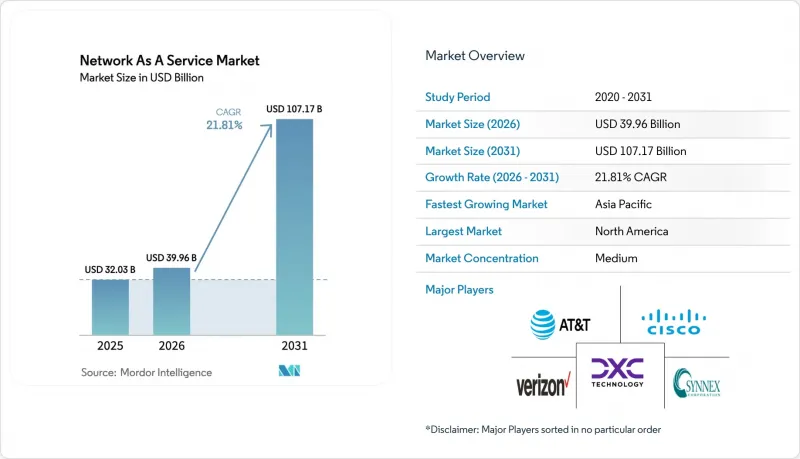
This report is Segmented by Type (LAN-As-A-Service, and More), Application (Virtual CPE, Bandwidth-On-Demand, and More), Organisation Size (Large Enterprises and Small and Medium Enterprises), Industry Vertical (IT and Telecom and More), Deployment Model (Public-Cloud-Based NaaS, and More), and Geography (North America, South America, and More). The Market Forecasts are Provided in Terms of Value (USD).
Global Network As A Service Market Trends and Insights
Cloud-First Network Transformation Roadmaps
Hybrid workloads dominate IT spend, and connections to hyperscale cloud on-ramps are climbing sharply. Azure ExpressRoute and AWS Direct Connect each experienced 40% year-over-year connection growth in 2024, indicating that core applications are now increasingly residing outside of enterprise data centers. Firms are replacing static MPLS circuits with programmable overlays that cut latency for SaaS by 30-50 milliseconds. Financial institutions, which cannot tolerate packet loss above 0.01%, are leading the adoption to protect real-time trading. The shortage of engineers trained in API-driven provisioning intensifies the demand for fully managed solutions that conceal complexity behind user-friendly portals. Consequently, providers embed orchestration APIs that allow enterprises to script bandwidth as code within DevOps pipelines.
Shift from CapEx to OpEx Subscription Budgeting Pressure
Revised IFRS 16 and ASC 842 rules recast owned hardware as a depreciating right-of-use asset, locking capital into long refresh cycles. Subscription NaaS converts fixed investments into elastic expenses, an arrangement prized by private equity portfolios that optimize EBITDA. Manufacturing groups leverage the model to throttle capacity during downturns without writing off equipment. Zero-based budgeting now forces IT leaders to justify spending annually, and pay-as-you-use circuits meet that hurdle more cleanly than multi-year hardware amortization. The shift accelerates vendor competition on service-level quality rather than box specifications, creating an incentive to bundle security and observability in a single invoice.
Persistent Data-Sovereignty and Residency Compliance Barriers
GDPR, China's Cybersecurity Law, and India's forthcoming Data Protection Bill require providers to establish separate control planes in each jurisdiction. Replicated infrastructure fragments the global footprint and raises per-site cost, eroding economies of scale. Schrems II further blocks personal-data transfers from the EU to the United States, requiring contractual clauses that many buyers deem risky. Financial institutions face compounded complexity because Basel III mandates resilience testing across all hosting regions. When control planes cannot orchestrate distributed zones from a central console, enterprises deploy hybrid models that temper the value proposition of the Network-as-a-Service market.
Other drivers and restraints analyzed in the detailed report include:
- SD-WAN and SASE Convergence Accelerating Managed WAN Refresh
- AI-Driven Network Assurance Reducing MTTR below 5 min
- Vendor Lock-In Fears around Proprietary Lifecycle Platforms
For complete list of drivers and restraints, kindly check the Table Of Contents.
Segment Analysis
In 2025, WAN-as-a-Service generated 61.50% of revenue, underscoring its role as the entry point for the Network As A Service market share. Multinationals with 50+ branches can capture immediate savings by replacing MPLS circuits with SD-WAN overlays, resulting in a 60% reduction in per-megabit costs. AI engines embedded in controllers dynamically steer traffic to the nearest cloud on-ramp, shrinking file transfer times between headquarters and public cloud. Service providers reinforce value through zero-touch edge devices that arrive pre-provisioned, thereby reducing deployment windows from weeks to hours.
LAN-as-a-Service, though smaller today, is growing at a 23.01% CAGR through 2031 as Wi-Fi 7 access points demand 802.3bt power budgets. Universities and hospitals that cannot fund wholesale switch upgrades pivot to campus-switch-as-a-service bundles that include power, analytics, and handset integration. Providers guarantee 10-gig uplinks for telepresence and electronic medical records, positioning LAN refresh as an operating expense rather than a capital hurdle. By converting campus networks into predictable subscriptions, suppliers expand the addressable pool of buyers, thereby increasing overall momentum in the Network As A Service market.
Virtual CPE captured 42.80% of application spend in 2025, reflecting the consolidation of routers, firewalls, and WAN optimizers onto x86 appliances. Branch offices reduce their hardware footprint by 70% and slash onsite service calls because zero-touch provisioning loads the full software stack at power-on. Bandwidth-on-demand supports temporary scale-ups at stadiums and conference centers, demonstrating the elasticity at the heart of the Network As A Service market.
Network-as-API, while nascent, is forecast to grow at a 22.78% CAGR to 2031. GSMA CAMARA specifications let developers program quality-of-service and device profiling directly from CI/CD pipelines. Telecommunications operators expose 5G network functions, such as geofencing, dynamic SIM activation, and guaranteed bit rates, creating new revenue paths beyond traditional connectivity. As enterprise DevOps teams integrate networking calls into application code, value shifts from physical links to API consumption, opening up greenfield opportunities within the broader Network As A Service market.
Complete Report Scope:
- By Type
- LAN-as-a-Service
- WAN-as-a-Service
- Campus-Switch-as-a-Service
- Data-Centre-Interconnect-as-a-Service
- Private-5G-as-a-Service
- By Application
- Virtual CPE (vCPE)
- Bandwidth-on-Demand (BoD)
- Integrated Network-Security-as-a-Service
- Virtual Private Network (VPN)
- Private Network Slice-as-a-Service
- Network-as-API
- By Organisation Size
- Large Enterprises
- Small and Medium Enterprises (SMEs)
- By Industry Vertical
- IT and Telecom
- BFSI
- Healthcare
- Manufacturing
- Retail and E-commerce
- Government and Public Sector
- Other Industry Verticals
- By Deployment Model
- Public-Cloud-Based NaaS
- Private-Cloud-Based NaaS
- Hybrid NaaS
- On-Prem Subscription NaaS
- By Geography
- North America
- United States
- Canada
- Mexico
- South America
- Brazil
- Argentina
- Rest of South America
- Europe
- Germany
- United Kingdom
- France
- Italy
- Spain
- Rest of Europe
- Asia-Pacific
- China
- Japan
- India
- South Korea
- Australia
- Rest of Asia-Pacific
- Middle East and Africa
- Middle East
- Saudi Arabia
- United Arab Emirates
- Turkey
- Rest of Middle East
- Africa
- South Africa
- Egypt
- Nigeria
- Rest of Africa
- Middle East
- North America
Geography Analysis
North America claimed 41.60% of the Network As A Service market in 2025, underpinned by Fortune 500 migrations from MPLS to SD-WAN, which lower network spend by 40%. Dense cloud interconnection fabrics mean most U.S. enterprises have access to at least three availability zones within 20 milliseconds of end users. Federal procurement funnels business toward providers holding impact-level clearances, so incumbents such as AT&T, Verizon, and Lumen defend share despite new entrants. Low-latency 5G slices for Wall Street trading demonstrate premium use cases that are willing to pay for microsecond-grade jitter control.
Asia-Pacific is on course for a 22.95% CAGR through 2031. India's Digital India initiative anchors government cloud adoption, and domestic data-localization clauses ensure demand for regional control planes. China Mobile and Huawei roll out private 5G at industrial hubs, while Japan's post-earthquake resilience push drives enterprises to multi-region NaaS architectures. South Korea's smart city sensors require priority slices for emergency vehicles, and Australia's mines rely on private 5G to guide autonomous trucks across 200 kilometers of outback terrain. Collectively, these programs expand the Network As A Service market across the world's fastest-growing economies.
Europe experiences fragmented deployment because the GDPR requires in-region data processing, which inflates per-site costs and prevents global optimization. Sovereign cloud zones in Germany and France ensure compliance, but they also demand parallel investments in staffing and monitoring. The United Kingdom's regulatory divergence post-Brexit further complicates matters, compelling vendors to duplicate infrastructure. Meanwhile, Middle East sovereign funds are backing hyperscale data-center interconnects to achieve Vision 2030 milestones, thereby reinforcing demand in Saudi Arabia and the UAE. Africa advances slowly outside of South Africa and Egypt, as mobile-first infrastructure competes for limited spectrum, although pan-African fiber projects by Liquid Intelligent Technologies are beginning to unlock latent enterprise demand.
- Cisco Systems, Inc.
- Hewlett Packard Enterprise (Aruba/GreenLake)
- AT&T Inc.
- Verizon Communications Inc.
- IBM Corp.
- DXC Technology
- TD SYNNEX
- NEC Corp.
- Oracle Corp.
- GTT Communications
- VMware (Broadcom)
- Telstra Group
- Lumen Technologies
- Cato Networks
- Aryaka Networks
- Juniper Networks
- Nokia (Alcatel-Lucent Enterprise)
- Akamai Technologies
- Masergy (Comcast Business)
- Proofpoint / Meta Networks
- Extreme Networks
- Fortinet Inc.
Additional Benefits:
- The market estimate (ME) sheet in Excel format
- 3 months of analyst support
TABLE OF CONTENTS
1 INTRODUCTION
- 1.1 Study Assumptions and Market Definition
- 1.2 Scope of the Study
2 RESEARCH METHODOLOGY
3 EXECUTIVE SUMMARY
4 MARKET LANDSCAPE
- 4.1 Market Overview
- 4.2 Market Drivers
- 4.2.1 Enterprises' "Cloud-First" Network Transformation Roadmaps
- 4.2.2 Shift from CapEx to OpEx Subscription Budgeting Pressure
- 4.2.3 SD-WAN and SASE Convergence Accelerating Managed WAN Refresh
- 4.2.4 Campus-LAN NaaS Demand to Counter Wi-Fi 7 Power Spikes
- 4.2.5 AI-Driven Network Assurance Reducing MTTR below 5 min
- 4.2.6 Private-5G Network Slicing Sold "As-a-Service" by CSPs
- 4.3 Market Restraints
- 4.3.1 Persistent Data-Sovereignty and Residency Compliance Barriers
- 4.3.2 Vendor Lock-In Fears around Proprietary Lifecycle Platforms
- 4.3.3 Complex Lease-Accounting Rules under IFRS 16/ASC 842
- 4.3.4 Edge-Site Power Cost Volatility Impacting NaaS TCO
- 4.4 Industry Value Chain Analysis
- 4.5 Regulatory Landscape
- 4.6 Technological Outlook
- 4.7 Porter's Five Forces Analysis
- 4.7.1 Bargaining Power of Suppliers
- 4.7.2 Bargaining Power of Buyers
- 4.7.3 Threat of New Entrants
- 4.7.4 Threat of Substitutes
- 4.7.5 Intensity of Competitive Rivalry
- 4.8 Assessment of the Impact of Macroeconomic Trends on the Market
5 MARKET SIZE AND GROWTH FORECASTS (VALUE)
- 5.1 By Type
- 5.1.1 LAN-as-a-Service
- 5.1.2 WAN-as-a-Service
- 5.1.3 Campus-Switch-as-a-Service
- 5.1.4 Data-Centre-Interconnect-as-a-Service
- 5.1.5 Private-5G-as-a-Service
- 5.2 By Application
- 5.2.1 Virtual CPE (vCPE)
- 5.2.2 Bandwidth-on-Demand (BoD)
- 5.2.3 Integrated Network-Security-as-a-Service
- 5.2.4 Virtual Private Network (VPN)
- 5.2.5 Private Network Slice-as-a-Service
- 5.2.6 Network-as-API
- 5.3 By Organisation Size
- 5.3.1 Large Enterprises
- 5.3.2 Small and Medium Enterprises (SMEs)
- 5.4 By Industry Vertical
- 5.4.1 IT and Telecom
- 5.4.2 BFSI
- 5.4.3 Healthcare
- 5.4.4 Manufacturing
- 5.4.5 Retail and E-commerce
- 5.4.6 Government and Public Sector
- 5.4.7 Other Industry Verticals
- 5.5 By Deployment Model
- 5.5.1 Public-Cloud-Based NaaS
- 5.5.2 Private-Cloud-Based NaaS
- 5.5.3 Hybrid NaaS
- 5.5.4 On-Prem Subscription NaaS
- 5.6 By Geography
- 5.6.1 North America
- 5.6.1.1 United States
- 5.6.1.2 Canada
- 5.6.1.3 Mexico
- 5.6.2 South America
- 5.6.2.1 Brazil
- 5.6.2.2 Argentina
- 5.6.2.3 Rest of South America
- 5.6.3 Europe
- 5.6.3.1 Germany
- 5.6.3.2 United Kingdom
- 5.6.3.3 France
- 5.6.3.4 Italy
- 5.6.3.5 Spain
- 5.6.3.6 Rest of Europe
- 5.6.4 Asia-Pacific
- 5.6.4.1 China
- 5.6.4.2 Japan
- 5.6.4.3 India
- 5.6.4.4 South Korea
- 5.6.4.5 Australia
- 5.6.4.6 Rest of Asia-Pacific
- 5.6.5 Middle East and Africa
- 5.6.5.1 Middle East
- 5.6.5.1.1 Saudi Arabia
- 5.6.5.1.2 United Arab Emirates
- 5.6.5.1.3 Turkey
- 5.6.5.1.4 Rest of Middle East
- 5.6.5.2 Africa
- 5.6.5.2.1 South Africa
- 5.6.5.2.2 Egypt
- 5.6.5.2.3 Nigeria
- 5.6.5.2.4 Rest of Africa
- 5.6.5.1 Middle East
- 5.6.1 North America
6 COMPETITIVE LANDSCAPE
- 6.1 Market Concentration
- 6.2 Strategic Moves
- 6.3 Market Share Analysis
- 6.4 Company Profiles (includes Global level Overview, Market Level Overview, Core Segments, Financials as Available, Strategic Information, Market Rank/Share for Key Companies, Products and Services, and Recent Developments)
- 6.4.1 Cisco Systems, Inc.
- 6.4.2 Hewlett Packard Enterprise (Aruba/GreenLake)
- 6.4.3 AT&T Inc.
- 6.4.4 Verizon Communications Inc.
- 6.4.5 IBM Corp.
- 6.4.6 DXC Technology
- 6.4.7 TD SYNNEX
- 6.4.8 NEC Corp.
- 6.4.9 Oracle Corp.
- 6.4.10 GTT Communications
- 6.4.11 VMware (Broadcom)
- 6.4.12 Telstra Group
- 6.4.13 Lumen Technologies
- 6.4.14 Cato Networks
- 6.4.15 Aryaka Networks
- 6.4.16 Juniper Networks
- 6.4.17 Nokia (Alcatel-Lucent Enterprise)
- 6.4.18 Akamai Technologies
- 6.4.19 Masergy (Comcast Business)
- 6.4.20 Proofpoint / Meta Networks
- 6.4.21 Extreme Networks
- 6.4.22 Fortinet Inc.
7 MARKET OPPORTUNITIES AND FUTURE OUTLOOK
- 7.1 White-space and Unmet-Need Assessment

