PUBLISHER: Mordor Intelligence | PRODUCT CODE: 2123019

PUBLISHER: Mordor Intelligence | PRODUCT CODE: 2123019
Anomaly Detection - Market Share Analysis, Industry Trends & Statistics, Growth Forecasts (2026 - 2031)
According to Mordor Intelligence, the anomaly detection market size reached USD 7.63 billion in 2026 and is projected to rise to USD 16.63 billion by 2031, translating into a robust 16.86% CAGR over the forecast period.
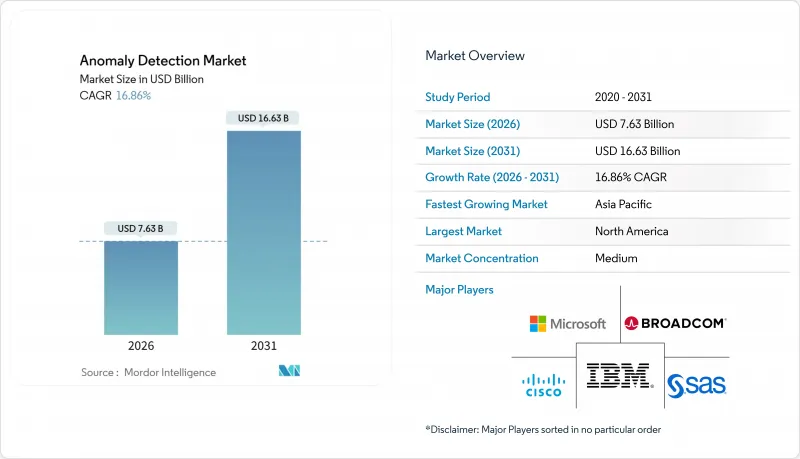
This report is Segmented by Component (Solutions, and Services), Deployment (On-Premise, Cloud, Hybrid), End-User Industry (Manufacturing, Healthcare, and More), Technology (Big Data Analytics, and More), Organization Size (Small and Medium Enterprises, and Large Enterprises), Application (Fraud Detection, Intrusion Detection, and More), and Geography. Market Forecasts are Provided in Terms of Value (USD).
Global Anomaly Detection Market Trends and Insights
Increasing Number of Cyberattacks Targeting Critical Infrastructure
Cyber adversaries shifted from IT to operational technology in 2024 and 2025, exploiting the convergence of plant-floor networks with enterprise systems. The U.S. Department of Energy logged 387 incidents against electric utilities in 2024, 41% higher than 2023, and 68% involved anomalous control commands that bypassed signature-based tools. Subsequent directives from the Transportation Security Administration require pipeline operators to deploy continuous anomaly monitoring, accelerating uptake in sectors historically reliant on air-gapped defenses. Updated IEC 62443 guidance positions anomaly detection as a compensating control when patching legacy controllers is infeasible, driving new projects in utilities and manufacturing where equipment lifecycles exceed 20 years.
Growing Adoption of Anomaly Detection in Fraud Prevention Across BFSI
Instant payment schemes and open banking APIs widened the fraud surface, prompting banks to embrace behavioral analytics that flag deviations in device, geolocation, and transaction velocity. The FedNow service processed 74 million transactions worth USD 45 billion in 2025, and its irreversibility heightened institutions' risk tolerance. JPMorgan Chase spent USD 2.1 billion on fraud-prevention technology in 2025, reporting a 34% drop in false positives after deploying anomaly-detection algorithms. Europe's revised Payment Services Directive compels strong customer authentication with real-time risk scoring, further embedding anomaly detection in core banking platforms.
Availability of Robust Open-Source Anomaly Detection Libraries Reducing Paid License Uptake
Production-ready frameworks such as PyOD and Alibi Detect amassed a broad developer following, with PyOD surpassing 8,200 GitHub stars by December 2025. Small firms with lean budgets increasingly opt for these tools, especially for performance monitoring and predictive maintenance. Although open-source lacks enterprise support and compliance certifications, community contributions keep pace with proprietary feature sets, compressing vendor pricing at the lower end of the market. The Linux Foundation's Adversarial Robustness Toolbox, launched in 2024, further commoditizes baseline anomaly detection and exerts downward pressure on license revenues.
Other drivers and restraints analyzed in the detailed report include:
- Proliferation of IoT Devices Expanding Attack Surface
- Convergence of AIOps with Anomaly Detection to Enable Autonomous Incident Response
- Shortage of Skilled Data Scientists Capable of Tuning Models
For complete list of drivers and restraints, kindly check the Table Of Contents.
Segment Analysis
Solutions dominated the anomaly detection market with a 66.71% share in 2025, reflecting widespread deployment of network behavior analytics and user behavior analytics across cloud and on-premises environments. However, services revenue is rising at a 17.11% CAGR through 2031 as organizations seek external expertise to fine-tune algorithms, integrate outputs into security orchestration and response playbooks, and combat model drift. Professional services became a strategic revenue stream for platform vendors; Splunk recorded 22% year-over-year growth in its services line during 2025. Managed services appeal to small and medium enterprises lacking security operations centers, offering 24/7 monitoring on a subscription basis.
Demand for operational support stems from rising model complexity. Transformer-based detectors require domain-specific feature engineering, hyperparameter tuning, and periodic retraining to handle evolving traffic patterns. Enterprises increasingly bundle ongoing advisory contracts with initial software purchases, elevating the importance of services in total contract value. The trend favors vendors able to provide certified personnel and outcome-based service-level agreements, thereby locking in recurring revenue while customers focus on core business priorities.
Cloud deployments held 58.91% of the anomaly detection market share in 2025 because elastic compute enables petabyte-scale model training. Yet hybrid architectures, expanding at a 17.39% CAGR, are emerging as the default among regulated industries that must retain sensitive telemetry on-premises. The European Union's Digital Operational Resilience Act obliges financial firms to ensure continuity even if a cloud vendor fails, prompting rollouts in which inference engines run on local appliances and aggregated features are sent to the cloud for model development.
This pattern optimizes latency and cost by eliminating raw-data egress while exploiting cloud-scale learning. Manufacturers with high-frequency sensor caches keep operational data in factories, train models in regional cloud zones, and then push compressed weights back to edge gateways. Such workflows help organizations comply with data-sovereignty statutes in India, Germany, and Canada, while maintaining access to advanced AI frameworks available only in public clouds.
Complete Report Scope:
- By Component
- Solutions
- Network Behavior Anomaly Detection
- User Behavior Anomaly Detection
- Services
- Professional Services
- Managed Services
- Solutions
- By Deployment
- On-Premise
- Cloud
- Hybrid
- By End-user Industry
- Banking, Financial Services and Insurance (BFSI)
- Manufacturing
- Healthcare
- IT and Telecommunications
- Government and Defense
- Retail and Ecommerce
- By Technology
- Machine Learning and Artificial Intelligence
- Big Data Analytics
- Data Mining and Business Intelligence
- Statistical Methods
- By Organization Size
- Small and Medium Enterprises
- Large Enterprises
- By Application
- Fraud Detection
- Intrusion Detection
- Fault Detection and Monitoring
- Data Exfiltration Detection
- Other Applications
- By Geography
- North America
- United States
- Canada
- Mexico
- Europe
- Germany
- United Kingdom
- France
- Russia
- Rest of Europe
- Asia-Pacific
- China
- Japan
- India
- South Korea
- Australia
- Rest of Asia-Pacific
- Middle East and Africa
- Middle East
- Saudi Arabia
- United Arab Emirates
- Rest of Middle East
- Africa
- South Africa
- Egypt
- Rest of Africa
- Middle East
- South America
- Brazil
- Argentina
- Rest of South America
- North America
Geography Analysis
North America accounted for 39.83% of the anomaly detection market share in 2025, driven by stringent breach-notification laws and mature threat intelligence networks. U.S. federal agencies must deploy behavioral analytics in accordance with OMB Memorandum 22-09 by fiscal 2026. Canada's amended privacy act imposes similar obligations on financial services and healthcare providers, expanding domestic demand.
Asia-Pacific is the fastest-growing region at a 17.82% CAGR. China's 2024 cybersecurity law amendments require critical information infrastructure operators to install anomaly detection systems, while India's Digital Personal Data Protection Act mandates behavioral monitoring for cross-border transfers. Japan's Ministry of Economy, Trade, and Industry issued connected-industry guidelines recommending the use of anomaly detection in automotive and electronics plants. South Korea's privacy regulator levied USD 6.1 million in fines during 2025 for inadequate monitoring, prompting broader adoption in telecommunications and e-commerce.
Europe balances strong privacy protections with growing cyber-resilience mandates. NIS2 requires essential-service operators to build continuous monitoring, yet GDPR's data-minimization principle restricts access to granular behavioral logs, spurring the development of on-premises and federated learning models. Germany's BSI guidelines recognize anomaly detection as a compensating control for legacy industrial controllers, thereby boosting adoption in chemical and automotive clusters. The U.K. National Cyber Security Centre reported 68% of large firms had deployed anomaly detection by 2025, up from 54% in 2024.
The Middle East and Africa, along with South America, represent emerging pockets of demand tied to national cybersecurity strategies. The United Arab Emirates and Saudi Arabia mandate continuous monitoring for critical infrastructure, accelerating projects in energy and transportation. Brazil's data-protection authority published guidance in 2024 that endorses behavioral analytics for unauthorized-access detection, catalyzing deployments in banking and healthcare.
- IBM Corporation
- Cisco Systems Inc.
- Microsoft Corporation
- Splunk Inc.
- Broadcom Inc.
- SAS Institute Inc.
- Trend Micro Incorporated
- Wipro Limited
- Verint Systems Inc.
- Guardian Analytics Inc.
- Securonix Inc.
- Gurucul Solutions, LLC
- Anodot Ltd.
- Happiest Minds Technologies Pvt. Ltd.
- Hewlett Packard Enterprise Company
- Dell Technologies Inc.
- Google LLC
- Amazon Web Services Inc.
- Rapid7 Inc.
- Micro Focus International plc
- LogRhythm Inc.
Additional Benefits:
- The market estimate (ME) sheet in Excel format
- 3 months of analyst support
TABLE OF CONTENTS
1 INTRODUCTION
- 1.1 Study Assumptions and Market Definition
- 1.2 Scope of the Study
2 RESEARCH METHODOLOGY
3 EXECUTIVE SUMMARY
4 MARKET LANDSCAPE
- 4.1 Market Overview
- 4.2 Market Drivers
- 4.2.1 Increasing Number of Cyberattacks Targeting Critical Infrastructure
- 4.2.2 Growing Adoption of Anomaly Detection in Fraud Prevention Across BFSI
- 4.2.3 Proliferation of IoT Devices Expanding Attack Surface
- 4.2.4 Convergence of AIOps with Anomaly Detection to Enable Autonomous Incident Response
- 4.2.5 Rise of Edge AI Chips Enabling Real-Time On-Device Anomaly Analytics
- 4.2.6 Mandatory Behavioral Monitoring in Zero Trust Security Frameworks Rolled Out by Governments
- 4.3 Market Restraints
- 4.3.1 Availability of Robust Open-Source Anomaly Detection Libraries Reducing Paid License Uptake
- 4.3.2 Shortage of Skilled Data Scientists Capable of Tuning Models
- 4.3.3 Model Drift in Dynamic Data Environments Increasing Maintenance Costs
- 4.3.4 Privacy Regulations Limiting Access to High-Granularity Data for Behavioral Analytics
- 4.4 Industry Value Chain Analysis
- 4.5 Regulatory Landscape
- 4.6 Technological Outlook
- 4.7 Porter's Five Forces Analysis
- 4.7.1 Bargaining Power of Suppliers
- 4.7.2 Bargaining Power of Buyers
- 4.7.3 Threat of New Entrants
- 4.7.4 Threat of Substitutes
- 4.7.5 Intensity of Competitive Rivalry
- 4.8 Impact of Macroeconomic Factors on the Market
5 MARKET SIZE AND GROWTH FORECASTS (VALUE)
- 5.1 By Component
- 5.1.1 Solutions
- 5.1.1.1 Network Behavior Anomaly Detection
- 5.1.1.2 User Behavior Anomaly Detection
- 5.1.2 Services
- 5.1.2.1 Professional Services
- 5.1.2.2 Managed Services
- 5.1.1 Solutions
- 5.2 By Deployment
- 5.2.1 On-Premise
- 5.2.2 Cloud
- 5.2.3 Hybrid
- 5.3 By End-user Industry
- 5.3.1 Banking, Financial Services and Insurance (BFSI)
- 5.3.2 Manufacturing
- 5.3.3 Healthcare
- 5.3.4 IT and Telecommunications
- 5.3.5 Government and Defense
- 5.3.6 Retail and Ecommerce
- 5.4 By Technology
- 5.4.1 Machine Learning and Artificial Intelligence
- 5.4.2 Big Data Analytics
- 5.4.3 Data Mining and Business Intelligence
- 5.4.4 Statistical Methods
- 5.5 By Organization Size
- 5.5.1 Small and Medium Enterprises
- 5.5.2 Large Enterprises
- 5.6 By Application
- 5.6.1 Fraud Detection
- 5.6.2 Intrusion Detection
- 5.6.3 Fault Detection and Monitoring
- 5.6.4 Data Exfiltration Detection
- 5.6.5 Other Applications
- 5.7 By Geography
- 5.7.1 North America
- 5.7.1.1 United States
- 5.7.1.2 Canada
- 5.7.1.3 Mexico
- 5.7.2 Europe
- 5.7.2.1 Germany
- 5.7.2.2 United Kingdom
- 5.7.2.3 France
- 5.7.2.4 Russia
- 5.7.2.5 Rest of Europe
- 5.7.3 Asia-Pacific
- 5.7.3.1 China
- 5.7.3.2 Japan
- 5.7.3.3 India
- 5.7.3.4 South Korea
- 5.7.3.5 Australia
- 5.7.3.6 Rest of Asia-Pacific
- 5.7.4 Middle East and Africa
- 5.7.4.1 Middle East
- 5.7.4.1.1 Saudi Arabia
- 5.7.4.1.2 United Arab Emirates
- 5.7.4.1.3 Rest of Middle East
- 5.7.4.2 Africa
- 5.7.4.2.1 South Africa
- 5.7.4.2.2 Egypt
- 5.7.4.2.3 Rest of Africa
- 5.7.4.1 Middle East
- 5.7.5 South America
- 5.7.5.1 Brazil
- 5.7.5.2 Argentina
- 5.7.5.3 Rest of South America
- 5.7.1 North America
6 COMPETITIVE LANDSCAPE
- 6.1 Market Concentration
- 6.2 Strategic Moves
- 6.3 Market Share Analysis
- 6.4 Company Profiles (includes Global Level Overview, Market Level Overview, Core Segments, Financials as available, Strategic Information, Market Rank/Share for Key Companies, Products and Services, and Recent Developments)
- 6.4.1 IBM Corporation
- 6.4.2 Cisco Systems Inc.
- 6.4.3 Microsoft Corporation
- 6.4.4 Splunk Inc.
- 6.4.5 Broadcom Inc.
- 6.4.6 SAS Institute Inc.
- 6.4.7 Trend Micro Incorporated
- 6.4.8 Wipro Limited
- 6.4.9 Verint Systems Inc.
- 6.4.10 Guardian Analytics Inc.
- 6.4.11 Securonix Inc.
- 6.4.12 Gurucul Solutions, LLC
- 6.4.13 Anodot Ltd.
- 6.4.14 Happiest Minds Technologies Pvt. Ltd.
- 6.4.15 Hewlett Packard Enterprise Company
- 6.4.16 Dell Technologies Inc.
- 6.4.17 Google LLC
- 6.4.18 Amazon Web Services Inc.
- 6.4.19 Rapid7 Inc.
- 6.4.20 Micro Focus International plc
- 6.4.21 LogRhythm Inc.
7 MARKET OPPORTUNITIES AND FUTURE OUTLOOK
- 7.1 White-space and Unmet-Need Assessment

