PUBLISHER: Mordor Intelligence | PRODUCT CODE: 2123028

PUBLISHER: Mordor Intelligence | PRODUCT CODE: 2123028
Germany Packaging - Market Share Analysis, Industry Trends & Statistics, Growth Forecasts (2026 - 2031)
According to Mordor Intelligence, the Germany packaging market size is expected to increase from USD 39.22 billion in 2026 to USD 48.73 billion by 2031, growing at a 4.44% CAGR over 2026-2031.
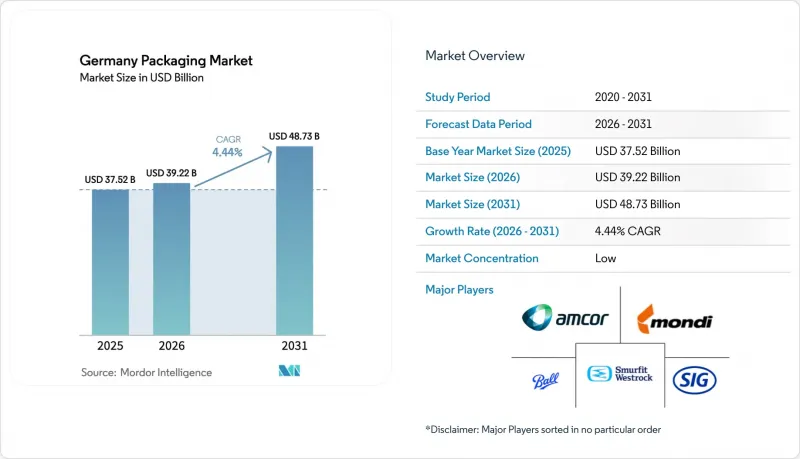
This report is Segmented by Material Type (Paper and Paperboard, Plastic, and More), Product Type (Paper and Paperboard Products, Plastic Products, and More), Packaging Format (Rigid, and Flexible), End-User (Food, Beverage, Pharmaceutical and Medical, Personal Care and Cosmetics, Industrial and Chemical, and More), and Geography (Europe, and More). The Market Forecasts are Provided in Terms of Value (USD).
Germany Packaging Market Trends and Insights
Pharmaceutical Cold-Chain Expansion Post-Brexit
European biologics traffic that once consolidated in the United Kingdom is increasingly staged through Frankfurt and Hamburg, lifting demand for temperature-controlled secondary packaging and pre-qualified pallet shippers. German converters that hold ISO 15378 certification for primary containers have secured multi-year supply agreements with vaccine producers, and Gerresheimer's investment in hermetic blister capacity (EUR 2 billion, USD 2.26 billion) positions the company to capture higher value orders. Polymer syringes with integrated needle shields introduced by SCHOTT Pharma in 2024 further illustrate the migration toward break-resistant formats in automated fill-finish environments.
Regulatory Push for Deposit Return System Expansion
In 2025, Germany extended its deposit scheme to milk and juice cartons, adding an estimated 600 million additional units to reverse-logistics channels within the first year. Converters swiftly re-engineered bottles in polyethylene terephthalate to improve optical sorting efficiency, while machinery suppliers Krones and ALPLA retrofitted blow-molding lines for tethered-cap compliance. Because the EU Packaging and Packaging Waste Regulation mirrors Germany's 90% collection benchmark, domestic producers enter the 2026-2031 horizon with a compliance head start, translating into lower contingency capital expenditure.
Skilled Labor Shortfall in High-Speed Automation
An aging workforce and tight vocational-training pipeline leave many converters struggling to staff mechatronics and PLC programming roles needed to operate multi-lane pouch fillers and rotary blow molders. Companies are installing operator-assist interfaces and remote-diagnostics modules to partially offset the talent gap, but these solutions cannot fully replace experienced technicians. As a result, planned speed increases on existing assets are slipping, curbing near-term throughput gains.
Other drivers and restraints analyzed in the detailed report include:
- Luxury Goods Export Growth Fueling Premium Packaging
- 3D Printing of Packaging Tooling Reducing Lead Times
- Capital Expenditure Freeze Amid Interest Rate Volatility
For complete list of drivers and restraints, kindly check the Table Of Contents.
Segment Analysis
Paper and paperboard commanded 37.91% of the Germany packaging market size in 2025 due to corrugated demand from e-commerce shipments. Nevertheless, biodegradable plastics are expanding at a 4.83% CAGR and are on track to double European bioplastic capacity to 4.69 million tons by 2030, with Germany contributing the largest share. Federal grants from the Ministry of Food and Agriculture accelerate R&D in bio-based polymers, encouraging converters to retrofit extrusion lines to run polylactic acid and polybutylene succinate blends.
Converters view bio-resins as a hedge against volatility in fossil-based polymers and looming recycled-content mandates. Stora Enso's Maxau mill upgrade (EUR 120 million, USD 135.6 million) adds specialty barrier paperboard that enables dry food and frozen applications to displace polyethylene terephthalate laminates. Metal packaging, led by aluminum cans, benefits from the 98% return infrastructure, while container glass retains niche positions in pharmaceuticals where inertness outweighs weight penalties.
Corrugated boxes held 23.88% share in 2025, yet pouches are forecast to expand at a 5.21% CAGR, leveraging consumer preference for resealable, lightweight formats. Mondi's retortable pouch, commercialized in 2024, cut material use by 70% compared with steel cans while preserving shelf life, illustrating the substitution pathway for shelf-stable meals. Folding cartons continue to serve OTC pharmaceuticals and cosmetics, but order sizes are shortening as brands test seasonal graphics via digital print.
Within rigid plastics, bottle demand is stable, though closure makers are moving toward tethered designs to meet EU litter-prevention rules. Metal aerosol containers remain critical for industrial lubricants, and local beverage canners have added sleeving capability for small-batch craft drinks. Koenig and Bauer's digital presses (EUR 1.27 billion, USD 1.44 billion in packaging machinery revenue, 2024) support rapid artwork swaps that align with micro-segmented marketing campaigns.
Complete Report Scope:
- By Material Type
- Paper and Paperboard
- Plastic
- Polyethylene Polypropylene (PP)
- High-density Polyethylene (HDPE) and Low-density Polyethylene (LDPE)
- Polyethylene Terephthalate (PET)
- Polyvinyl Chloride (PVC)
- Polystyrene (PS)
- Other Plastics
- Metal
- Container Glass
- By Product Type
- Paper and Paperboard Product Type
- Folding Carton and Rigid Boxes
- Corrugated Boxes and Containers
- Single-use Paper Products
- Other Paper and Paperboard Product Types
- Plastic Product Type
- Rigid Plastics
- Bottles and Jars
- Caps and Closures
- Bulk-Grade Products
- Other Rigid Plastics Product Types
- Flexible Plastics
- Pouches
- Bags
- Films and Wraps
- Other Flexible Plastics Product Types
- Rigid Plastics
- Metal Product Type
- Cans
- Caps and Closures
- Aerosol Containers
- Other Metal Product Types
- Container Glass Product Type
- Bottles
- Jars
- Paper and Paperboard Product Type
- By Packaging Format
- Rigid Packaging Format
- Flexible Packaging Format
- By End-user
- Food
- Beverage
- Pharmaceutical and Medical
- Personal Care and Cosmetics
- Industrial and Chemical
- Agriculture
- Automotive
- Other End-users
List of Companies Covered in this Report:
- Amcor plc
- Mondi plc
- Ball Corporation
- Ardagh Group S.A.
- Crown Holdings Inc.
- O-I Glass Germany GmbH
- Smurfit WestRock plc
- Stora Enso Oyj
- Constantia Flexibles GmbH
- SIG Combibloc Group
- Gerresheimer AG
- Schutz GmbH & Co. KGaA
- Klockner Pentaplast GmbH
- Heidelberger Druck-maschinen AG
- Mayr-Melnhof Gruppe
- ALPLA Werke Alwin Lehner GmbH & Co KG
- Sealed Air Corp.
- Greif Germany GmbH
Additional Benefits:
- The market estimate (ME) sheet in Excel format
- 3 months of analyst support
TABLE OF CONTENTS
1 INTRODUCTION
- 1.1 Study Assumptions and Market Definition
- 1.2 Scope of the Study
2 RESEARCH METHODOLOGY
3 EXECUTIVE SUMMARY
4 MARKET LANDSCAPE
- 4.1 Market Overview
- 4.2 Market Drivers
- 4.2.1 Sustainability-Driven Material Shift
- 4.2.2 E-Commerce Volume Surge
- 4.2.3 Smart and Active Packaging Adoption
- 4.2.4 AI-Enabled Mass-Customization
- 4.2.5 Germany's Reusable Mandate Logistics Build-Out
- 4.2.6 Industry-5.0 Retrofit of Legacy Lines
- 4.3 Market Restraints
- 4.3.1 Stringent Plastics and PPWR Compliance Cost
- 4.3.2 Volatile Resin and Energy Prices
- 4.3.3 Shortage of Authorized Food-Grade PCR Polyolefins
- 4.3.4 Reusable Packaging Attitude-Behaviour Gap
- 4.4 Industry Value Chain Analysis
- 4.5 Regulatory Landscape
- 4.6 Porter's Five Forces Analysis
- 4.6.1 Threat of New Entrants
- 4.6.2 Bargaining Power of Buyers
- 4.6.3 Bargaining Power of Suppliers
- 4.6.4 Threat of Substitutes
- 4.6.5 Competitive Rivalry
5 MARKET SIZE AND GROWTH FORECASTS (VALUE)
- 5.1 By Material Type
- 5.1.1 Paper and Paperboard
- 5.1.2 Plastic
- 5.1.2.1 Polyethylene Polypropylene (PP)
- 5.1.2.2 High-density Polyethylene (HDPE) and Low-density Polyethylene (LDPE)
- 5.1.2.3 Polyethylene Terephthalate (PET)
- 5.1.2.4 Polyvinyl Chloride (PVC)
- 5.1.2.5 Polystyrene (PS)
- 5.1.2.6 Other Plastics
- 5.1.3 Metal
- 5.1.4 Container Glass
- 5.2 By Product Type
- 5.2.1 Paper and Paperboard Product Type
- 5.2.1.1 Folding Carton and Rigid Boxes
- 5.2.1.2 Corrugated Boxes and Containers
- 5.2.1.3 Single-use Paper Products
- 5.2.1.4 Other Paper and Paperboard Product Types
- 5.2.2 Plastic Product Type
- 5.2.2.1 Rigid Plastics
- 5.2.2.1.1 Bottles and Jars
- 5.2.2.1.2 Caps and Closures
- 5.2.2.1.3 Bulk-Grade Products
- 5.2.2.1.4 Other Rigid Plastics Product Types
- 5.2.2.2 Flexible Plastics
- 5.2.2.2.1 Pouches
- 5.2.2.2.2 Bags
- 5.2.2.2.3 Films and Wraps
- 5.2.2.2.4 Other Flexible Plastics Product Types
- 5.2.2.1 Rigid Plastics
- 5.2.3 Metal Product Type
- 5.2.3.1 Cans
- 5.2.3.2 Caps and Closures
- 5.2.3.3 Aerosol Containers
- 5.2.3.4 Other Metal Product Types
- 5.2.4 Container Glass Product Type
- 5.2.4.1 Bottles
- 5.2.4.2 Jars
- 5.2.1 Paper and Paperboard Product Type
- 5.3 By Packaging Format
- 5.3.1 Rigid Packaging Format
- 5.3.2 Flexible Packaging Format
- 5.4 By End-user
- 5.4.1 Food
- 5.4.2 Beverage
- 5.4.3 Pharmaceutical and Medical
- 5.4.4 Personal Care and Cosmetics
- 5.4.5 Industrial and Chemical
- 5.4.6 Agriculture
- 5.4.7 Automotive
- 5.4.8 Other End-users
6 COMPETITIVE LANDSCAPE
- 6.1 Market Concentration
- 6.2 Strategic Moves
- 6.3 Market Share Analysis
- 6.4 Company Profiles (includes Global level Overview, Market level overview, Core Segments, Financials as available, Strategic Information, Market Rank/Share for key companies, Products and Services, and Recent Developments)
- 6.4.1 Amcor plc
- 6.4.2 Mondi plc
- 6.4.3 Ball Corporation
- 6.4.4 Ardagh Group S.A.
- 6.4.5 Crown Holdings Inc.
- 6.4.6 O-I Glass Germany GmbH
- 6.4.7 Smurfit WestRock plc
- 6.4.8 Stora Enso Oyj
- 6.4.9 Constantia Flexibles GmbH
- 6.4.10 SIG Combibloc Group
- 6.4.11 Gerresheimer AG
- 6.4.12 Schutz GmbH & Co. KGaA
- 6.4.13 Klockner Pentaplast GmbH
- 6.4.14 Heidelberger Druck-maschinen AG
- 6.4.15 Mayr-Melnhof Gruppe
- 6.4.16 ALPLA Werke Alwin Lehner GmbH & Co KG
- 6.4.17 Sealed Air Corp.
- 6.4.18 Greif Germany GmbH
7 MARKET OPPORTUNITIES AND FUTURE OUTLOOK
- 7.1 White-space and Unmet-Need Assessment

