PUBLISHER: Mordor Intelligence | PRODUCT CODE: 2123032

PUBLISHER: Mordor Intelligence | PRODUCT CODE: 2123032
Italy Packaging Industry - Market Share Analysis, Industry Trends & Statistics, Growth Forecasts (2026 - 2031)
According to Mordor Intelligence, the packaging industry in Italy market size is expected to grow from USD 3.44 billion in 2025 to USD 3.55 billion in 2026 and is forecast to reach USD 4.14 billion by 2031 at 3.12% CAGR over 2026-2031.
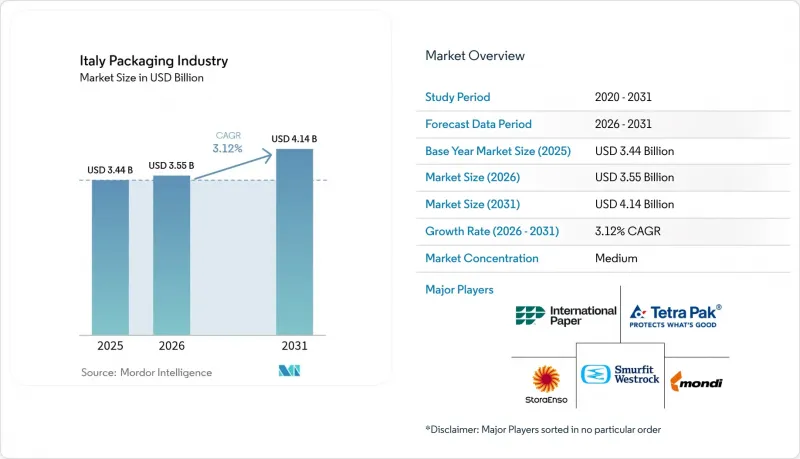
This report is Segmented by Packaging Type (Plastic, Paper, Container Glass, and Metal Cans), Format (Flexible, and Rigid), End-Use Industry (Food, Beverage, Pharmaceuticals, Personal Care, and More), and Function (Primary, Secondary, and Tertiary). The Market Forecasts are Provided in Terms of Value (USD).
Italy Packaging Industry Trends and Insights
Growing Adoption of Lightweight and Recyclable Materials
Converters accelerate material innovation as the EUR 0.45/kg plastic tax and brand-owner sustainability scorecards converge. Lavazza achieved 76% recyclable packaging in 2023 and targets full recyclability by 2025, illustrating food-sector leadership. Casa Optima commercialized 100% recyclable polypropylene packs in 2024, showcasing the technical viability of mono-material solutions. Investments in barrier coatings that remove multilayer complexity enable drop-in replacements without sacrificing shelf life. Retail penalties for non-recyclable formats now influence upstream product-development decisions, creating measurable competitive advantages for firms with R&D capabilities that shorten qualification cycles. As national retailers elevate recyclability thresholds annually, lightweight and recyclable designs become prerequisites for shelf access and export clearance.
Surge in E-commerce Parcel Volumes
Online retail worth EUR 58.8 billion (USD 64.1 billion) in 2024 has redefined shipment profiles, especially for food and grocery, which reached EUR 4.6 billion (USD 6.39 billion) with 8% year-over-year growth. Corrugated suppliers see spikes around Northern logistics hubs, prompting capacity expansions and just-in-time satellite plants that lower transit costs. Dimensional-weight pricing pushes right-sizing software, expandable mailers, and cushioning that tolerates two-way journeys under circular commerce models. Return-ready designs for electronics and apparel add new revenue lines for converters specializing in tear-strip and reseal features. These packaging requirements increasingly dictate upstream material choice, favoring lightweight paper and mono-polyolefin films that align cost, protection, and recyclability.
Volatility in Virgin Polymer and Paper Pulp Prices
Global petrochemical swings raised polymer quotes above five-year averages in 2024, while pulp costs held firm after Nordic supply disruptions. Versalis shuttered cracking units in Brindisi and Priolo, lifting import reliance and exposing converters to freight and FX risk. Smaller operators with limited hedging absorb immediate EBITDA erosion, triggering M&A as firms seek scale procurement power. Paper converters face certification ceilings that curb raw-fiber availability, reinforcing recycled-fiber investment but tying prices to virgin-pulp trajectories. Buyers now request indexed contracts or mixed-material packs to buffer volatility, occasionally delaying innovation rollouts until cost stability returns.
Other drivers and restraints analyzed in the detailed report include:
- EU PPWR and EPR Compliance Accelerating Sustainable Packaging
- AI-Driven Sorting and Quality Control in Recycling Facilities
- Plastic Packaging Tax Squeezing Converter Margins
For complete list of drivers and restraints, kindly check the Table Of Contents.
Segment Analysis
Plastic retained a 42.03% share of the packaging industry in the Italian market in 2025, anchored by the barrier performance sought in food and personal-care categories. The segment's expansion remains steady, though the packaging industry in the Italian market for paper alternatives is projected to grow at a 4.55% CAGR to 2031 on the back of e-commerce and PPWR-driven substitution.
Paper converters win orders from online retail, corrugated boxes, and molded-fiber containers exempt from the plastic tax. Hybrid innovations, such as water-based coatings that replace polyethylene liners, shorten the payback for brand owners seeking recyclable claims. Glass maintains premium niches in beverages and cosmetics; Verallia's Italian division posted EUR 1.53 billion (USD 1.80 billion) H1 2024 revenue, aided by recycled-glass surcharges passed onto buyers. Metal cans, prized for infinite recyclability, benefit from consumer trust in shelf-stable food during geopolitical supply disruptions. Firms straddling multiple materials hedge policy risks while servicing customers migrating between substrates.
Complete Report Scope:
- By Packaging Type
- Plastic Packaging
- By Type
- Rigid Plastic Packaging
- By Material Type
- Polyethylene (PE)
- Polypropylene (PP)
- Polyethylene Terephthalate (PET)
- Polyvinyl Chloride (PVC)
- Polystyrene (PS) and Expanded Polystyrene (EPS)
- Other Material Types
- By Product Type
- Bottles and Jars
- Caps and Closures
- Trays and Containers
- Other Product Types
- By End-use Industry
- Food
- Beverage
- Pharmaceutical
- Cosmetics and Personal Care
- Industrial
- Other End-use Industry
- By Material Type
- Flexible Plastic Packaging
- By Material Type
- Polyethylene (PE)
- Biaxially Oriented Polypropylene (BOPP)
- Cast Polypropylene (CPP)
- Other Material Types
- By Product Type
- Pouches and Bags
- Films and Wraps
- Other Product Types
- By End-use Industry
- Food
- Beverage
- Pharmaceutical
- Cosmetics and Personal Care
- Industrial
- Other End-use Industry
- By Material Type
- Rigid Plastic Packaging
- By Product Type
- Bottles and Jars
- Pouches and Bags
- Bulk-Grade Products
- Other Product Types
- By End-use Industry
- Food
- Beverages
- Cosmetics and Personal Care
- Pharamceuticals
- Industrial
- Other End-use Industry
- By Type
- Paper Packaging
- By Product Type
- Folding Carton
- Corrugated Boxes
- Liquid Paperboard
- Other Product Type
- By End-use Industry
- Food
- Beverages
- E-commerce
- Other End-use Industry
- By Product Type
- Container Glass
- By Color
- Green
- Amber
- Flint
- Other Colors
- By End-use Industry
- Food
- Beverage
- Alcoholic
- Non-Alcoholic
- Personal Care and Cosmetics
- Pharmaceuticals (excluding Vials and Ampoules)
- Perfumery
- By Color
- Metal Cans and Containers
- By Material Type
- Steel
- Aluminum
- By Product Type
- Cans
- Drums and Barrels
- Caps and Closures
- Other Product Type
- By End-use Industry
- Food
- Beverage
- Chemicals and Petroleum
- Industrial
- Paints and coatings
- Other End-use Industry
- By Material Type
- Plastic Packaging
- By Packaging Format
- Flexible
- Rigid
- By End-use Industry
- Food
- Beverage
- Pharmaceuticals and Healthcare
- Personal Care and Cosmetics
- Industrial
- E-commerce
- Other End-use Industry
List of Companies Covered in this Report:
- Tetra Pak International SA
- International Paper Company
- Mondi plc
- Stora Enso Oyj
- Smurfit WestRock
- Amcor plc
- Carton Pack SpA
- Zignago Vetro SpA
- Wipak Bordi Srl
- Plast Pack Packaging Srl
- Rotofil Srl
- AFG Srl
- Gruppo Goglio SpA
- Sealed Air Corporation
- Verallia SA
- Italpack Cartons Srl
- PET Engineering Srl
- IMA Industrie Macchine Automatiche SpA
Additional Benefits:
- The market estimate (ME) sheet in Excel format
- 3 months of analyst support
TABLE OF CONTENTS
1 INTRODUCTION
- 1.1 Study Assumptions and Market Definition
- 1.2 Scope of the Study
2 RESEARCH METHODOLOGY
3 EXECUTIVE SUMMARY
4 MARKET LANDSCAPE
- 4.1 Market Overview
- 4.2 Market Drivers
- 4.2.1 Growing adoption of lightweight and recyclable materials
- 4.2.2 Surge in e-commerce parcel volumes
- 4.2.3 EU PPWR and EPR compliance accelerating sustainable packaging
- 4.2.4 AI-driven sorting and quality control in recycling facilities
- 4.2.5 Heat-pump manufacturing boom driving EPS packaging demand
- 4.3 Market Restraints
- 4.3.1 Volatility in virgin polymer and paper pulp prices
- 4.3.2 Plastic packaging tax (EUR 0.45 /kg) squeezing converter margins
- 4.3.3 North-South disparities in recycling infrastructure
- 4.4 Industry Value Chain Analysis
- 4.5 Porter's Five Forces Analysis
- 4.5.1 Bargaining Power of Suppliers
- 4.5.2 Bargaining Power of Buyers
- 4.5.3 Threat of New Entrants
- 4.5.4 Threat of Substitute Products
- 4.5.5 Intensity of Competitive Rivalry
- 4.6 The Impact of Macroeconomic Factors on the Market
- 4.7 Technological Outlook
- 4.8 Regulatory Landscape
5 MARKET SIZE AND GROWTH FORECASTS (VALUE)
- 5.1 By Packaging Type
- 5.1.1 Plastic Packaging
- 5.1.1.1 By Type
- 5.1.1.1.1 Rigid Plastic Packaging
- 5.1.1.1.1.1 By Material Type
- 5.1.1.1.1.1.1 Polyethylene (PE)
- 5.1.1.1.1.1.2 Polypropylene (PP)
- 5.1.1.1.1.1.3 Polyethylene Terephthalate (PET)
- 5.1.1.1.1.1.4 Polyvinyl Chloride (PVC)
- 5.1.1.1.1.1.5 Polystyrene (PS) and Expanded Polystyrene (EPS)
- 5.1.1.1.1.1.6 Other Material Types
- 5.1.1.1.1.2 By Product Type
- 5.1.1.1.1.2.1 Bottles and Jars
- 5.1.1.1.1.2.2 Caps and Closures
- 5.1.1.1.1.2.3 Trays and Containers
- 5.1.1.1.1.2.4 Other Product Types
- 5.1.1.1.1.3 By End-use Industry
- 5.1.1.1.1.3.1 Food
- 5.1.1.1.1.3.2 Beverage
- 5.1.1.1.1.3.3 Pharmaceutical
- 5.1.1.1.1.3.4 Cosmetics and Personal Care
- 5.1.1.1.1.3.5 Industrial
- 5.1.1.1.1.3.6 Other End-use Industry
- 5.1.1.1.1.1 By Material Type
- 5.1.1.1.2 Flexible Plastic Packaging
- 5.1.1.1.2.1 By Material Type
- 5.1.1.1.2.1.1 Polyethylene (PE)
- 5.1.1.1.2.1.2 Biaxially Oriented Polypropylene (BOPP)
- 5.1.1.1.2.1.3 Cast Polypropylene (CPP)
- 5.1.1.1.2.1.4 Other Material Types
- 5.1.1.1.2.2 By Product Type
- 5.1.1.1.2.2.1 Pouches and Bags
- 5.1.1.1.2.2.2 Films and Wraps
- 5.1.1.1.2.2.3 Other Product Types
- 5.1.1.1.2.3 By End-use Industry
- 5.1.1.1.2.3.1 Food
- 5.1.1.1.2.3.2 Beverage
- 5.1.1.1.2.3.3 Pharmaceutical
- 5.1.1.1.2.3.4 Cosmetics and Personal Care
- 5.1.1.1.2.3.5 Industrial
- 5.1.1.1.2.3.6 Other End-use Industry
- 5.1.1.1.2.1 By Material Type
- 5.1.1.1.1 Rigid Plastic Packaging
- 5.1.1.2 By Product Type
- 5.1.1.2.1 Bottles and Jars
- 5.1.1.2.2 Pouches and Bags
- 5.1.1.2.3 Bulk-Grade Products
- 5.1.1.2.4 Other Product Types
- 5.1.1.3 By End-use Industry
- 5.1.1.3.1 Food
- 5.1.1.3.2 Beverages
- 5.1.1.3.3 Cosmetics and Personal Care
- 5.1.1.3.4 Pharamceuticals
- 5.1.1.3.5 Industrial
- 5.1.1.3.6 Other End-use Industry
- 5.1.1.1 By Type
- 5.1.2 Paper Packaging
- 5.1.2.1 By Product Type
- 5.1.2.1.1 Folding Carton
- 5.1.2.1.2 Corrugated Boxes
- 5.1.2.1.3 Liquid Paperboard
- 5.1.2.1.4 Other Product Type
- 5.1.2.2 By End-use Industry
- 5.1.2.2.1 Food
- 5.1.2.2.2 Beverages
- 5.1.2.2.3 E-commerce
- 5.1.2.2.4 Other End-use Industry
- 5.1.2.1 By Product Type
- 5.1.3 Container Glass
- 5.1.3.1 By Color
- 5.1.3.1.1 Green
- 5.1.3.1.2 Amber
- 5.1.3.1.3 Flint
- 5.1.3.1.4 Other Colors
- 5.1.3.2 By End-use Industry
- 5.1.3.2.1 Food
- 5.1.3.2.2 Beverage
- 5.1.3.2.2.1 Alcoholic
- 5.1.3.2.2.2 Non-Alcoholic
- 5.1.3.2.3 Personal Care and Cosmetics
- 5.1.3.2.4 Pharmaceuticals (excluding Vials and Ampoules)
- 5.1.3.2.5 Perfumery
- 5.1.3.1 By Color
- 5.1.4 Metal Cans and Containers
- 5.1.4.1 By Material Type
- 5.1.4.1.1 Steel
- 5.1.4.1.2 Aluminum
- 5.1.4.2 By Product Type
- 5.1.4.2.1 Cans
- 5.1.4.2.2 Drums and Barrels
- 5.1.4.2.3 Caps and Closures
- 5.1.4.2.4 Other Product Type
- 5.1.4.3 By End-use Industry
- 5.1.4.3.1 Food
- 5.1.4.3.2 Beverage
- 5.1.4.3.3 Chemicals and Petroleum
- 5.1.4.3.4 Industrial
- 5.1.4.3.5 Paints and coatings
- 5.1.4.3.6 Other End-use Industry
- 5.1.4.1 By Material Type
- 5.1.1 Plastic Packaging
- 5.2 By Packaging Format
- 5.2.1 Flexible
- 5.2.2 Rigid
- 5.3 By End-use Industry
- 5.3.1 Food
- 5.3.2 Beverage
- 5.3.3 Pharmaceuticals and Healthcare
- 5.3.4 Personal Care and Cosmetics
- 5.3.5 Industrial
- 5.3.6 E-commerce
- 5.3.7 Other End-use Industry
6 COMPETITIVE LANDSCAPE
- 6.1 Market Concentration
- 6.2 Strategic Moves
- 6.3 Market Share Analysis
- 6.4 Company Profiles (includes Global level Overview, Market level overview, Core Segments, Financials as available, Strategic Information, Market Rank/Share for key companies, Products and Services, and Recent Developments)
- 6.4.1 Tetra Pak International SA
- 6.4.2 International Paper Company
- 6.4.3 Mondi plc
- 6.4.4 Stora Enso Oyj
- 6.4.5 Smurfit WestRock
- 6.4.6 Amcor plc
- 6.4.7 Carton Pack SpA
- 6.4.8 Zignago Vetro SpA
- 6.4.9 Wipak Bordi Srl
- 6.4.10 Plast Pack Packaging Srl
- 6.4.11 Rotofil Srl
- 6.4.12 AFG Srl
- 6.4.13 Gruppo Goglio SpA
- 6.4.14 Sealed Air Corporation
- 6.4.15 Verallia SA
- 6.4.16 Italpack Cartons Srl
- 6.4.17 PET Engineering Srl
- 6.4.18 IMA Industrie Macchine Automatiche SpA
7 MARKET OPPORTUNITIES AND FUTURE OUTLOOK
- 7.1 White-space and Unmet-Need Assessment

