PUBLISHER: Mordor Intelligence | PRODUCT CODE: 2123057

PUBLISHER: Mordor Intelligence | PRODUCT CODE: 2123057
United States Asset Management - Market Share Analysis, Industry Trends & Statistics, Growth Forecasts (2026 - 2031)
According to Mordor Intelligence, the United States asset management market size is projected at USD 70.97 trillion in 2026 and forecast to reach USD 125.98 trillion by 2031, reflecting a 12.16% CAGR.
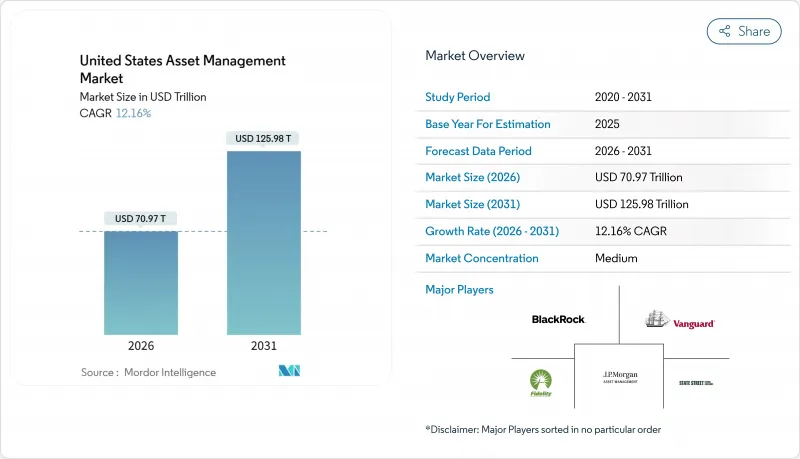
This report is Segmented by Asset Class (Equity, Fixed Income, Alternative Assets, Other Asset Classes), Firm Type (Broker-Dealers, Banks, Wealth Advisory Firms, Other Firm Types), Mode of Advisory (Human Advisory, Robo-Advisory), Client Type (Retail, Institutional), and Management Source (Offshore, Onshore). The Market Forecasts are Provided in Terms of Value (USD).
United States Asset Management Market Trends and Insights
AI-Driven Portfolio Automation and Real-Time Analytics Adoption
Generative and agentic AI are moving from operational support to decision engines that assemble data, identify signals, and simulate outcomes for investment teams, which is compressing research cycles and expanding coverage across asset classes. Large United States technology firms' AI capital expenditure is on track to exceed USD 500 billion in 2026, accounting for nearly 25% of total United States market capex, and hyperscalers are generating an estimated USD 25 billion in incremental quarterly revenue from AI activity, growing at a 200% year-over-year pace. Managers are applying AI to ingest filings, transcripts, and alternative data to produce near real-time analytics and risk views that used to require weeks of manual effort, which is lifting throughput at a lower marginal cost per insight. The same techniques are enabling the electronification of less-liquid markets as language models parse credit and derivatives documents to accelerate price discovery and liquidity formation across OTC workflows. At the product layer, AI is improving portfolio personalization and tax-aware trading inside active ETF wrappers and direct indexing programs that are now gaining broader platform acceptance. The overall effect is a widening gap between firms that modernize data and model infrastructure at scale and firms that cannot move beyond pilot deployments.
Expansion of HNW and Mass-Affluent Investable Assets
High-net-worth households now anchor growth strategies as wealth continues to consolidate and advisors expand their offering beyond portfolio construction to tax planning, estate coordination, and family services. Retail investors hold a significant portion of global assets, and their allocation to alternatives is expected to grow faster than institutional allocations in the coming decade, which is driving product and distribution innovation to serve this channel at scale. Private market firms are targeting this segment aggressively: retail investors hold nearly half of global AUM totaling USD 295 trillion, and alternative investment allocations from individual capital are projected to rise 12% annually over the next decade compared to 8% from institutional capital. Managers and platforms see meaningful revenue potential from retail participation in alternative strategies, so they are building education, simplified onboarding, and guardrails for liquidity and suitability to reduce friction for advisors. Asset managers are responding by expanding service models beyond traditional investment management: 98% of HNW practices now offer estate planning, 90% provide charitable planning, and 75% deliver family counseling services. The net result is a larger addressable pool for alternatives and custom indexing, with wealth teams positioned as key gatekeepers for flows into private and hybrid exposures.
Rising Regulatory and Cyber-Security Compliance Costs
FINRA's 2026 oversight report highlights how generative AI enables deepfakes, voice cloning, synthetic IDs, and adaptive malware that raise the bar for identity verification, monitoring, and incident response. Broker-dealers face mandatory daily customer reserve computations beginning June 30, 2026, which will force changes to funding processes, contingency plans, and liquidity stress testing across operations and treasury functions. Amendments to Regulation S-P heighten expectations for safeguarding customer information and notification protocols, with compliance dates in late 2025 and mid-2026, depending on firm size. The SEC's examination priorities for 2026 elevate scrutiny on complex products, custody, and conflicts, which will require more robust documentation and testing across marketing, operations, and supervision. Enforcement actions have emphasized that weak controls can trigger penalties even without identified investor losses, which makes preventative security and governance investments non-negotiable. By January 2026, a growing patchwork of state privacy laws will increase the complexity of data inventories, vendor oversight, and automated decision-making disclosures that intersect with AI use cases.
Other drivers and restraints analyzed in the detailed report include:
- Democratization of Private Markets via Tokenized and Interval Funds
- Corporate Pension Surplus Redeployment to OCIO Mandates
- Ongoing Fee Compression from Passive and Robo Propositions
For complete list of drivers and restraints, kindly check the Table Of Contents.
Segment Analysis
Equity commanded the largest share at 44.56% in 2025 within the United States asset management market share, while alternative assets are set to register the fastest growth at 14.62% CAGR from 2026 to 2031. Private markets have scaled as companies stay private longer and investors target illiquidity premia to diversify return sources beyond traditional beta. The United States asset management market benefits as managers distribute interval and tender-offer funds to wealth channels and add secondary solutions to improve liquidity profiles for clients. The United States asset management market also sees broadening adoption of active ETF wrappers that improve tax efficiency and speed time to market for systematic and fundamental strategies.
Within alternatives, private credit continues to gain share as direct lending and asset-based finance offer senior secured exposures with attractive spreads versus broadly syndicated loans and high yield benchmarks. Infrastructure demand is rising as data center growth, grid modernization, and energy transition spur capital formation in power generation and transmission, which supports long-dated, inflation-linked cash flows. Real estate has shown early signs of stabilization as net absorption trends improve and distress creates entry points for flexible credit solutions and hybrid capital. Other asset classes, including digital assets, have gained new distribution channels after regulatory approvals for spot crypto ETPs in early 2024, which catalyzed significant net inflows and created new options for exposure management. The United States asset management market is expected to maintain this multi-asset expansion as managers tailor structures to advisor workflows and household objectives.
Wealth advisory firms captured the largest share at 33.48% in 2025 and are also forecasted to be the fastest-growing cohort at 13.88% CAGR through 2031. The United States asset management market is increasingly intermediated by advisors who bundle planning, tax optimization, and access to alternatives for HNW families that are raising allocations to private strategies. Registered investment advisers have broadened services beyond investment management to include estate planning, charitable giving, and family governance, which helps defend pricing and deepen relationships. Banks leverage trust and custody capabilities to cross-sell asset management, but they face constraints tied to capital requirements and oversight that narrow proprietary risk-taking. The United States asset management market is also influenced by platform aggregators that provide technology, model portfolios, and capital support for M&A and succession, which helps independents compete with wirehouse networks.
Broker-dealers face increasing scrutiny under Regulation Best Interest as supervisors evaluate share class selection, complex products, and disclosures around conflicts and costs. This scrutiny pushes more firms to standardize due diligence and fee benchmarking, which can favor low-cost ETFs and model-based advice in core allocations. Other firm types, including pension consultants and family offices, are winning mandates for specialized alternative strategies and OCIO services as sponsors pursue risk alignment and operational scale. The United States asset management industry is therefore polarizing around scaled platforms and specialist boutiques, with mid-sized managers needing distribution partnerships and cost discipline to maintain competitiveness. Over the forecast horizon, advisory-led distribution is likely to remain the primary gatekeeper of flows into both public and private strategies.
Complete Report Scope:
- By Asset Class
- Equity
- Fixed Income
- Alternative Assets
- Other Asset Classes
- By Firm Type
- Broker-Dealers
- Banks
- Wealth Advisory Firms
- Other Firm Types
- By Mode of Advisory
- Human Advisory
- Robo-Advisory
- By Client Type
- Retail
- Institutional
- By Management Source
- Offshore
- Onshore
List of Companies Covered in this Report:
- Vanguard Group
- BlackRock Inc.
- Fidelity Investments
- State Street Global Advisors
- J.P. Morgan Asset Management
- Goldman Sachs Asset Management
- Charles Schwab Asset Management
- Invesco Ltd.
- T. Rowe Price
- Capital Group
- BNY Mellon Investment Management
- Franklin Templeton
- Dimensional Fund Advisors
- Northern Trust Asset Management
- Wellington Management
- PIMCO
- Nuveen (TIAA)
- Brookfield Asset Management
- AllianceBernstein
- Apollo Global Management
Additional Benefits:
- The market estimate (ME) sheet in Excel format
- 3 months of analyst support
TABLE OF CONTENTS
1 Introduction
- 1.1 Study Assumptions & Market Definition
- 1.2 Scope of the Study
2 Research Methodology
3 Executive Summary
4 Market Landscape
- 4.1 Market Overview
- 4.2 Market Drivers
- 4.2.1 AI-driven portfolio automation & real-time analytics adoption
- 4.2.2 Expansion of HNW & mass-affluent investable assets
- 4.2.3 Democratisation of private markets via tokenised/interval funds
- 4.2.4 Corporate pension surplus redeployment to OCIO mandates
- 4.2.5 Active-ETF wrapper migration unlocking tax-efficient flows
- 4.2.6 Workplace emergency-savings programmes boosting cash AUM
- 4.3 Market Restraints
- 4.3.1 Rising regulatory & cyber-security compliance costs
- 4.3.2 Ongoing fee compression from passive & robo propositions
- 4.3.3 Distribution-platform concentration squeezing mid-size firms
- 4.4 Value Chain Analysis
- 4.5 Regulatory Landscape
- 4.6 Technological Outlook
- 4.7 Porter's Five Forces
- 4.7.1 Threat of New Entrants
- 4.7.2 Bargaining Power of Buyers
- 4.7.3 Bargaining Power of Suppliers
- 4.7.4 Threat of Substitutes
- 4.7.5 Intensity of Rivalry
5 Market Size & Growth Forecasts (Value)
- 5.1 By Asset Class
- 5.1.1 Equity
- 5.1.2 Fixed Income
- 5.1.3 Alternative Assets
- 5.1.4 Other Asset Classes
- 5.2 By Firm Type
- 5.2.1 Broker-Dealers
- 5.2.2 Banks
- 5.2.3 Wealth Advisory Firms
- 5.2.4 Other Firm Types
- 5.3 By Mode of Advisory
- 5.3.1 Human Advisory
- 5.3.2 Robo-Advisory
- 5.4 By Client Type
- 5.4.1 Retail
- 5.4.2 Institutional
- 5.5 By Management Source
- 5.5.1 Offshore
- 5.5.2 Onshore
6 Competitive Landscape
- 6.1 Market Concentration
- 6.2 Strategic Moves
- 6.3 Market Share Analysis
- 6.4 Company Profiles (includes Global level Overview, Market level Overview, Core Segments, Financials as available, Strategic Information, Market Rank/Share for key companies, Products & Services, and Recent Developments)
- 6.4.1 Vanguard Group
- 6.4.2 BlackRock Inc.
- 6.4.3 Fidelity Investments
- 6.4.4 State Street Global Advisors
- 6.4.5 J.P. Morgan Asset Management
- 6.4.6 Goldman Sachs Asset Management
- 6.4.7 Charles Schwab Asset Management
- 6.4.8 Invesco Ltd.
- 6.4.9 T. Rowe Price
- 6.4.10 Capital Group
- 6.4.11 BNY Mellon Investment Management
- 6.4.12 Franklin Templeton
- 6.4.13 Dimensional Fund Advisors
- 6.4.14 Northern Trust Asset Management
- 6.4.15 Wellington Management
- 6.4.16 PIMCO
- 6.4.17 Nuveen (TIAA)
- 6.4.18 Brookfield Asset Management
- 6.4.19 AllianceBernstein
- 6.4.20 Apollo Global Management
7 Market Opportunities & Future Outlook
- 7.1 White-space & unmet-need assessment

