PUBLISHER: Mordor Intelligence | PRODUCT CODE: 2123060

PUBLISHER: Mordor Intelligence | PRODUCT CODE: 2123060
Aircraft Arresting System - Market Share Analysis, Industry Trends & Statistics, Growth Forecasts (2026 - 2031)
According to Mordor Intelligence, the aircraft arresting system market size is expected to grow from USD 1.33 billion in 2025 to USD 1.41 billion in 2026 and is forecast to reach USD 1.92 billion by 2031 at 6.35% CAGR over 2026-2031.
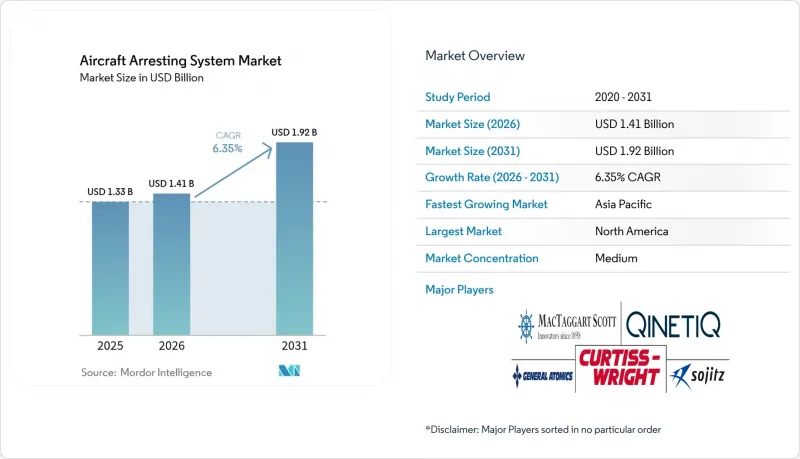
This report is Segmented by Platform (Sea-Based and Land-Based), Technology Type (Cable and Reel, Net Barrier, and More), End User (Military Airbase, Commercial Airport, and More), Component (Energy Absorber, Hook and Cable, and More), Fit (New Installation and Retrofit), and Geography (North America, Europe, Asia-Pacific, and More). The Market Forecasts are Provided in Terms of Value (USD).
Global Aircraft Arresting System Market Trends and Insights
Expansion of Fifth-Generation Combat Aircraft Fleets
F-35 variants place unprecedented loads on arresting hooks, prompting rapid material upgrades and hook-point redesigns to meet 15-engagement life requirements. Carrier-borne F-35C testing revealed early wear that forced replacement after single-digit cycles, driving innovation in high-strength alloys. Elevated approach weights, 18,000 lbs with full payload, require larger energy-absorber capacity, fueling procurement of electromagnetic systems able to modulate deceleration precisely. Marine Corps trials with M-31 gear at Twentynine Palms proved the aircraft's flexibility for Expeditionary Advanced Base Operations. The US FY 2025 aviation budget of USD 61.2 billion underwrites aircraft and corresponding arresting upgrades.
Growth in Short-Runway and Expeditionary Airfield Operations
Distributed-operations doctrine pushes arresting systems into austere zones. The Air Force's Mobile Aircraft Arresting System (MAAS) can be installed on gravel or asphalt in two hours by six airmen. Exercises such as Operation BEEFY validated the MAAS deployment for F-16s under challenging weather. Expeditionary interest extends to adapting Electromagnetic Aircraft Launch System (EMALS) for shore bases, offering catapult-like flexibility without full-length runways. These deployments enlarge the aircraft arresting system market as nations harden dispersed operating bases.
High Up-Front Capital Expenditure and Lengthy Certification Cycles
Full EMAS installation can exceed USD 10 million per runway end, forcing smaller airports to rely on FAA grants that cover up to 95%, yet remain competitive to secure. Defense programs face similar burdens; AAG unit costs breached procurement thresholds after design changes, underscoring certification complexity in new technology. Proprietary systems limit vendor competition, elevating acquisition and lifecycle costs, which restrains broader adoption in the aircraft arresting system industry.
Other drivers and restraints analyzed in the detailed report include:
- Global Safety-Regulation Convergence toward Runway-End Over-Run Protection
- Technological Shift from Hydraulic to Electromagnetic and Rotary-Friction Systems
- Supply-Chain Dependence on Specialty Alloys and High-Cycle Springs
For complete list of drivers and restraints, kindly check the Table Of Contents.
Segment Analysis
Sea-based platforms are forecast to grow at an 8.12% CAGR, closing the gap with dominant land installations with a 64.02% aircraft arresting system market share in 2025. Fleet expansion in Asia-Pacific-including China's Fujian and South Korea's CVX-requires electromagnetic arrestors to handle heavier jets and future unmanned systems. US-French collaboration on next-generation carriers signals similar technology migration to Europe.
Land systems remain essential for dispersed operations. MAAS enables two-hour deployment on roads and packed earth, supporting fighter detachments without traditional infrastructure. Commercial airports adopt EMAS, where terrain blocks runway extensions, with more than 500 installations recorded by 2024. Both trends sustain a diversified aircraft arresting system market.
Engineered Material Arresting System (EMAS) revenue grows at a 8.86% CAGR, eroding the 36.72% share held by Cable and Reel designs. FAA studies on next-generation materials anticipate end-of-life replacement waves, opening space for lighter, recyclable blocks that maintain crush characteristics. Finite-element tests of pervious concrete confirm its capacity to decelerate aircraft rapidly while simplifying drainage, demonstrating future low-carbon options.
Cable and Reel remains entrenched in legacy bases because of hook compatibility and lower purchase cost. Rotary-friction units offer middle-ground solutions for regional airports needing reliable performance without electromagnetic complexity. Electromagnetic designs secure flag-carrier interest due to higher sortie rates and simplified maintenance cycles, positioning them as the premium tier in the aircraft arresting system market.
Complete Report Scope:
- By Platform
- Sea-based
- Land-based
- By Technology Type
- Cable and Reel
- Net Barrier
- Engineered Material Arresting System (EMAS)
- Rotary-Friction/Hydraulic
- Electromagnetic/Magnetic
- By End User
- Military Airbase
- Commercial Airport
- Aircraft Carrier
- By Component
- Energy Absorber
- Hook and Cable
- Support Structure and Foundations
- Control and Monitoring Unit
- By Fit
- New Installation
- Retrofit
- By Geography
- North America
- United States
- Canada
- Europe
- United Kingdom
- Germany
- France
- Italy
- Rest of Europe
- Asia-Pacific
- China
- Japan
- India
- South Korea
- Rest of Asia-Pacific
- South America
- Brazil
- Rest of South America
- Middle East and Africa
- Middle East
- Saudi Arabia
- United Arab Emirates
- Rest of Middle East
- Africa
- South Africa
- Rest of Africa
- Middle East
- North America
Geography Analysis
North America retains a 40.02% share of the aircraft arresting system market, anchored by the US Navy's AAG program and an FAA mandate that has delivered more than 500 EMAS runway ends. Canada's 150 m safety-area rule further expands civil demand, especially at land-locked airports, while Curtiss-Wright's collaboration on helicopter handling builds specialized niches. The FAA's USD 4.0 billion airport-grant line item for 2026 sustains capital flows into safety infrastructure.
Asia-Pacific is the fastest-expanding region, with an 7.94% CAGR, propelled by China's multi-carrier fleet and India's collaboration on next-generation electromagnetic recovery. South Korea's CVX program underscores the region's appetite for advanced solutions. ICAO's Asia-Pacific Aerodrome Design Task Force has codified runway-end safety, ensuring steady civil aviation demand.
Europe maintains incremental growth driven by NATO standardization. French and Belgian upgrades reinforce a shared supplier base, easing logistics for deployed operations, Air Force Technology. Emerging markets in Africa embrace ICAO guidance; Sierra Leone's safety plan specifies arresting systems where terrain prevents wider safety areas. The Middle East leverages US and European foreign military sales channels for carrier and land-based gear, diversifying the global aircraft arresting system market.
- Curtiss-Wright Corporation
- General Atomics
- MacTaggart, Scott and Company Limited
- Runway Safe Group AB
- SCAMA AB
- A-tech Inc.
- QinetiQ Group
- The Boeing Company
- Sojitz Aerospace Corporation
- John Galt International Engineering Limited
- SDT Space & Defence Technologies Inc.
- TEKJET A.S.
- Neometrix
- SIR-BA Technology and Defense Industry Inc.
Additional Benefits:
- The market estimate (ME) sheet in Excel format
- 3 months of analyst support
TABLE OF CONTENTS
1 INTRODUCTION
- 1.1 Study Assumptions and Market Definition
- 1.2 Scope of the Study
2 RESEARCH METHODOLOGY
3 EXECUTIVE SUMMARY
4 MARKET LANDSCAPE
- 4.1 Market Overview
- 4.2 Market Drivers
- 4.2.1 Expansion of fifth-generation combat aircraft fleets
- 4.2.2 Growth in short-runway and expeditionary airfield operations
- 4.2.3 Global safety-regulation convergence toward runway-end over-run protection
- 4.2.4 Technological shift from hydraulic to electromagnetic and rotary-friction systems
- 4.2.5 Insurance and liability pressures driving civil-airport retrofits
- 4.2.6 Increase in worldwide aircraft-carrier and LHD/LHA deployments
- 4.3 Market Restraints
- 4.3.1 High up-front capital expenditure and lengthy certification cycles
- 4.3.2 Supply-chain dependence on specialty alloys and high-cycle springs
- 4.3.3 Competing investment priorities: autobrake and runway-surface enhancements
- 4.3.4 Limited standardization across aircraft types
- 4.4 Value Chain Analysis
- 4.5 Regulatory and Technological Outlook
- 4.6 Porter's Five Forces Analysis
- 4.6.1 Bargaining Power of Suppliers
- 4.6.2 Bargaining Power of Buyers
- 4.6.3 Threat of New Entrants
- 4.6.4 Threat of Substitutes
- 4.6.5 Competitive Rivalry
5 MARKET SIZE AND GROWTH FORECASTS (VALUE)
- 5.1 By Platform
- 5.1.1 Sea-based
- 5.1.2 Land-based
- 5.2 By Technology Type
- 5.2.1 Cable and Reel
- 5.2.2 Net Barrier
- 5.2.3 Engineered Material Arresting System (EMAS)
- 5.2.4 Rotary-Friction/Hydraulic
- 5.2.5 Electromagnetic/Magnetic
- 5.3 By End User
- 5.3.1 Military Airbase
- 5.3.2 Commercial Airport
- 5.3.3 Aircraft Carrier
- 5.4 By Component
- 5.4.1 Energy Absorber
- 5.4.2 Hook and Cable
- 5.4.3 Support Structure and Foundations
- 5.4.4 Control and Monitoring Unit
- 5.5 By Fit
- 5.5.1 New Installation
- 5.5.2 Retrofit
- 5.6 By Geography
- 5.6.1 North America
- 5.6.1.1 United States
- 5.6.1.2 Canada
- 5.6.2 Europe
- 5.6.2.1 United Kingdom
- 5.6.2.2 Germany
- 5.6.2.3 France
- 5.6.2.4 Italy
- 5.6.2.5 Rest of Europe
- 5.6.3 Asia-Pacific
- 5.6.3.1 China
- 5.6.3.2 Japan
- 5.6.3.3 India
- 5.6.3.4 South Korea
- 5.6.3.5 Rest of Asia-Pacific
- 5.6.4 South America
- 5.6.4.1 Brazil
- 5.6.4.2 Rest of South America
- 5.6.5 Middle East and Africa
- 5.6.5.1 Middle East
- 5.6.5.1.1 Saudi Arabia
- 5.6.5.1.2 United Arab Emirates
- 5.6.5.1.3 Rest of Middle East
- 5.6.5.2 Africa
- 5.6.5.2.1 South Africa
- 5.6.5.2.2 Rest of Africa
- 5.6.5.1 Middle East
- 5.6.1 North America
6 COMPETITIVE LANDSCAPE
- 6.1 Market Concentration
- 6.2 Strategic Moves
- 6.3 Market Share Analysis
- 6.4 Company Profiles (includes Global Level Overview, Market Level Overview, Core Segments, Financials as available, Strategic Information, Market Rank/Share, Products and Services, Recent Developments)
- 6.4.1 Curtiss-Wright Corporation
- 6.4.2 General Atomics
- 6.4.3 MacTaggart, Scott and Company Limited
- 6.4.4 Runway Safe Group AB
- 6.4.5 SCAMA AB
- 6.4.6 A-tech Inc.
- 6.4.7 QinetiQ Group
- 6.4.8 The Boeing Company
- 6.4.9 Sojitz Aerospace Corporation
- 6.4.10 John Galt International Engineering Limited
- 6.4.11 SDT Space & Defence Technologies Inc.
- 6.4.12 TEKJET A.S.
- 6.4.13 Neometrix
- 6.4.14 SIR-BA Technology and Defense Industry Inc.
7 MARKET OPPORTUNITIES AND FUTURE OUTLOOK
- 7.1 White-space and Unmet-Need Assessment

