PUBLISHER: Mordor Intelligence | PRODUCT CODE: 2123068

PUBLISHER: Mordor Intelligence | PRODUCT CODE: 2123068
Payment As A Service - Market Share Analysis, Industry Trends & Statistics, Growth Forecasts (2026 - 2031)
According to Mordor Intelligence, the payment as a service market size was valued at USD 14.52 billion in 2025 and estimated to grow from USD 19.09 billion in 2026 to reach USD 74.94 billion by 2031, at a CAGR of 31.45% during the forecast period (2026-2031).
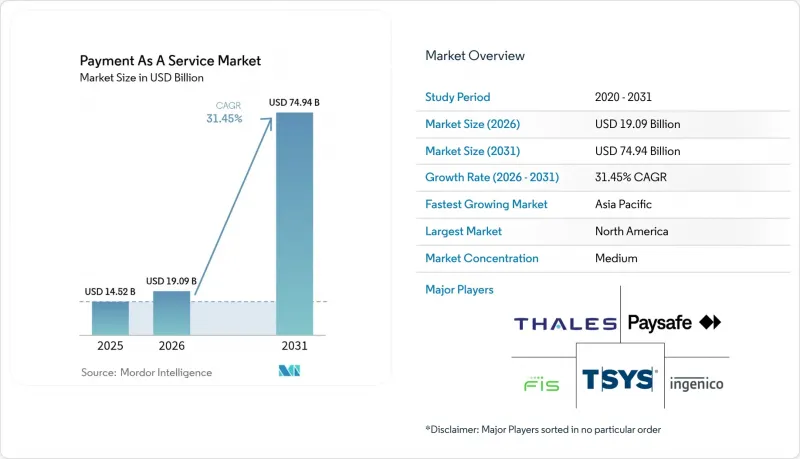
This report is Segmented by Type of Services (Merchant Financing, Regulatory Compliance, and More), Payment Method (Digital Wallets, Cryptocurrencies, and More), Deployment Model (Cloud-Based, On-Premise, Hybrid), Organization Size (Large Enterprises, and Small and Medium Enterprises), End-User Industry (Retail and E-Commerce, and More), and Geography. The Market Forecasts are Provided in Terms of Value (USD).
Global Payment As A Service Market Trends and Insights
Rapid Expansion of Real-Time Payment Rails Globally
Central banks across 70 jurisdictions now operate or pilot instant-payment schemes, creating a parallel infrastructure that bypasses legacy card networks. The United States FedNow Service reached 900 participating institutions by late 2024, clearing payments in under 10 seconds and shortening merchant cash cycles from days to seconds. India's Unified Payments Interface (UPI) handled 16.73 billion transactions in December 2024 alone, a 45% year-over-year increase that underscores the momentum behind zero-fee rail. Brazil's Pix processed 42 billion payments in 2024, surpassing combined credit and debit card volumes and prompting acquirers to shift their focus to value-added services. The mandatory adoption of ISO 20022 for correspondent banking has further encouraged providers to adopt modern architectures. As real-time rails proliferate, gateway margins rooted in card-routing complexity face compression, amplifying the need for unified APIs that abstract multiple networks.
Embedded Finance Opportunities for Non-Bank Brands
Enterprises integrate payment acceptance, lending, and card issuance into native experiences to monetize transaction flows. Shopify extended over USD 5 billion in merchant cash advances during 2024, leveraging sales data for real-time underwriting. Uber introduced a driver debit card that provides instant access to earnings and captures interchange revenue at the daily spend level. PSD3 clarifies licensing routes, letting non-banks rely on Banking-as-a-Service partners for regulatory capital and accelerating embedded launches. Stripe's USD 1.1 billion purchase of stablecoin platform Bridge signals that programmable money is viewed as the next adjacency. The shift rewards platforms that treat payments as an embedded utility rather than a standalone service.
Complex Multi-Jurisdiction Compliance Burdens
Fragmented licensing standards require providers to maintain redundant capital buffers, reporting processes, and consumer-protection protocols, thereby inflating compliance costs by 15-20%. PSD3 tilts fraud liability toward payment initiation service providers, necessitating deeper risk reserves. Divergent BNPL affordability rules between the United Kingdom and the United States require parallel underwriting engines. India's data-localization rule for payment aggregators mandates domestic storage, adding regional cloud instances. PCI DSS 4.0 obliges continuous monitoring, raising the bar for merchants to self-host payments. These burdens favor scaled platforms that can amortize compliance overhead.
Other drivers and restraints analyzed in the detailed report include:
- Growth in E-Commerce and Marketplace Transactions
- Regulatory Push Toward Open Banking and PSD2 Compliance
- Data-Privacy and Cyber-Security Concerns
For complete list of drivers and restraints, kindly check the Table Of Contents.
Segment Analysis
Security and fraud protection contributed significantly to the payment as a service market in 2025 and is forecast to grow at a 33.68% CAGR through 2031, outpacing the overall payment as a service market CAGR. Payment applications and gateways, which account for 40.65% of revenue, yet face a margin squeeze as open banking and real-time rails simplify connectivity.
Merchants now evaluate fraud prevention as a revenue safeguard, evidenced by PCI DSS 4.0 rules that have driven cloud-based security uptake. Platforms also bundle merchant financing, using transaction telemetry to underwrite credit; Shopify disbursed more than USD 5 billion in 2024. Regulation-as-a-Service gains relevance as PSD3 tightens liability, and reconciliation tools round out full-stack offerings. Providers that can integrate these features into consumption-priced APIs are best positioned for the expansion of the payment as a service market.
Card networks retained a 48.10% share in 2025, the largest allocation in the payment as a service market share context, although growth trails emerging options. Buy now, pay later is projected to post a 33.05% CAGR through 2031, the fastest among methods, following the FCA's standardization of affordability checks.
Digital wallets continue to scale across the Asia-Pacific region, thanks to UPI's 16.73 billion transactions in December 2024. Account-to-account alternatives are flourishing in Europe, where PSD3 dismantles data exclusivity. Cryptocurrencies remain niche, yet Stripe's stablecoin acquisition signals hedging against potential mainstream adoption as a settlement method. Providers capable of multi-rail orchestration capture broader payment as a service market opportunities.
Complete Report Scope:
- By Type of Services
- Merchant Financing
- Regulatory Compliance
- Security and Fraud Protection
- Payment Applications and Gateways
- Other Type of Services
- By Payment Method
- Card-Based Payments
- Digital Wallets
- Buy Now Pay Later (BNPL)
- Cryptocurrencies
- Other Payment Methods
- By Deployment Model
- Cloud-Based
- On-Premise
- Hybrid
- By Organization Size
- Large Enterprises
- Small and Medium Enterprises
- By End-User Industry
- Retail and E-Commerce
- Banking Financial Services and Insurance (BFSI)
- Hospitality
- Media and Entertainment
- Other End-User Industries
- By Geography
- North America
- United States
- Canada
- Mexico
- Europe
- United Kingdom
- Germany
- France
- Italy
- Rest of Europe
- Asia-Pacific
- China
- Japan
- India
- South Korea
- Rest of Asia
- Middle East and Africa
- Middle East
- Saudi Arabia
- United Arab Emirates
- Rest of Middle East
- Africa
- South Africa
- Egypt
- Rest of Africa
- Middle East
- South America
- Brazil
- Argentina
- Rest of South America
- North America
Geography Analysis
North America contributed 36.05% of the 2025 revenue, the largest regional allocation in the payment as a service market. FedNow's 900-bank network demonstrates the viability of real-time settlement. Canada launched its Real-Time Rail in 2024, yet concentrated banking slows merchant onboarding. Mexico's CoDi QR initiative lifts digital inclusion, but cash remains resilient.
Europe navigates PSD3 transitions that favor account-to-account payments. FCA guidance on variable recurring payments trims subscription friction. Germany's Girocard tallies 6 billion national-only transactions. France's wholesale CBDC pilot tests programmable securities settlement. Klarna processed EUR 10 billion (USD 10.8 billion) across Southern Europe in 2024, showing BNPL appeal.
The Asia-Pacific region records the highest forecast CAGR of 34.52% for the payment as a service market. UPI's December 2024 throughput evidences wallet dominance. China's e-CNY pilot boasts 260 million wallets. Japan's Zengin System processed 2.5 billion instant payments. Korea mandated real-time fraud monitoring, resulting in a 30% reduction in unauthorized losses. Southeast Asia remains fragmented, providing opportunities for aggregation platforms to capitalize on arbitrage.
The Middle East shows uneven uptake: Saudi Arabia's instant rail cleared 500 million payments in 2024, while other markets stay cash-heavy. Israel exports fraud-detection tech globally. Turkey's capital controls complicate cross-border flows. Africa is led by Kenya's M-Pesa, which handles 20 billion transactions, and South Africa's Rapid Payments Programme.
South America pivots from cash as Brazil's Pix tops card volumes. Argentina's Transferencias 3.0 rollout helps combat macroeconomic instability. Chile pilots a wholesale CBDC for cross-border settlement with Peru. High smartphone density supports wallet adoption, yet currency volatility and disparate regulation remain headwinds.
- Fidelity National Information Services Inc.
- Thales Group S.A.
- Ingenico Group S.A.
- Agilysys Inc.
- Paysafe Holdings UK Limited
- Total System Services LLC
- Mastercard Incorporated
- PayPal Holdings Inc.
- Verifone Systems Inc.
- Pineapple Payments Holdings LLC
- Adyen N.V.
- Stripe Inc.
- Block Inc. (Square)
- Worldline S.A.
- Checkout Ltd.
- Marqeta Inc.
- Rapyd Financial Network Ltd.
- Fiserv Inc.
- ACI Worldwide Inc.
- PayU Payments Private Limited
Additional Benefits:
- The market estimate (ME) sheet in Excel format
- 3 months of analyst support
TABLE OF CONTENTS
1 INTRODUCTION
- 1.1 Study Assumptions and Market Definition
- 1.2 Scope of the Study
2 RESEARCH METHODOLOGY
3 EXECUTIVE SUMMARY
4 MARKET LANDSCAPE
- 4.1 Market Overview
- 4.2 Market Drivers
- 4.2.1 Rising Smartphone Penetration and Digital Service Adoption
- 4.2.2 Growth in E-Commerce and Marketplace Transactions
- 4.2.3 Regulatory Push Toward Open Banking and PSD2 Compliance
- 4.2.4 Rapid Expansion of Real-Time Payment Rails Globally
- 4.2.5 Embedded Finance Opportunities for Non-Bank Brands
- 4.2.6 Uptake of PayFac-as-a-Service Models by SMEs
- 4.3 Market Restraints
- 4.3.1 Lack of Globally Harmonised Payment Standards
- 4.3.2 Complex Multi-Jurisdiction Compliance Burdens
- 4.3.3 Data-Privacy and Cyber-Security Concerns
- 4.3.4 High Chargeback and Fraud-Related Operating Costs
- 4.4 Value-Chain Analysis
- 4.5 Regulatory Landscape
- 4.6 Technological Outlook
- 4.7 Impact of Macroeconomic Factors on the Market
- 4.8 Porter's Five Forces Analysis
- 4.8.1 Bargaining Power of Suppliers
- 4.8.2 Bargaining Power of Buyers/Consumers
- 4.8.3 Threat of New Entrants
- 4.8.4 Threat of Substitute Products
- 4.8.5 Intensity of Competitive Rivalry
5 MARKET SIZE AND GROWTH FORECASTS (VALUE)
- 5.1 By Type of Services
- 5.1.1 Merchant Financing
- 5.1.2 Regulatory Compliance
- 5.1.3 Security and Fraud Protection
- 5.1.4 Payment Applications and Gateways
- 5.1.5 Other Type of Services
- 5.2 By Payment Method
- 5.2.1 Card-Based Payments
- 5.2.2 Digital Wallets
- 5.2.3 Buy Now Pay Later (BNPL)
- 5.2.4 Cryptocurrencies
- 5.2.5 Other Payment Methods
- 5.3 By Deployment Model
- 5.3.1 Cloud-Based
- 5.3.2 On-Premise
- 5.3.3 Hybrid
- 5.4 By Organization Size
- 5.4.1 Large Enterprises
- 5.4.2 Small and Medium Enterprises
- 5.5 By End-User Industry
- 5.5.1 Retail and E-Commerce
- 5.5.2 Banking Financial Services and Insurance (BFSI)
- 5.5.3 Hospitality
- 5.5.4 Media and Entertainment
- 5.5.5 Other End-User Industries
- 5.6 By Geography
- 5.6.1 North America
- 5.6.1.1 United States
- 5.6.1.2 Canada
- 5.6.1.3 Mexico
- 5.6.2 Europe
- 5.6.2.1 United Kingdom
- 5.6.2.2 Germany
- 5.6.2.3 France
- 5.6.2.4 Italy
- 5.6.2.5 Rest of Europe
- 5.6.3 Asia-Pacific
- 5.6.3.1 China
- 5.6.3.2 Japan
- 5.6.3.3 India
- 5.6.3.4 South Korea
- 5.6.3.5 Rest of Asia
- 5.6.4 Middle East and Africa
- 5.6.4.1 Middle East
- 5.6.4.1.1 Saudi Arabia
- 5.6.4.1.2 United Arab Emirates
- 5.6.4.1.3 Rest of Middle East
- 5.6.4.2 Africa
- 5.6.4.2.1 South Africa
- 5.6.4.2.2 Egypt
- 5.6.4.2.3 Rest of Africa
- 5.6.4.1 Middle East
- 5.6.5 South America
- 5.6.5.1 Brazil
- 5.6.5.2 Argentina
- 5.6.5.3 Rest of South America
- 5.6.1 North America
6 COMPETITIVE LANDSCAPE
- 6.1 Market Concentration
- 6.2 Strategic Moves
- 6.3 Market Share Analysis
- 6.4 Company Profiles (includes Global level Overview, Market level overview, Core Segments, Financials as available, Strategic Information, Market Rank/Share for key companies, Products and Services, and Recent Developments)
- 6.4.1 Fidelity National Information Services Inc.
- 6.4.2 Thales Group S.A.
- 6.4.3 Ingenico Group S.A.
- 6.4.4 Agilysys Inc.
- 6.4.5 Paysafe Holdings UK Limited
- 6.4.6 Total System Services LLC
- 6.4.7 Mastercard Incorporated
- 6.4.8 PayPal Holdings Inc.
- 6.4.9 Verifone Systems Inc.
- 6.4.10 Pineapple Payments Holdings LLC
- 6.4.11 Adyen N.V.
- 6.4.12 Stripe Inc.
- 6.4.13 Block Inc. (Square)
- 6.4.14 Worldline S.A.
- 6.4.15 Checkout Ltd.
- 6.4.16 Marqeta Inc.
- 6.4.17 Rapyd Financial Network Ltd.
- 6.4.18 Fiserv Inc.
- 6.4.19 ACI Worldwide Inc.
- 6.4.20 PayU Payments Private Limited
7 MARKET OPPORTUNITIES AND FUTURE OUTLOOK
- 7.1 White-Space and Unmet-Need Assessment

