PUBLISHER: Mordor Intelligence | PRODUCT CODE: 2123079

PUBLISHER: Mordor Intelligence | PRODUCT CODE: 2123079
Duty Free And Travel Retail - Market Share Analysis, Industry Trends & Statistics, Growth Forecasts (2026 - 2031)
According to Mordor Intelligence, the duty free and travel retail market size is projected to be USD 94.24 billion in 2025, USD 102.51 billion in 2026, and reach USD 156.15 billion by 2031, growing at a CAGR of 8.78% from 2026 to 2031.
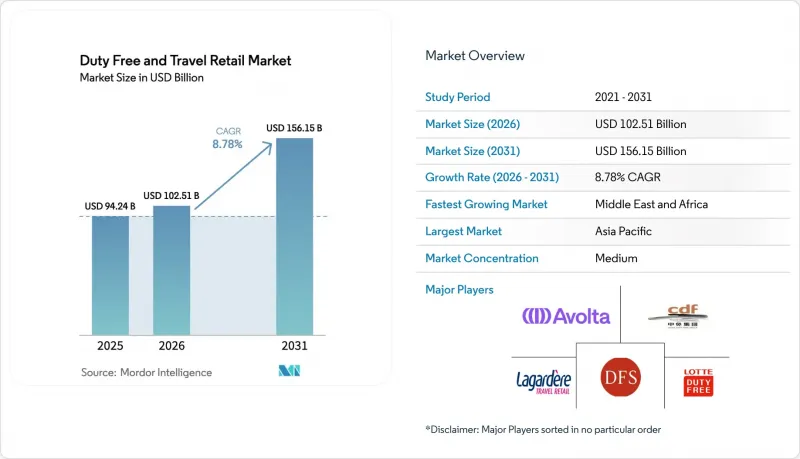
This report Segments the Industry Into by Product Type (Perfumes & Cosmetics, Wines & Spirits, and More), by Distribution Channel (Airport Shops, On-Board Aircraft, and More), by Price Range (Premium & Luxury, Mid-Tier, and More), by Geography (North America, South America, and More), and More Segments. The Market Forecasts are Provided in Terms of Value (USD).
Global Duty Free And Travel Retail Market Trends and Insights
Expansion of Offshore Duty-Free Zones and Free-Trade Islands Boosting Shopper Footfall
Hainan's shift to island-wide special customs operations in December 2025 materially broadened zero-tariff eligibility and simplified logistics, which strengthens its role as a policy-driven retail destination and encourages luxury and premium brands to scale presence on the island. The move institutionalizes a durable value proposition for travellers and residents, supporting higher visit frequency and deeper baskets as more product categories become eligible under the free-trade framework. Complementary rules on value-added processing pave the way for selective local finishing and assembly, which further integrates retail, logistics, and light manufacturing within a single consumption hub. The policy architecture signals to other tourism economies that calibrated tariff and customs settings can unlock incremental demand in the duty-free and travel retail market. As travel flows normalize, these free-trade retail models broaden category choice, price ladders, and promotional flexibility while maintaining regulatory guardrails. The ripple effect is a positive cycle where higher footfall attracts more brands and store investments, which in turn improve shopper experience and conversion in the duty-free and travel retail market.
Recovery of Long-Haul Leisure Travel Reviving Fragrance and Beauty Category Spend
International travel demand now exceeds pre-pandemic levels, with 1.1 billion arrivals in the first nine months of 2025 and a 5% year-on-year uplift, indicating sustained support for cross-border shopping propensity. Long-haul routes linking Asia-Pacific, Europe, and the Middle East hubs are particularly supportive for categories like beauty and fashion that benefit from destination and transfer shopping patterns. Airports and operators have responded with refined category adjacencies and traveller segment targeting, including more localized assortments that align with origin markets and travel purpose. Several leading hubs reported strong 2025 retail months that coincided with peak travel waves, underscoring how recovered capacity and stable schedules translate into retail throughput in the duty-free and travel retail market. The net effect is renewed momentum for perfumes and cosmetics in airport retail, strengthened by a greater focus on high-conversion merchandising and targeted activations.
Progressive Plain-Packaging and Marketing Curbs on Tobacco Products Shrinking Margins
Regulatory momentum on tobacco control has strengthened worldwide under the WHO Framework Convention on Tobacco Control, which does not exempt duty-free channels from core measures like health warnings and marketing curbs. Packaging restrictions reduce brand-led differentiation at the point of sale and compress premium tiers, shifting price competition toward value formats and alternative nicotine products. WHO and regional health bodies report continued expansion of tobacco control coverage, raising compliance requirements for operators and suppliers in the duty-free and travel retail market. These measures also constrain promotional levers in-store, impacting category visibility and speed of new product introductions in regulated jurisdictions. Retailers are responding by focusing on compliant shopper communication, supply chain integrity, and careful allocation of shelf space across tobacco and non-tobacco alternatives. Over the long term, cumulative policy effects point to lower growth from traditional tobacco, encouraging a mix shift toward higher-margin categories in the duty-free and travel retail market.
Other drivers and restraints analyzed in the detailed report include:
- Premiumization Trend in Duty-Free Liquor Targeting Millennial Traveler Segments
- Introduction of Arrival-Hall Duty-Free Formats Unlocking Incremental Purchases
- Currency Volatility in Emerging Tourism Economies Eroding Perceived Price Advantage
For complete list of drivers and restraints, kindly check the Table Of Contents.
Segment Analysis
Perfumes and cosmetics accounted for 35.74% of the duty free and travel retail market share in 2025, reflecting the category's centrality to traffic-driven retail and the crossover appeal of prestige beauty among international travellers. The duty free and travel retail market is benefiting from the return of long-haul itineraries, which typically convert at higher rates in beauty, supported by brand activations and curated gifting assortments that fit travel occasions. Beauty operators continue to refine space planning and staff training to lift per-passenger yield while aligning stock depth to peaks in holiday travel. Adjacencies with fashion accessories and watches provide a pathway to multi-category baskets as hubs expand experiential zones. With core traffic drivers normalizing, the category mix in the duty free and travel retail market is anchored by beauty leadership and rising premiumization.
Fashion and accessories are the fastest-growing product group, set to expand at a 12.87% CAGR through 2031, supported by luxury-led concepts and curated assortments that include small leather goods, sunglasses, and selective pre-owned formats where permitted. Wines and spirits are capturing mix upgrades through storytelling-led promotions and exclusives that raise average selling price without sacrificing volume, a strategy reinforced by operator focus on non-aeronautical yield per square foot. Tobacco faces structural headwinds as regulatory controls broaden, which shifts emphasis toward compliant merchandising and careful space allocation while favouring growth in alternative categories. Confectionery and fine foods leverage sense-of-place and localized gifting, which sustain impulse conversion close to gates and in arrivals stores. Electronics and gadgets contribute steady traffic with device and accessory refresh cycles that align with travel timing in the duty free and travel retail market.
Airport shops held 61.73% share of the duty free and travel retail market size in 2025, reflecting the central role of airside locations as the primary interface for international shoppers. The scale and visibility of airport stores allow operators to orchestrate category adjacencies, brand takeovers, and cross-promotions that lift conversion as dwell time stabilizes. Leading operators continue to invest in digital infrastructure and store automation that compress checkout times and unlock staff bandwidth for higher-touch selling. As traffic and schedules normalize, airports benefit from higher predictability in peaks, supporting better inventory planning and targeted promotions in the duty free and travel retail market. Meanwhile, curated arrivals concepts were permitted to add incremental capacity and convenience for inbound passengers.
E-commerce and omnichannel pre-order are the fastest-growing channels, advancing at a 12.74% CAGR through 2031 as digital journeys move upstream into trip planning and seat selection. Loyalty-driven personalization and real-time inventory visibility are key levers, as seen in programs that report higher average transaction values and repeat purchase behaviour among enrolled travellers. Airport-branded sites and partner platforms enable reserved pickup and upsell at collection points, improving conversion and reducing basket abandonment. Smart lockers and click-and-collect remove friction for time-sensitive passengers while creating new touchpoints for cross-selling. Onboard programs are incorporating pre-order integrations, but scale remains anchored in airport and omnichannel flows in the duty free and travel retail market.
Complete Report Scope:
- By Product Type
- Perfumes & Cosmetics
- Wines & Spirits
- Fashion & Accessories
- Tobacco Products
- Confectionery & Fine Foods
- Electronics & Gadgets
- By Distribution Channel
- Airport Shops
- On-board Aircraft
- Seaport & Cruise Line Stores
- Border & Downtown Duty-Free
- Railway Stations
- E-commerce / Omnichannel Pre-order
- By Price Range
- Premium & Luxury
- Mid-tier
- Economy
- By Consumer Profile
- Leisure Travelers
- Business Travelers
- VFR & Expat Shoppers
- By Geography
- North America
- United States
- Canada
- Mexico
- South America
- Brazil
- Peru
- Chile
- Argentina
- Rest of South America
- Europe
- United Kingdom
- Germany
- France
- Spain
- Italy
- BENELUX (Belgium, Netherlands, Luxembourg)
- NORDICS (Denmark, Finland, Iceland, Norway, Sweden)
- Rest of Europe
- Asia-Pacific
- India
- China
- Japan
- Australia
- South Korea
- South-East Asia (Singapore, Malaysia, Thailand, Indonesia, Vietnam, Philippines)
- Rest of Asia-Pacific
- Middle East and Africa
- United Arab Emirates
- Saudi Arabia
- South Africa
- Nigeria
- Rest of Middle East and Africa
- North America
Geography Analysis
Asia-Pacific captured 56.84% of the duty free and travel retail market size in 2025, supported by large aviation corridors and policy innovations that elevate offshore consumption. Hainan's special customs regime is reinforcing the island's position as an offshore shopping destination by expanding zero-tariff coverage and streamlining customs, which sustains shopper footfall and broadens category appeal. Regional hubs continue to invest in terminal enhancements and digital journeys, adding capacity and improving retail adjacency. As travel rebalances, Japan, Korea, and Southeast Asia corridors offer resilient demand for beauty, fashion, and luxury gifting. These pillars reinforce Asia-Pacific's scale advantage in the duty free and travel retail market.
The Middle East is the fastest-growing region with a projected 9.85% CAGR through 2031, buoyed by capacity expansions and luxury-led retail propositions at mega-hubs. Operators are focusing on high-margin categories, curated exclusives, and loyalty at scale to maximize spend from transfer-heavy traffic. Several airports have reported strong 2025 retail months aligned with robust long-haul flows, illustrating how consistent connectivity translates into retail throughput. Investments in store upgrades, wayfinding, and quick-service checkouts are designed to preserve conversion as security processes evolve. These factors add momentum to the duty free and travel retail market in the region.
Europe and North America remain critical through their large hub networks and steady adoption of omnichannel pre-order that deepens engagement beyond the gate. Strategic concessions in leading European airports are increasing retail square footage and refreshing offer architecture, which supports improved yield per passenger. In North America, airport authorities and operators are aligning on digital-first store concepts and flexible layouts that support rapid category pivots as travel patterns shift. South America and Africa show rising contributions as concessions expand and store networks grow at primary gateways, aided by global operators' entry and investment. These developments broaden the footprint and resilience of the duty free and travel retail market.
- Avolta AG (Dufry)
- China Duty Free Group Co. Ltd.
- Lagardere Travel Retail
- DFS Group (LVMH)
- Lotte Duty Free
- Dubai Duty Free
- Heinemann SE & Co. KG
- Qatar Duty Free
- King Power International (Thailand)
- Aer Rianta International
- 3Sixty Duty Free
- Flemingo International
- WHSmith Travel
- Shilla Duty Free
- Bahrain Duty Free
- Duty Free Americas
- Delhi Duty Free
- JR/Duty Free (Australia)
- Beirut Duty Free
- Nuance Group
- Mumbai Travel Retail
- London Heathrow - World Duty Free
- Alpha Airport Shopping
- Qatar Airways In-flight Retail
- ANA Trading Duty Free
Additional Benefits:
- The market estimate (ME) sheet in Excel format
- 3 months of analyst support
TABLE OF CONTENTS
1 Introduction
- 1.1 Study Assumptions & Market Definition
- 1.2 Scope of the Study
2 Research Methodology
3 Executive Summary
4 Market Landscape
- 4.1 Market Overview
- 4.2 Market Drivers
- 4.2.1 Expansion of offshore duty-free zones and free-trade islands boosting shopper footfall
- 4.2.2 Airport privatization & non-aeronautical revenue focus expanding retail floor plates
- 4.2.3 Recovery of long-haul leisure travel reviving fragrance & beauty category spend
- 4.2.4 Rise of omni-channel pre-order / click-and-collect elevating conversion rates
- 4.2.5 Premiumization trend in duty-free liquor targeting millennial traveler segments
- 4.2.6 Introduction of arrival-hall duty-free formats unlocking incremental purchases
- 4.3 Market Restraints
- 4.3.1 Progressive plain-packaging & marketing curbs on tobacco products shrinking margins
- 4.3.2 Currency volatility in emerging tourism economies eroding perceived price advantage
- 4.3.3 Lengthening security & immigration wait-times reducing passenger dwell-time for shopping
- 4.3.4 Ingredient-specific regulatory bans narrowing cosmetics & sunscreen assortments
- 4.4 Value / Supply-Chain Analysis
- 4.5 Regulatory or Technological Outlook
- 4.6 Porter's Five Forces
- 4.6.1 Threat of New Entrants
- 4.6.2 Bargaining Power of Suppliers
- 4.6.3 Bargaining Power of Buyers
- 4.6.4 Threat of Substitutes
- 4.6.5 Competitive Rivalry
5 Market Size & Growth Forecasts
- 5.1 By Product Type
- 5.1.1 Perfumes & Cosmetics
- 5.1.2 Wines & Spirits
- 5.1.3 Fashion & Accessories
- 5.1.4 Tobacco Products
- 5.1.5 Confectionery & Fine Foods
- 5.1.6 Electronics & Gadgets
- 5.2 By Distribution Channel
- 5.2.1 Airport Shops
- 5.2.2 On-board Aircraft
- 5.2.3 Seaport & Cruise Line Stores
- 5.2.4 Border & Downtown Duty-Free
- 5.2.5 Railway Stations
- 5.2.6 E-commerce / Omnichannel Pre-order
- 5.3 By Price Range
- 5.3.1 Premium & Luxury
- 5.3.2 Mid-tier
- 5.3.3 Economy
- 5.4 By Consumer Profile
- 5.4.1 Leisure Travelers
- 5.4.2 Business Travelers
- 5.4.3 VFR & Expat Shoppers
- 5.5 By Geography
- 5.5.1 North America
- 5.5.1.1 United States
- 5.5.1.2 Canada
- 5.5.1.3 Mexico
- 5.5.2 South America
- 5.5.2.1 Brazil
- 5.5.2.2 Peru
- 5.5.2.3 Chile
- 5.5.2.4 Argentina
- 5.5.2.5 Rest of South America
- 5.5.3 Europe
- 5.5.3.1 United Kingdom
- 5.5.3.2 Germany
- 5.5.3.3 France
- 5.5.3.4 Spain
- 5.5.3.5 Italy
- 5.5.3.6 BENELUX (Belgium, Netherlands, Luxembourg)
- 5.5.3.7 NORDICS (Denmark, Finland, Iceland, Norway, Sweden)
- 5.5.3.8 Rest of Europe
- 5.5.4 Asia-Pacific
- 5.5.4.1 India
- 5.5.4.2 China
- 5.5.4.3 Japan
- 5.5.4.4 Australia
- 5.5.4.5 South Korea
- 5.5.4.6 South-East Asia (Singapore, Malaysia, Thailand, Indonesia, Vietnam, Philippines)
- 5.5.4.7 Rest of Asia-Pacific
- 5.5.5 Middle East and Africa
- 5.5.5.1 United Arab Emirates
- 5.5.5.2 Saudi Arabia
- 5.5.5.3 South Africa
- 5.5.5.4 Nigeria
- 5.5.5.5 Rest of Middle East and Africa
- 5.5.1 North America
6 Competitive Landscape
- 6.1 Market Concentration
- 6.2 Strategic Moves
- 6.3 Market Share Analysis
- 6.4 Company Profiles {(includes Global level Overview, Market level overview, Core Segments, Financials as available, Strategic Information, Market Rank/Share for key companies, Products & Services, and Recent Developments)}
- 6.4.1 Avolta AG (Dufry)
- 6.4.2 China Duty Free Group Co. Ltd.
- 6.4.3 Lagardere Travel Retail
- 6.4.4 DFS Group (LVMH)
- 6.4.5 Lotte Duty Free
- 6.4.6 Dubai Duty Free
- 6.4.7 Heinemann SE & Co. KG
- 6.4.8 Qatar Duty Free
- 6.4.9 King Power International (Thailand)
- 6.4.10 Aer Rianta International
- 6.4.11 3Sixty Duty Free
- 6.4.12 Flemingo International
- 6.4.13 WHSmith Travel
- 6.4.14 Shilla Duty Free
- 6.4.15 Bahrain Duty Free
- 6.4.16 Duty Free Americas
- 6.4.17 Delhi Duty Free
- 6.4.18 JR/Duty Free (Australia)
- 6.4.19 Beirut Duty Free
- 6.4.20 Nuance Group
- 6.4.21 Mumbai Travel Retail
- 6.4.22 London Heathrow - World Duty Free
- 6.4.23 Alpha Airport Shopping
- 6.4.24 Qatar Airways In-flight Retail
- 6.4.25 ANA Trading Duty Free
7 Market Opportunities & Future Outlook
- 7.1 White-space & Unmet-Need Assessment

