PUBLISHER: Mordor Intelligence | PRODUCT CODE: 2123085

PUBLISHER: Mordor Intelligence | PRODUCT CODE: 2123085
Insight As A Service Application - Market Share Analysis, Industry Trends & Statistics, Growth Forecasts (2026 - 2031)
According to Mordor Intelligence, the insight-as-a-service application market size in 2026 is estimated at USD 8.64 billion, growing from 2025 value of USD 7.23 billion with 2031 projections showing USD 21.12 billion, growing at 19.56% CAGR over 2026-2031.
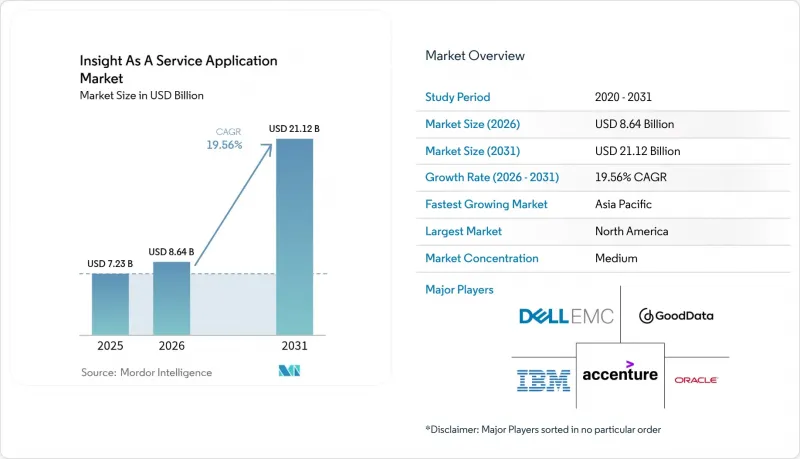
This report is Segmented by Deployment Mode (Public Cloud, and More), Service Type (Predictive Insights, and More), Application (Customer Life-Cycle Management, and More), Organization Size (Large Enterprises, and Small and Medium Enterprises), End-User Industry (BFSI, IT and Telecom, and More), and Geography (North America, and More). The Market Forecasts are Provided in Terms of Value (USD).
Global Insight As A Service Application Market Trends and Insights
Growing Use of Generative AI for Automated Insights
Generative AI is compressing insight delivery from days to minutes. IBM's watsonx.Data embeds large language models inside lakehouse environments, allowing analysts to query structured and unstructured data conversationally. Snowflake processed 12 billion Cortex AI queries in its first quarter, with 35% of these queries utilizing generative functions, such as document summarization. SAP customers cut month-end close cycles by 60% after integrating the Joule Copilot with Analytics Cloud. By automating narrative creation and anomaly detection, generative AI democratizes analytics and broadens the insight-as-a-service application market.
Migration Toward Consumption-Based Analytics Subscriptions
Hybrid pricing, which combines a base fee with usage overages, now covers 61% of software-as-a-service vendors, up from 38% in 2022. Databricks' consumption revenue rose 75% year over year, triple its seat-based growth, after customers expanded real-time and machine-learning workloads. The flexible model removes capital barriers for SMEs and aligns vendor incentives with performance, fueling retention that averages 18 months longer than fixed plans.
Data Security and Safety Concerns
Snowflake's June 2024 breach exposed 165 customer environments after attackers used recycled credentials, shaking confidence in cloud analytics. IBM's X-Force found misconfigurations caused 28% of breaches, many tied to complex permission models on analytics services. Europe's NIS2 directive now requires incident disclosure within 24 hours, adding compliance pressure. Heightened scrutiny slows procurement and lengthens proof-of-concept cycles, limiting near-term expansion.
Other drivers and restraints analyzed in the detailed report include:
- Increasing Adoption of Big Data and IoT
- Increasing Customer Engagement Demand
- Shortage of Domain-Specific Data-Science Talent
For complete list of drivers and restraints, kindly check the Table Of Contents.
Segment Analysis
Hybrid environments are projected to grow at a 20.24% CAGR through 2031, despite the public cloud holding a 55.02% share of the insight-as-a-service application market in 2025. IBM found 87% of enterprises use multiple clouds, with 62% citing compliance as a driver. Red Hat OpenShift subscriptions rose 34% year over year as firms orchestrated Kubernetes across on-premise and public clouds.
Hybrid adoption is on the rise as financial institutions continue to store sensitive data on-premises while training models in hyperscaler regions. Google Cloud's confidential computing encrypts data during processing, bringing regulated workloads to public infrastructure and lifting healthcare customer count 58% in 2024. Edge nodes at factories and stores are now extensions of hybrid clouds, deepening the penetration of the insight-as-a-service application market.
Prescriptive insights, though trailing predictive insight revenue today, are advancing at a 23.12% CAGR as companies automate operational choices. Anaplan's connected planning reduces manual scenario modeling by 70% for consumer goods manufacturers. Workday's 2024 purchase of an optimization engine confirms the pivot toward recommendation-oriented services.
Deep reinforcement learning demonstrates its prescriptive power: DeepMind reduced Google's data-center energy use by 40% in 2024. As more firms embed decision engines directly into workflows, the insight-as-a-service application market size for prescriptive platforms will widen.
Complete Report Scope:
- By Deployment Mode
- Public Cloud
- Private Cloud
- Hybrid Cloud
- By Service Type
- Predictive Insights
- Descriptive Insights
- Prescriptive Insights
- By Application
- Customer Life-Cycle Management
- Revenue Cycle Management
- Branding and Marketing Insights
- Strategy Management
- Supply-Chain Optimization
- Other Applications
- By Organization Size
- Large Enterprises
- Small and Medium Enterprises
- By End-user Industry
- BFSI
- IT and Telecom
- Healthcare
- Retail and E-Commerce
- Manufacturing
- Energy and Utilities
- Other End-user Industries
- By Geography
- North America
- United States
- Canada
- Mexico
- South America
- Brazil
- Argentina
- Rest of South America
- Europe
- Germany
- United Kingdom
- France
- Italy
- Spain
- Rest of Europe
- Asia Pacific
- China
- Japan
- India
- South Korea
- Rest of Asia Pacific
- Middle East and Africa
- Middle East
- Saudi Arabia
- United Arab Emirates
- Turkey
- Rest of Middle East
- Africa
- South Africa
- Nigeria
- Kenya
- Rest of Africa
- Middle East
- North America
Geography Analysis
North America accounted for 40.77% of the insight-as-a-service application market in 2025. The United States Federal Data Strategy mandates the use of open APIs for public datasets by 2025, thereby expanding government analytics demand. Canada allocated CAD 2.4 billion (USD 1.8 billion) for cloud migration in federal agencies, supporting regional growth. Mexico's open-banking regulation generated 450 million API calls monthly by year-end 2024, catalyzing fintech analytics.
The Asia Pacific is projected to post a 21.77% CAGR, the fastest growth rate worldwide. China's Digital Economy Development Plan aims for a 10% annual expansion in data-driven industries. India's Digital India initiative connected 1.2 billion residents to digital ID and payments, broadening analytics workloads in public services. Singapore deployed 110,000 sensors under its Smart Nation program, feeding real-time optimization models. Government mandates and hyperscaler investment combine to deepen the insight-as-a-service application market footprint.
Europe's GDPR influences architectural design through strict data minimization and deletion rules, adding 15-20% to project costs. Germany's Gaia-X federation enrolled 350 firms by late 2024, spurring demand for distributed analytics platforms. The United Kingdom budgeted GBP 1.2 billion (USD 1.5 billion) for public-sector data modernization, with National Health Service projects taking 40% of spending. Emerging markets show pockets of momentum, such as Saudi Arabia's USD 500 billion NEOM smart-city deployment, where edge analytics underpin transport and energy optimization.
- Oracle Corporation
- Accenture plc
- International Business Machines Corporation
- Dell Technologies Inc.
- Deloitte Touche Tohmatsu Limited
- GoodData Corporation
- Capgemini SE
- SmartFocus Ltd.
- Zephyr AI Health Inc.
- NTT Data Corporation
- Microsoft Corporation
- Amazon Web Services Inc.
- Google LLC
- SAP SE
- SAS Institute Inc.
- Salesforce Inc.
- TIBCO Software Inc.
- Alteryx Inc.
- QlikTech International AB
- Tableau Software LLC
- Sisense Inc.
- Domo Inc.
- Teradata Corporation
- MicroStrategy Incorporated
Additional Benefits:
- The market estimate (ME) sheet in Excel format
- 3 months of analyst support
TABLE OF CONTENTS
1 INTRODUCTION
- 1.1 Study Assumptions and Market Definition
- 1.2 Scope of the Study
2 RESEARCH METHODOLOGY
3 EXECUTIVE SUMMARY
4 MARKET LANDSCAPE
- 4.1 Market Overview
- 4.2 Impact of Macroeconomic Factors on the Market
- 4.3 Market Drivers
- 4.3.1 Increasing Adoption of Big Data and IoT
- 4.3.2 Increasing Customer Engagement Demand
- 4.3.3 Growing Use of Generative AI for Automated Insights
- 4.3.4 Migration Toward Consumption-Based Analytics Subscriptions
- 4.3.5 Rising Compliance Complexity Driving Outsourced Insight Demand
- 4.3.6 Expansion of Industry-Specific Vertical AI Platforms
- 4.4 Market Restraints
- 4.4.1 Data Security and Safety Concerns
- 4.4.2 Shortage of Domain-Specific Data-Science Talent
- 4.4.3 Vendor Lock-In and Interoperability Challenges
- 4.4.4 Escalating Cloud-Compute Cost Pressures
- 4.5 Industry Value Chain Analysis
- 4.6 Regulatory Landscape
- 4.7 Technological Outlook
- 4.8 Porter's Five Forces Analysis
- 4.8.1 Threat of New Entrants
- 4.8.2 Bargaining Power of Buyers
- 4.8.3 Bargaining Power of Suppliers
- 4.8.4 Threat of Substitute Products
- 4.8.5 Intensity of Competitive Rivalry
5 MARKET SIZE AND GROWTH FORECASTS (VALUE)
- 5.1 By Deployment Mode
- 5.1.1 Public Cloud
- 5.1.2 Private Cloud
- 5.1.3 Hybrid Cloud
- 5.2 By Service Type
- 5.2.1 Predictive Insights
- 5.2.2 Descriptive Insights
- 5.2.3 Prescriptive Insights
- 5.3 By Application
- 5.3.1 Customer Life-Cycle Management
- 5.3.2 Revenue Cycle Management
- 5.3.3 Branding and Marketing Insights
- 5.3.4 Strategy Management
- 5.3.5 Supply-Chain Optimization
- 5.3.6 Other Applications
- 5.4 By Organization Size
- 5.4.1 Large Enterprises
- 5.4.2 Small and Medium Enterprises
- 5.5 By End-user Industry
- 5.5.1 BFSI
- 5.5.2 IT and Telecom
- 5.5.3 Healthcare
- 5.5.4 Retail and E-Commerce
- 5.5.5 Manufacturing
- 5.5.6 Energy and Utilities
- 5.5.7 Other End-user Industries
- 5.6 By Geography
- 5.6.1 North America
- 5.6.1.1 United States
- 5.6.1.2 Canada
- 5.6.1.3 Mexico
- 5.6.2 South America
- 5.6.2.1 Brazil
- 5.6.2.2 Argentina
- 5.6.2.3 Rest of South America
- 5.6.3 Europe
- 5.6.3.1 Germany
- 5.6.3.2 United Kingdom
- 5.6.3.3 France
- 5.6.3.4 Italy
- 5.6.3.5 Spain
- 5.6.3.6 Rest of Europe
- 5.6.4 Asia Pacific
- 5.6.4.1 China
- 5.6.4.2 Japan
- 5.6.4.3 India
- 5.6.4.4 South Korea
- 5.6.4.5 Rest of Asia Pacific
- 5.6.5 Middle East and Africa
- 5.6.5.1 Middle East
- 5.6.5.1.1 Saudi Arabia
- 5.6.5.1.2 United Arab Emirates
- 5.6.5.1.3 Turkey
- 5.6.5.1.4 Rest of Middle East
- 5.6.5.2 Africa
- 5.6.5.2.1 South Africa
- 5.6.5.2.2 Nigeria
- 5.6.5.2.3 Kenya
- 5.6.5.2.4 Rest of Africa
- 5.6.5.1 Middle East
- 5.6.1 North America
6 COMPETITIVE LANDSCAPE
- 6.1 Market Concentration
- 6.2 Strategic Moves
- 6.3 Market Share Analysis
- 6.4 Company Profiles (includes Global Level Overview, Market Level Overview, Core Segments, Financials as available, Strategic Information, Market Rank / Share for Key Companies, Products and Services, and Recent Developments)
- 6.4.1 Oracle Corporation
- 6.4.2 Accenture plc
- 6.4.3 International Business Machines Corporation
- 6.4.4 Dell Technologies Inc.
- 6.4.5 Deloitte Touche Tohmatsu Limited
- 6.4.6 GoodData Corporation
- 6.4.7 Capgemini SE
- 6.4.8 SmartFocus Ltd.
- 6.4.9 Zephyr AI Health Inc.
- 6.4.10 NTT Data Corporation
- 6.4.11 Microsoft Corporation
- 6.4.12 Amazon Web Services Inc.
- 6.4.13 Google LLC
- 6.4.14 SAP SE
- 6.4.15 SAS Institute Inc.
- 6.4.16 Salesforce Inc.
- 6.4.17 TIBCO Software Inc.
- 6.4.18 Alteryx Inc.
- 6.4.19 QlikTech International AB
- 6.4.20 Tableau Software LLC
- 6.4.21 Sisense Inc.
- 6.4.22 Domo Inc.
- 6.4.23 Teradata Corporation
- 6.4.24 MicroStrategy Incorporated
7 MARKET OPPORTUNITIES AND FUTURE OUTLOOK
- 7.1 White-Space and Unmet-Need Assessment

