PUBLISHER: Mordor Intelligence | PRODUCT CODE: 2123088

PUBLISHER: Mordor Intelligence | PRODUCT CODE: 2123088
Digital Rights Management (DRM) - Market Share Analysis, Industry Trends & Statistics, Growth Forecasts (2026 - 2031)
According to Mordor Intelligence, digital rights management market size in 2026 is estimated at USD 6.93 billion, growing from 2025 value of USD 6.23 billion with 2031 projections showing USD 11.76 billion, growing at 11.16% CAGR over 2026-2031.
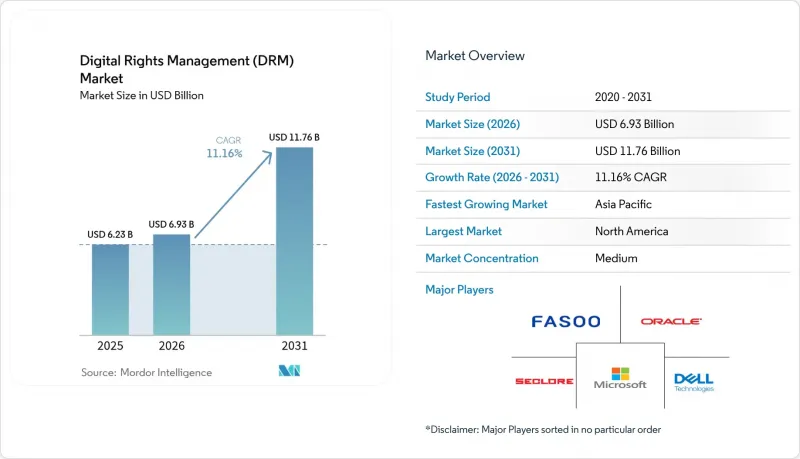
This report is Segmented by Component (Software, Services), Deployment Mode (On-Premises, Cloud), End-User Enterprise Size (Small and Medium Enterprises, Large Enterprises), End-User Industry (Media and Entertainment, BFSI, Healthcare, and More), and Geography (North America, South America, Europe, Asia Pacific, Middle East and Africa). The Market Forecasts are Provided in Terms of Value (USD).
Global Digital Rights Management (DRM) Market Trends and Insights
Proliferation of OTT Video and Streaming Subscriptions
OTT platforms distribute higher-value 4K and 8K assets that demand hardened encryption and multi-DRM strategies to span Widevine, FairPlay, and PlayReady. Live sports streaming intensifies low-latency protection requirements, especially across mobile-centric Asia Pacific audiences. Platform operators leverage adaptive bitrate streaming coupled with forensic watermarking to curb session hijacking. The diversity of connected devices from smart TVs to in-vehicle infotainment fuels demand for standards-based DRM that scales seamlessly across chipsets. Competitive differentiation now centers on delivering robust security without buffering or resolution downgrades, ensuring subscriber retention in an increasingly crowded content landscape.
BYOD and Remote-Work Data-Security Mandates
Permanent hybrid-work policies push DRM from content protection into file-centric data-security frameworks. Enterprises integrate Zero-Trust principles, requiring persistent encryption that travels with a document and authenticates user identity at every access point. Mobile-first DRM, exemplified by Fasoo's GPS-aware screen-watermarking, safeguards data on unmanaged Android and iOS devices while feeding behavioral telemetry into security operations centers . Integration with identity-and-access-management platforms enables real-time revocation, meeting auditors' insistence on demonstrable control. The driver is most pronounced in regulated verticals where fines for non-compliance escalate annually.
Persistent Device/Format Incompatibilities
Ecosystem fragmentation forces content owners to juggle multiple DRM implementations as browser vendors deprecate legacy modules. Google's discontinuation of Widevine CDM on iOS compels developers to integrate FairPlay for Apple hardware, doubling maintenance overhead. Older smart TVs and set-top boxes receive security patches irregularly, creating weak links in license enforcement chains. Enterprises with mixed mobile and desktop fleets struggle to standardize policy enforcement, elevating support costs and delaying rollout of new content formats.
Other drivers and restraints analyzed in the detailed report include:
- Rising Digital-IP Litigation and Penalties
- Government Push for Data-Sovereignty Compliance
- User-Experience Backlash Over Intrusive Controls
For complete list of drivers and restraints, kindly check the Table Of Contents.
Segment Analysis
Software platforms retained 63.85% of Digital Rights Management market share in 2025, reflecting entrenched demand for integrated license servers, analytics dashboards, and rules engines. Services, however, posted a 17.32% CAGR as organizations turned to specialists for multi-DRM orchestration and blockchain integration. Managed-security providers bundle 24X7 license-server monitoring with rapid threat-intel updates, appealing to SMEs that lack in-house expertise.
Adobe's Digital Media revenue of USD 4.23 billion in Q1 2025 underscores buyers' willingness to invest in AI-infused DRM capabilities. Consulting engagements now extend beyond deployment into continuous compliance auditing, supporting a shift toward outcome-based service contracts. Over the forecast horizon, services are expected to bridge skills gaps as quantum-safe encryption pilots emerge, cementing their share of incremental expenditure.
The cloud model represented 56.10% of Digital Rights Management market size in 2025 and is forecast to expand at 17.95% CAGR. Centralized license servers ease policy updates and scale elastically to support event-driven spikes such as live sports finals. IBM notes that 82% of data breaches occur in cloud venues, prompting enterprises to extend DRM controls into object-storage tiers and SaaS repositories.
Hybrid topologies flourish where creative assets remain on-premises for editing while distribution keys reside in regional clouds to satisfy localization mandates. Edge nodes embed lightweight DRM to secure 4K streams at sub-second latency, reducing buffering complaints in bandwidth-variable markets. On-premises deployments persist in defense and public-safety domains where air-gapped environments prevail, yet even these sectors explore private-cloud key management to cut operational overhead.
Complete Report Scope:
- By Component
- Software
- Services
- By Deployment Mode
- On-premises
- Cloud
- By End-user Enterprise Size
- Small and Medium Enterprises (SMEs)
- Large Enterprises
- By End-user Industry
- Media and Entertainment
- BFSI
- IT and Telecommunication
- Healthcare
- Education
- Government and Public Sector
- Others End-user Industry (Manufacturing, Retail, etc.)
- By Geography
- North America
- United States
- Canada
- Mexico
- South America
- Brazil
- Argentina
- Rest of South America
- Europe
- United Kingdom
- Germany
- France
- Italy
- Spain
- Russia
- Rest of Europe
- Asia Pacific
- China
- Japan
- India
- South Korea
- Australia and New Zealand
- Rest of Asia Pacific
- Middle East and Africa
- Middle East
- Saudi Arabia
- United Arab Emirates
- Turkey
- Rest of Middle East
- Africa
- South Africa
- Nigeria
- Kenya
- Rest of Africa
- Middle East
- North America
Geography Analysis
North America accounted for 37.95% of Digital Rights Management market in 2025, supported by stringent sectoral mandates such as HIPAA, SOX, and the California Consumer Privacy Act. Financial institutions and media conglomerates lead multi-DRM rollouts that integrate blockchain-anchored license reconciliation to streamline royalty settlements. U.S. cloud providers partner with Canadian broadcasters to deploy cross-border key-vault redundancy that satisfies rival sovereignty laws without sacrificing latency.
Asia Pacific is forecast to record a 15.94% CAGR through 2031, propelled by surging mobile video traffic and data-localization statutes in India, Indonesia, and Vietnam. China's directive mandating DRM receivers in new-model vehicles underscores regulatory acceleration, pushing chipset suppliers to embed cost-optimized decryption blocks. Indian telecom operators bundle DRM as a revenue-sharing value-add for independent filmmakers, while Korean edtech companies secure interactive textbooks across BYOD tablets. Regional spending rises sharply as creative-industry exports require interoperable rights management to monetize globally.
Europe's steady progression reflects the GDPR enforcement wave and the upcoming NIS2 directive that imposes higher cyber-resilience standards on critical-infrastructure operators. Media regulators encourage multi-DRM cooperation to standardize cross-border streaming, aiding pan-European content portals. Southern European broadcasters transition from legacy CAS smart-cards to converged DRM, trimming conditional-access costs by 30%. Meanwhile, emerging hubs in South America and Africa benefit from falling cloud-CDN pricing, adopting turnkey DRM to curb illegal IPTV services and protect locally produced drama series. These regions contribute incremental but rising shares as handset penetration and fiber rollout gather pace.
List of Companies Covered in this Report:
- Adobe Inc.
- Microsoft Corporation
- Google LLC (Widevine)
- Apple Inc.
- Oracle Corporation
- IBM Corporation
- Amazon Web Services Inc. (AWS Elemental)
- Dell Technologies Inc.
- SAP SE (NextLabs Inc.)
- Seclore Technology Pvt Ltd
- Fasoo Inc.
- Irdeto B.V.
- OpenText Corporation
- Locklizard Limited
- Vitrium Systems Inc.
- Bynder B.V.
- CapLinked Inc.
- Digify Pte Ltd
- FADEL Partners Inc.
- ArtistScope Pty Ltd
- Widevine Technologies Inc. (legacy)
Additional Benefits:
- The market estimate (ME) sheet in Excel format
- 3 months of analyst support
TABLE OF CONTENTS
1 INTRODUCTION
- 1.1 Study Assumptions and Market Definition
- 1.2 Scope of the Study
2 RESEARCH METHODOLOGY
3 EXECUTIVE SUMMARY
4 MARKET LANDSCAPE
- 4.1 Market Overview
- 4.2 Market Drivers
- 4.2.1 Proliferation of OTT video and streaming subscriptions
- 4.2.2 BYOD and remote-work data-security mandates
- 4.2.3 Rising digital-IP litigation and penalties
- 4.2.4 Government push for data-sovereignty compliance
- 4.2.5 Blockchain-anchored smart contracts for content monetisation
- 4.2.6 Generative-AI-driven piracy deepfakes escalating DRM demand
- 4.3 Market Restraints
- 4.3.1 Persistent device/format incompatibilities
- 4.3.2 User-experience backlash over intrusive controls
- 4.3.3 Open-source watermarking challenging proprietary DRM
- 4.3.4 Quantum-computing threat to current encryption standards
- 4.4 Industry Value--Chain Analysis
- 4.5 Regulatory Landscape
- 4.6 Technological Outlook
- 4.7 Porter's Five Forces Analysis
- 4.7.1 Bargaining Power of Suppliers
- 4.7.2 Bargaining Power of Consumers
- 4.7.3 Threat of New Entrants
- 4.7.4 Intensity of Competitive Rivalry
- 4.7.5 Threat of Substitutes
5 MARKET SIZE AND GROWTH FORECASTS (VALUE)
- 5.1 By Component
- 5.1.1 Software
- 5.1.2 Services
- 5.2 By Deployment Mode
- 5.2.1 On-premises
- 5.2.2 Cloud
- 5.3 By End-user Enterprise Size
- 5.3.1 Small and Medium Enterprises (SMEs)
- 5.3.2 Large Enterprises
- 5.4 By End-user Industry
- 5.4.1 Media and Entertainment
- 5.4.2 BFSI
- 5.4.3 IT and Telecommunication
- 5.4.4 Healthcare
- 5.4.5 Education
- 5.4.6 Government and Public Sector
- 5.4.7 Others End-user Industry (Manufacturing, Retail, etc.)
- 5.5 By Geography
- 5.5.1 North America
- 5.5.1.1 United States
- 5.5.1.2 Canada
- 5.5.1.3 Mexico
- 5.5.2 South America
- 5.5.2.1 Brazil
- 5.5.2.2 Argentina
- 5.5.2.3 Rest of South America
- 5.5.3 Europe
- 5.5.3.1 United Kingdom
- 5.5.3.2 Germany
- 5.5.3.3 France
- 5.5.3.4 Italy
- 5.5.3.5 Spain
- 5.5.3.6 Russia
- 5.5.3.7 Rest of Europe
- 5.5.4 Asia Pacific
- 5.5.4.1 China
- 5.5.4.2 Japan
- 5.5.4.3 India
- 5.5.4.4 South Korea
- 5.5.4.5 Australia and New Zealand
- 5.5.4.6 Rest of Asia Pacific
- 5.5.5 Middle East and Africa
- 5.5.5.1 Middle East
- 5.5.5.1.1 Saudi Arabia
- 5.5.5.1.2 United Arab Emirates
- 5.5.5.1.3 Turkey
- 5.5.5.1.4 Rest of Middle East
- 5.5.5.2 Africa
- 5.5.5.2.1 South Africa
- 5.5.5.2.2 Nigeria
- 5.5.5.2.3 Kenya
- 5.5.5.2.4 Rest of Africa
- 5.5.5.1 Middle East
- 5.5.1 North America
6 COMPETITIVE LANDSCAPE
- 6.1 Market Concentration
- 6.2 Strategic Moves
- 6.3 Market Share Analysis
- 6.4 Company Profiles (includes Global level Overview, Market level overview, Core Segments, Financials as available, Strategic Information, Market Rank/Share for key companies, Products and Services, and Recent Developments)
- 6.4.1 Adobe Inc.
- 6.4.2 Microsoft Corporation
- 6.4.3 Google LLC (Widevine)
- 6.4.4 Apple Inc.
- 6.4.5 Oracle Corporation
- 6.4.6 IBM Corporation
- 6.4.7 Amazon Web Services Inc. (AWS Elemental)
- 6.4.8 Dell Technologies Inc.
- 6.4.9 SAP SE (NextLabs Inc.)
- 6.4.10 Seclore Technology Pvt Ltd
- 6.4.11 Fasoo Inc.
- 6.4.12 Irdeto B.V.
- 6.4.13 OpenText Corporation
- 6.4.14 Locklizard Limited
- 6.4.15 Vitrium Systems Inc.
- 6.4.16 Bynder B.V.
- 6.4.17 CapLinked Inc.
- 6.4.18 Digify Pte Ltd
- 6.4.19 FADEL Partners Inc.
- 6.4.20 ArtistScope Pty Ltd
- 6.4.21 Widevine Technologies Inc. (legacy)
7 MARKET OPPORTUNITIES AND FUTURE OUTLOOK
- 7.1 White-space and Unmet-Need Assessment

