PUBLISHER: Mordor Intelligence | PRODUCT CODE: 2123096

PUBLISHER: Mordor Intelligence | PRODUCT CODE: 2123096
Security Operation Center As A Service - Market Share Analysis, Industry Trends & Statistics, Growth Forecasts (2026 - 2031)
According to Mordor Intelligence, the security operation center as a service market was valued at USD 14.77 billion in 2026 and is projected to reach USD 26.93 billion by 2031, advancing at a 12.77% CAGR over the forecast period.
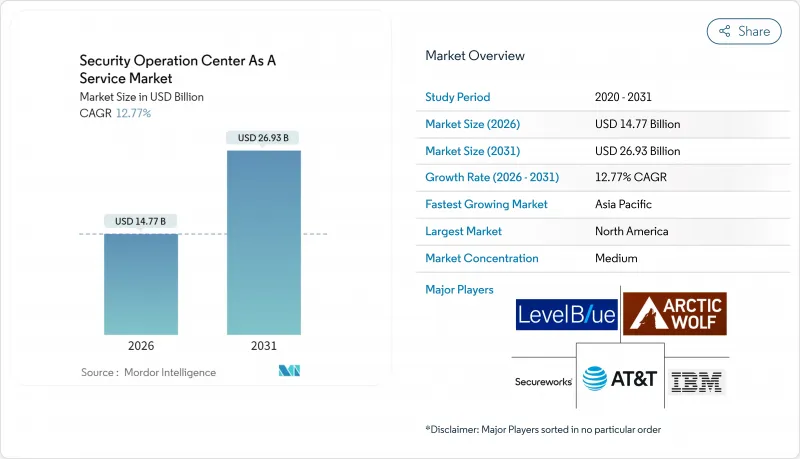
This report is Segmented by Enterprise Size (Small and Medium Enterprises, and Large Enterprises), Service Type (Managed Detection and Response, Incident Response and Threat Hunting, and More), Deployment Model (Public Cloud, Private Cloud, and Hybrid Cloud), End-User Industry (BFSI, IT and Telecom, and More), Geography. The Market Forecasts are Provided in Terms of Value (USD).
Global Security Operation Center As A Service Market Trends and Insights
Exponential Rise in Multi-Vector Cyber-Attacks
Threat actors now chain ransomware, data exfiltration, and denial-of-service extortion in rapid succession, overwhelming in-house teams that still rely on periodic log reviews. The Federal Bureau of Investigation recorded USD 12.5 billion in cyber-crime losses during 2023, a 22% surge driven by ransomware and business email compromise. In 2024, the Cybersecurity and Infrastructure Security Agency observed a 30% uptick in incidents involving initial-access brokers that shorten dwell time to fewer than 24 hours. This acceleration favors managed detection and response providers that maintain global analyst benches and behavioral analytics capable of identifying lateral movement within minutes. Organizations that once tolerated weekly reviews now demand sub-hour mean time to detect, creating dependencies on outsourced experts. The shift from perimeter defense to assume-breach postures further boosts incident-response retainer sales bundled with continuous monitoring.
Escalating Cybersecurity-Talent Shortage
The worldwide security workforce gap reached 4 million positions in 2024, including 700,000 vacancies in North America alone. Salary inflation for tier-one analysts topped 15% year-over-year, yet turnover remained higher than 25%, eroding institutional knowledge and expanding alert backlogs. Small and medium enterprises struggle most to match compensation levels offered by large technology and financial players, prompting them to adopt subscription-based security operation center as a service market offerings that spread analyst costs across hundreds of clients. Providers achieve economies of scale to fund advanced automation and threat-intelligence platforms that individual enterprises cannot justify. The shortage is particularly acute in cloud-native disciplines such as Kubernetes runtime protection, further solidifying the outsourcing trend.
Data-Sovereignty and Log-Residency Concerns
General Data Protection Regulation restrictions on personal-data transfer compel providers to operate in-region security operations centers or adopt standard contractual clauses, adding cost and complexity. India's Digital Personal Data Protection Act introduces similar requirements, spurring investments in domestic facilities. China's Cybersecurity Law prevents overseas export of critical information infrastructure logs, effectively reserving that portion of demand for local champions. The resulting fragmentation hampers global providers' economies of scale, yet gives regional specialists a home-field advantage.
Other drivers and restraints analyzed in the detailed report include:
- Expanding Cloud and Hybrid IT Attack Surface
- Regulatory Push for Real-Time Incident Disclosure
- Integration Complexity With Legacy Tooling
For complete list of drivers and restraints, kindly check the Table Of Contents.
Segment Analysis
The large-enterprise tier accounted for 68.23% of 2025 revenue in the security operation center as a service market, reflecting the breadth of hybrid estates and stringent audit obligations. These buyers often keep tier-three threat hunting and in-house intelligence but outsource tier-one triage and tier-two investigation, retaining institutional context while gaining 24/7 coverage. The security operations center-as-a-service market for small and medium enterprises is growing faster, advancing at a 13.84% CAGR, because turnkey cloud subscriptions eliminate capital expenditure and scale with headcount growth. Programmatic channel sales by managed service providers further lower acquisition costs and make advanced detection affordable.
Small companies typically adopt standardized playbooks that bundle endpoint detection, security awareness training, and vulnerability scanning, while large organizations demand bespoke runbooks and sector-specific intelligence. As chief information security officers face persistent hiring gaps, even Fortune 500 firms are increasing the portion of alerts routed to external analysts. For smaller buyers, outsourcing is becoming the only viable path to regulatory compliance and cyber-insurance eligibility.
Managed detection and response captured 41.52% of security operation center as a service market share in 2025, underpinned by continuous monitoring and guided remediation. Incident response and threat hunting services are projected to post a 13.19% CAGR to 2031, outperforming passive log aggregation as enterprises recognize that adversaries can dwell undetected for weeks without proactive searches. The security operation center as a service market size for proactive hunting remains smaller today but commands premium pricing because it requires senior analysts versed in adversary tactics.
Legacy security monitoring is commoditizing as cloud data lakes decouple storage from analytics, prompting providers to integrate automation that suppresses false positives and focuses analysts on high-fidelity signals. Bundled orchestration capabilities and vulnerability management are also emerging as growth vectors, allowing vendors to consolidate toolsets and justify higher average revenue per customer. The unified approach reduces breach costs and simplifies procurement.
Complete Report Scope:
- By Enterprise Size
- Small and Medium Enterprises (SMEs)
- Large Enterprises
- By Service Type
- Managed Detection and Response (MDR)
- Incident Response and Threat Hunting
- Security Monitoring and Log Management
- Other Service Types
- By Deployment Model
- Public Cloud
- Private Cloud
- Hybrid Cloud
- By End-User Industry
- BFSI
- IT and Telecom
- Healthcare and Life Sciences
- Manufacturing
- Government and Public Sector
- Retail and E-Commerce
- By Geography
- North America
- United States
- Canada
- Mexico
- Europe
- Germany
- United Kingdom
- France
- Italy
- Spain
- Russia
- Rest of Europe
- Asia Pacific
- China
- Japan
- India
- South Korea
- ASEAN
- Australia and New Zealand
- Rest of Asia Pacific
- South America
- Brazil
- Argentina
- Rest of South America
- Middle East
- Saudi Arabia
- UAE
- Turkey
- Rest of Middle East
- Africa
- South Africa
- Nigeria
- Rest of Africa
- North America
Geography Analysis
North America accounted for 43.81% of 2025 revenue, buoyed by the United States Securities and Exchange Commission's disclosure rule, mature cyber-insurance markets, and a concentration of Fortune 500 enterprises. The region is witnessing the replacement of legacy on-premises security information and event management platforms with cloud-native managed detection and response solutions that lower the total cost of ownership. Canada's breach-notification regime further supports demand, while nearshoring activity in Mexico exposes regional hubs to heightened cyber risk.
Europe claimed a roughly 28% share, anchored by the Network and Information Security Directive 2 that compels 24-hour reporting across essential and important entities. Germany, France, and the United Kingdom bolster adoption through national certifications that raise service-quality baselines. Nevertheless, General Data Protection Regulation residency provisions fragment the provider landscape, favoring vendors with in-country security operations centers.
Asia Pacific is projected to expand at a 15.27% CAGR, the fastest worldwide. India's Digital Personal Data Protection Act requires local storage of security telemetry, prompting global providers to open Mumbai and Bengaluru facilities. Singapore's six-hour incident-reporting rule for critical information infrastructure, Australia's Critical Infrastructure Protection Act, and South Korea's financial-sector guidelines all create compliance-driven demand. China remains dominated by domestic suppliers due to outbound-data restrictions, yet multinational firms often execute parallel contracts for subsidiaries to maintain group-wide visibility.
South America, the Middle East, and Africa contributed nearly 15% of 2025 revenue. Brazil's central bank cybersecurity resolution and the United Arab Emirates' managed security licensing scheme have stimulated regional growth. Saudi Arabia's Essential Cybersecurity Controls compel critical infrastructure to implement 24/7 monitoring, and South Africa's regulators are enforcing cyber-resilience guidelines despite macroeconomic headwinds.
- SecureWorks Inc.
- IBM Corporation
- AT&T Inc.
- Arctic Wolf Networks, Inc.
- Trustwave Holdings, Inc. (LevelBlue)
- Atos SE
- BAE Systems plc
- Capgemini SE
- Symantec Corporation
- Thales Group (Thales S.A.)
- Fujitsu Limited
- NTT Ltd. (NTT Security Corporation)
- Lumen Technologies, Inc.
- Alert Logic, Inc.
- Cygilant, Inc.
- BlackStratus, Inc.
- Digital Guardian, Inc.
- Rapid7, Inc.
- Securonix, Inc.
- Trellix LLC
Additional Benefits:
- The market estimate (ME) sheet in Excel format
- 3 months of analyst support
TABLE OF CONTENTS
1 INTRODUCTION
- 1.1 Study Assumptions and Market Definition
- 1.2 Scope of the Study
2 RESEARCH METHODOLOGY
3 EXECUTIVE SUMMARY
4 MARKET LANDSCAPE
- 4.1 Market Overview
- 4.2 Market Drivers
- 4.2.1 Exponential Rise in Multi-Vector Cyber-Attacks
- 4.2.2 Escalating Cybersecurity-Talent Shortage
- 4.2.3 Expanding Cloud and Hybrid IT Attack Surface
- 4.2.4 Regulatory Push for Real-Time Incident Disclosure
- 4.2.5 Cyber-Insurance Mandates for 24/7 MDR
- 4.2.6 OT and IoT Convergence Demanding Unified Visibility
- 4.3 Market Restraints
- 4.3.1 Data-Sovereignty and Log-Residency Concerns
- 4.3.2 Integration Complexity With Legacy Tooling
- 4.3.3 Limited Organization-Specific Context in Outsourced SOC
- 4.3.4 Alert-Fatigue From High False-Positive Rates
- 4.4 Industry Value Chain Analysis
- 4.5 Regulatory Landscape
- 4.6 Technological Outlook
- 4.7 Porter's Five Forces Analysis
- 4.7.1 Bargaining Power of Suppliers
- 4.7.2 Bargaining Power of Buyers
- 4.7.3 Threat of New Entrants
- 4.7.4 Threat of Substitutes
- 4.7.5 Intensity of Competitive Rivalry
- 4.8 Impact of Macroeconomic Factors on the Market
5 MARKET SIZE AND GROWTH FORECASTS (VALUE)
- 5.1 By Enterprise Size
- 5.1.1 Small and Medium Enterprises (SMEs)
- 5.1.2 Large Enterprises
- 5.2 By Service Type
- 5.2.1 Managed Detection and Response (MDR)
- 5.2.2 Incident Response and Threat Hunting
- 5.2.3 Security Monitoring and Log Management
- 5.2.4 Other Service Types
- 5.3 By Deployment Model
- 5.3.1 Public Cloud
- 5.3.2 Private Cloud
- 5.3.3 Hybrid Cloud
- 5.4 By End-User Industry
- 5.4.1 BFSI
- 5.4.2 IT and Telecom
- 5.4.3 Healthcare and Life Sciences
- 5.4.4 Manufacturing
- 5.4.5 Government and Public Sector
- 5.4.6 Retail and E-Commerce
- 5.5 By Geography
- 5.5.1 North America
- 5.5.1.1 United States
- 5.5.1.2 Canada
- 5.5.1.3 Mexico
- 5.5.2 Europe
- 5.5.2.1 Germany
- 5.5.2.2 United Kingdom
- 5.5.2.3 France
- 5.5.2.4 Italy
- 5.5.2.5 Spain
- 5.5.2.6 Russia
- 5.5.2.7 Rest of Europe
- 5.5.3 Asia Pacific
- 5.5.3.1 China
- 5.5.3.2 Japan
- 5.5.3.3 India
- 5.5.3.4 South Korea
- 5.5.3.5 ASEAN
- 5.5.3.6 Australia and New Zealand
- 5.5.3.7 Rest of Asia Pacific
- 5.5.4 South America
- 5.5.4.1 Brazil
- 5.5.4.2 Argentina
- 5.5.4.3 Rest of South America
- 5.5.5 Middle East
- 5.5.5.1 Saudi Arabia
- 5.5.5.2 UAE
- 5.5.5.3 Turkey
- 5.5.5.4 Rest of Middle East
- 5.5.6 Africa
- 5.5.6.1 South Africa
- 5.5.6.2 Nigeria
- 5.5.6.3 Rest of Africa
- 5.5.1 North America
6 COMPETITIVE LANDSCAPE
- 6.1 Market Concentration
- 6.2 Strategic Moves
- 6.3 Market Share Analysis
- 6.4 Company Profiles (includes Global Level Overview, Market Level Overview, Core Segments, Financials as Available, Strategic Information, Market Rank/Share for Key Companies, Products and Services, and Recent Developments)
- 6.4.1 SecureWorks Inc.
- 6.4.2 IBM Corporation
- 6.4.3 AT&T Inc.
- 6.4.4 Arctic Wolf Networks, Inc.
- 6.4.5 Trustwave Holdings, Inc. (LevelBlue)
- 6.4.6 Atos SE
- 6.4.7 BAE Systems plc
- 6.4.8 Capgemini SE
- 6.4.9 Symantec Corporation
- 6.4.10 Thales Group (Thales S.A.)
- 6.4.11 Fujitsu Limited
- 6.4.12 NTT Ltd. (NTT Security Corporation)
- 6.4.13 Lumen Technologies, Inc.
- 6.4.14 Alert Logic, Inc.
- 6.4.15 Cygilant, Inc.
- 6.4.16 BlackStratus, Inc.
- 6.4.17 Digital Guardian, Inc.
- 6.4.18 Rapid7, Inc.
- 6.4.19 Securonix, Inc.
- 6.4.20 Trellix LLC
7 MARKET OPPORTUNITIES AND FUTURE OUTLOOK
- 7.1 White-Space and Unmet-Need Assessment

