PUBLISHER: Mordor Intelligence | PRODUCT CODE: 2123107

PUBLISHER: Mordor Intelligence | PRODUCT CODE: 2123107
Palm Vein Biometrics - Market Share Analysis, Industry Trends & Statistics, Growth Forecasts (2026 - 2031)
According to Mordor Intelligence, the palm vein biometrics market size is expected to grow from USD 1.7 billion in 2025 to USD 1.99 billion in 2026 and is forecast to reach USD 4.42 billion by 2031 at 17.28% CAGR over 2026-2031.
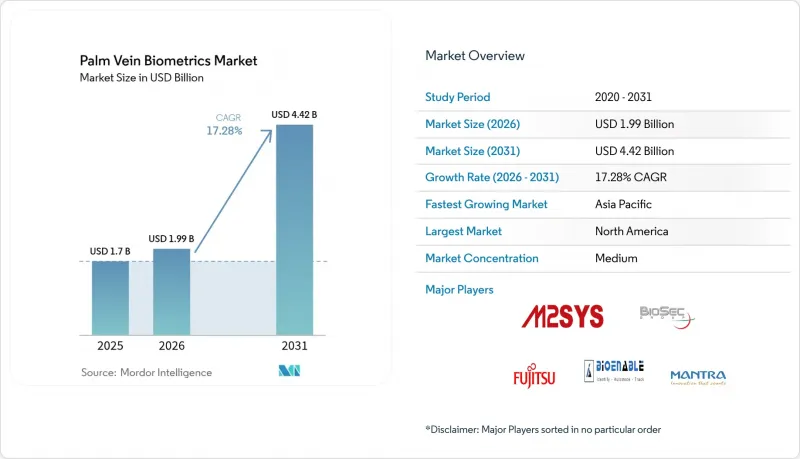
This report is Segmented by Component (Hardware, Software and Solution, Services), Technology (Near-Infrared Imaging, Optical Imaging, Thermal Imaging, and Hybrid Imaging), End-User Industry (Banking and Financial Institutions, Healthcare Providers, Government Agencies, and Commercial and Industrial Enterprises), and Geography. The Market Forecasts are Provided in Terms of Value (USD).
Global Palm Vein Biometrics Market Trends and Insights
Rising Adoption of Contactless Authentication in BFSI Sector
Banks are embedding palm scans directly into point-of-sale rails to hit sub-one-second transaction times and eliminate card-present fraud. J.P. Morgan's stadium-based pilot completed every payment in under a second during the 2024 Formula 1 Miami Grand Prix. Mastercard rolled out palm checkout in Uruguay's Tienda Inglesa stores in June 2024, its first palm deployment in the program that had relied on facial recognition. U.S. credit-union processors PSCU and Co-op Solutions enabled 4,000 issuers to add pay-by-palm in April 2024 with eight-week implementation timelines. UAE regulators aim to make Palm ID the region's de-facto metro and ATM credential by 2026. The financial sector's pivot frames palm authentication as a loyalty-driven personalization asset rather than a narrow fraud-control tool.
Stringent Data Privacy Regulations Mandating Biometric Upgrades
The EU's GDPR, China's PIPL, and India's DPDPA classify vascular templates as sensitive data that require explicit consent, data minimization, and, where cross-border transfers occur, supplementary encryption measures. Schrems II invalidated the EU-U.S. Privacy Shield, forcing European companies to adopt local or sovereign-cloud storage. China's PIPL mandates the Cyberspace Administration of China security assessments for transfers that involve over 1 million data subjects. ISO/IEC TS 22604:2024 now provides enterprises with a template-protection blueprint and encourages moves toward encrypted on-device matching, a model Amazon One follows by storing signatures within a secure AWS domain rather than on the reader itself. Compliance pressure, therefore, accelerates the migration from password systems to cryptographically protected biometrics.
High Upfront Hardware and Integration Costs
Near-infrared sensor arrays cost three-to-five times more than commodity fingerprint readers. Qualcomm and Telpo's P105 terminal integrate dual RGB + IR cameras plus liveness optics, positioning it as a premium device that small retailers must justify through fraud savings. Integration adds USD 5,000-20,000 in professional services when legacy systems lack vascular drivers, locking out low-margin merchants in emerging markets.
Other drivers and restraints analyzed in the detailed report include:
- Post-Pandemic Demand for Hygienic Touch-Free Patient Identification in Healthcare
- Cloud-Based Palm ID SaaS Models Shrinking Total Cost of Ownership for SMEs
- Limited Interoperability Standards Across Vendors
For complete list of drivers and restraints, kindly check the Table Of Contents.
Segment Analysis
Hardware captured 67.52% of palm vein biometrics market share in 2025 as every authentication point needs a dedicated reader. Hospitals, airports, and stadiums deploy hundreds of units, keeping hardware revenue proportional to footprint. Services, however, will log a 18.77% CAGR, reflecting template-database maintenance, algorithm retuning, and compliance audits. Digital Sense's integration work for Mastercard's Uruguay checkout launch demonstrates how middleware bridges palm readers to legacy POS software. Cloud platforms shift value toward recurring subscriptions, yet readers remain indispensable for high-throughput gates, ensuring hardware stays above 50% of revenue through 2031.
Software royalties are also rising. Vendors license matching engines under per-device fees, and ISO/IEC 30107-3:2023 presentation-attack-detection mandates guarantee constant firmware refreshes. Managed-service providers flourish because small retailers lack staff trained to troubleshoot false rejects or conduct privacy-impact assessments. Even with SaaS, enterprises pay monthly for log review, encryption-key rotation, and sovereign-cloud hosting where data-localization laws apply, locking in services growth.
Complete Report Scope:
- By Component
- Hardware
- Software and Solution
- Services
- By Technology
- Near-Infrared Imaging
- Optical Imaging
- Thermal Imaging
- Hybrid Imaging
- By End-User Industry
- Banking and Financial Institutions
- Healthcare Providers
- Government Agencies
- Commercial and Industrial Enterprises
- By Geography
- North America
- United States
- Canada
- Mexico
- Europe
- United Kingdom
- Germany
- France
- Italy
- Rest of Europe
- Asia-Pacific
- China
- Japan
- India
- South Korea
- Rest of Asia
- Middle East
- Israel
- Saudi Arabia
- United Arab Emirates
- Turkey
- Rest of Middle East
- Africa
- South Africa
- Egypt
- Rest of Africa
- South America
- Brazil
- Argentina
- Rest of South America
- North America
Geography Analysis
North America held a 39.78% palm vein biometrics market share in 2025, underpinned by Amazon One's rollout to 500 Whole Foods stores and 150 third-party venues that have logged more than 8 million transactions with an 80% repeat rate. U.S. consumers show high biometric acceptance, with PYMNTS reporting 52% prefer biometrics over passwords. Canada pilots palm payments in grocery chains, while Mexico City explores the modality for metro fare gates. The region benefits from permissive regulations that rely on disclosure rather than explicit consent, lowering deployment friction.
Asia Pacific is the fastest-growing geography, posting a 17.62% CAGR toward 2031. Hitachi's SAKULaLa expanded to 100 plus venues across retail and rail, and Tencent's PalmAI Service claims 100 million users across Beijing Airport Express, Shenzhen University, and 7-Eleven stores. China's PIPL complicates cross-border data flows, yet domestic volumes dwarf Western markets. India's new data law allows cross-border transfers unless on a blacklist, creating opportunity for cloud SaaS vendors, although sectoral regulators may issue tighter rules for finance or health. South Korea, Australia, and Singapore run pilots in banks and hospitals, while Indonesia studies palm scans for its 270 million-citizen national ID upgrade.
Europe trails due to GDPR constraints; biometric data sits under Article 9's special-category protections requiring explicit consent. Visa and Feedzai found 40% of UK consumers willing to use biometrics for banking, but Schrems II forces U.S. cloud vendors to adopt EU data centers, inflating costs. France, Germany, and Italy test palm readers in hospitals and airports but keep template storage local. The Middle East emerges as a bright spot: the UAE targets nationwide palm infrastructure by 2026, and Dubai-based AstraTech launched Palm Pay in 2024 for hover-to-pay retail checkouts. Saudi Arabia explores border-control pilots, signalling Gulf-wide momentum.
Africa and South America remain nascent. Brazil's LGPD classifies biometrics as sensitive and requires standard contractual clauses for transfers, while South Africa studies palm vein for refugee identity. Funding gaps and hardware costs restrain volume, though Mastercard's Uruguay pilot may seed regional interest.
- Fujitsu Limited
- Hitachi Ltd.
- NEC Corporation
- M2SYS Technology LLC
- BioSec Group Ltd.
- BioEnable Technologies Private Limited
- Imprivata Inc.
- Mantra Softech (India) Private Limited
- IdentyTech Solutions Ltd.
- Matrix Comsec Private Limited
- Keyo Inc.
- Tencent Cloud Computing (Beijing) Company Limited
- Amazon Web Services, Inc.
- ZKTECO Co., Ltd.
- Idemia France SAS
- Recogtech B.V.
- Shenzhen Huifan Technology Co., Ltd.
- Hikvision Digital Technology Co., Ltd.
- Thales Group
- Mofiria Corporation
Additional Benefits:
- The market estimate (ME) sheet in Excel format
- 3 months of analyst support
TABLE OF CONTENTS
1 INTRODUCTION
- 1.1 Study Assumptions and Market Definition
- 1.2 Scope of the Study
2 RESEARCH METHODOLOGY
3 EXECUTIVE SUMMARY
4 MARKET LANDSCAPE
- 4.1 Market Overview
- 4.2 Market Drivers
- 4.2.1 Rising Adoption of Contactless Authentication in BFSI Sector
- 4.2.2 Stringent Data Privacy Regulations Mandating Biometric Upgrades
- 4.2.3 Post-Pandemic Demand for Hygienic Touch-Free Patient Identification in Healthcare
- 4.2.4 Cloud-Based Palm ID SaaS Models Shrinking Total Cost of Ownership for SMEs
- 4.2.5 Smartphone-Enabled Remote Enrollment Unlocking Decentralized User Acquisition
- 4.2.6 Tariff-Driven Nearshoring of Sensor Production Lowering Supply-Chain Risk
- 4.3 Market Restraints
- 4.3.1 High Upfront Hardware and Integration Costs
- 4.3.2 Limited Interoperability Standards Across Vendors
- 4.3.3 Rising Scrutiny of Biometric Cloud Storage by Data Sovereignty Laws
- 4.3.4 Scaling Latency Issues in Large-Scale Vein Template Databases
- 4.4 Industry Value Chain Analysis
- 4.5 Regulatory Landscape
- 4.6 Technological Outlook
- 4.7 Impact of Macroeconomic Factors on the Market
- 4.8 Porter's Five Forces Analysis
- 4.8.1 Threat of New Entrants
- 4.8.2 Bargaining Power of Buyers
- 4.8.3 Bargaining Power of Suppliers
- 4.8.4 Threat of Substitute Products
- 4.8.5 Intensity of Competitive Rivalry
5 MARKET SIZE AND GROWTH FORECASTS (VALUE)
- 5.1 By Component
- 5.1.1 Hardware
- 5.1.2 Software and Solution
- 5.1.3 Services
- 5.2 By Technology
- 5.2.1 Near-Infrared Imaging
- 5.2.2 Optical Imaging
- 5.2.3 Thermal Imaging
- 5.2.4 Hybrid Imaging
- 5.3 By End-User Industry
- 5.3.1 Banking and Financial Institutions
- 5.3.2 Healthcare Providers
- 5.3.3 Government Agencies
- 5.3.4 Commercial and Industrial Enterprises
- 5.4 By Geography
- 5.4.1 North America
- 5.4.1.1 United States
- 5.4.1.2 Canada
- 5.4.1.3 Mexico
- 5.4.2 Europe
- 5.4.2.1 United Kingdom
- 5.4.2.2 Germany
- 5.4.2.3 France
- 5.4.2.4 Italy
- 5.4.2.5 Rest of Europe
- 5.4.3 Asia-Pacific
- 5.4.3.1 China
- 5.4.3.2 Japan
- 5.4.3.3 India
- 5.4.3.4 South Korea
- 5.4.3.5 Rest of Asia
- 5.4.4 Middle East
- 5.4.4.1 Israel
- 5.4.4.2 Saudi Arabia
- 5.4.4.3 United Arab Emirates
- 5.4.4.4 Turkey
- 5.4.4.5 Rest of Middle East
- 5.4.5 Africa
- 5.4.5.1 South Africa
- 5.4.5.2 Egypt
- 5.4.5.3 Rest of Africa
- 5.4.6 South America
- 5.4.6.1 Brazil
- 5.4.6.2 Argentina
- 5.4.6.3 Rest of South America
- 5.4.1 North America
6 COMPETITIVE LANDSCAPE
- 6.1 Market Concentration
- 6.2 Strategic Moves
- 6.3 Market Share Analysis
- 6.4 Company Profiles (includes Global Level Overview, Market Level Overview, Core Segments, Financials as available, Strategic Information, Market Rank/Share for key companies, Products and Services, and Recent Developments)
- 6.4.1 Fujitsu Limited
- 6.4.2 Hitachi Ltd.
- 6.4.3 NEC Corporation
- 6.4.4 M2SYS Technology LLC
- 6.4.5 BioSec Group Ltd.
- 6.4.6 BioEnable Technologies Private Limited
- 6.4.7 Imprivata Inc.
- 6.4.8 Mantra Softech (India) Private Limited
- 6.4.9 IdentyTech Solutions Ltd.
- 6.4.10 Matrix Comsec Private Limited
- 6.4.11 Keyo Inc.
- 6.4.12 Tencent Cloud Computing (Beijing) Company Limited
- 6.4.13 Amazon Web Services, Inc.
- 6.4.14 ZKTECO Co., Ltd.
- 6.4.15 Idemia France SAS
- 6.4.16 Recogtech B.V.
- 6.4.17 Shenzhen Huifan Technology Co., Ltd.
- 6.4.18 Hikvision Digital Technology Co., Ltd.
- 6.4.19 Thales Group
- 6.4.20 Mofiria Corporation
7 MARKET OPPORTUNITIES AND FUTURE OUTLOOK
- 7.1 White-Space and Unmet-Need Assessment

