PUBLISHER: Mordor Intelligence | PRODUCT CODE: 2123154

PUBLISHER: Mordor Intelligence | PRODUCT CODE: 2123154
Europe Bicycle - Market Share Analysis, Industry Trends & Statistics, Growth Forecasts (2026 - 2031)
According to Mordor Intelligence, the Europe bicycle market size stands at USD 33.37 billion in 2026 and is projected to reach USD 50.38 billion by 2031, registering an 8.59% CAGR over the forecast period.
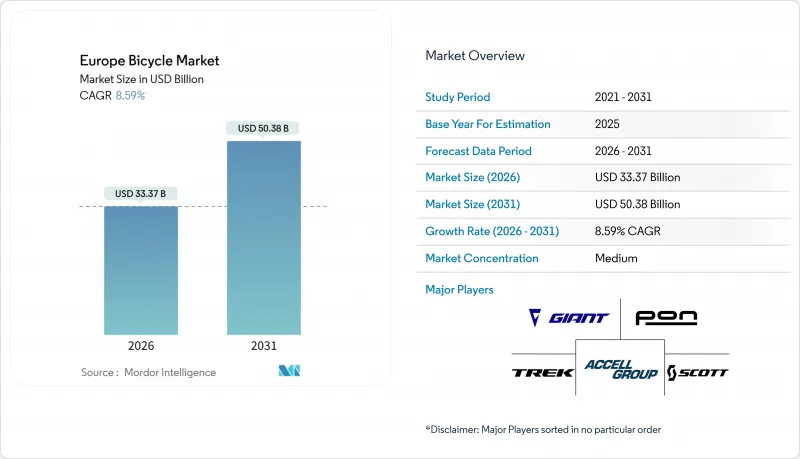
This report is Segmented by Product Type (Road/City, Mountain/All-Terrain, Hybrid, E-Bicycle, and Other Types), Design (Regular and Folding), End-User (Men, Women, and Children), Distribution Channel (Offline Retail Stores and Online Retail Stores), and Geography (United Kingdom, Germany, France, Italy, Spain, and More). The Market Forecasts are Provided in Terms of Value (USD) and Volume (Units)
Europe Bicycle Market Trends and Insights
Urban congestion drives commuter bicycle adoption
European cities are addressing traffic saturation by redefining first-mile and last-mile mobility economics. Paris allocated EUR 250 million (USD 272 million) between 2021 and 2026 to develop 1,400 kilometers of bike lanes. This shift reflects municipalities' focus on induced demand, favoring cargo e-bikes and speed pedelecs over leisure models. Increasing urban density and rising fuel costs position bicycles as a cost-efficient alternative. E-bikes, in particular, extend commuting distances and attract professionals seeking flexible, low-emission travel options. Policies such as the European Union's Sustainable Urban Mobility Plans and national subsidies are integrating cycling into public transit systems, enhancing first and last-mile connectivity while reducing car dependency. In 2024, 75% of the European Union's population resides in cities, according to the World Bank, intensifying urban congestion . This demographic trend increases daily mobility needs, driving the adoption of bikes and e-bikes as efficient solutions for navigating crowded urban areas and minimizing travel times.
Health and fitness awareness fuels recreational cycling
In 2024, Sport England reported that 7,169,700 individuals in England engaged in cycling, highlighting a significant shift where cycling has evolved from being merely a mode of transportation to becoming a core component of wellness and fitness routines. This transformation has been largely driven by the growing emphasis on health and well-being in the post-pandemic era. As a result, fitness-focused consumers are increasingly seeking high-end features, such as lightweight carbon frames for enhanced performance, electronic shifting systems for smoother gear transitions, and integrated power meters for accurate performance monitoring, over prioritizing affordability. This growing demand for premium products allows manufacturers to maintain strong profit margins, even as overall sales volumes begin to stabilize. Moreover, this consumer segment exhibits lower price sensitivity, offering manufacturers a degree of insulation against policy changes, such as France's decision to terminate its bike bonus subsidy in February 2025.
Alternative transportation options constrain bicycle market share
Urban mobility budgets are becoming increasingly fragmented due to the growing popularity of e-scooters and the expansion of rapid transit networks. Shared e-scooters are replacing not only cycling trips and walking but also public transport journeys. This highlights that micro-mobility options are competing more directly with bicycles than with cars. In the Netherlands, the prohibition of e-scooters on public roads protects its cycling market. Conversely, Spain and France allow e-scooters, which intensifies direct competition. In Italy, the strong motorcycle culture adds another layer of complexity: in cities like Rome and Milan, motorcycles remain popular for their weather protection and speed, even with congestion charges, limiting bicycle adoption. For bicycle manufacturers, the strategic focus should be on enhancing utility, such as cargo capacity and weather resistance, rather than prioritizing speed or convenience, as e-scooters and transit options already dominate those areas.
Other drivers and restraints analyzed in the detailed report include:
- Government sustainable transportation policies accelerate market growth
- Environmental consciousness and sustainability goals drive adoption
- Elevated e-bicycle prices limit mass-market penetration
For complete list of drivers and restraints, kindly check the Table Of Contents.
Segment Analysis
In 2025, e-bicycles accounted for 50.17% of the European market share and are expected to grow at a 9.56% CAGR through 2031. Mid-tier models are increasingly using lithium-iron-phosphate batteries instead of nickel-manganese-cobalt chemistries, offering a longer cycle life and lower costs, though with a slight reduction in energy density. The second-largest category, road and city bicycles, serves commuters who value speed and efficiency on paved roads. On the other hand, mountain and all-terrain models cater to recreational users in the Alpine and Nordic regions. Hybrid bicycles, which combine road and off-road features, were once popular among versatile riders. However, their market share is declining as e-bike motors remove the need for compromise. Riders can now choose specialized frames and rely on pedal assistance to handle diverse terrains. While cargo and recumbent models remain niche, they are growing rapidly, particularly in urban logistics.
As e-bicycles continue to dominate, traditional bicycle manufacturers without motor and battery integration capabilities are experiencing compressed margins. Companies like Bosch and Shimano demonstrate vertical integration, allowing component suppliers to capture value that previously belonged to frame builders. This trend is pressuring brands such as Canyon and Specialized to either develop proprietary electronics or face commoditization. The EU's Alternative Fuels Infrastructure Regulation, which requires workplace charging points, is removing a major barrier to e-bike adoption. This policy not only highlights a forward-thinking approach but also reverses traditional market dynamics, with policy now outpacing consumer demand.
In 2025, regular-design bicycles accounted for 83.35% of the market. However, folding variants are experiencing rapid growth, with a 10.21% CAGR projected for 2026-2031, making them the fastest-growing segment. Brompton's G Line, launched in 2024, highlights the evolving perception of folding models. Featuring 20-inch wheels, 8-speed gearing, and hydraulic disc brakes, these bicycles are now competing on performance rather than being seen solely as utilitarian. Similarly, the Electric P Line, equipped with a lightweight titanium frame weighing 15.6 kilograms, underwent 8 years of in-house research and development to achieve UL2849 certification. This achievement reflects stricter safety standards, which are raising entry barriers for low-cost competitors. Folding bicycles are particularly effective for intermodal commuting, such as transitioning from train to office or car to trail. This advantage explains their significant growth in densely populated cities like London, Paris, and Berlin, where extensive public transit systems often leave last-mile gaps.
Regular designs maintain their dominance due to superior ride quality, component compatibility, and higher resale value. Enthusiasts and long-distance commuters prioritize frame stiffness and wheel size over portability, ensuring continued demand for traditional geometries. The key insight is that folding bicycles are not replacing regular models but are instead establishing a parallel category. They cater to urban professionals who integrate cycling with public transit rather than competing directly. Manufacturers should avoid positioning folding bikes as universal solutions and instead focus on targeting specific commuter profiles with tailored marketing and distribution strategies.
Complete Report Scope:
- By Product Type
- Road/City
- Mountain/All-Terrain
- Hybrid
- E-Bicycle
- Other Types
- By Design
- Regular
- Folding
- By End-User
- Men
- Women
- Children
- By Distribution Channel
- Offline Retail Stores
- Online Retail Stores
- By Country
- United Kingdom
- Germany
- France
- Italy
- Spain
- Russia
- Sweden
- Belgium
- Poland
- Netherlands
- Rest of Europe
List of Companies Covered in this Report:
- Accell Group NV
- Trek Bicycle Corporation
- Pon Holdings BV
- Giant Manufacturing Co. Ltd
- Scott Sports SA
- Merida Industry Co. Ltd
- Riese and Muller GmbH
- Canyon Bicycles GmbH
- Decathlon SA
- Bosch eBike Systems (Robert Bosch GmbH)
- Shimano Inc.
- VanMoof BV
- Orbea S. Coop.
- KTM Fahrrad GmbH
- myStromer AG
- Bianchi S.p.A.
- Bulls Bikes (ZEG eG)
- Ribble Cycles
- Simplon Fahrrad GmbH
- Specialized Bicycle Components Inc.
Additional Benefits:
- The market estimate (ME) sheet in Excel format
- 3 months of analyst support
TABLE OF CONTENTS
1 INTRODUCTION
- 1.1 Study Assumptions and Market Definition
- 1.2 Scope of the Study
2 RESEARCH METHODOLOGY
3 EXECUTIVE SUMMARY
4 MARKET LANDSCAPE
- 4.1 Market Overview
- 4.2 Market Drivers
- 4.2.1 Increasing traffic congestion in urban areas is leading to higher adoption of bicycles for daily commuting.
- 4.2.2 Growing awareness of health and fitness is driving a rise in cycling activities.
- 4.2.3 Government efforts to promote sustainable transportation are encouraging bicycle usage.
- 4.2.4 Rising environmental consciousness and sustainability goals are boosting bicycle adoption.
- 4.2.5 Corporate wellness initiatives are fostering greater use of bicycles among employees.
- 4.2.6 Escalating fuel prices are positioning bicycles as an economical mode of transportation.
- 4.3 Market Restraints
- 4.3.1 Alternative transportation options such as motorcycles and rapid transit systems reduce bicycle adoption rates
- 4.3.2 Elevated prices of electric bicycles limit widespread consumer acceptance across regions
- 4.3.3 Proliferation of fake bicycle products negatively impacts market expansion
- 4.3.4 Inadequate road infrastructure in rural regions affects bicycle riding experience
- 4.4 Consumer Behaviour Analysis
- 4.5 Regulatory Landscape
- 4.6 Technological Outlook
- 4.7 Porter's Five Forces
- 4.7.1 Threat of New Entrants
- 4.7.2 Bargaining Power of Buyers
- 4.7.3 Bargaining Power of Suppliers
- 4.7.4 Threat of Substitutes
- 4.7.5 Intensity of Competitive Rivalry
5 MARKET SIZE AND GROWTH FORECASTS (VALUE AND VOLUME)
- 5.1 By Product Type
- 5.1.1 Road/City
- 5.1.2 Mountain/All-Terrain
- 5.1.3 Hybrid
- 5.1.4 E-Bicycle
- 5.1.5 Other Types
- 5.2 By Design
- 5.2.1 Regular
- 5.2.2 Folding
- 5.3 By End-User
- 5.3.1 Men
- 5.3.2 Women
- 5.3.3 Children
- 5.4 By Distribution Channel
- 5.4.1 Offline Retail Stores
- 5.4.2 Online Retail Stores
- 5.5 By Country
- 5.5.1 United Kingdom
- 5.5.2 Germany
- 5.5.3 France
- 5.5.4 Italy
- 5.5.5 Spain
- 5.5.6 Russia
- 5.5.7 Sweden
- 5.5.8 Belgium
- 5.5.9 Poland
- 5.5.10 Netherlands
- 5.5.11 Rest of Europe
6 COMPETITIVE LANDSCAPE
- 6.1 Market Concentration
- 6.2 Strategic Moves
- 6.3 Market Share Analysis
- 6.4 Company Profiles (includes Global level Overview, Market level overview, Core Segments, Financials as available, Strategic Information, Market Rank/Share for key companies, Products and Services, and Recent Developments)
- 6.4.1 Accell Group NV
- 6.4.2 Trek Bicycle Corporation
- 6.4.3 Pon Holdings BV
- 6.4.4 Giant Manufacturing Co. Ltd
- 6.4.5 Scott Sports SA
- 6.4.6 Merida Industry Co. Ltd
- 6.4.7 Riese and Muller GmbH
- 6.4.8 Canyon Bicycles GmbH
- 6.4.9 Decathlon SA
- 6.4.10 Bosch eBike Systems (Robert Bosch GmbH)
- 6.4.11 Shimano Inc.
- 6.4.12 VanMoof BV
- 6.4.13 Orbea S. Coop.
- 6.4.14 KTM Fahrrad GmbH
- 6.4.15 myStromer AG
- 6.4.16 Bianchi S.p.A.
- 6.4.17 Bulls Bikes (ZEG eG)
- 6.4.18 Ribble Cycles
- 6.4.19 Simplon Fahrrad GmbH
- 6.4.20 Specialized Bicycle Components Inc.
7 MARKET OPPORTUNITIES AND FUTURE OUTLOOK

