PUBLISHER: Mordor Intelligence | PRODUCT CODE: 2123156

PUBLISHER: Mordor Intelligence | PRODUCT CODE: 2123156
Tunable Laser - Market Share Analysis, Industry Trends & Statistics, Growth Forecasts (2026 - 2031)
According to Mordor Intelligence, the tunable laser market size is projected to expand from USD 15.59 billion in 2025 and USD 17.16 billion in 2026 to USD 26.03 billion by 2031, registering a CAGR of 8.69% between 2026 to 2031.
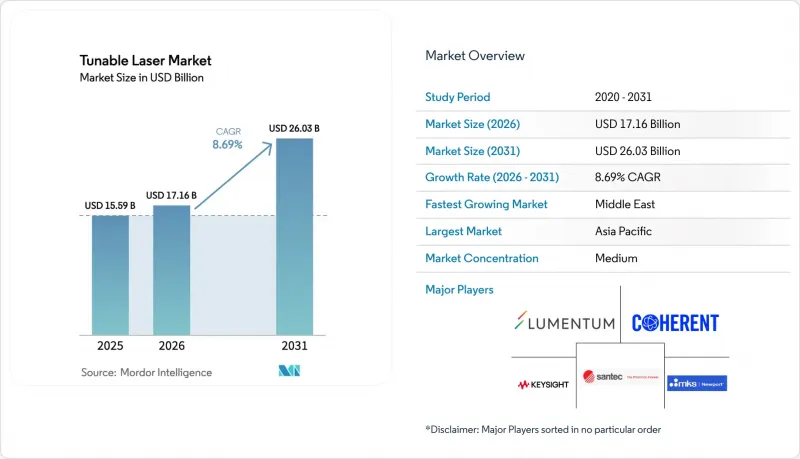
This report is Segmented by Source Type (C-Wave, External Cavity Lasers, and More), End-User Industry (Manufacturing and Industrial, Telecommunication and Networking Devices, Research and Academia, and More), Wavelength Range (Visible, Near-Infrared, and More), Tuning Mechanism (Current-Tuned, MEMS-Tuned, and More), and Geography. The Market Forecasts are Provided in Terms of Value (USD).
Global Tunable Laser Market Trends and Insights
Increased Adoption of Tunable Diode Laser Gas Analyzers
Industrial emitters are upgrading to in-situ spectroscopy to comply with tighter methane and VOC limits. Tunable diode laser absorption spectroscopy measures trace gases directly in hot, corrosive stacks, eliminating sample conditioning that hampers legacy probes. The U.S. Environmental Protection Agency's 2024 methane rule triggered a replacement cycle across refineries and LNG terminals. Yokogawa recorded a 35% year-over-year jump in 2024 TDLAS orders as Middle Eastern operators aligned with ISO 14001 requirements. Semiconductor fabs now use the same technique to control oxygen at sub-ppm levels in atomic-layer deposition tools, underlining cross-industry pull.
Growing Demand for Spectroscopy in Life Sciences
Continuous manufacturing in pharmaceuticals depends on real-time analytics that non-destructively verify active ingredient concentration. FDA's 2025 guidance accelerated the deployment of inline Raman and mid-IR sensors linked to tunable lasers. Quantum-cascade devices scanning the 3-8 µm region enable label-free imaging of lipid metabolism in oncology screening, cutting assay times from days to hours. Swept-source optical coherence tomography, powered by 100 kHz vertical-cavity tunables, is moving beyond ophthalmology into cardiology suites, broadening the clinical installed base.
Complexity in System Design and Function
Coherent 400 G modules require wavelength accuracy within +-1.8 GHz over a 40 °C temperature swing, requiring closed-loop piezo or MEMS cavity control. Start-ups lacking advanced simulation and environmental test assets struggle to pass IEC 61300-3-35 reliability trials. A 2024 field return at a top transceiver vendor traced to control-loop overshoot that induced mode hops during temperature cycling. Such missteps prolong qualification and lock smaller players out of volume contracts.
Other drivers and restraints analyzed in the detailed report include:
- Expansion of Fiber-Optic Communication Networks
- Rising Deployment in 5 G and Data-Center Coherent Optics
- High Capital Cost of Narrow-Linewidth Tunable Lasers
For complete list of drivers and restraints, kindly check the Table Of Contents.
Segment Analysis
C-wave devices held the leading 33.57% share of the tunable laser market in 2025, reflecting entrenched use in dense wavelength-division multiplexing systems that ride the 1530-1565 nm gain plateau of erbium amplifiers. Telecom operators favor these parts because upgrades preserve existing amplifier chains, shrinking capex cycles. External-cavity lasers enable long-haul coherent transport with <=100 kHz linewidth, supporting 64-QAM formats over oceanic spans. Optical parametric oscillators, while niche in shipment volume, are set for a 9.21% CAGR driven by mid-IR defense countermeasure and pharma analytics pull, revealing white space away from C-band incumbency. Other variants, such as distributed Bragg reflector and vertical-cavity sources, address short-reach data-center links where footprint and BOM cost outweigh the tuning range.
Hybrid III-V-on-silicon prototypes recorded in 2025 aim to reduce costs by co-packaging indium phosphide gain chips with silicon photonics passive waveguides. Once yields mature, the approach could shift type preferences toward integrated external cavities that dovetail with CMOS foundries, boosting overall efficiency in the tunable laser market. Defense funding for terahertz photomixing using dual-wavelength tunables foreshadows a longer-horizon "other types" disruption, yet pump-laser power and crystal temperature stability remain engineering bottlenecks.
Manufacturing and industrial retained 42.89% of 2025 revenue thanks to continuous-emissions monitoring and combustion control deployments. Tunable diode laser spectroscopy is now standard on new gas turbines, cementing a steady equipment-replacement cadence. Aerospace and defense, however, is projected to compound at 9.47% through 2031, powered by frequency-hopping rangefinders, space-based optical links, and early directed-energy demonstrators. Lockheed Martin's 2024 contract for 1550 nm ultra-narrow lasers on satellite terminals underscores this shift.
Telecommunication and networking devices absorb the bulk of C-band output, yet margin pressure mounts as pluggable coherent modules commoditize. Healthcare relies on vertical-cavity swept-source designs that deliver 100 kHz scans for ophthalmic angiography, a procedure newly reimbursed by the U.S. CMS since 2024. Research institutes continue to pioneer quantum-dot and microcomb approaches that later migrate into volume segments, preserving academia's role as an innovation testbed.
Complete Report Scope:
- By Source Type
- C-wave
- External Cavity Lasers
- Optical Parametric Oscillators
- Other Source Types
- By End-User Industry
- Manufacturing and Industrial
- Telecommunication and Networking Devices
- Healthcare
- Aerospace and Defense
- Research and Academia
- By Wavelength Range
- Visible (400-700 nm)
- Near-Infrared (700-1500 nm)
- Short-Wave Infrared (1500-2500 nm)
- Mid-Infrared (Above 2500 nm)
- By Tuning Mechanism
- Temperature-Tuned
- Current-Tuned
- MEMS-Tuned
- Mechanical Grating-Tuned
- By Geography
- North America
- United States
- Canada
- Mexico
- Europe
- Germany
- United Kingdom
- France
- Russia
- Rest of Europe
- Asia-Pacific
- China
- Japan
- India
- South Korea
- Australia
- Rest of Asia-Pacific
- Middle East and Africa
- Middle East
- Saudi Arabia
- United Arab Emirates
- Rest of Middle East
- Africa
- South Africa
- Egypt
- Rest of Africa
- Middle East
- South America
- Brazil
- Argentina
- Rest of South America
- North America
Geography Analysis
Asia-Pacific accounted for 47.92% of 2025 revenue, as China vertically integrated indium phosphide epitaxy and lowered coherent module pricing by 25% versus 2023 levels. Domestic suppliers met Huawei's 400 G coherent launch in 2024, though reported narrow-linewidth yields trail global averages by 10-15 points. Japan leverages precision MEMS and optics know-how yet cedes volume shipments to lower-cost mainland fabs, focusing instead on subsystem exports.
North America benefits from hyperscale cloud builds and defense space programs. Lumentum's California wafer expansion slated for 2026 adds 40% capacity against chronic indium-phosphide shortages. The CHIPS Act funds packaging R&D but remains thin on photonic front-end subsidies, thereby preserving reliance on imports for raw wafers. Canada and Mexico absorb spillover demand for distributed acoustic sensing in energy corridors, anchoring regional diversification.
Europe's growth centers on automotive LiDAR adoption. Germany's tier-1 suppliers locked multi-year commitments with Coherent for MEMS-tuned 1550 nm sources that will ship into 2027 electric platforms. Horizon Europe's EUR 1.2 billion photonics budget backs hybrid integration pilots that could equalize cost with Asia-Pacific post-2028. The Middle East, while starting from a smaller base, is set for a 9.44% CAGR thanks to Saudi Arabia's NEOM fiber plan and the UAE's 10 G-PON tender, which specifies software-defined WDM enabled by tunable lasers. South America and Africa remain cost-constrained, yet pilot rural DWDM backbones in Brazil and South Africa preview latent upside once fiber penetration matures.
- Lumentum Operations LLC
- Coherent Inc.
- EKSPLA UAB
- EXFO Inc.
- Keysight Technologies Inc.
- HUBNER GmbH and Co. KG
- Sacher Lasertechnik GmbH
- Newport Corporation
- Santec Corporation
- Thorlabs Inc.
- TOPTICA Photonics AG
- Finisar Corporation
- Luna Innovations Incorporated
- NeoPhotonics Corporation
- NKT Photonics A/S
- ID Photonics GmbH
- Jenoptik AG
- EMCORE Corporation
- TeraXion Inc.
- APE Angewandte Physik & Elektronik GmbH
Additional Benefits:
- The market estimate (ME) sheet in Excel format
- 3 months of analyst support
TABLE OF CONTENTS
1 INTRODUCTION
- 1.1 Study Assumptions and Market Definition
- 1.2 Scope of the Study
2 RESEARCH METHODOLOGY
3 EXECUTIVE SUMMARY
4 MARKET LANDSCAPE
- 4.1 Market Overview
- 4.2 Market Drivers
- 4.2.1 Increased Adoption of Tunable Diode Laser Gas Analyzers
- 4.2.2 Growing Demand for Spectroscopy in Life Sciences
- 4.2.3 Expansion of Fiber-Optic Communication Networks
- 4.2.4 Rising Deployment in 5G and Data-Center Coherent Optics
- 4.2.5 Emergence of Tunable Lasers for Quantum Computing
- 4.2.6 Adoption in Chip-Scale LiDAR Modules for ADAS
- 4.3 Market Restraints
- 4.3.1 Complexity in System Design and Function
- 4.3.2 High Capital Cost of Narrow-Linewidth Tunable Lasers
- 4.3.3 Supply-Chain Constraints for Specialty Semiconductor Materials
- 4.3.4 Thermal Drift and Wavelength Stability Challenges in Harsh Environments
- 4.4 Industry Value Chain Analysis
- 4.5 Impact of Macroeconomic Factors on the Market
- 4.6 Technological Outlook
- 4.7 Regulatory Landscape
- 4.8 Porter's Five Forces Analysis
- 4.8.1 Bargaining Power of Suppliers
- 4.8.2 Bargaining Power of Buyers
- 4.8.3 Threat of New Entrants
- 4.8.4 Threat of Substitutes
- 4.8.5 Intensity of Competitive Rivalry
5 MARKET SIZE AND GROWTH FORECASTS (VALUE)
- 5.1 By Source Type
- 5.1.1 C-wave
- 5.1.2 External Cavity Lasers
- 5.1.3 Optical Parametric Oscillators
- 5.1.4 Other Source Types
- 5.2 By End-User Industry
- 5.2.1 Manufacturing and Industrial
- 5.2.2 Telecommunication and Networking Devices
- 5.2.3 Healthcare
- 5.2.4 Aerospace and Defense
- 5.2.5 Research and Academia
- 5.3 By Wavelength Range
- 5.3.1 Visible (400-700 nm)
- 5.3.2 Near-Infrared (700-1500 nm)
- 5.3.3 Short-Wave Infrared (1500-2500 nm)
- 5.3.4 Mid-Infrared (Above 2500 nm)
- 5.4 By Tuning Mechanism
- 5.4.1 Temperature-Tuned
- 5.4.2 Current-Tuned
- 5.4.3 MEMS-Tuned
- 5.4.4 Mechanical Grating-Tuned
- 5.5 By Geography
- 5.5.1 North America
- 5.5.1.1 United States
- 5.5.1.2 Canada
- 5.5.1.3 Mexico
- 5.5.2 Europe
- 5.5.2.1 Germany
- 5.5.2.2 United Kingdom
- 5.5.2.3 France
- 5.5.2.4 Russia
- 5.5.2.5 Rest of Europe
- 5.5.3 Asia-Pacific
- 5.5.3.1 China
- 5.5.3.2 Japan
- 5.5.3.3 India
- 5.5.3.4 South Korea
- 5.5.3.5 Australia
- 5.5.3.6 Rest of Asia-Pacific
- 5.5.4 Middle East and Africa
- 5.5.4.1 Middle East
- 5.5.4.1.1 Saudi Arabia
- 5.5.4.1.2 United Arab Emirates
- 5.5.4.1.3 Rest of Middle East
- 5.5.4.2 Africa
- 5.5.4.2.1 South Africa
- 5.5.4.2.2 Egypt
- 5.5.4.2.3 Rest of Africa
- 5.5.4.1 Middle East
- 5.5.5 South America
- 5.5.5.1 Brazil
- 5.5.5.2 Argentina
- 5.5.5.3 Rest of South America
- 5.5.1 North America
6 COMPETITIVE LANDSCAPE
- 6.1 Market Concentration
- 6.2 Strategic Moves
- 6.3 Market Share Analysis
- 6.4 Company Profiles (includes Global Level Overview, Market Level Overview, Core Segments, Financials as available, Strategic Information, Market Rank/Share for Key Companies, Products and Services, and Recent Developments)
- 6.4.1 Lumentum Operations LLC
- 6.4.2 Coherent Inc.
- 6.4.3 EKSPLA UAB
- 6.4.4 EXFO Inc.
- 6.4.5 Keysight Technologies Inc.
- 6.4.6 HUBNER GmbH and Co. KG
- 6.4.7 Sacher Lasertechnik GmbH
- 6.4.8 Newport Corporation
- 6.4.9 Santec Corporation
- 6.4.10 Thorlabs Inc.
- 6.4.11 TOPTICA Photonics AG
- 6.4.12 Finisar Corporation
- 6.4.13 Luna Innovations Incorporated
- 6.4.14 NeoPhotonics Corporation
- 6.4.15 NKT Photonics A/S
- 6.4.16 ID Photonics GmbH
- 6.4.17 Jenoptik AG
- 6.4.18 EMCORE Corporation
- 6.4.19 TeraXion Inc.
- 6.4.20 APE Angewandte Physik & Elektronik GmbH
7 MARKET OPPORTUNITIES AND FUTURE OUTLOOK
- 7.1 White-Space and Unmet-Need Assessment

